
Location shapes everything about your optometry practice. The right site brings steady patient flow, supports premium pricing, and makes growth easier. The wrong site means constant marketing struggle and compromised economics. This guide provides a framework for evaluating potential locations so you make this critical decision with confidence.
For the complete picture on launching your practice, see our guide on starting an optometric practice.
Table of Contents
- What Is the Location Decision Framework?
- How Do Demographics Shape Your Patient Base?
- How Do You Analyze the Competition?
- Why Do Visibility and Access Matter?
- What Are the Physical Space Requirements?
- How Do You Evaluate Lease Terms and Financial Impact?
- What Are the Pros and Cons of Each Location Type?
- What Does the Decision Process Look Like?
- What Common Mistakes Should You Avoid?
What Is the Location Decision Framework?
Every potential location should be evaluated across five dimensions:
Demographics: Who lives and works nearby? Competition: What other options do patients have? Visibility and Access: Can patients find and reach you easily? Physical Space: Does the space work for optometry? Financial Terms: Do the numbers make sense?
No location scores perfectly on all dimensions. Your job is finding the best overall fit for your practice model and goals.
How Do Demographics Shape Your Patient Base?
Demographics determine your ceiling. Even perfect execution cannot overcome a location without enough potential patients.
What Should You Know About Population Density and Growth?
Key questions: How many people live within 5 miles? 10 miles? Is the population growing, stable, or declining? What is the daytime population (workers) versus residential population?
Rule of thumb: One OD can typically support a practice with 15,000-25,000 people in the primary service area. More competition requires larger populations.
Data sources: U.S. Census Bureau. Local economic development agencies. Commercial real estate brokers. Demographics providers like ESRI.
How Does Age Distribution Affect Your Practice?
Different age groups have different eye care needs:
| Age Group | Eye Care Pattern | Revenue Potential |
|---|---|---|
| Under 18 | Annual exams, myopia management | Moderate (dependent on parents) |
| 18-40 | Every 1-2 years, contacts heavy | High for contacts and fashion frames |
| 40-55 | Annual, progressive lenses begin | High for progressives |
| 55+ | Annual or more, medical issues | High for medical services and multiple pairs |
A location near retirement communities offers different opportunities than one near a university campus.
How Do Income Levels Impact Your Practice Model?
Income affects include insurance mix (private pay vs. vsp vs. medicaid), frame price points patients will consider, willingness to pay for premium lens options, and demand for specialty services.
Data point: Median household income should generally be at least $50,000 for a full-service private practice model. Lower income areas can work with different service and pricing approaches.
What Should You Know About the Insurance Landscape?
Understand the dominant insurance patterns: What percentage have vision insurance vs. medical only? Which vision plans dominate (VSP, EyeMed, other)? What is the employer landscape (large employers with benefits vs. many small businesses)?
Matching your insurance participation to local patterns affects patient access.
How Do You Analyze the Competition?
Understanding existing options helps you position effectively.
How Should You Map Competitors?
Create a map showing include all optometry practices within 5 miles, ophthalmology practices, optical retail (lenscrafters, pearle, costco, walmart), and online competitors’ market share.
How Do You Evaluate Competitor Strength?
Not all competition is equal. Assess:
Established private practices: How long have they been there? What is their reputation? Are they accepting new patients? What services do they emphasize?
Retail optical: What is their price positioning? How is their service quality? Are they focused on speed or relationships?
Corporate chains: How aggressive is their marketing? What is their patient experience? Are they expanding or contracting?
How Do You Find the Gap?
Look for underserved needs: Are existing practices accepting new patients promptly? Is there a wait time problem in the area? Are certain services (pediatric, specialty contacts, medical) underrepresented? Is there a price tier (premium or value) without good options?
The best locations have enough demand for another practice, not markets where existing providers struggle to fill schedules.
Why Do Visibility and Access Matter?
Patients cannot visit if they cannot find you or get there conveniently.
What Makes for Ideal Street Visibility?
Ideal characteristics: Located on or near a main road. Visible signage from traffic flow. Not hidden behind other buildings. Easy to identify from the street.
Reality: Prime visibility costs more. Balance visibility value against lease costs.
How Do Traffic Patterns Affect Your Location?
Consider both vehicle and foot traffic include is this a commuter route?, is there lunchtime foot traffic?, what is the traffic flow at different times?, and is traffic primarily passing through or stopping nearby?.
What Are the Parking Requirements?
Optometry patients often bring family members and leave with dilated eyes or new glasses: Is parking adequate and convenient? Is it free or paid? Is it shared with high-turnover uses (restaurants) that compete for spots? Can patients exit safely with dilated pupils?
What Accessibility Factors Should You Consider?
Consider patient accessibility include ada compliance (required), proximity to public transit (if relevant in your market), ease of navigation for elderly patients, and stroller/wheelchair accessibility.
How Does Co-tenancy Influence Your Location?
Who are your neighbors? Beneficial neighbors include include primary care physicians, pediatricians, pharmacies, and general retail that draws your demographic.
Challenging neighbors include direct competitors, high-noise businesses, and uses that make parking difficult.
What Are the Physical Space Requirements?
Optometry practices have specific space needs.
What Are the Minimum Space Guidelines?
| Practice Model | Minimum Size | Comfortable Size |
|---|---|---|
| Solo OD, minimal optical | 1,200 sq ft | 1,500 sq ft |
| Solo OD, full optical | 1,500 sq ft | 2,000 sq ft |
| Two OD practice | 2,200 sq ft | 2,800 sq ft |
| Multi-OD group practice | 3,000+ sq ft | 4,000+ sq ft |
What Are the Essential Areas?
Reception and waiting: 150-250 square feet minimum. Comfortable seating for 6-10 patients. Clear sight lines to front desk.
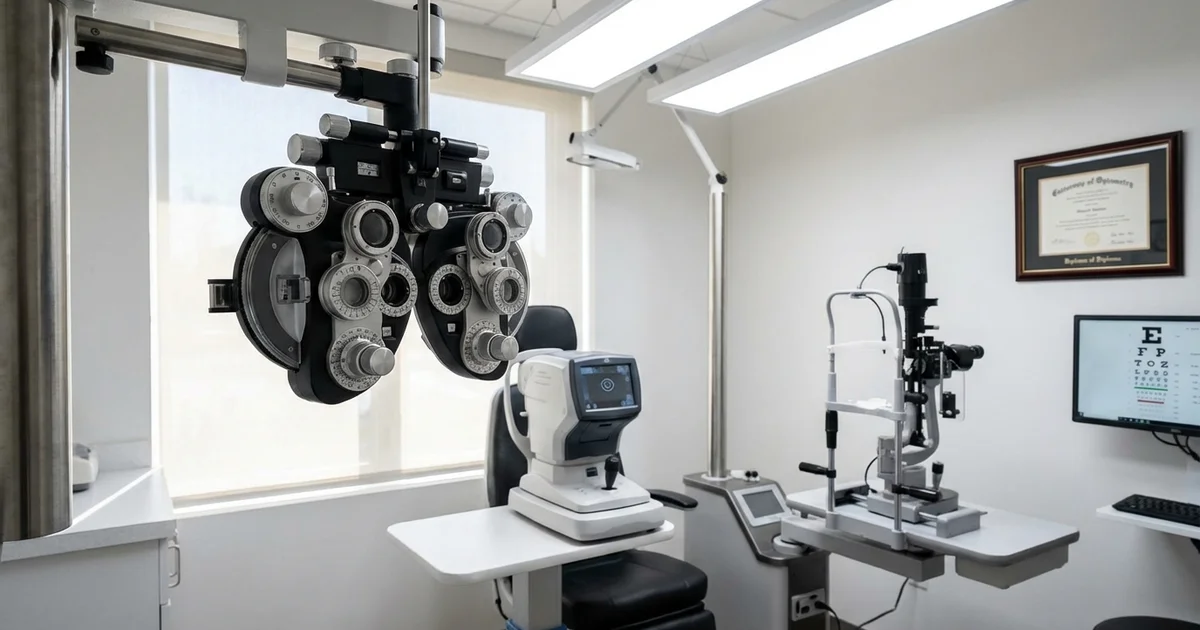
Exam lanes: 100-120 square feet per lane. Minimum 20 feet length (10 feet with mirrors). Proper electrical and data infrastructure.
Pre-testing area: 100-150 square feet. Space for auto-refractor, tonometer, visual fields. Patient flow consideration.
Optical dispensary: 200-400 square feet minimum. Good lighting for frame selection. Mirror placement. Seating for fittings.
Contact lens area: Training space. Inventory storage. Sink access.
Office/administrative: Provider office. Staff break area. Storage. Server/IT room.
What Infrastructure Should You Verify?
Verify before signing a lease include electrical capacity for equipment, plumbing for contact lens area, hvac adequacy, data/internet infrastructure, and soundproofing potential (exam room privacy).
What Should You Know About Build-Out?
Most spaces require modification:
Typical optometry build-out costs: $50-$150 per square foot depending on condition and extent of work.
Landlord contributions: Many landlords provide tenant improvement allowances (TI). Typical range is $20-$60 per square foot for new leases.
Timeline: Build-out typically takes 8-16 weeks. Plan accordingly.
How Do You Evaluate Lease Terms and Financial Impact?
The lease is a major financial commitment. Understand the terms fully.
What Are the Key Lease Terms to Understand?
Base rent: Monthly cost per square foot. Compare to market rates for similar spaces.
NNN (Triple Net): Additional charges for property taxes, insurance, and common area maintenance. Can add 20-40% to base rent.
Annual escalations: Typical increases are 2-4% annually. Lock in reasonable escalations.
Term length: 3-5 years for new practices. Longer terms may secure better rates but reduce flexibility.
Personal guarantee: Expect landlords to require personal guarantee for new businesses. Try to negotiate a cap or burn-off provision.
Assignment/sublease rights: Protect your ability to sell the practice or exit the lease if needed.
How Should You Model the Location’s Economics?
Before committing, model the location’s economics:
Break-even analysis: Total monthly occupancy cost (rent + NNN + utilities). Revenue needed to cover occupancy at 10-12% of revenue target. Patient volume required to generate that revenue.
Example: 1,800 sq ft at $22/sq ft NNN = $39,600 annual rent. NNN adds $7/sq ft = $12,600 annually. Total occupancy: $52,200/year or $4,350/month. At 10% of revenue, requires $522,000 annual revenue to be sustainable.
Growth scenarios: Can this location support your year-3 and year-5 goals? Is there expansion potential? What happens if a competitor opens nearby?
What Negotiation Strategies Work Best?
Landlords negotiate, especially for good tenants:
Use points: Healthcare tenants are stable and desirable. Longer lease terms earn better rates. Multiple location potential (if you might grow). Credit strength and business plan.
What to negotiate: Free rent period (1-3 months for build-out). Tenant improvement allowance. Capped NNN increases. First right of refusal on adjacent space. Signage rights. Parking allocation.
What Are the Pros and Cons of Each Location Type?
Medical Office Buildings
Pros: Built-in referral relationships. Professional environment. Shared services possible. Patients already coming for healthcare.
Cons: Often limited optical visibility. Strict use restrictions. Higher rents. Less retail foot traffic.
Best for: Practices emphasizing medical optometry or ophthalmology referral relationships.
Retail Strip Centers
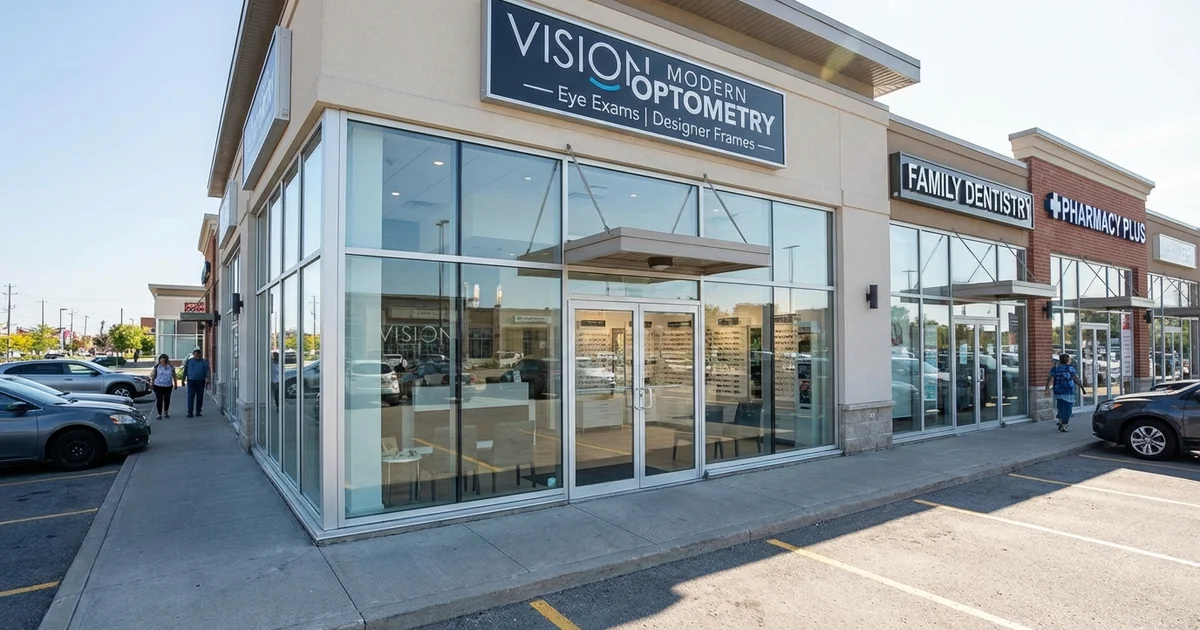
Pros: High visibility. Foot traffic. Parking usually adequate. Co-tenancy with complementary retail.
Cons: Less professional image (perception). Turnover in neighboring tenants. Signage restrictions may apply. Evening/weekend hours expected.
Best for: Full-service practices with strong optical focus.
Standalone Buildings
Pros: Maximum control. Prominent signage. Expansion flexibility. Build practice identity.
Cons: Higher cost (often purchase required). All maintenance responsibility. More complex financing. May be overbuilt for early-stage practice.
Best for: Established practices or practitioners with significant capital.
Professional Office Parks
Pros: Professional environment. Often good parking. Reasonable rents. Stable tenant mix.
Cons: Lower visibility. Limited walk-in potential. May lack retail energy. Location may be off main roads.
Best for: Practices relying primarily on referrals and appointments rather than walk-ins.
What Does the Decision Process Look Like?
Step 1: Define Requirements
Before looking at specific properties:
- Determine your target practice model
- Calculate required space
- Identify must-have features
- Set maximum rent budget
Step 2: Market Survey
Work with a commercial real estate broker to:
- Identify available properties meeting basic criteria
- Understand market rents
- Learn about upcoming availabilities
- Get landlord reputation information
Step 3: Short List Evaluation
For promising properties:
- Visit at different times of day
- Observe traffic and parking patterns
- Research neighbors
- Verify infrastructure feasibility
Step 4: Financial Analysis
For top candidates:
- Model complete occupancy costs
- Project revenue requirements
- Compare across options
- Identify negotiation priorities
Step 5: Negotiate and Commit
With your preferred location:
- Engage attorney for lease review
- Negotiate key terms
- Secure appropriate tenant improvements
- Plan build-out timeline
What Common Mistakes Should You Avoid?
Overbuilding: Do not lease 3,000 square feet hoping to grow into it. The carry cost damages early economics.
Ignoring competition trends: A location without competition today may have a Warby Parker opening next year. Understand the market direction.
Underestimating build-out: Optometry build-outs are specialized. Get contractor quotes before committing to a space.
Focusing only on rent: A cost-effective lease in a bad location is not a bargain. Total economics include marketing cost to overcome poor visibility.
Personal preference over business logic: The charming Victorian building downtown may not be where your target patients shop.
Keeping every appointment slot filled starts with answering every call. Talk to our team about how MyBCAT helps optometry practices capture more patients and reduce revenue leakage.
Next Steps
Location is one component of launching a successful practice. For guidance on equipment, staffing, compliance, and operations, review our comprehensive Starting an Optometric Practice 101 guide.
Building your practice team? Our guide on staffing your new optometry practice covers roles, hiring, and training.
Last Updated: January 2026
Sources: SBA - Pick Your Business Location, Review of Optometric Business