
Patient no-shows cost US healthcare $150 billion annually. For individual practices, that translates to approximately $150,000 in lost revenue each year. For multi-location groups, the math multiplies quickly. A 20-location organization with average no-show rates loses over $3 million annually in unfilled appointments. This guide provides the framework for building a no-show recovery program that fills schedule gaps fast and reduces future missed appointments.
Table of Contents
- How Big Is the No-Show Problem by the Numbers?
- Why Do No-Shows Happen?
- What Does the No-Show Recovery Program Framework Look Like?
- How Can Predictive Analytics Prevent No-Shows?
- What Technology Do Multi-Location Groups Need?
- What KPIs Should You Track for No-Show Recovery?
- What Does the Implementation Roadmap Look Like?
- What Are Common Mistakes in No-Show Recovery?
How Big Is the No-Show Problem by the Numbers?
Understanding the scope of no-shows helps justify investment in recovery programs.
No-show rate benchmarks:
| Metric | Value | Source |
|---|---|---|
| US no-show rate range | 5.5% - 50% | Industry research |
| Global average | 23.5% | Healthcare studies |
| Outpatient typical range | 23% - 33% | MGMA data |
| Annual US cost | $150 billion | System-wide estimate |
| Per-practice annual loss | ~$150,000 | Average practice |
| Daily revenue impact | 14% per missed | Medical groups |
The productivity impact: Every three no-shows in an eight-hour shift reduces productivity by 12.5%. For a multi-location group running 10 providers per day across sites, that productivity drain compounds into significant operational inefficiency.
The attrition risk: Research shows patients who no-show once have a 70% higher attrition rate within 18 months compared to 19% for those who attend. A single no-show often signals the beginning of patient loss, not just one missed appointment.
Why Do No-Shows Happen?
Before building recovery systems, understand the root causes:
Primary reasons patients miss appointments:
| Reason | Percentage | Recovery Approach |
|---|---|---|
| Forgetfulness | 33% | Automated reminders |
| Poor communication | 31.5% | Multi-channel confirmation |
| Transportation issues | Variable | Telehealth options, ride assistance |
| Scheduling conflicts | Variable | Flexible rescheduling |
| Anxiety about visit | Variable | Pre-visit engagement |
| Financial concerns | Variable | Payment plan communication |
Multi-location groups face additional complexity: varied patient demographics, travel distances, and site-specific factors (weather, local events) all influence no-show rates differently by location.
What Does the No-Show Recovery Program Framework Look Like?
An effective recovery program operates on three timeframes: prevention (before the appointment), rapid response (same-day recovery), and follow-up (rebooking the patient).
Phase 1: Prevention (Before the Appointment)
Tiered reminder sequence: Research shows the optimal reminder timing: 5 days before: Initial reminder with appointment details. 3 days before: Confirmation request (reply to confirm). 1 day before: Final reminder with directions/prep instructions. Morning of: Day-of reminder (for afternoon appointments).
Channel selection matters: 67.3% of patients prefer text message reminders. 86% of people ignore calls from unknown numbers. Email serves as backup documentation but has lower engagement.
Text-based reminders with self-scheduling tools reduce no-show rates by up to 29%.
Pre-appointment intake calls (PAI): For high-value appointments or high-risk patients, calls 1-3 days prior improve show rates by confirming logistics and addressing concerns.
Phase 2: Rapid Response (Same-Day Recovery)
When a patient no-shows, the clock starts immediately. Every hour that slot remains empty represents lost revenue.
Same-day recovery protocol:
| Time After No-Show | Action | Goal |
|---|---|---|
| 0-15 minutes | Confirm no-show (vs. running late) | Verify status |
| 15-30 minutes | Contact patient via text | Offer same-day reschedule |
| 30-60 minutes | Activate waitlist | Fill the slot |
| Same day | Log in PM system | Track for analysis |
Waitlist management: Maintain an active waitlist of patients wanting earlier appointments. When a no-show creates an opening, automated systems can immediately offer the slot to waitlist patients. Groups report recovering 30-40% of no-show slots through effective waitlist management.
Phase 3: Follow-Up (Rebooking)
Patients who no-show need prompt outreach to reschedule before they drift into dormancy.
72-hour rebooking window: Contact no-show patients within 72 hours while the missed appointment is still top of mind. After this window, rebooking rates decline significantly.
Rebooking outreach sequence: Same day: Text offering convenient reschedule times. Next day: Follow-up text or email if no response. Day 3: Phone call for non-responders. Day 7: Final text with “we miss you” messaging.
How Can Predictive Analytics Prevent No-Shows?
Advanced no-show recovery programs use predictive models to identify high-risk appointments and intervene proactively.
Risk factors for no-show prediction: Previous no-show history (strongest predictor). Time since last visit. Appointment lead time (longer lead time = higher risk). Day of week and time of day. Weather forecast. Local events. Distance from practice. Insurance type.
Modern predictive models achieve 85% accuracy in forecasting which appointments are at high risk for no-show. This enables targeted intervention: extra reminders, confirmation calls, or strategic overbooking.
Strategic overbooking: Based on historical no-show rates and real-time predictions, some practices overbook by 10% to offset expected gaps. For example, if a radiology department historically sees 20% no-shows on Monday mornings, scheduling 11 patients for 10 slots maintains productivity.
Caution: Overbooking requires careful calibration. Over-aggressive overbooking creates patient wait time issues when more patients show than expected.
What Technology Do Multi-Location Groups Need?
Effective no-show recovery at scale requires integrated technology.
Core platform requirements:
| Capability | Purpose | Impact |
|---|---|---|
| PM/EHR integration | Real-time appointment data | Enables automation |
| HIPAA-compliant SMS | Patient communication | Primary channel |
| Two-way messaging | Patient responses | Self-service rebooking |
| Automated triggers | Time-based workflows | Reduces staff burden |
| Waitlist management | Slot recovery | Fills gaps faster |
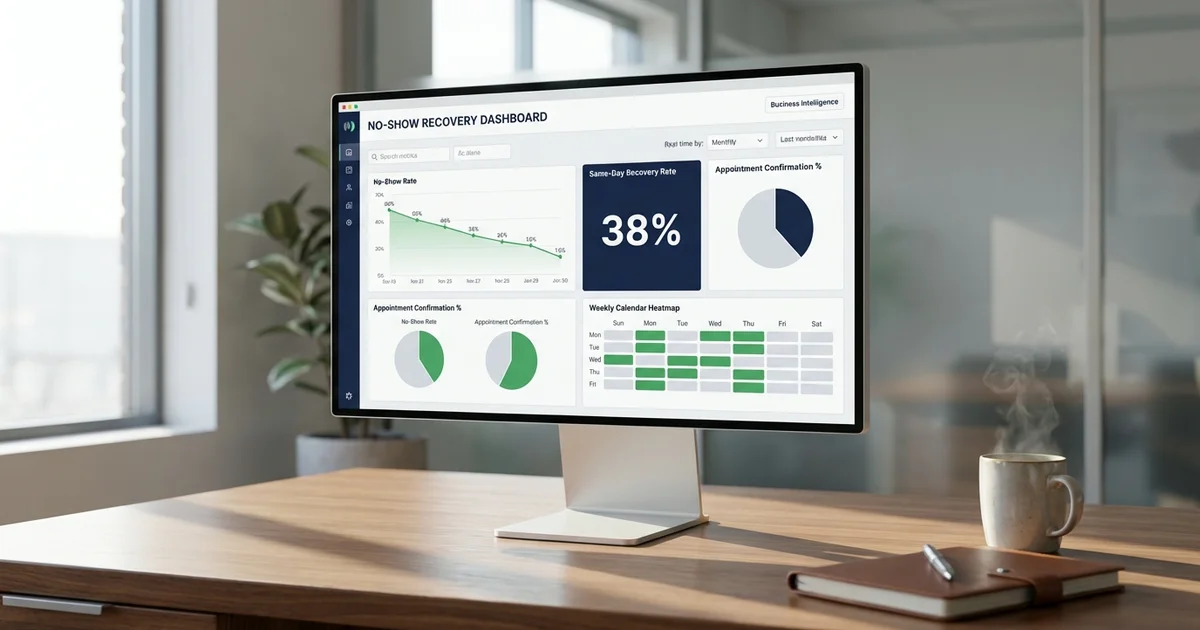
| Analytics dashboard | Performance tracking | Continuous improvement |
Multi-location specific needs:
- Centralized view across all sites
- Location-specific benchmarking
- Cross-location waitlist (patient willing to visit different site)
- Unified reporting for operations leadership
What KPIs Should You Track for No-Show Recovery?
Track these metrics to measure program effectiveness:
Primary metrics:
| KPI | Target | Calculation |
|---|---|---|
| No-show rate | 5-8% | No-shows / Total scheduled |
| Same-day recovery rate | 30-40% | Slots filled same day / No-shows |
| 72-hour rebooking rate | 50%+ | Rebooked within 72 hrs / No-shows |
| Reminder confirmation rate | 70%+ | Confirmations / Reminders sent |
| Net schedule utilization | 92%+ | Completed appointments / Capacity |
Location-level benchmarking: For multi-location groups, track each site against network averages. Identify outliers on both ends:
- High performers: Document best practices
- Underperformers: Investigate root causes and provide support
What Does the Implementation Roadmap Look Like?
Week 1-2: Assessment
- Audit current no-show rates by location, provider, day/time
- Identify highest-impact opportunities
- Evaluate existing reminder systems
Week 3-4: Technology setup
- Implement or configure SMS platform
- Integrate with PM/scheduling system
- Build automated reminder sequences
- Set up waitlist management
Week 5-6: Process deployment
- Train front desk on same-day recovery protocol
- Establish 72-hour rebooking workflows
- Create scripts for phone outreach
Week 7-8: Optimization
- Monitor initial results
- Adjust reminder timing and messaging
- Calibrate overbooking levels if applicable
Ongoing: Continuous improvement
- Weekly KPI review
- Monthly location benchmarking
- Quarterly process refinement
What Are Common Mistakes in No-Show Recovery?
Waiting too long to respond: Every hour a slot remains empty is lost revenue. Same-day recovery protocols must activate within 15-30 minutes of a no-show.
Single-channel reminders: Relying only on phone calls (86% ignored) or only on email (low open rates) underperforms multi-channel approaches. Text-first, with phone backup for non-responders.
No consequences for repeat offenders: Patients with multiple no-shows consume disproportionate resources. Consider policies requiring prepayment or confirmation calls for chronic no-showers.
Ignoring the data: Without analytics, you cannot identify patterns (Tuesday mornings have 3x no-shows) or measure improvement. Data-driven programs outperform intuition-based approaches.
Key Takeaways
No-show recovery programs protect revenue and improve patient care continuity. For multi-location groups:
- No-shows cost US healthcare $150 billion annually; individual practices lose ~$150,000/year
- The global average no-show rate is 23.5%; best-in-class achieves 5-8%
- Patients who no-show once have 70% higher attrition risk within 18 months
- Text reminders at 5/3/1 days before appointments reduce no-shows by up to 29%
- Same-day recovery protocols can fill 30-40% of no-show slots via waitlist
- Predictive models achieve 85% accuracy in identifying high-risk appointments
- Technology integration is essential for multi-location scale
The practices that treat no-shows as a recoverable problem, rather than an inevitable loss, capture significant revenue that competitors leave on the table.
For strategies on bringing back patients who have already lapsed, see our dormant patient reactivation playbook.
Related Reading
-
multi-location no-show reduction Every missed call costs your practice revenue. Talk to our team about how MyBCAT helps healthcare practices answer every call and keep schedules full.