Optometry Practice Location: How to Choose the Right Site for Long-Term Success
Your optometry practice location will determine up to 40% of your revenue potential before you see your first patient. Research from the American Optometric Association shows that practices in high-visibility locations with strong demographic matches generate 2.3x more new patient appointments than comparable practices in secondary locations. Yet most new practice owners spend more time selecting equipment than analyzing their site options.
The difference between a thriving practice and one that struggles often comes down to a few miles, the right side of the street, or proximity to complementary businesses. This guide breaks down every factor you need to evaluate when selecting your optometry practice location.
Table of Contents
- Why Do Location Decisions Make or Break Optometry Practices?
- How Do Demographics Match Your Location to Your Target Patients?
- How Do You Analyze the Local Eye Care Competitive Landscape?
- What Are the Physical Site Requirements for Modern Optometry Practices?
- What Visibility and Accessibility Factors Matter Most?
- What Lease Terms and Financial Considerations Should You Negotiate?
- What Red Flags Should Disqualify a Location?
- How Do You Score and Compare Location Options?
- How Do You Protect Your Investment After Location Selection?
Why Do Location Decisions Make or Break Optometry Practices?
The healthcare real estate market operates differently than standard commercial leasing. Your patients have specific expectations about accessibility, parking, and convenience that other retail tenants don’t face. A restaurant can succeed in a quirky walkup location. An optometry practice cannot.
Consider these statistics from recent healthcare facility studies:
73% of patients choose their eye care provider based on location convenience. Practices within 0.5 miles of major retail anchors see 35% higher walk-in traffic. Corner locations with two-street visibility command 15-20% higher patient volumes. Practices with dedicated parking average 28% better patient satisfaction scores.
The financial implications compound over time. A practice generating 20 new patients per month versus 30 new patients per month, a gap often attributable to location quality, will see a revenue difference of $180,000 to $240,000 annually. Over a 10-year lease, that location decision represents a multi-million dollar variable.
How Do Demographics Match Your Location to Your Target Patients?
Before evaluating specific properties, you need granular data on the population surrounding each potential site. Generic assumptions about “good neighborhoods” lead to expensive mistakes.
What Key Demographic Factors Should You Analyze?
Population Density and Growth Trends
Your optometry practice location should serve a primary trade area of approximately 15,000 to 25,000 residents within a 3-mile radius for suburban settings, or within 1 mile for urban locations. Population growth projections matter more than current numbers. A stagnant or declining area will require you to capture market share from established competitors, a much harder path than growing with an expanding community.
Age Distribution
Different age groups have distinct eye care needs and visit frequencies:
| Age Group | Annual Visit Rate | Average Revenue Per Visit |
|---|---|---|
| Under 18 | 0.4 visits | $185 |
| 18-40 | 0.6 visits | $245 |
| 40-55 | 1.2 visits | $320 |
| 55+ | 1.8 visits | $385 |
A location skewing toward residents aged 40 and above will generate higher per-patient revenue and more frequent visits. However, competition for these patients is also more intense.
Income and Insurance Coverage
Median household income correlates with frame and lens upgrades, cosmetic contact lens sales, and elective services like myopia management. Analyze the insurance mix in your target area. Locations with high percentages of VSP, EyeMed, or other major vision plans require different operational models than areas dominated by medical insurance or self-pay patients.
Where Can You Find Demographic Data?
Free resources like the U.S. Census Bureau’s American Community Survey provide baseline population data. Commercial services like ESRI Business Analyst, Placer.ai, or healthcare-specific platforms offer more granular insights including daytime population, traffic patterns, and consumer spending data.
Your state optometric association may provide practice viability studies for a modest fee. These reports combine demographic analysis with competitive density mapping.
How Do You Analyze the Local Eye Care Competitive Landscape?
An area with excellent demographics but eight optometrists per 10,000 residents presents challenges that perfect population data cannot overcome. You need both demand and reasonable competitive intensity.
How Do You Calculate Market Saturation?
The national average sits at approximately one optometrist per 10,000 people. In your target trade area:
Identify all ODs within the primary radius using Google Maps, Yelp, and insurance provider directories. Count total optometrists, including those in retail settings like LensCrafters or Walmart Vision. Divide your trade area population by total ODs.
A ratio below 8,000:1 indicates potential oversaturation. Ratios above 12,000:1 suggest underserved markets with expansion opportunity.
How Do You Assess Competitor Quality?
Not all competition is equal. A solo practitioner approaching retirement represents different competitive pressure than a newly opened multi-doctor practice with aggressive marketing. Drive by competitor locations and evaluate:
Facility condition and curb appeal. Parking availability and convenience. Hours of operation (gaps you could fill). Online reviews and reputation scores. Whether they accept the same insurance plans you’ll accept.
Weak competitors in good locations often indicate patients seeking alternatives. This creates opportunity if you offer a superior experience.
What Are the Physical Site Requirements for Modern Optometry Practices?
Your optometry practice location must accommodate clinical needs, patient comfort, and operational efficiency. Compromising on space leads to workflow bottlenecks that limit your capacity for years.
What Are the Space Planning Guidelines?
A full-scope optometry practice typically requires 1,500 to 2,500 square feet to function effectively. Budget approximately:
Reception and waiting area: 150-250 sq ft. Pretesting room: 100-150 sq ft. Exam lanes (two minimum): 120-150 sq ft each. Optical dispensary: 400-600 sq ft. Contact lens fitting area: 80-120 sq ft. Private office: 100-150 sq ft. Break room and storage: 150-200 sq ft. Restrooms: 100 sq ft (ADA compliance required).
What Infrastructure Does a Medical Office Need?
Medical office buildouts require specific infrastructure that general retail spaces may lack:
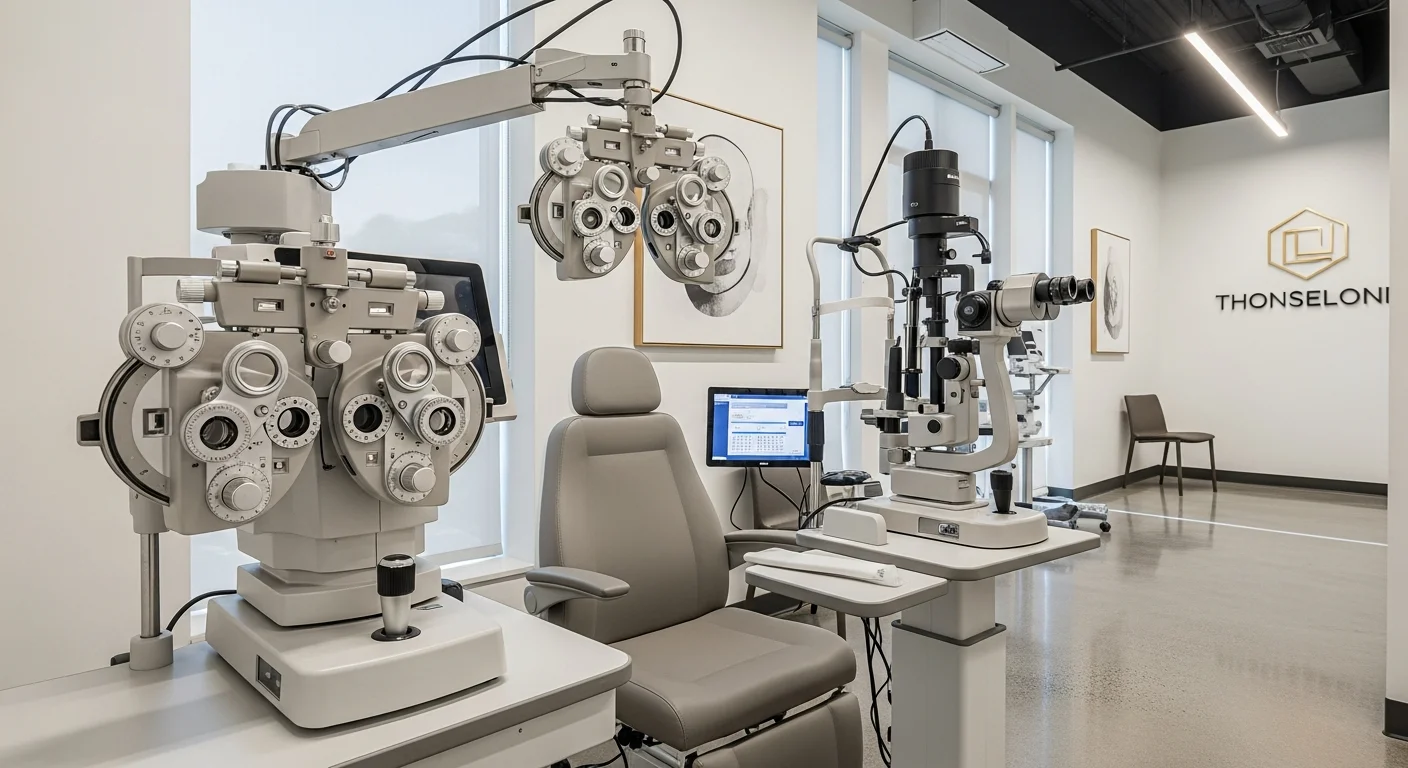
Electrical capacity: Modern diagnostic equipment, including OCT, fundus cameras, and autorefractors, demands dedicated circuits and adequate amperage. Request electrical plans before signing.
Plumbing: You’ll need at least one ADA-compliant restroom for patients and ideally a second for staff. Ensure water supply and drainage can support your fixture count.
HVAC zoning: Exam rooms and equipment areas require consistent climate control. Verify the system can maintain appropriate temperatures without patient discomfort.
Data infrastructure: Today’s practices require reliable high-speed internet for EHR systems, insurance verification, and patient communication platforms. Fiber availability is increasingly essential.
What Visibility and Accessibility Factors Matter Most?
The best demographics and perfect space mean nothing if patients cannot find you or park conveniently.
What Makes for Good Signage and Street Visibility?
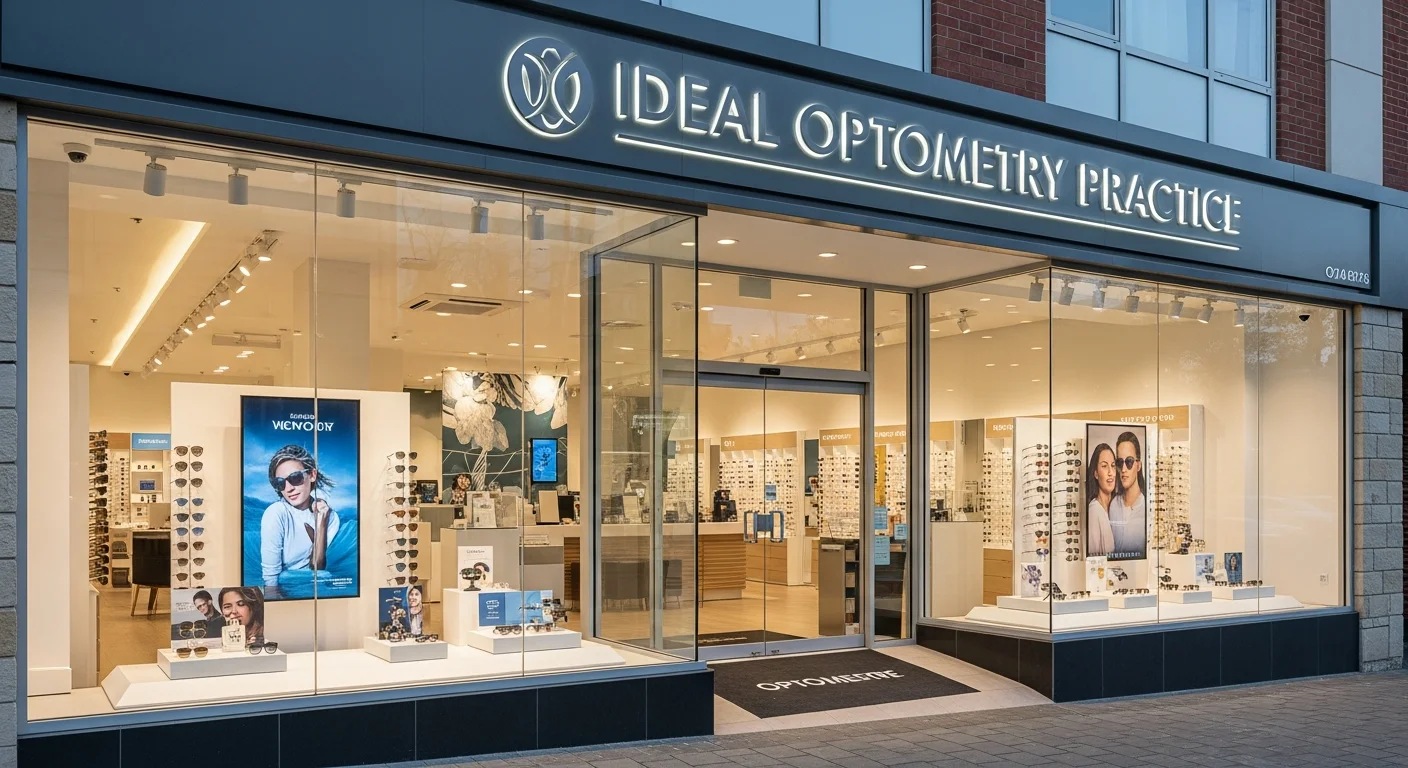
Your optometry practice location should offer clear sightlines from the primary traffic artery. Consider:
Can drivers see your signage at 35 mph with enough time to safely turn in? Do trees, utility poles, or adjacent buildings block your storefront? What signage does the landlord permit, and are there local ordinances limiting size or illumination? Will seasonal changes (snow removal berms, summer foliage) affect visibility?
Corner locations at signalized intersections provide maximum exposure. Patients stopped at red lights notice businesses they might miss at full speed.
How Much Parking Do You Need?
Healthcare practices require more parking per square foot than typical retail. Your patients include elderly individuals, parents with young children, and visually impaired patients post-dilation. The standard of 4-5 parking spaces per 1,000 square feet applies, but more is always better.
Evaluate:
Total dedicated spaces for your suite. Proximity of spaces to your entrance. Whether parking is shared with high-turnover businesses (restaurants, salons). Accessibility for disabled patients (ADA spaces near entrance). Ease of navigation for patients with dilated pupils.
Ingress and Egress
Patients should access your parking lot from both directions of traffic flow without dangerous left turns across multiple lanes. Shopping centers with traffic signals or median breaks provide safer access than strip centers requiring uncontrolled turns.
What Lease Terms and Financial Considerations Should You Negotiate?
Commercial real estate negotiations differ substantially from residential leasing. Understanding common terms protects your financial interests.
What Are Common Lease Structures?
Triple Net (NNN): You pay base rent plus your proportional share of property taxes, insurance, and common area maintenance. This is standard for medical office space. Budget 20-30% above base rent for these pass-throughs.
Modified Gross: Landlord includes some expenses in base rent, typically property taxes and insurance, while you pay utilities and janitorial.
Gross Lease: Rare for medical offices, this structure bundles all costs into a single monthly payment.
Which Key Lease Terms Should You Negotiate?
First-time practice owners often accept initial lease drafts without negotiation. This is a costly mistake. Push back on:
Tenant improvement allowance: Landlords typically offer $20-50 per square foot toward buildout costs. Medical offices require more extensive improvements. Negotiate higher allowances or reduced rent during buildout.
Rent escalations: Standard annual increases of 2-3% are reasonable. Avoid clauses tying increases to CPI without caps.
Exclusive use provisions: Protect your practice by preventing the landlord from leasing to competing eye care providers within the same center.
Assignment and sublease rights: Your practice may eventually sell or relocate. Ensure the lease permits assignment to a successor doctor.
Personal guarantee limitations: New practices may require personal guarantees, but negotiate for guarantee burnoff after 2-3 years of on-time payment.
What Red Flags Should Disqualify a Location?
Some location problems cannot be solved with marketing or operational adjustments. Walk away from properties with:
Declining anchor tenants: If the grocery store or major retailer is closing, the center will lose foot traffic. Deferred maintenance: Neglected parking lots, broken fixtures, and worn common areas signal ownership problems. Restrictive signage rules: If you cannot adequately identify your practice from the street, patients will struggle to find you. Inadequate parking ratios: Medical practices cannot thrive with limited parking, regardless of other positives. Environmental concerns: Former dry cleaners, gas stations, or industrial sites may have contamination issues. Zoning complications: Verify medical office use is permitted by right, not by variance.
How Do You Score and Compare Location Options?
Create a weighted evaluation matrix to compare potential locations objectively. Score each site on a 1-10 scale for:
Demographics (weight: 25%): Population, income, age distribution, growth trends. Competition (weight: 20%): Market saturation, competitor quality, differentiation opportunity. Visibility (weight: 15%): Signage potential, street exposure, landmark quality. Accessibility (weight: 15%): Parking, traffic patterns, public transit. Space quality (weight: 15%): Layout, infrastructure, buildout requirements. Financial terms (weight: 10%): Rent, TI allowance, lease flexibility.
Multiply each score by its weight and sum for a composite rating. This forces systematic comparison rather than gut reactions to whichever property you toured most recently.
How Do You Protect Your Investment After Location Selection?
Once you’ve signed a lease for your optometry practice location, patient communication becomes critical. New practices often invest heavily in buildout and equipment while underinvesting in systems to capture the patients their location attracts.
Consider that 23% of all calls to healthcare practices go unanswered during business hours. For new practices still building reputation, every missed call represents a potential patient choosing a competitor. Your visibility advantage disappears if patients calling for appointments reach voicemail.
Modern practices implement AI-powered communication systems that ensure 24/7 call answering, appointment scheduling, and patient follow-up. These technologies protect the investment you’ve made in selecting a premium location by converting location-driven inquiries into actual patient relationships.
The location decision also affects your ability to recruit and retain quality staff. Practices in convenient, well-maintained locations with adequate parking and nearby amenities attract stronger candidates than those in isolated or difficult-to-reach sites. Staff commute patterns matter because employees who face long or frustrating drives to work are more likely to leave for comparable positions closer to home. When evaluating a potential site, consider not just patient accessibility but also the employee experience of working there every day.
Key Takeaways
Selecting your optometry practice location requires balancing multiple factors against your specific practice vision and financial constraints. The practices that thrive long-term approach site selection with the same rigor they bring to clinical care.
Remember these principles:
- Demographics determine demand, but competition determines your share
- Visibility and parking directly impact new patient acquisition
- Space constraints limit growth; invest in adequate square footage from the start
- Negotiate lease terms aggressively; landlords expect pushback
- Walk away from locations with fundamental flaws, no matter how attractive other features appear
Your location decision will shape your practice for a decade or more. Invest the time and research required to choose wisely. The difference between a good location and a great location compounds every month you operate, translating directly to practice value and professional satisfaction.
Keeping every appointment slot filled starts with answering every call. Talk to our team about how MyBCAT helps optometry practices capture more patients and reduce revenue leakage.