
Healthcare practices lose 10-17% of their patient base every year to attrition. For a practice with 2,000 active patients and an average patient lifetime value of about $4,200 (often cited in the $2,000-$5,000 range for dental), that can translate to roughly $840,000 walking out the door annually. The solution is not more marketing spend on new patient acquisition. It is a systematic patient recall campaign that brings dormant patients back at a fraction of the cost.
This framework breaks down exactly how to build recall campaigns that work, including the channel mix, timing sequences, and messaging strategies that top-performing practices use to achieve reactivation rates of 20-30%.
Table of Contents
- Why Do Patient Recall Campaigns Matter More Than New Patient Acquisition?
- The Patient Recall Campaign Framework
- What Common Mistakes Kill Recall Campaigns?
- How Do You Build Your 90-Day Recall Campaign?
- Should You Automate Recall or Not?
- How Does Recall Connect to Your Broader Patient Access Strategy?
Why Do Patient Recall Campaigns Matter More Than New Patient Acquisition?
Most practice owners obsess over new patient numbers while ignoring a fundamental economic reality: retaining an existing patient costs 5-25x less than acquiring a new one. A 5% improvement in retention can increase profits by 25-95%, according to research from Vital Interaction.
The numbers tell the story clearly:
| Metric | New Patient | Reactivated Patient |
|---|---|---|
| Acquisition Cost | $150-520 | $0-50 |
| Conversion Likelihood | 5-20% | 60-70% |
| Time to First Appointment | Weeks | Days |
| Lifetime Value Potential | Unknown | Established |
Existing patients already know your practice, trust your team, and have a history you can reference. They just need a reason to come back.
What Is the True Cost of Patient Attrition?
Consider what happens when a dental practice with 3,000 patients experiences the industry-average 17% annual attrition:
510 patients lost per year. Average production per patient: $4,200. Annual revenue loss: $2.14 million.
Even recovering 20% of those patients through a systematic recall campaign would add $428,000 in revenue. That is the business case for making patient recall a priority.
The Patient Recall Campaign Framework
This framework organizes recall campaigns into six phases: identification, segmentation, channel selection, message development, execution, and measurement. Each phase builds on the previous one to create a systematic approach that scales.
Phase 1: Identify Your Dormant Patient Population
Start by defining what “dormant” means for your practice. The standard definition varies by specialty:
| Practice Type | Dormant Threshold | Reasoning |
|---|---|---|
| General Dentistry | 12+ months since last visit | 6-month hygiene cycle |
| Optometry | 18+ months since last exam | Annual exam schedule plus buffer |
| Veterinary | 14-18+ months since last visit | Annual wellness standard |
| Primary Care | 24+ months since last visit | Annual physical standard |
Pull a report from your practice management system showing all patients who meet your dormant threshold. For most practices, this population represents 15-25% of the total patient database.
Phase 2: Segment by Priority and Potential
Not all dormant patients deserve equal attention. Segment your list based on:
High Priority (Contact First) Patients with incomplete treatment plans. Patients with chronic conditions requiring monitoring. High-value patients (top 20% by historical spend). Patients who left due to scheduling issues (not dissatisfaction).
Medium Priority Patients with no outstanding treatment needs. Patients who moved or changed insurance. Patients with average historical value.
Low Priority (May Not Be Worth Pursuing) Patients who explicitly requested removal. Patients with outstanding balances and no payment history. Patients outside your service area.
This segmentation ensures your team spends time on patients most likely to return and generate value.
Phase 3: Select Your Channel Mix
The research is clear: multi-channel campaigns dramatically outperform single-channel approaches. Here is how each channel performs:
| Channel | Open/Response Rate | Best For | Limitations |
|---|---|---|---|
| SMS/Text | 98% open rate | Quick responses, appointment confirmations | Character limits, requires opt-in |
| 20-30% open rate | Detailed information, educational content | Lower engagement, spam filters | |
| Phone Calls | Direct conversation | High-value patients, complex situations | Time-intensive (8+ min per call) |
| Direct Mail | Physical presence | Older demographics, “we miss you” campaigns | Higher cost, slower response |
The optimal approach combines channels:
- SMS + Email only: 50-65% reduction in no-shows, 7-10% no-show rate
- Comprehensive (all channels): 70-85% reduction, 3-6% no-show rate
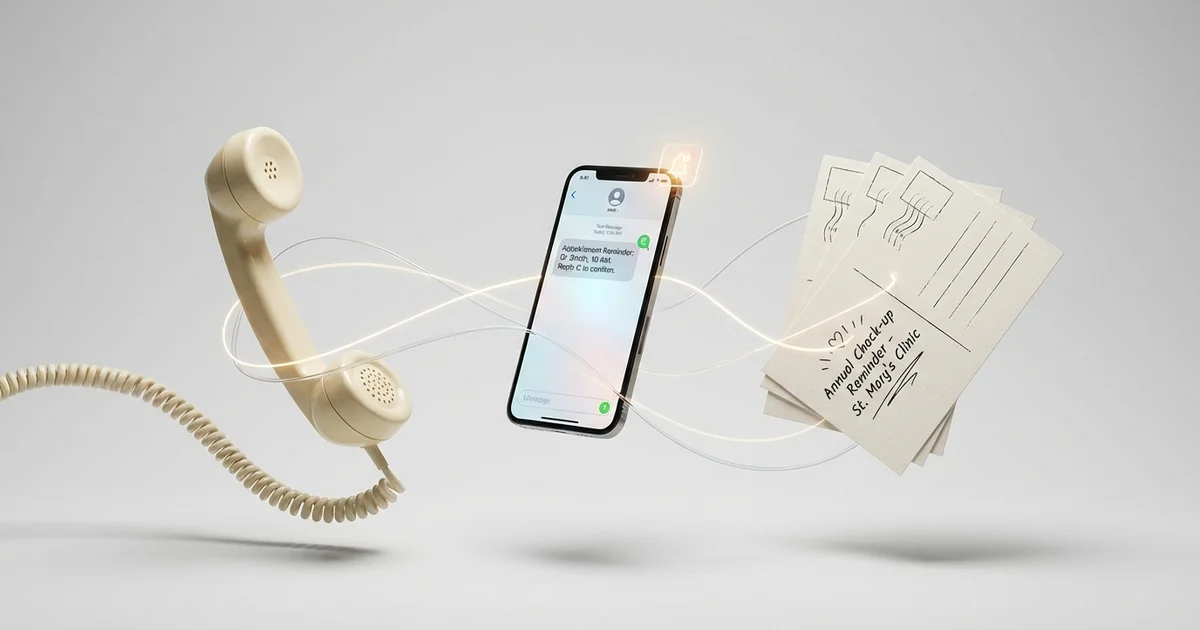
For patient recall specifically, lead with SMS for its 98% open rate, support with email for detailed information, and reserve phone calls for high-value patients or those who do not respond to digital outreach.
Phase 4: Develop Your Messaging Strategy
Personalization is not optional. Research shows 96% of consumers act on personalized messaging versus only 20% who engage with generic content. Personalized emails achieve an 18% click-through rate compared to 2% for generic campaigns.
Effective recall messages include:
Patient name and specific context (last visit date, last treatment). Clear reason to return (overdue for cleaning, prescription expiring). Easy scheduling path (link, phone number, or reply option). Sense of appropriate urgency (without being pushy).
Example SMS Sequence:
Day 1 (Initial Outreach)
Hi [First Name], it has been [X months] since your last visit at [Practice Name]. Your [specific service] is overdue. Reply YES to schedule or tap here: [link]
Day 7 (Follow-up)
[First Name], just checking in. We have openings this week for your [service]. Same-day appointments available. Book here: [link]
Day 14 (Final Reminder)
Last reminder: [First Name], your [service] is [X months] overdue. We would hate to see you fall behind on your [dental/eye/pet] health. Schedule today: [link]
For more message templates, consider developing scripts tailored to your practice’s voice and patient demographics.
Phase 5: Execute with Proper Timing
Timing affects response rates more than most practices realize. Research shows:
SMS sent at 6 PM achieves 41% higher confirmation rates than messages sent at noon. Emails perform best between 5 AM and 10 AM. Start outreach 30 days before the patient’s ideal return date for preventive visits.
Recommended Cadence:
| Day | Action | Channel |
|---|---|---|
| Day 1 | Initial outreach | SMS |
| Day 3 | Follow-up | Email with more detail |
| Day 7 | Second reminder | SMS |
| Day 14 | Final digital attempt | |
| Day 21 | Phone call (high-value only) | Phone |
| Day 30 | Direct mail (optional) | Postcard |
For practices running campaigns at scale, automation is essential. Manual outreach consumes 8+ minutes per patient call. A practice trying to reactivate 500 dormant patients manually would need 67+ staff hours just for phone calls.
Phase 6: Measure What Matters
Track these KPIs to evaluate campaign performance:
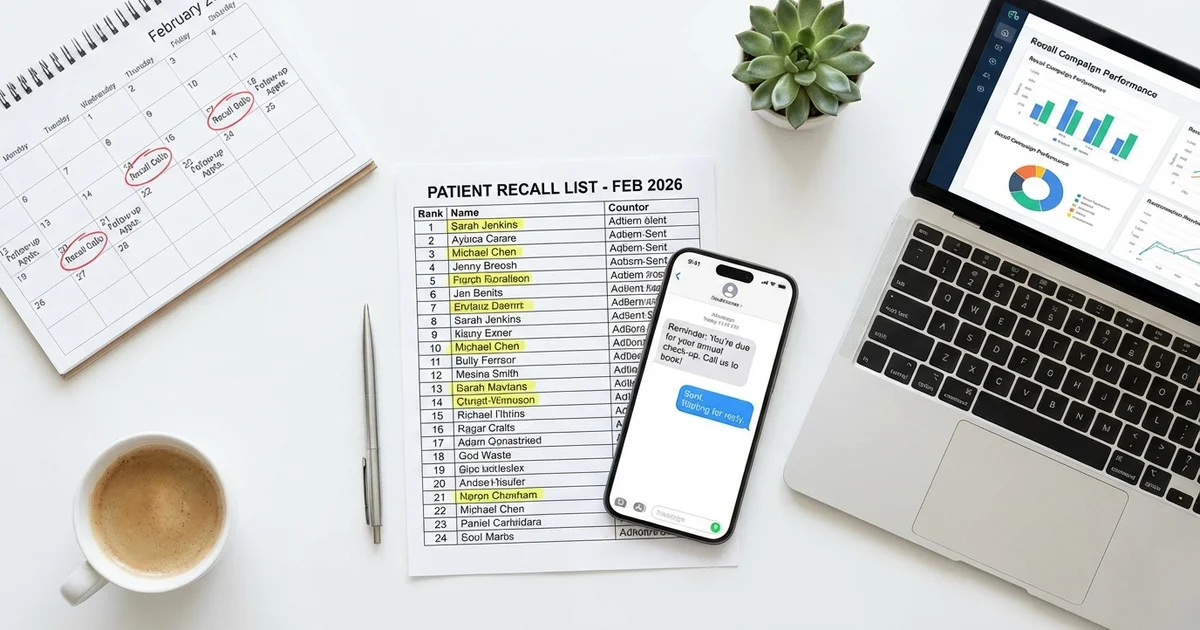
Primary Metrics: Reactivation Rate: Percentage of contacted patients who schedule. Cost Per Reactivation: Total campaign cost divided by reactivated patients. Revenue Recovered: Production from reactivated patients over 12 months. ROI: Revenue recovered divided by campaign cost.
Secondary Metrics: Open rates by channel. Response rates by segment. Time from outreach to appointment. No-show rate for reactivated patients.
Benchmark Targets:
| Metric | Poor | Average | Good | Excellent |
|---|---|---|---|---|
| Reactivation Rate | <5% | 5-10% | 10-20% | >20% |
| Cost Per Reactivation | >$100 | $50-100 | $25-50 | <$25 |
| Campaign ROI | <5x | 5-20x | 20-50x | >50x |
Real-world results validate these benchmarks. Modern Dentistry achieved 59 reactivations in 90 days, generating $49,456 in revenue for a 140x ROI using automated text-based recall.
What Common Mistakes Kill Recall Campaigns?
Mistake 1: Relying on Generic Mass Messages
Practices that blast their entire dormant list with identical messages see poor results. Patients ignore generic outreach because it signals the practice does not actually know or care about them individually.
Fix: Segment your list and personalize every message with patient name, last visit date, and specific services due.
Mistake 2: Single-Channel Only
Using only email (with its 20-30% open rate) leaves 70-80% of patients unreached. Using only phone calls makes campaigns prohibitively expensive and slow.
Fix: Lead with SMS, support with email, reserve phone for high-value patients.
Mistake 3: No Follow-Up Sequence
Many practices send one message and give up. Patient recall requires multiple touches. Research shows a 3-4 contact sequence significantly outperforms single-touch campaigns.
Fix: Build a minimum 3-touch sequence across 2-3 weeks.
Mistake 4: Ignoring the Affordability Conversation
Gallup research found 70% of patients who decline care cite affordability as the reason, yet only 23% were offered payment plans. Patients may be dormant because they cannot afford care, not because they do not want it.
Fix: Include payment plan options or financing information in recall messaging for treatment-related outreach.
Mistake 5: Manual Tracking and Execution
Paper-based tracking creates knowledge gaps. Staff turnover means institutional knowledge about patient relationships disappears. Manual execution cannot scale.
Fix: Use practice management software or a dedicated recall platform to automate tracking and outreach.
How Do You Build Your 90-Day Recall Campaign?
Here is a practical timeline for launching your first systematic recall campaign:
Week 1-2: Foundation Pull dormant patient list from PMS. Segment by priority (high/medium/low). Define channel strategy and message templates. Set up tracking in spreadsheet or software.
Week 3-4: High-Priority Launch Begin outreach to high-priority segment. Monitor response rates and adjust messaging. Train staff on handling inbound scheduling requests.
Week 5-8: Expand and Optimize Roll out to medium-priority segment. A/B test message variations. Add phone outreach for non-responders.
Week 9-12: Measure and Systematize Calculate ROI and cost per reactivation. Document what worked and what did not. Establish recurring campaign cadence (monthly or quarterly).
For practices joining larger organizations or managing multiple locations, integrating recall systems during acquisition creates consistency across the network.
Should You Automate Recall or Not?
Small practices with under 50 dormant patients can manage recall manually. Beyond that threshold, automation becomes essential.
Automation handles: Patient identification and segmentation. Multi-channel message delivery. Response tracking and follow-up triggers. Appointment booking integration. Performance reporting.
Humans should handle:
- High-value patient phone calls
- Complex scheduling situations
- Patients expressing concerns or complaints
- Treatment plan discussions
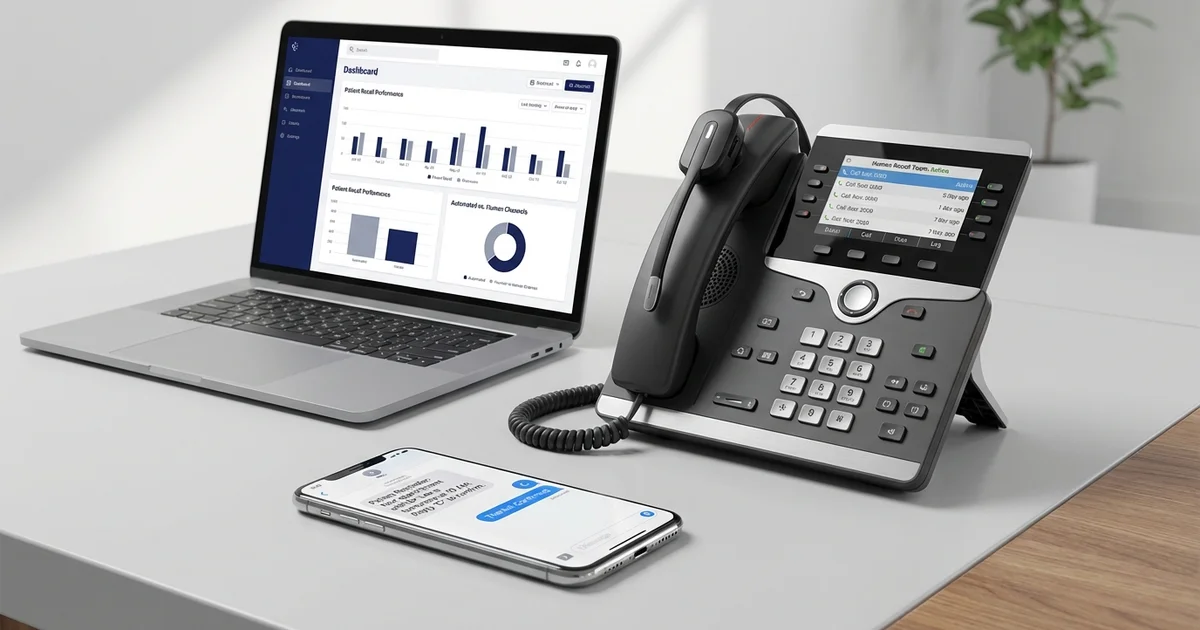
The best results come from hybrid approaches that combine automated outreach at scale with human intervention for high-touch situations. Learn more about finding the right balance in our guide to human + AI hybrid models for patient intake.
How Does Recall Connect to Your Broader Patient Access Strategy?
Patient recall does not exist in isolation. It connects to every other aspect of how patients interact with your practice:
-
Call answering: Patients who respond to recall campaigns need someone to answer when they call. Missed calls undo recall campaign success. See the revenue impact of missed calls.
-
Online scheduling: Offer self-service booking links in recall messages. Patients who can book at 10 PM without calling are more likely to complete the action.
-
Multi-location coordination: Groups with multiple locations need centralized recall management to prevent duplicate outreach and enable patients to book at any convenient location. See our multi-location intake guide.
Key Takeaways
-
Patient attrition costs more than you think. At 10-17% annually with $4,200 average patient value, a 3,000-patient practice loses $2+ million per year.
-
Reactivation beats acquisition on economics. Retention costs 5-25x less than acquisition, and existing patients convert at 60-70% versus 5-20% for new leads.
-
Multi-channel wins. SMS plus email reduces no-shows by 50-65%. Adding phone and mail pushes reduction to 70-85%.
-
Personalization is required. Generic messages get ignored by 80% of patients. Personalized outreach drives 96% action rates.
-
Timing matters. Send SMS at 6 PM, emails in the morning, and start outreach 30 days before the ideal return date.
-
Measure ROI. Top-performing campaigns achieve 20%+ reactivation rates and 50x+ ROI. Track your numbers to improve.
Related Reading
- Patient Recall Service: What It Is and When You Need It
- Dormant Patient Reactivation: A 30-Day Playbook
- Patient Reactivation Campaign Timeline: 7 Days to 90 Days
Reactivating dormant patients is one of the highest-ROI investments a practice can make. Talk to our team about how MyBCAT combines call answering with patient recall to keep your schedule full.
Sources
- Overjet: Boost Patient Lifetime Value With Dental AI
- Artisan Growth Strategies: Healthcare Patient Acquisition and Retention Costs
- Arini AI: Improve Patient Retention and Recall Rate
- RevenueWell: Perfect Dental Recall Campaign
- Practice Numbers: Dental Recall System
- Gallup: Pet Owners Skipped Veterinary Care
- Overjet: Dental Patient Targeting 2025
- Dental Tribune: Automated Appointment Reminders Study
Losing patients to poor recall? See our multi-location recall solution