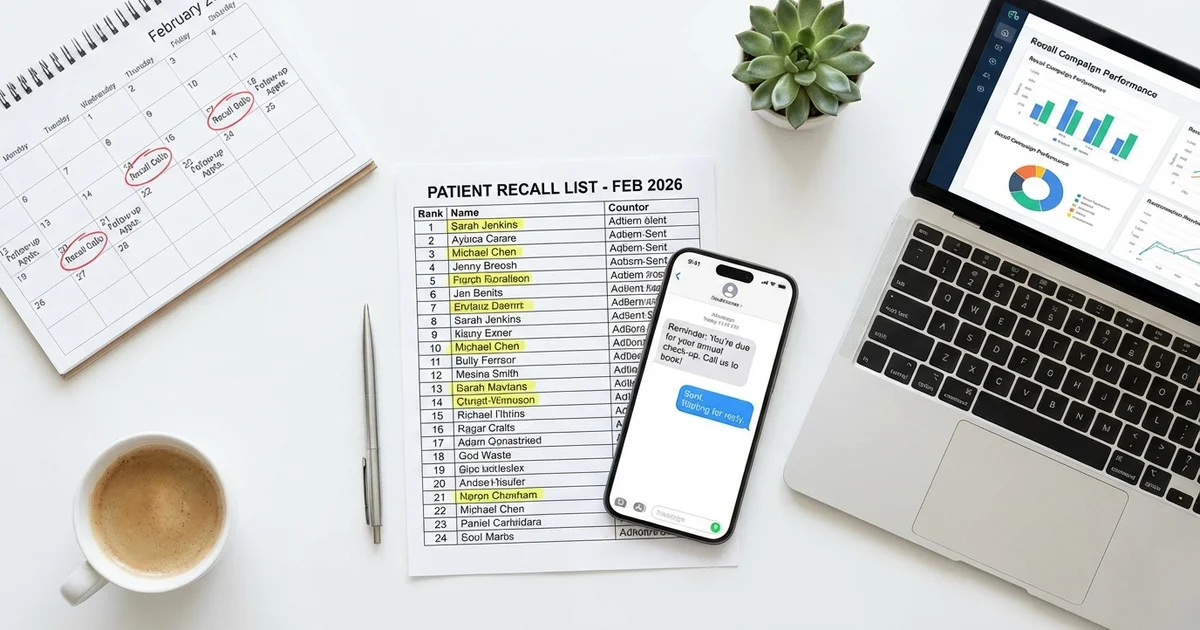
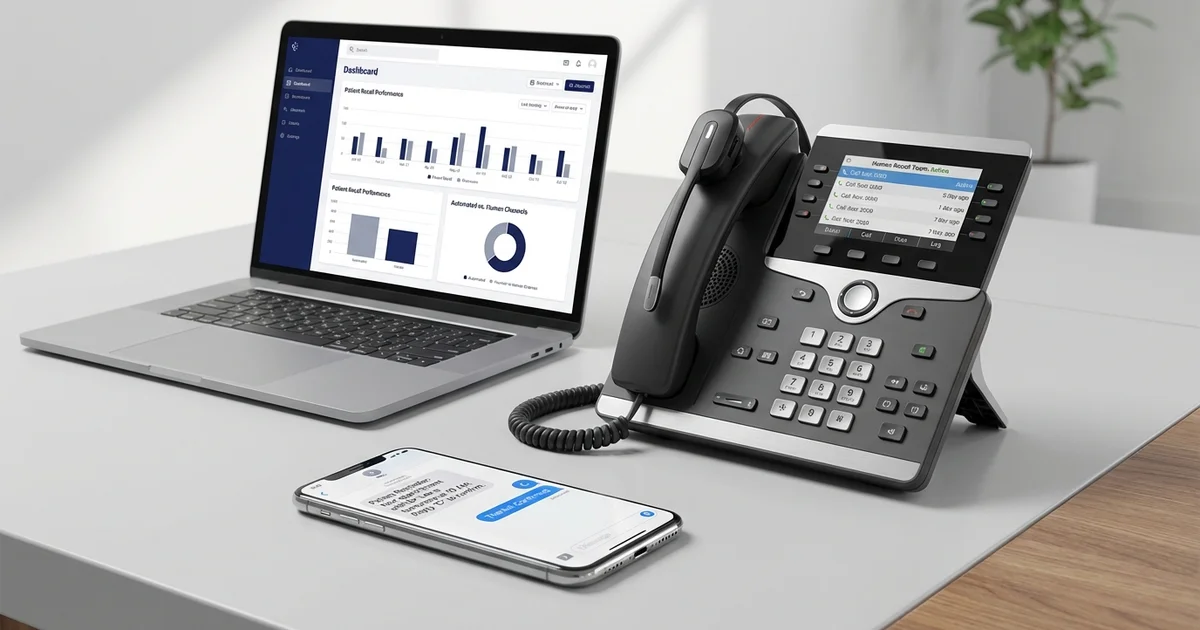
Multi-location healthcare groups face a fundamental question when building their recall campaign framework: should patient outreach be automated, handled by live agents, or a combination of both? Research shows the answer depends on patient demographics, appointment type, and operational scale. Live phone calls achieve 32% completion rates compared to 17% for automated texts in preventive care contexts, yet automation costs 55-65% less per message. This guide presents the data and decision framework operations leaders need to choose the right approach.
Table of Contents
- What Is the Core Question: Efficiency vs. Effectiveness?
- When Does Each Approach Work Best?
- Why Is a Hybrid Model Best Practice for Multi-Location Groups?
- How Do You Choose the Right Approach?
- How Do You Build a Hybrid Recall System?
- What Are Common Mistakes in Choosing an Approach?
What Is the Core Question: Efficiency vs. Effectiveness?
The automated vs human recall debate centers on a tradeoff between scalability and conversion rates.
The efficiency argument for automation: Text messaging costs 55-65% less per message than phone calls. Automated systems reach more patients with less staff time. One study found automated texting reduced acute care resource use by 41% compared to phone interventions for post-discharge follow-up.
The effectiveness argument for human outreach: Live phone calls achieve 32% completion rates vs 17% for text messages in colorectal cancer screening studies. Phone call reminders achieved 35-85% attendance rates compared to 15-65% for SMS in radiology. Personalized messages generate 3-4x higher response rates than generic automated reminders.
The research suggests neither approach wins universally. The optimal choice depends on specific factors.
When Does Each Approach Work Best?
When Does Automated Recall Outperform Human Outreach?
Research identifies specific scenarios where automation delivers superior results:
Post-discharge follow-up: Studies from the University of Pennsylvania found automated texting reduced hospital readmissions and acute care utilization. One program achieved 87.3% reach rate with 97% enrollment of eligible patients, resulting in zero readmissions among participants during the study period.
Younger patient demographics: Patients under 40 show higher engagement with digital channels. Text-based outreach aligns with communication preferences for this demographic.
High-volume, routine reminders: For standard appointment confirmations where the relationship is already established, automated systems handle volume efficiently. Automated reminder systems can reduce no-show rates by up to 39%.
Cost-sensitive scaling: Multi-location groups needing to reach thousands of patients cannot afford per-patient phone calls for every touchpoint. Automation enables broad reach within budget constraints.
When Does Human Outreach Outperform Automation?
Research equally identifies scenarios requiring the human touch:
Older patient populations (41-60+): Studies in Saudi Arabian radiology departments found phone calls significantly outperformed SMS for patients aged 41-60. The emotional connection with a real person drives higher response rates for this demographic.
Preventive care and screening: For colorectal cancer screening, live phone calls nearly doubled completion rates compared to text messages (32% vs 17%). Complex health decisions benefit from conversation.
Patients who have lapsed longer: Dormant patients (12+ months since last visit) respond better to personalized outreach that acknowledges the gap and rebuilds the relationship. Generic automated messages fail to address why they stopped coming.
Service recovery situations: Patients who had negative experiences or declined appointments previously need human engagement to address objections and rebuild trust.
Why Is a Hybrid Model Best Practice for Multi-Location Groups?
The evidence points toward a hybrid approach as optimal for healthcare groups operating at scale.
Hybrid model structure:
| Outreach Type | Method | Rationale |
|---|---|---|
| Initial contact (all patients) | Automated SMS | Cost-efficient, high reach |
| Non-responders (high-value) | Live phone call | Personalized conversion |
| Non-responders (standard) | Second automated attempt | Balanced cost/benefit |
| Objection handling | Live agent | Requires conversation |
| Post-booking confirmation | Automated | Simple, transactional |
Research supports this sequenced approach. One study found nurses needed to make only 1.4 additional phone calls on average after an initial automated texting program, with 83% of patients responding to initial automated messages.
The math for a 10-location group:
A group with 5,000 dormant patients per year: Automated SMS to all 5,000: ~$250 (at $0.05/message). 15% response rate: 750 patients engaged. Live calls to 4,250 non-responders (high-value only, ~1,000): $3,000-$5,000. Additional 20% conversion from calls: 200 patients. Total patients reactivated: 950 (19% overall). Revenue at $3,000 average patient value: $2.85 million recovered.
Compared to all-automated approach (15% = 750 patients = $2.25M) or all-human approach (higher cost, limited scalability), the hybrid model optimizes both reach and conversion.
How Do You Choose the Right Approach?
Use this framework to determine the right mix for your organization:
Factor 1: Patient Demographics
| Dominant Age Group | Recommended Primary Channel |
|---|---|
| Under 40 | Automated SMS with phone fallback |
| 40-60 | Hybrid (SMS first, phone follow-up) |
| 60+ | Phone-first with automated confirmation |
Factor 2: Dormancy Duration
| Time Since Last Visit | Recommended Approach |
|---|---|
| 6-12 months | Automated SMS effective |
| 12-18 months | Hybrid recommended |
| 18+ months | Live outreach required |
The longer patients have been away, the more personalized the outreach needs to be. Generic reminders fail for long-dormant patients who have likely moved on mentally.
Factor 3: Appointment Value
| Average Appointment Value | Cost-Effective Approach |
|---|---|
| Under $100 | Automated only |
| $100-300 | Hybrid |
| $300+ | Justified for live outreach |
High-value appointments (comprehensive exams, procedures, specialty consultations) justify the additional cost of live agent outreach.
Factor 4: Operational Capacity
| Staff Availability | Recommended Approach |
|---|---|
| No dedicated recall staff | Outsourced hybrid service |
| Part-time recall capacity | Automated + targeted calls |
| Full-time recall coordinator | In-house hybrid |
Multi-location groups without dedicated staff at each site benefit most from centralized hybrid services that handle automation and live outreach from a single team.
How Do You Build a Hybrid Recall System?
What Are the Technology Requirements?
For automated outreach:
- HIPAA-compliant SMS platform with PM system integration
- Automated triggers based on last visit date
- Two-way messaging for patient responses
- Online booking links for self-scheduling
For live outreach:
- Call center or dedicated staff with scheduling system access
- Scripts optimized for different patient scenarios
- Call recording for quality assurance
- Real-time dashboard tracking attempts and outcomes
What Are the Sequencing Best Practices?
Research-backed timing for hybrid outreach:
Week 1: Automated SMS to all due patients
- “Hi [Name], it’s time for your [appointment type] at [Practice]. Reply YES to schedule or call [number].”
Week 2: Second automated SMS to non-responders
- Slightly different messaging, increased urgency
Week 3: Live phone calls to high-value non-responders
- Personalized script referencing patient history
- Address objections, offer convenient times
Week 4: Final automated attempt + direct mail for unreachables
- “We’ve been trying to reach you…” messaging
- Postcard for patients with no valid phone/email
How Do You Measure Hybrid Performance?
Track these KPIs to optimize your mix:
| Metric | Benchmark | Purpose |
|---|---|---|
| Automated response rate | 15-25% | Measures message effectiveness |
| Phone contact rate | 25-40% | Measures reachability |
| Phone conversion rate | 30-50% | Measures agent effectiveness |
| Overall reactivation rate | 15-25% | Campaign success metric |
| Cost per reactivated patient | $5-15 | Efficiency measure |
What Are Common Mistakes in Choosing an Approach?
Over-investing in automation: Groups that rely entirely on automated outreach cap their recovery rate at 15-20%. The patients who respond to automation are the easy wins. Recovering the rest requires human engagement.
Under-investing in automation: Groups that use only phone calls face scalability limits and high costs. Automation should handle the first touch and easy conversions, freeing agents for complex cases.
One-size-fits-all messaging: Generic messages to all patients regardless of demographics or dormancy duration underperform segmented approaches by 30-50%.
Insufficient follow-up: Single-touch outreach (one text or one call) captures only a fraction of recoverable patients. Structured sequences with 3-5 touches optimize results.
Key Takeaways
The automated vs human patient recall question has a nuanced answer supported by research:
- Live phone calls outperform automated texts for preventive care (32% vs 17%) and older demographics
- Automated systems cost 55-65% less and can reduce no-show rates by up to 39%
- Hybrid approaches optimize both reach and conversion for multi-location groups
- Segment patients by demographics, dormancy duration, and value to determine channel
- Expect 15-25% overall reactivation with properly executed hybrid programs
- Cost per reactivated patient should fall between $5-15 for efficient operations
The groups achieving the best results combine the scalability of automation with the conversion power of human connection, deployed strategically based on patient characteristics.
For a detailed week-by-week implementation guide, see our dormant patient reactivation playbook. For scripting guidance, review our patient recall scripts.
Related Reading
- Patient Recall Solution
- Patient Recall Service: What It Is and When You Need It
- Dormant Patient Reactivation: 30-Day Multi-Location Playbook
- Patient Recall Campaign Framework: Step-by-Step Guide
Multi-location groups seeking centralized recall support can learn more about our enterprise multi-location recall solution.
Reactivating dormant patients is one of the highest-ROI investments a practice can make. Talk to our team about how MyBCAT combines call answering with patient recall to keep your schedule full.