
The difference between a 15% and 30% recall booking rate often comes down to the words you use. Effective patient recall scripts increase response rates by 20-30% compared to generic “time for your appointment” messaging. This guide provides ready-to-use phone and SMS scripts for every recall scenario, with objection handling templates and adaptation guidance for multi-location healthcare groups. For reminder cadence, channel mix, and confirmation workflows after an appointment is booked, see our appointment reminder best practices guide.
Table of Contents
- Why Do Scripts Matter for Patient Recall?
- What Are the Best Phone Scripts for Patient Recall?
- What Are the Best SMS Templates for Patient Recall?
- How Should You Handle Patient Objections?
- What Are the Best Timing Practices?
- How Do You Adapt Scripts for Multiple Locations?
- How Do You Measure Script Effectiveness?
Why Do Scripts Matter for Patient Recall?
Scripts ensure consistency, train new staff quickly, and capture best practices that drive results.
Benefits of structured recall scripts: Consistent patient experience across all staff members. Faster onboarding for new team members. Higher conversion rates from proven language. Reduced awkwardness in difficult conversations (objections, no-shows). Scalable execution across multiple locations.
Research shows personalized messages generate 3-4x higher response rates than generic reminders. Scripts provide the framework for personalization at scale.
The script is only half the equation. Someone has to work the list consistently, which is where most practices stall. If your front desk cannot keep up with recall calls, a dedicated optometry virtual assistant and call team can run these exact scripts daily without pulling staff off in-office patients.
What Are the Best Phone Scripts for Patient Recall?
Phone calls remain the most effective channel for high-value patients and those who have been dormant longer than 12 months. These scripts balance warmth with efficiency.
Script 1: Standard Recall (Due for Appointment)
Use when: Patient is approaching or has reached their recall interval (6-month hygiene, annual exam, etc.)
Phone Script: Standard Recall
Opening:
"Hi, this is [Your Name] calling from [Practice Name]. May I speak with [Patient Name]?"
[If patient answers:]
"Hi [Patient Name], I'm calling because our records show you're due for your [appointment type - exam/cleaning/checkup]. Dr. [Provider] wanted me to reach out and see if we can get you scheduled.
Do you have your calendar handy? I have availability [offer 2-3 specific times] this week, or I can look at next week if that works better for you."
[If they need to think about it:]
"No problem! I'll send you a text with our online booking link so you can schedule when it's convenient. What's the best number to text?"
Key elements: Reference the specific provider by name (builds relationship). Offer specific times rather than open-ended “when works for you”. Provide an easy fallback (text with booking link).
Script 2: Overdue Patient (3-6 Months Past Due)
Use when: Patient has missed their recall window but hasn’t been gone long
Phone Script: Overdue Patient
Opening:
"Hi [Patient Name], this is [Your Name] from [Practice Name]. How are you doing?"
[After greeting:]
"I noticed it's been about [X months] since your last visit with Dr. [Provider], and I wanted to check in. We know life gets busy!
Is there anything that's been keeping you from coming in? Sometimes patients tell us they're worried about [common concern - cost, time, discomfort] and we can usually work something out."
[Listen to response, then:]
"I'd love to get you back on the schedule. We have [specific times] available this week. What works best for your schedule?"
Key elements: Acknowledge the gap without judgment (“life gets busy”). Proactively surface common objections. Show willingness to address concerns.
Script 3: Long-Dormant Patient (12+ Months)
Use when: Patient hasn’t been seen in over a year and may have mentally moved on
Phone Script: Long-Dormant Patient
Opening:
"Hi [Patient Name], this is [Your Name] from [Practice Name]. We haven't seen you in a while and Dr. [Provider] asked me to personally reach out."
[After greeting:]
"It's been about [X months] since your last visit. We want you to know you're still welcome here and we'd love to see you again.
A lot has changed since your last visit: we've [mention improvement: new technology, extended hours, new services, etc.].
I know it's been a while. Is there anything we could have done better during your last visits? We're always trying to improve."
[If they mention a concern:]
"Thank you for sharing that. I really appreciate the feedback. Let me make a note so we can make sure your next visit is better.
Would you be open to giving us another chance? I can get you scheduled with [specific time options]."
Key elements: “Personally reach out” language elevates importance. Acknowledge the gap directly. Ask for feedback (shows you care). Frame as “giving us another chance”.
Script 4: No-Show Follow-Up (Same Day or Next Day)
Use when: Patient missed their scheduled appointment without calling to cancel
Phone Script: No-Show Follow-Up
"Hi [Patient Name], this is [Your Name] from [Practice Name]. I'm calling about your appointment that was scheduled for [time] today/yesterday.
We noticed you weren't able to make it in. I hope everything is okay!
We had that time reserved just for you, and we want to make sure you still get the care you need.
What happened? Did something come up? Let's find a time that works better for your schedule. I have [specific times] available this week."
[If they apologize:]
"No worries. It happens! The important thing is getting you rescheduled. What time works better for you?"
Key elements: Express concern for their wellbeing first. Gently note the reserved time (accountability without guilt). Focus on rescheduling, not the missed appointment.
If no-shows are a recurring leak rather than an occasional miss, a systematic no-show recovery service can chase every missed appointment the same day, every day.
What Are the Best SMS Templates for Patient Recall?
Text messages achieve higher delivery and read rates than email or voicemail. Keep messages short, personal, and action-oriented.
Template 1: Pre-Due Reminder (2-4 Weeks Before Due Date)
SMS Template
Hi [First Name]! This is [Practice Name]. You're coming due for your [appointment type] with Dr. [Provider]. Reply YES to schedule or call us at [phone]. We look forward to seeing you!
Character count: ~186 (may span 2-3 SMS segments with actual names)
Template 2: Due Now
SMS Template
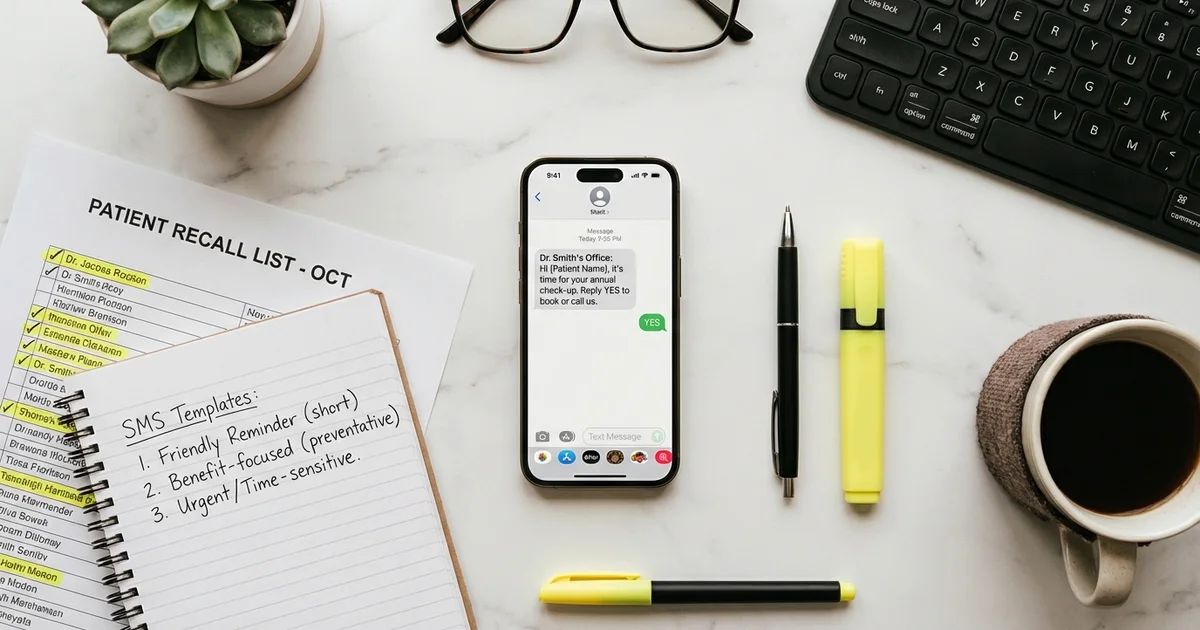
Hi [First Name], it's time for your [appointment type] at [Practice Name]! We have openings this week. Reply YES to book or click here to schedule: [booking link]
Template 3: Overdue (Gentle)
SMS Template
Hi [First Name], we noticed it's been a while since your last visit to [Practice Name]. Your [appointment type] is overdue. Reply YES to schedule or CALL to chat with our team. We're here when you're ready!
Template 4: Overdue (Urgency)
SMS Template
[First Name], your [appointment type] at [Practice Name] is now [X months] overdue. Regular [exams/checkups/cleanings] help catch issues early. Let's get you scheduled. Reply YES or call [phone].
Template 5: Last Chance
SMS Template
[First Name], we've been trying to reach you about your overdue [appointment type]. Please reply or call [phone] if you'd like to stay on as a patient. We're here when you're ready. [Practice Name]
Template 6: No-Show Same Day
SMS Template
Hi [First Name], we missed you at your appointment today! Life happens. No worries. Reply to reschedule or call [phone]. We want to make sure you get the care you need. [Practice Name]
Template 7: Appointment Confirmation
SMS Template
Hi [First Name]! Confirming your appt at [Practice Name] on [Date] at [Time] with Dr. [Provider]. Reply YES to confirm or RESCHEDULE if you need a different time. See you soon!
How Should You Handle Patient Objections?
Patients give objections. How you respond determines whether they book or disengage permanently.
Objection: “I’m too busy right now”
Phone Response
"I completely understand. Everyone's schedule is packed these days. What if we looked at early morning or late afternoon times? We also have [Saturday hours/extended hours] if that helps. Even a quick appointment is better than letting things slide."
SMS Response
Totally get it! We have early AM, late PM, and [Saturday] times. When's typically less hectic for you? Reply and I'll find something that fits.
Objection: “I’ll call you back to schedule”
Phone Response
"Of course! Before I let you go, what day this week works best for you, generally? I can send you a text reminder with available times for that day, so you don't have to remember to call back."
[Or if they insist:]
"No problem at all. I'll send you a quick text with our booking link so you can schedule whenever it's convenient. Is [phone number] still the best number?"
Objection: “I don’t think I can afford it right now”
Phone Response
"I hear you. That's a real concern for a lot of patients. Let me tell you about a couple options: We offer [payment plans/financing], and your preventive [exam/cleaning] may be covered by insurance at little to no cost. Would it help if I checked your benefits before we schedule?"
SMS Response
We understand cost concerns! Many preventive visits are covered by insurance. We also offer payment plans. Call [phone] and we can check your benefits. Often it costs less than you'd think.
Objection: “I’m seeing someone else now”
Phone Response
"Oh, that's great that you're still taking care of your [dental health/eye health/etc.]! We'll update our records. Just so you know, if anything ever changes or you need a second opinion, we'd be happy to see you again. Take care!"
[Note: Don't push. Update records to avoid future outreach to this patient.]
Objection: “I had a bad experience last time”
Phone Response
"I'm really sorry to hear that. Can you tell me what happened? I want to make sure we address it...
[Listen fully, don't interrupt]
Thank you for sharing that. I completely understand why that was frustrating. I'm going to make a note in your file so we can do better next time. Would you be willing to give us another chance? I can make sure Dr. [Provider] personally addresses this."
What Are the Best Timing Practices?
When you reach out matters as much as what you say.
Optimal call times: Tuesday-Thursday, 10am-12pm and 2pm-4pm. Avoid Monday mornings and Friday afternoons. For working professionals: early morning (8-9am) or after 5pm.
Optimal text times:
- Tuesday-Thursday, 9am-11am or 1pm-3pm
- Evening texts (6-8pm) can work for working patients
- Avoid weekends unless patient prefers
Multi-attempt sequence:
- Day 1: SMS (morning)
- Day 3: Second SMS if no response
- Day 5-7: Phone call to non-responders
- Day 10: Final SMS
- Day 14+: Remove from active campaign, flag for future reactivation
How Do You Adapt Scripts for Multiple Locations?
For healthcare groups operating multiple sites, scripts need local customization within a standard framework.
Standardize:
- Opening and closing language
- Objection handling responses
- Compliance language (HIPAA, opt-out instructions)
- Brand voice and tone
Localize:
- Practice name and location
- Provider names
- Phone numbers and booking links
- Hours of operation
- Location-specific services or promotions
Template structure for multi-location:
Multi-Location SMS Template
Hi [First Name], this is [Practice Name] [Location]. You're due for your [appointment type] with Dr. [Provider]. We have openings at our [City] office this week. Reply YES to book or call [location phone].
How Do You Measure Script Effectiveness?
Track these metrics to identify which scripts perform best:
| Metric | Target | How to Measure |
|---|---|---|
| Contact rate (phone) | 25-40% | Calls answered / Calls attempted |
| Response rate (SMS) | 15-25% | Replies / Messages sent |
| Booking rate | 30-50% | Appointments booked / Contacts made |
| Show rate | 85%+ | Appointments completed / Appointments booked |
| Opt-out rate | <2% | Opt-outs / Messages sent |
A/B testing approach:
- Test one variable at a time (opening line, call-to-action, timing)
- Run tests for at least 100 contacts per variant
- Document winning scripts and roll out across all locations
Key Takeaways
Effective patient recall scripts combine personalization with efficiency:
- Personalized messages generate 3-4x higher response rates than generic reminders
- Phone scripts should reference the specific provider and offer concrete scheduling options
- SMS templates should be concise (under 160 characters ideal, but prioritize clarity over character count)
- Objection handling scripts prevent conversations from ending without resolution
- Timing matters: Tuesday-Thursday, mid-morning or early afternoon performs best
- Multi-location groups should standardize framework but localize details
- Track metrics by script to identify what works and refine continuously
The scripts in this guide are starting points. Adapt them to your practice’s voice, patient demographics, and specific services. Test, measure, and iterate.
For the complete framework on running recall campaigns, see our patient recall campaign framework. For guidance on whether to use automation or live agents, review our automated vs human patient recall comparison.
Related Reading
- Patient Recall Solution
- Reactivation Call Centers for Multi-Location Medical Groups
- Reactivation Text Templates: SMS Scripts That Work
- Reactivation Campaign KPIs: Metrics for Multi-Location Groups
- MyBCAT vs Hello Rache: Which Patient Recall Approach Works Better?
- What Is Patient Intake? Complete Definition
Reactivating dormant patients is one of the highest-ROI investments a practice can make. Talk to our team about how MyBCAT combines call answering with patient recall to keep your schedule full.