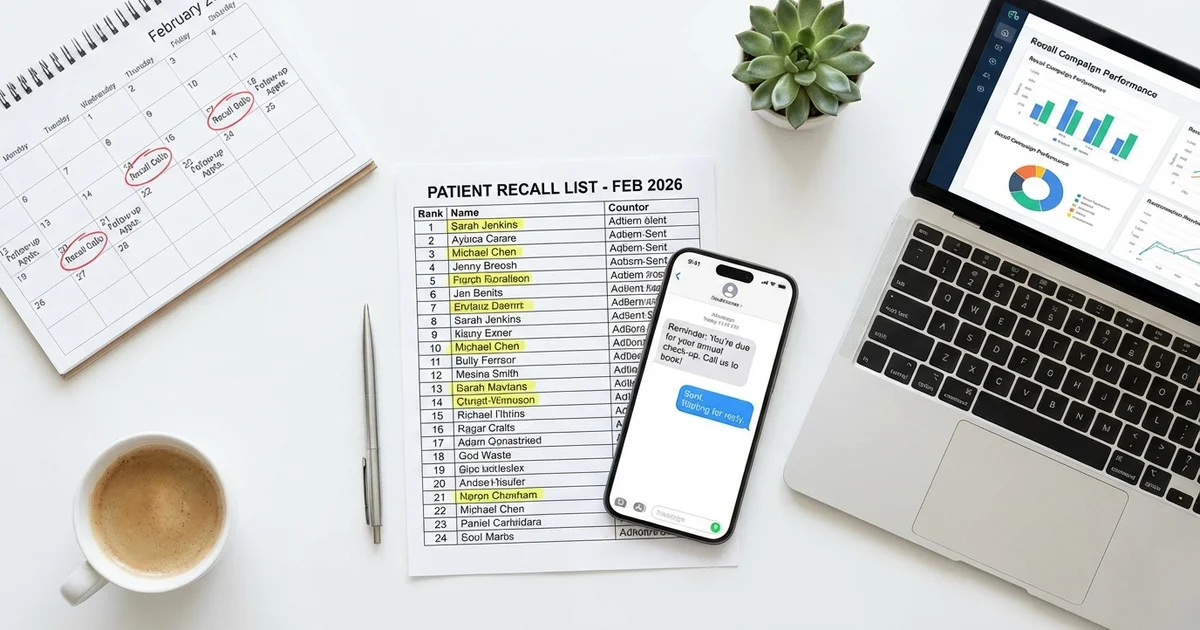


Multi-location medical groups lose 10% of their patient base annually to attrition. For a 15-location DSO with 6,000 patients per site, that translates to 9,000 patients walking out the door each year. A dedicated reactivation call center can recover 20-30% of those dormant patients, generating over $1 million in recaptured revenue. Building this capability starts with a solid patient recall campaign framework. This guide breaks down how operations leaders at healthcare groups with 3+ locations can build, measure, and scale reactivation programs that deliver measurable EBITDA impact.
Table of Contents
- Why Does Reactivation Matter More at Scale?
- What Is the Multi-Location Reactivation Problem?
- Centralized vs. Distributed Reactivation Models
- How Do You Build Your Reactivation Call Center?
- The Four-Stage Reactivation Campaign Framework
- How Do You Measure Reactivation ROI at Enterprise Scale?
- Why Do Robocalls Fail and Human Contact Win?
- What Mistakes Do Multi-Location Groups Make?
- How Does Reactivation Integrate with Your Broader Patient Lifecycle?
- How Do You Build a Business Case for Centralized Reactivation?
Why Does Reactivation Matter More at Scale?
Single-location practices treat patient attrition as inevitable. Multi-location groups cannot afford that mindset. The math compounds quickly: a 10% annual loss across 15 locations means thousands of patients disappearing from your active roster every year.
Consider the financial reality. Each dormant patient represents $400-800 in annual production, depending on specialty. When you multiply that across 9,000 lapsed patients, you are looking at $3.6 million to $7.2 million in unrealized revenue sitting in your own database.
The acquisition cost comparison makes the case clearer. Acquiring a new patient typically costs 2-6x more than reactivating an existing one. Your dormant patients already know your brand, have visit history in your system, and require no marketing spend to reach. They are the lowest-cost revenue opportunity in your portfolio.
For PE-backed groups focused on same-store growth metrics, reactivation campaigns directly improve the numbers that drive valuations.
What Is the Multi-Location Reactivation Problem?
Running reactivation out of individual locations creates three operational failures.
Inconsistent execution. Location A runs a postcard campaign. Location B tries text messages. Location C does nothing. You have no standardized approach, no comparable data, and no way to optimize across the network.
Duplicate costs. Each location maintains its own outbound calling infrastructure, trains its own staff, and develops its own scripts. You pay for the same capability 15 times instead of once.
No visibility. Without centralized reporting, you cannot answer basic questions: Which locations have the highest reactivation rates? Which channels perform best? What is the cost per reactivated patient across the group?
Multi-location groups need centralized reactivation infrastructure. That means dedicated call center operations, whether in-house, outsourced, or hybrid, that can execute consistent campaigns across all sites while rolling up performance data to a single dashboard.
Centralized vs. Distributed Reactivation Models
Operations leaders face a structural decision: centralize reactivation calling or distribute it across locations.
Centralized Model
A dedicated reactivation team handles outbound campaigns for all locations from a single hub. This approach works best for groups with 10+ locations where standardization and scale economics matter most.
Advantages include consistent messaging and scripting across all sites, single technology stack (dialer, crm, analytics), easier quality assurance and compliance monitoring, lower cost per call through volume efficiency, and unified reporting and benchmarking.
Disadvantages: Less local context (agents may not know specific providers). Requires integration with multiple practice management systems. Initial setup investment in technology and training.
Distributed Model
Front desk staff at each location handle reactivation calls during downtime. This approach suits smaller groups (3-5 locations) with lower call volumes.
Advantages include local knowledge of patients and providers, no additional staffing costs, and staff already have system access.
Disadvantages include inconsistent execution based on location priorities, competes with inbound call handling, difficult to track and optimize, and higher effective cost per call.
Hybrid Model
Centralized campaign management with local fulfillment. The central team segments lists, develops scripts, schedules outreach, and tracks results. Location staff execute calls using provided materials and report outcomes.
This model balances standardization with local relationships. It works well during the transition period as groups build centralized capabilities.
For groups pursuing rapid growth or preparing for an exit, centralized operations typically deliver the operational metrics PE sponsors expect. The centralized vs. distributed intake framework applies the same logic to reactivation infrastructure.
How Do You Build Your Reactivation Call Center?
Reactivation calling requires different skills than inbound patient service. Outbound agents must handle rejection, maintain energy across dozens of calls, and convert cold contacts into scheduled appointments.
Staffing Calculations
The standard formula starts with call volume targets. For a 15-location group with 9,000 dormant patients:
Target contact rate: 25% (2,250 live conversations). Calls required to reach target: 9,000 attempts. Calls per agent per day: 80-100 outbound. Campaign duration: 20 business days. Agents needed: 4-5 FTEs dedicated to reactivation.
Add 30-35% shrinkage factor for breaks, training, and turnover. Your actual staffing requirement becomes 6-7 FTEs for this campaign volume.
SLA Benchmarks
Measure reactivation call centers differently than inbound support. Key metrics include:
| Metric | Target | Why It Matters |
|---|---|---|
| Contact Rate | 15-25% | Percentage of dials reaching a live person |
| Conversion Rate | 8-15% | Percentage of contacts who schedule |
| Cost Per Reactivation | $150-300 | Total annual operating cost divided by kept appointments |
| Appointments Kept | 70-80% | Show rate for reactivated patients |
| Revenue Per Reactivation | $400-800 | Average production from reactivated patient visits |
Compare these metrics across locations to identify performance gaps. A location with 8% conversion rate versus the network average of 12% signals a scripting, timing, or staff training issue worth investigating.
Technology Stack
Centralized reactivation requires: Power dialer with local caller ID presentation. Integration with practice management systems across all locations. Call recording for compliance and quality review. Real-time dashboard showing campaign progress. Scheduling capability to book directly into provider calendars.
The KPI dashboard for multi-location intake provides a framework for building unified reporting across your network.
The Four-Stage Reactivation Campaign Framework
Effective reactivation campaigns follow a structured sequence. Random calls to old patients waste resources. A systematic approach maximizes contact rates and conversions.
Stage 1: Segmentation (Week 1)
Pull your dormant patient list and segment by:
- Time since last visit (6-12 months, 12-24 months, 24+ months)
- Patient value (based on historical production)
- Treatment completion status (incomplete treatment plans flag higher-value targets)
- Insurance status (patients with active coverage convert at higher rates)
Prioritize high-value patients with recent activity and active insurance. These contacts have the highest conversion probability and revenue potential.
The dormant patient reactivation playbook details the 30-day execution timeline for this segmentation process.
Stage 2: Multi-Channel Outreach (Weeks 2-3)
Research shows that 4-5 contact attempts can reach up to 95% of your dormant patient pool, with multi-channel campaigns recovering 20-30% of targeted patients. Structure your touches across channels:
- Touch 1: Text message (90%+ open rate)
- Touch 2: Email with scheduling link
- Touch 3: Phone call
- Touch 4: Second phone call (different time of day)
- Touch 5: Postcard or final text
Space touches 3-5 days apart. This cadence maintains presence without irritating patients.
Stage 3: Conversion Calls (Weeks 3-4)
When patients respond or answer calls, agents must convert interest into scheduled appointments. Key script elements:
- Acknowledge the gap since their last visit
- Reference specific treatment history or unfinished care
- Offer convenient scheduling (same-day, early morning, after work)
- Address common objections (insurance questions, provider availability)
- Confirm the appointment before ending the call
Patient recall scripts provide tested language for these conversion conversations.
Stage 4: Post-Reactivation Retention (Ongoing)
Reactivated patients have higher attrition risk than continuous patients. Build retention protocols:
- Appointment reminder sequence (text + email + phone for high-value patients)
- Provider follow-up within 48 hours of visit
- Next appointment scheduling before patient leaves
- Recall system enrollment for future outreach
A patient who completes their reactivation appointment but leaves without scheduling next steps will likely lapse again.
How Do You Measure Reactivation ROI at Enterprise Scale?
Operations leaders need to quantify reactivation performance in terms that resonate with PE sponsors and executive teams.
Direct Revenue Impact
Calculate straightforward: reactivated patients multiplied by average production per visit.
Example: 500 reactivated patients × $600 average production = $300,000 direct revenue impact
Cost Efficiency
Compare cost per reactivation against cost per new patient acquisition.
| Channel | Cost Per Acquisition | Typical Conversion |
|---|---|---|
| Digital Marketing | $150-300 | 2-5% |
| Direct Mail | $100-200 | 1-3% |
| Reactivation Call | $150-300 | 8-15% |
Reactivation delivers lower cost and higher conversion because you are reaching warm contacts who already know your brand.
EBITDA Contribution
For groups tracking EBITDA margins, reactivation revenue contributes at higher margins than new patient revenue. No marketing spend, no acquisition cost, minimal incremental overhead. The contribution margin on reactivated patient visits often exceeds 60%.
Track these metrics monthly across all locations. Create a reactivation dashboard that shows:
- Dormant patient count by location
- Campaign performance (contacts, conversions, revenue)
- Cost per reactivation by channel
- Trend lines showing improvement over time
The reactivation campaign KPIs guide provides detailed measurement frameworks for multi-location groups.
Why Do Robocalls Fail and Human Contact Win?
Healthcare groups sometimes attempt automated reactivation through robocalls or AI-powered dialers. The data shows this approach fails.
Robocalls trigger spam filters. Mobile carriers block high-volume automated calls. Patients who receive robocalls associate the behavior with scammers, damaging your brand.
Human contact drives conversion. A trained agent who can answer questions, address concerns, and build rapport converts at 8-15%. Automated systems convert at 1-3% at best.
The automated vs. human patient recall comparison breaks down when automation works (appointment reminders) versus when human contact is essential (reactivation conversations).
For multi-location groups, the math favors human call centers. The higher conversion rate more than offsets the additional labor cost, and you avoid the brand damage from perceived spam outreach.
What Mistakes Do Multi-Location Groups Make?
Mistake 1: Treating All Dormant Patients Equally
A patient who last visited 8 months ago requires different outreach than one absent for 3 years. Segment your lists and adjust messaging, channel mix, and offer strategy by dormancy duration.
Mistake 2: Underinvesting in Call Center Training
Reactivation agents need specialized skills: objection handling, empathetic communication, appointment scheduling across multiple locations. Generic customer service training produces generic results.
Mistake 3: Running Campaigns Without Control Groups
How do you know your campaign worked? Without a control group of dormant patients who receive no outreach, you cannot isolate campaign impact from natural return behavior. Hold back 10% of your list as a control.
Mistake 4: Ignoring Post-Reactivation Retention
Reactivating a patient who lapses again in 6 months wastes your campaign investment. Build retention protocols that keep reactivated patients engaged beyond their return visit.
Mistake 5: Operating Without Location-Level Benchmarks
If you cannot compare reactivation performance across locations, you cannot identify what works. Standardize metrics and reporting to enable optimization.
How Does Reactivation Integrate with Your Broader Patient Lifecycle?
Reactivation call centers should not operate in isolation. They connect to your overall patient lifecycle infrastructure.
Inbound Call Handling
Patients responding to reactivation outreach often call back. Your inbound team must recognize these warm leads and route them appropriately. A reactivation respondent who gets transferred three times before scheduling will likely abandon.
See how multi-location healthcare intake operations connect inbound and outbound functions.
Recall and Reminder Systems
Reactivation targets patients who fell through your recall system. After reactivating them, ensure they enter a functioning recall workflow that prevents future lapsing.
The patient recall campaign framework shows how proactive recall reduces the dormant patient pool that reactivation must address.
Provider Communication
Providers should know when their former patients return. A reactivated patient visiting their original provider improves retention compared to seeing whoever has availability.
How Do You Build a Business Case for Centralized Reactivation?
Operations leaders advocating for reactivation investment need a clear business case. Here is a framework:
Current State
- Total dormant patients across network: 9,000
- Annual attrition cost: $3.6M+ in unrealized revenue
- Current reactivation approach: Ad hoc by location
Proposed Investment
- Centralized call center: 6 FTEs + technology stack
- Annual operating cost: $350,000-450,000
Projected Return
- Reactivated patients (Year 1): 1,500 (17% of dormant pool)
- Revenue impact: $900,000
- Net ROI: 100-150%
Additional Benefits
- Standardized performance data across locations
- Reduced acquisition marketing spend
- Improved patient retention metrics
- Higher EBITDA margin on reactivated revenue
For PE-backed groups, frame the investment in terms of multiple expansion. Improved retention metrics and higher same-store growth contribute to higher exit multiples beyond the direct revenue impact.
Key Takeaways
- Multi-location groups lose 10% of patients annually, creating a significant reactivation opportunity
- Centralized call centers outperform distributed approaches for groups with 10+ locations
- Human contact converts at 8-15% compared to 1-3% for automated outreach
- Four-stage campaigns (segment, outreach, convert, retain) maximize reactivation yield
- Cost per reactivation ($150-300) beats cost per new patient acquisition ($300-500+)
- Measure reactivation contribution to EBITDA, not just revenue
Related Reading
- Patient Recall Solution
- Reactivation Text Templates: SMS Scripts That Work
- Reactivation Campaign KPIs: Metrics for Multi-Location Groups
- Patient Recall Segmentation: Who to Call First (and Why)
Reactivating dormant patients is one of the highest-ROI investments a practice can make. Talk to our team about how MyBCAT combines call answering with patient recall to keep your schedule full.
Sources
- CDC: Client Reminder and Recall Systems
- Dialog Health: Healthcare Call Center Statistics
- HCIC Healthcare Contact Center Survey Report 2024