
Table of Contents
- Why Does Urgent Care Call Volume Break At Scale?
- What Should Be Centralized Across Multi-Location Urgent Care?
- How Should Groups Separate Urgent Calls From Routine Demand?
- Which Metrics Should COOs Review Across The Network?
- How Should A Multi-Location Rollout Be Structured?
- How Should Buying Committees Evaluate Support Models?
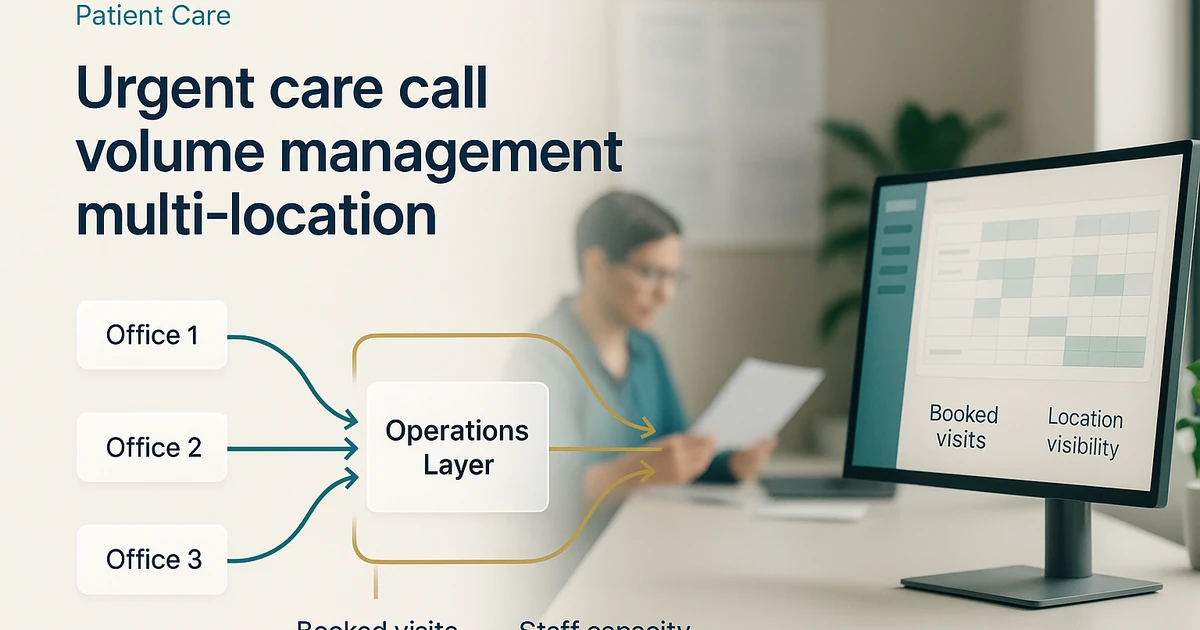
Urgent care call volume management multi-location leaders face a different problem than a front desk that simply feels busy. At scale, phone demand is not one queue. It is a portfolio-wide access system spanning visit requests, occupational medicine questions, follow-up inquiries, billing questions, portal messages, and callbacks that may land at different sites with different habits.
For COOs and VPs of Operations, the goal is not just more people answering phones. The goal is standardization, centralization, SLA calibration, and a clean operating model that keeps urgent access visible while giving leadership a reliable view of demand.
That access lens is supported by how patient experience is measured. AHRQ CAHPS benchmark data includes ambulatory access measures such as urgent appointment timing and same-day answers to phone questions, which makes call handling a patient-access issue rather than a narrow phone-system issue (AHRQ).
A multi-location urgent care group should therefore treat call volume as part of enterprise operations: a shared workflow with defined routing, trained roles, documented exceptions, QA review, and reporting that can be compared across the network.
Why Does Urgent Care Call Volume Break At Scale?
Urgent care access breaks down when each site interprets demand through its own staffing pattern, phone tree, and scheduling habits. One center may transfer clinical questions quickly, another may hold them at registration, and another may send callers to voicemail when the lobby gets crowded.
None of those choices may look dramatic in isolation. Across a multi-location group, however, those differences create uneven patient experience, inconsistent documentation, and limited visibility for leadership.
MGMA discusses phone access, call centers, centralized phone operations, queueing, callback options, dropped calls, and metrics such as speed to answer and abandonment rate, which are directly relevant to larger medical groups managing call volume (MGMA).
The enterprise issue is that fragmented phone operations make those measures hard to interpret. If sites define a handled call, callback, transfer, or abandoned call differently, the dashboard becomes a collection of anecdotes rather than an operating instrument.
Site-by-site variation hides the real constraint
At the site level, a high-call period may look like a staffing issue. At the group level, it may reveal a routing issue, a schedule-template issue, a portal-education issue, or a training gap in how urgent requests are classified. Centralized review is designed to help leaders separate those causes before adding headcount or changing scripts.
For example, an urgent care network may find that one site receives many insurance questions because online pre-registration instructions are unclear, while another receives repeat calls because callbacks are not documented in the same system. The point is not to blame a location. The point is to identify which parts of the workflow should be standardized across every access channel.
Urgent care demand mixes administrative and clinical risk
Urgent care callers rarely present themselves in clean operational categories. A caller may begin with a scheduling request, then mention a symptom that requires an approved clinical handoff. Another may call about an employer form, then disclose that the visit is time-sensitive for work clearance. A third may be trying to choose between a same-day visit, virtual option, or another care path.
That mix requires a routing model that distinguishes administrative completion from clinical escalation. AMA STEPS Forward provides guidance on team triage for phone calls and portal messages when patients have acute care needs, including decisions about office, telehealth, urgent care, or emergency department disposition (AMA).
Nonclinical agents should not diagnose, downplay symptoms, or improvise advice. They should follow an approved decision tree, collect required information, document the interaction, and route exceptions to the right role with a clear handoff.
What Should Be Centralized Across Multi-Location Urgent Care?
Centralization does not mean every decision moves away from the site. It means the group decides which rules belong to the enterprise and which exceptions remain site-specific.
Urgent care networks usually need common definitions for call types, escalation paths, callback ownership, schedule access, transfer rules, and documentation standards. Without that shared layer, each location becomes its own access model.
MGMA describes central scheduling in a large multispecialty group with more than 60 locations and urgent/express care sites, which is relevant for multi-location access design, centralized scheduling, and reducing location-by-location variability (MGMA).
The lesson for urgent care executives is not that every organization needs the same structure. It is that scale requires governance: standard work, shared training, and the ability to compare performance without translating each site’s custom process.
Standardize the intake taxonomy
A central intake taxonomy defines what the group means by new visit request, return visit question, occupational medicine request, test-result question, billing transfer, clinical escalation, portal support, prescription-related request, and callback. The taxonomy should be short enough for agents to use during live interactions, but specific enough to produce meaningful reporting.
The taxonomy also needs ownership rules. A call type should map to a role, a system of record, a required note, and a next action. If a request cannot be completed by the access team, the workflow should identify the receiving team and the information required for a clean handoff.
Centralize the knowledge base before centralizing the queue
A shared queue without a shared knowledge base simply moves confusion to a larger audience. Before expanding central phone coverage, the group should document location hours, accepted visit types, occupational medicine rules, provider-specific constraints, payer-related routing, forms handling, callback expectations, and escalation contacts.
The knowledge base should be reviewed by operations, clinical leadership, revenue cycle, and site representatives.
This is where many rollouts can stall. The central team is asked to create consistency while the underlying rules remain inconsistent. A stronger operating model should address the most common rule conflicts before go-live, then treat remaining exceptions as governance items rather than informal workarounds.
How Should Groups Separate Urgent Calls From Routine Demand?
A scalable call-volume model does not treat every inquiry as equally urgent. It protects urgent access by moving routine administrative demand into channels that can handle it consistently, while keeping a clear path for callers who need human support. This is especially important in urgent care because the access team may receive the first signal that a request should not remain in an administrative queue.
HealthIT.gov explains that portals can support online booking, refills, secure messaging, and reduced phone calls, which is relevant to deflecting non-urgent call volume while preserving access for urgent patient needs (HealthIT.gov).
AAFP also outlines telephone traffic studies, expanded phone availability, direct lines by call type, and routing improvements, giving operators a practical framework for studying inbound demand before redesigning the phone model (AAFP).
Move routine demand into governed digital workflows
Digital access is useful only when it follows the same operating rules as the phone queue. If a portal request, web form, or text response creates a separate process with different documentation and ownership, the group has added another inbox rather than another access channel.
Routine demand should be routed through workflows that have clear intake fields, ownership, follow-up logic, and exception handling.
For urgent care, this can include appointment requests, basic registration support, employer form intake, general location questions, and administrative follow-up where the group’s policy allows it. The important decision is not whether the channel is digital or live. It is whether the request reaches a documented owner and produces a traceable next action.
Keep escalation rules conservative and explicit
Escalation rules should be simple enough for nonclinical agents to apply consistently. If a caller mentions symptoms, acuity, medication concerns, or uncertainty about where to seek care, the agent should follow the approved handoff path rather than attempting to resolve the question.
The workflow should identify what information the agent may collect, what language the agent may use, and what role receives the escalation (AMA).
Buying committees should look closely at how vendors train for these boundaries. A managed intake partner should be able to explain how it separates scheduling, message intake, callback routing, and escalation. It should also show how exceptions are documented for QA review without exposing unnecessary information to people who do not need it.
Which Metrics Should COOs Review Across The Network?
Call-volume management needs a portfolio dashboard, but a dashboard is useful only when definitions are stable. If one site marks a transferred call as resolved and another marks it as escalated, the executive team cannot compare outcomes. The first analytics project is often definition control: what counts as answered, abandoned, transferred, escalated, resolved, or pending callback.
MGMA’s discussion of call-center efficiency is useful here because it frames phone performance through operational concepts such as queueing, callbacks, dropped calls, speed to answer, and abandonment rate (MGMA).
For urgent care groups, those measures should be paired with quality review. Fast handling is not sufficient if the next action is unclear, the wrong team receives the handoff, or the documentation does not support follow-up.
Calibrate SLAs by call type
A single SLA for every call can distort behavior. Appointment requests, employer-services questions, portal-support questions, and possible clinical escalations should not be managed as if they carry the same operational risk. The group should define service expectations by queue, channel, and escalation class, then review whether those expectations are realistic for the staffing model and systems access.
SLA calibration should also account for site workflows. If the access center can schedule some visit types directly but must transfer others, leadership should know which exceptions are driving handoffs. That visibility helps the COO decide whether to change permissions, retrain agents, update schedule templates, or keep the exception in place because the risk profile justifies it.
Use QA to test consistency, not just courtesy
Quality assurance should evaluate whether the workflow was followed, not only whether the caller was treated politely. A QA scorecard for urgent care access should review call classification, identity and registration steps, approved language, escalation selection, documentation quality, and next-action clarity.
Calibration sessions should include supervisors and operational owners so the review process stays connected to real scheduling and handoff rules.
This is also where centralization affects financial discipline. Leadership cannot responsibly attribute access performance to staffing cost alone when the process itself is inconsistent. A mature QA program gives operators a way to see whether missed handoffs, unclear routing, or unmanaged callbacks are creating rework across the portfolio.
How Should A Multi-Location Rollout Be Structured?
A rollout should begin with process discovery, not a new phone menu. The group needs to understand call types, systems access, schedule permissions, site exceptions, clinical escalation boundaries, and reporting definitions before routing more volume into a central team.
That discovery should include operations, clinical leadership, revenue cycle, IT, and site leaders because each group owns part of the access experience.
The rollout should also connect to the broader patient-access architecture. A central access team may need EHR or PMS access, phone-system reporting, knowledge-base governance, QA tooling, workforce scheduling, and integration paths for callbacks or forms.
Internal planning resources such as an enterprise patient access center implementation guide and EHR/PMS integration planning can help buying committees define the operating model before procurement.
Start with a representative pilot
A useful pilot should include sites that expose normal complexity: different visit mixes, different hours, different payer workflows, and different staff habits. The goal is not to prove that one carefully selected location can work under ideal conditions. The goal is to learn which rules need clarification before the model expands across the network.
The pilot should produce updated scripts, routing rules, exception lists, QA criteria, and reporting definitions. It should also identify which site-specific rules can be retired, which must stay, and which require an executive decision. That discipline prevents the central team from inheriting every legacy process as a permanent exception.
Build governance into the operating cadence
After launch, governance should include regular review of volume patterns, escalation reasons, unresolved callbacks, queue health, QA findings, and location-level variance. The review should produce operational decisions, not just a report. If a recurring handoff fails, someone must own the fix.
For larger networks, governance also needs change control. When a site changes hours, adds a service line, modifies occupational medicine rules, or changes provider availability, the access team needs an approved update path. Without that control, the knowledge base decays and agents begin relying on informal memory.
How Should Buying Committees Evaluate Support Models?
The support-model decision should begin with the operating problem, not with a vendor category. Some groups need overflow support because volume spikes are uneven. Others need central scheduling because access rules are already standardized.
Others need broader front desk outsourcing because callbacks, portal messages, and administrative follow-up are spread across locations with limited QA visibility.
One enterprise-ready model is a managed access layer connected to the existing systems and accountable to enterprise reporting. That may include live answering, centralized scheduling, overflow handling, after-hours protocols where approved, and integration support through the broader medical answering service and integrations architecture.
The buying committee should evaluate whether the model can support scale, training, privacy and security review, and portfolio-level reporting.
Evaluate process ownership, not just staffing coverage
A staffing-only model may add capacity without resolving variation. Buying committees should ask who owns script updates, QA calibration, escalation review, dashboard definitions, onboarding, and change management. If those responsibilities remain scattered across sites, the group may still lack a governed access model.
A stronger vendor evaluation asks for workflow evidence. Can the partner map call types to outcomes? Can it show how exceptions are escalated and reviewed? Can it support the group’s required systems without creating parallel documentation? Can it report location variance in a way operators can act on?
Match the model to enterprise readiness
A group with unclear scheduling rules may need standardization before full centralization. A group with clean rules but uneven coverage may need overflow and callback support. A PE-backed platform integrating acquisitions may need a phased model that absorbs new sites without forcing every workflow change at once.
This is why a centralized versus distributed intake framework can be useful before an RFP. The question is not whether centralization is inherently better. The question is which parts of urgent care access should be centralized, which should remain site-led, and which require a hybrid model with strict reporting.
Related Reading
The following internal resources expand the operational themes in this playbook. They are included for navigation only and should not be treated as external evidence for the claims above. Use them to connect call-volume management with patient-access implementation, QA calibration, and vendor evaluation.
For urgent care groups, the most useful next step is usually to compare the current intake model against adjacent enterprise workflows. If the group has already standardized phone routing, the next gap may be QA. If QA exists but reporting definitions vary, the next gap may be dashboard governance.
Patient access operations
- Enterprise Patient Access Center Implementation
- Patient Access Center Metrics for Healthcare Executives
- Healthcare Call Center Outsourcing for Multi-Location Groups
QA and intake design
- Multi-Location Call Center QA Calibration for Healthcare
- Centralized vs Distributed Intake Framework
Sources
- AHRQ: Section 5: Determining Where To Focus Efforts To Improve Patient Experience
- HealthIT.gov: Chapter 2 - Patient Engagement Playbook
- MGMA: Patient access priorities for 2026: Tackling wait times, phones, no-shows and more
- MGMA: Central scheduling to support practice growth and success in the accountable care environment
- AAFP: Improving Telephone Management in Your Practice
- AMA STEPS Forward: Saving Time Playbook: Build a Well-Run Ambulatory Practice by Optimizing Teamwork and Clinical Operations