

Table of Contents
- Why does healthcare call center outsourcing get harder in a multi-location group?
- What should a multi-location group define before vendor selection?
- How do HIPAA and BAA requirements shape the outsourcing model?
- Can centralized teams route patients safely across locations?
- What operating model usually works best across 3+ locations?
- How should a COO stage rollout and vendor oversight?
Healthcare call center outsourcing can look simple from a distance. A group may have inconsistent answer coverage, uneven front-desk staffing, or too many calls spilling into voicemail, so it starts looking for outside help. That framing can miss what changes once the organization operates across three or more locations.
For a multi-location healthcare group, outsourcing is often as much a standardization decision as a staffing decision. COOs, VPs of Operations, and buying committees may evaluate it through centralization, SLA calibration, QA visibility, and EBITDA impact, not just hourly coverage.
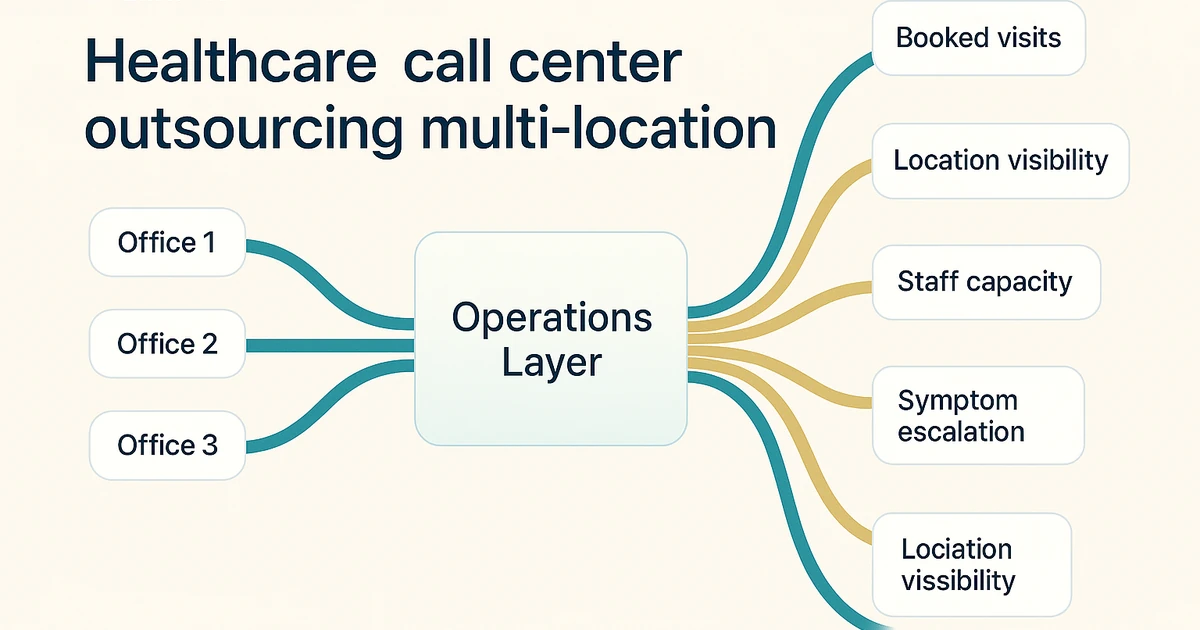
The practical question is not only whether a vendor can answer calls. It is whether the model can support a repeatable operating layer across every site.
That is why enterprise teams often compare outsourcing to broader patient-access design choices, not to a single receptionist vacancy. If your organization is evaluating front desk outsourcing, the real issue may be whether centralized call handling can reduce operational drift without creating new compliance or routing risk.
Why does healthcare call center outsourcing get harder in a multi-location group?
A single location may tolerate a surprising amount of variance. A three-location or fifteen-location group may find that much harder. What looks like flexibility at the site level can become inconsistency at the portfolio level.
Once calls move across multiple sites, the operating problem changes shape. One location may escalate symptom-related calls immediately, while another may treat the same caller as routine scheduling.
One site may log outcomes cleanly in the PMS, while another may rely on free-text notes. One office may close the loop on missed callbacks, while another may assume the vendor handled it. The result is not just uneven service. It can also weaken enterprise control.
Distributed phone workflows create hidden variance
Multi-location groups may discover that call handling remains one of the more fragmented workflows in the organization. Clinical brands, revenue cycle processes, and procurement rules may be centralized, while phones still behave as if each office is an island. That fragmentation can be costly because it obscures where leakage actually occurs.
The hidden cost is not limited to labor. It can show up in inconsistent patient experience, unclear ownership, duplicate vendor management, and reporting that is hard to compare across sites.
That is why some operators compare outsourcing decisions to the broader centralized vs distributed intake framework rather than treating them as isolated staffing fixes.
Buying committees care about governance, not just coverage
Enterprise buyers often start asking a different set of questions than smaller practices ask. They want to know who owns routing logic, who approves script changes, how exception handling is reviewed, how QA is calibrated, and whether location-level reporting rolls into one executive view.
That governance lens is what often turns outsourcing into an enterprise project. If the vendor can only answer calls but cannot fit into standardized reporting, escalation design, and operating review, the group may not have centralized much. It may have moved inconsistency to another seat.
What should a multi-location group define before vendor selection?
Groups can issue an RFP too early. They ask vendors to solve problems that the organization itself has not yet defined. That can produce vague proposals and a rollout full of local exceptions.
Before vendor conversations become serious, the operating team typically needs a clear model for scope, authority, and escalation. Without that definition, the vendor can end up designing the workflow by default, which is usually a poor substitute for enterprise governance.
Scope by call type, service line, and location rule
Not every call should live in the same queue, and not every location should be treated as identical if service lines differ.
Scheduling, referral intake, recall, after-hours messaging, billing questions, and symptom-related calls can create different operational and risk profiles. A buying committee should decide which workflows can be standardized and which require location-aware rules.
This is where many groups can benefit from working backward from the future-state model they want, not the mess they inherited. If the goal is a true patient access layer, the outsourcing scope should reflect enterprise priorities first and historical phone habits second.
That design work can also make later conversations such as a patient access center RFP much cleaner.
Set escalation, SLA calibration, and ownership up front
A vendor should not be guessing when to warm-transfer a call, when to create a message, or when to route to clinical staff. Those thresholds belong to the operator. They should be defined before rollout, reviewed by stakeholders, and applied consistently across sites unless a documented exception exists.
The same goes for SLA calibration. Enterprise groups should define what they want measured, how call outcomes are categorized, who owns script updates, and how disputes get resolved. If these decisions wait until after go-live, location-level workarounds can start to harden into the new operating model.
How do HIPAA and BAA requirements shape the outsourcing model?
Healthcare call center outsourcing becomes materially different when patient information is involved. Once the vendor is handling protected health information on behalf of a covered entity, the arrangement becomes part of the group’s compliance architecture (HHS Business Associates).
This matters even more in a multi-location setting because a centralized workflow can expose PHI from many sites through one operating channel. That is why compliance review typically happens alongside operations and procurement, not after the commercial decision is already made.
When the vendor becomes a business associate
HHS explains that a covered entity generally needs written assurances that a business associate will appropriately safeguard PHI before the covered entity discloses it (HHS Business Associates).
For a multi-location group, that means outsourced call handling should be evaluated based on what data the team creates, receives, maintains, or transmits across the network.
In practice, that shifts the conversation. A vendor that can see appointment context, capture messages tied to care, or handle routing across multiple sites may be more than a phone partner; it may become part of the PHI-handling workflow (HHS Business Associates).
Buying committees should treat that accordingly and review the model with compliance counsel before rollout.
What the agreement should clarify before scale
HHS also publishes sample business associate contract provisions that address permitted uses and disclosures of PHI, safeguards, subcontractor obligations, breach reporting, and return or destruction terms (HHS Business Associate Contracts).
Those provisions are directly relevant when a group centralizes call handling across many locations.
For enterprise operators, the contract discussion should also connect back to operating reality. If the group expects call notes, recordings, audit cooperation, retention rules, or location-specific access boundaries, those expectations should be defined before the rollout. Multi-location outsourcing can fail quietly when the commercial model scales faster than the governance model.
Can centralized teams route patients safely across locations?
This is usually the point where executive teams slow down, and with reason. Centralization is more defensible when the workflow is designed with clear boundaries, protocols, and escalation rules (Wheeler et al.; Huibers et al.).
Non-clinical intake should not be asked to improvise medical judgment, and clinical escalation should not depend on whichever site built the best local workaround.
The useful question is not whether outsourced teams are “safe” in the abstract. The more practical question is what protocol scope, decision support, training, and escalation design are required for safe and consistent routing at enterprise scale (Wheeler et al.; Huibers et al.).
What the telephone triage literature actually suggests
Peer-reviewed literature has examined telephone triage safety across clinical and non-clinical decision makers, as well as the broader out-of-hours evidence base for remote triage (Wheeler et al.; Huibers et al.).
For enterprise buyers, the practical inference is that protocol design, supervision, and escalation boundaries deserve at least as much scrutiny as the simple in-house-versus-outsourced label.
That is why mature multi-location groups often narrow the role definition. A centralized team can gather information, follow approved scripts, flag urgency, and route quickly, but it should not be left to freelance clinical interpretation.
A lower-risk enterprise model is a controlled workflow with explicit handoff points and auditable exceptions (Wheeler et al.; Huibers et al.).
What large-scale standardization can look like
One of the clearest large-system examples is NHS Pathways. NHS England Digital describes it as a clinical decision support system used across multiple urgent and emergency care settings, including NHS 111 and 999 (NHS Pathways).
The lesson is not that every healthcare group needs the same infrastructure. The lesson is that scale tends to require shared routing logic with controlled governance.
That broader routing question also shows up in published research on whether nurse telephone triage can direct people to the appropriate care setting and how telephone triage availability can influence lower-acuity emergency department use (Jácome et al.; Howell).
For multi-location operators, that suggests centralization can be an access-management issue, not just a call-answering issue.
What operating model usually works best across 3+ locations?
The most durable model is often not total standardization at the script line level and not total location freedom either. It is centralized governance with location-aware execution. That gives the group one system of control while preserving the rules that genuinely need to vary by site, provider, or service line.
This distinction matters because many outsourcing projects can fail from overcorrection. They either allow too many local exceptions, which can weaken standardization, or they erase too much local context, which can create avoidable friction for patients and staff.
Centralized governance with location-aware execution
In a workable enterprise model, the central operations team owns routing categories, QA criteria, reporting definitions, script approvals, and change control. Local practices contribute the rules that truly need localization, such as provider schedules, service-line constraints, referral pathways, and approved escalation contacts.
That structure is what makes enterprise call answering for healthcare different from generic overflow coverage. The vendor executes inside a controlled enterprise design. Sites are less likely to independently rewrite the rules every time a staffing shortage or workflow preference appears.
Integration and reporting cannot be an afterthought
If the outsourcing model cannot write structured outcomes back into the workflow, centralization becomes harder to manage. The group needs clean dispositions, location-level dashboards, and reporting that ties calls to next actions, not just raw volume. Otherwise, leadership may see activity but not much control.
That is why integration planning belongs near the front of the project. Groups can underestimate how much reporting discipline depends on system design, reason-code taxonomy, and workflow closure.
The difference between a usable centralized program and a black box often comes down to the quality of the EHR and PMS integration strategy.
How should a COO stage rollout and vendor oversight?
A multi-location rollout should be treated as an operating model deployment, not as a series of disconnected site launches. The goal of the pilot is to validate the governance framework, not to create a temporary exception that looks successful in one office.
That distinction protects the enterprise business case. If the pilot succeeds only because one location manager personally carries the workflow, the group has not proven scalability. It has only proven that heroics are possible.
Pilot the model you intend to scale
A good pilot uses the same decision rights, QA rubric, reporting definitions, and escalation design that the organization intends to use after expansion. It can start with one or two sites, but it should not rely on one-off rules that disappear the moment rollout broadens. Otherwise, the pilot can understate the operational work required for real centralization.
This is also why buying committees often pair rollout planning with RFP discipline. The project should prove whether the vendor can operate inside the future-state model, not whether it can temporarily accommodate local chaos.
That mindset can produce a better healthcare call center ROI conversation because it focuses on repeatability rather than short-term optics.
Build QA, SLA calibration, and review cadence from day one
Vendor management should not begin after launch. It should be built into the launch. Regular QA calibration, script change governance, exception review, and executive reporting should already exist before the first major scale wave.
This is where outsourcing becomes an enterprise operating layer instead of a staffing patch. A disciplined cadence gives leadership one place to review service consistency, routing accuracy, site exceptions, and trend lines across the network.
Groups that formalize this early can have a much easier time sustaining multi-location call center QA calibration as the footprint grows.
Healthcare call center outsourcing can absolutely work in a multi-location environment. The groups that get the most value from it are often the ones that stop treating it as phone coverage and start treating it as patient-access infrastructure. Standardization, centralization, controlled escalation, and executive visibility can make the model easier to scale.
Related Reading
- Enterprise Call Answering for Healthcare Groups
- Patient Access Center RFP Vendor Checklist
- Multi-Location Call Center QA Calibration
- EHR/PMS Integration for Centralized Scheduling
- Healthcare Call Center ROI for Enterprise
Sources
- HHS Business Associates
- HHS Business Associate Contracts
- NHS Pathways - NHS England Digital
- Safety of clinical and non-clinical decision makers in telephone triage: a narrative review - PubMed
- Safety of telephone triage in out-of-hours care: a systematic review
- ED Utilization by Uninsured and Medicaid Patients after Availability of Telephone Triage - PubMed
- Potential of a nurse telephone triage line to direct elderly to appropriate health care settings - PubMed
Managing healthcare call center outsourcing across 3+ locations? Request an Enterprise Assessment for your group.