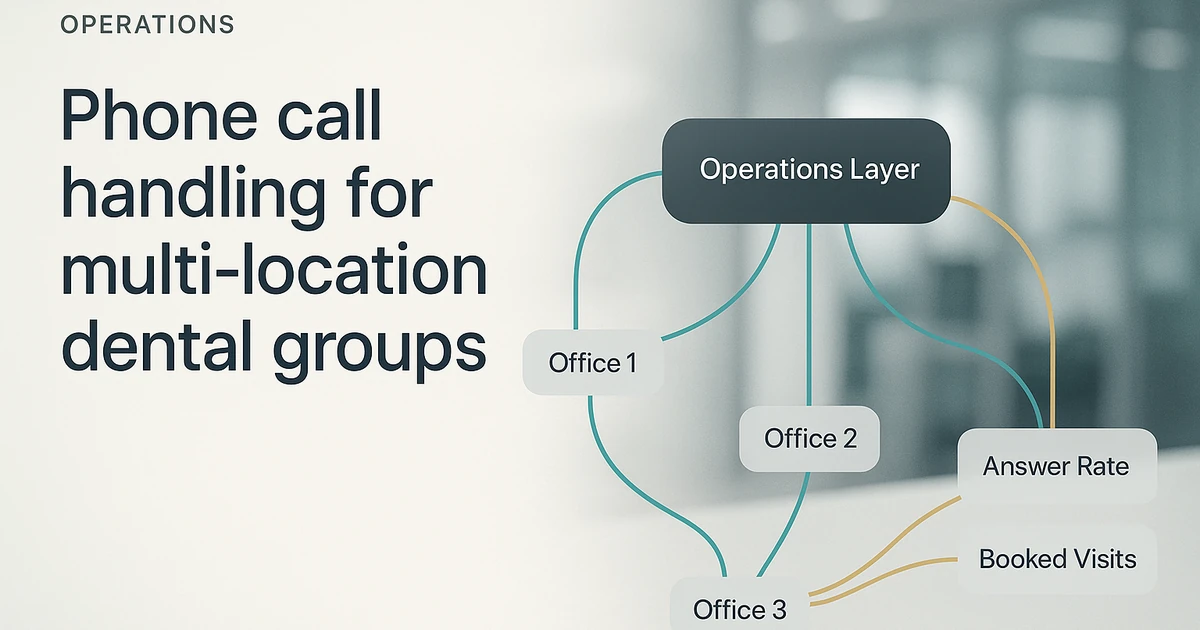


Managing patient calls outside of business hours presents a different set of challenges for healthcare organizations with three or more locations than it does for single-site practices. When a patient calls after hours, they expect the same level of care and professionalism regardless of which location they typically visit.
For operations leaders responsible for multiple sites, the question is not simply whether to offer after-hours coverage but how to deliver that coverage consistently, efficiently, and in a way that supports rather than fragments the organization’s broader patient access strategy.
This playbook examines the operational dimensions of after-hours medical answering service benefits for multi-location healthcare groups.
It addresses the concerns that matter to COOs, VPs of Operations, and Directors of Patient Access: how to standardize protocols across locations, how to maintain visibility into after-hours performance, and how to build an after-hours program that scales with organizational growth rather than creating additional complexity.
Why Do Multi-Location Healthcare Groups Need Centralized After-Hours Coverage?
When each location manages its own after-hours solution independently, the result is often a patchwork of different vendors, protocols, and patient experiences.
A patient who has visited multiple locations within the same organization may encounter different hold times, different triage questions, and different escalation paths depending on which location’s phone line they call. This inconsistency undermines the brand cohesion that multi-location groups work to build during business hours.
The Challenge of Fragmented After-Hours Operations
Fragmented after-hours coverage creates operational blind spots. When Location A uses one answering service with its own reporting dashboard and Location B uses a different vendor with incompatible data formats, the regional or corporate operations team cannot easily compare performance across sites.
Questions that should have straightforward answers, such as how many after-hours calls resulted in same-day appointments, or which locations have the highest call abandonment rates outside business hours, become research projects requiring manual data reconciliation.
The staffing implications compound this complexity. If each location manages its own after-hours solution, each location must also handle vendor relationships, invoice processing, protocol updates, and quality monitoring.
For a five-location group, this might mean five different contracts, five different sets of call scripts, and five different approaches to escalation. The administrative burden scales linearly with location count rather than benefiting from centralization economies.
How Inconsistent After-Hours Experiences Affect Patient Perceptions
Patients who choose a multi-location healthcare group often do so with the expectation of standardized care. They expect that whether they are seen at the downtown clinic or the suburban satellite location, they will receive the same quality of attention. When the after-hours experience differs dramatically between locations, it creates cognitive dissonance for patients who think of the organization as a unified entity.
Research from the AHRQ Patient Safety Network has examined the safety and effectiveness of telephone triage in after-hours care settings, including how accurately triage personnel estimate urgency [1].
This research underscores that consistent protocols matter not just for patient satisfaction but for clinical appropriateness. When triage approaches vary by location, the organization cannot be confident that urgent situations are being identified and escalated with the same reliability everywhere.
The Operational Case for Unified After-Hours Infrastructure
Centralizing after-hours coverage does not mean that every call is routed to a single physical location or that local nuances are ignored. Rather, it means establishing a unified platform through which all after-hours calls flow, governed by standardized protocols while allowing for location-specific customizations where clinically or operationally appropriate.
This approach enables network-wide reporting, consistent quality monitoring, and the ability to scale coverage as the organization acquires or opens new locations.
For PE-backed healthcare groups and DSOs pursuing aggressive growth strategies, the ability to onboard new locations onto an existing after-hours infrastructure is a significant operational advantage. Instead of negotiating a new vendor contract and building a new set of protocols for each acquisition, the operations team can extend the existing framework to new sites with relative efficiency.
What Operational Challenges Does Centralized After-Hours Coverage Solve?
Before investing in centralized after-hours infrastructure, operations leaders need to understand the specific problems this investment addresses. The benefits are not abstract improvements in patient experience but concrete solutions to operational challenges that consume administrative time, create compliance risk, and hinder visibility into after-hours performance.
Eliminating Redundant Vendor Relationships
When each location contracts independently with after-hours answering services, the organization maintains multiple vendor relationships that require ongoing management.
Each vendor relationship involves contract negotiations, periodic rate reviews, escalation procedures when service quality issues arise, and coordination when protocol changes are needed. For operations leaders managing a portfolio of locations, this redundancy translates into significant administrative overhead.
Consolidating to a single after-hours platform or a small set of coordinated vendors allows the organization to use its total call volume for better pricing, establish master service agreements that apply across all locations, and designate a single point of contact for service level discussions.
The purchasing power of a multi-location group becomes an asset rather than being diluted across fragmented vendor relationships.
Standardizing Escalation Protocols
One of the more serious operational risks in fragmented after-hours coverage is inconsistent escalation protocols. If Location A’s answering service escalates urgent calls to the on-call provider via text message while Location B’s service uses a phone tree that may introduce delays, the organization faces uneven clinical response times and potential patient safety concerns.
A systematic review published through the National Institutes of Health found that telephone triage was safe in 97% of all patients contacting out-of-hours care services [2].
This evidence supports the effectiveness of well-designed telephone triage protocols, but the key qualifier is “well-designed.” A centralized approach ensures that escalation protocols are designed once, tested, refined based on incident data, and applied uniformly across the network.
Creating Network-Wide Visibility
Operations leaders cannot manage what they cannot measure. When after-hours data exists in separate silos at each location, understanding aggregate performance requires manual data compilation that is often incomplete and always delayed.
Real-time dashboards that show call volume, average hold time, escalation rates, and patient callback completion across all locations enable proactive management rather than retrospective fire-fighting.
This visibility also supports resource allocation decisions. If after-hours call volume at certain locations consistently exceeds capacity thresholds while other locations see relatively low demand, the organization can explore pooled coverage models where calls overflow to agents with available capacity regardless of original location. This kind of optimization is only possible when visibility spans the entire network.
How Does After-Hours Service Quality Impact Patient Outcomes?
The connection between after-hours accessibility and patient outcomes operates through several mechanisms.
While multi-location groups must be careful not to overstate clinical claims without supporting evidence, the operational reality is that after-hours coverage influences whether patients receive timely guidance, whether they seek appropriate levels of care, and whether they maintain continuity with their primary care team rather than fragmenting their care across unconnected providers.
The Role of Telephone Triage in Guiding Care Decisions
When patients call after hours, they often face uncertainty about whether their symptoms warrant immediate attention or can wait until the next business day. The triage conversation shapes their subsequent behavior.
Effective telephone triage helps patients understand when they should proceed to an emergency department, when they can safely wait for a scheduled appointment, and when home care measures are appropriate while they wait.
The American Dental Association’s guidelines on emergency treatment protocols note that providers are obliged to make reasonable arrangements for emergency care of patients of record, including after-hours access [3].
While this guidance originates in dentistry, the principle applies broadly across healthcare specialties: organizations have professional obligations to ensure patients can access guidance when they need it, not only during business hours.
Continuity of Care Through Shared Information Access
One advantage that employed provider models and integrated delivery networks have in the after-hours context is the ability to share patient information through electronic medical records. When after-hours coverage personnel can access relevant patient history, allergies, current medications, and recent visit notes, they can provide more informed guidance than a generic answering service operating without clinical context.
Healthcare executives have noted that after-hours consultations with employed providers who share electronic medical records promote continuity of care in ways that fragmented after-hours solutions cannot match [6]. For multi-location groups, this means that investments in integrated EHR systems pay dividends not only during business hours but also in the quality of after-hours interactions.
Assessment Frameworks for After-Hours Quality
Measuring the quality of after-hours telephone triage requires frameworks designed specifically for this context. Peer-reviewed research has developed assessment tools measuring communication, patient safety, and efficiency in out-of-hours telephone triage services [7], providing organizations with structured approaches to evaluating whether their after-hours programs meet acceptable standards.
For operations leaders, implementing these assessment frameworks across all locations creates accountability and identifies sites that may need additional training, protocol refinement, or resource allocation. Without standardized quality measurement, underperforming locations may go undetected until a patient complaint or adverse event brings attention to the gap.
What Are the Key Benefits of Enterprise After-Hours Medical Answering?
The benefits of centralizing and standardizing after-hours medical answering extend beyond patient experience improvements. For operations leaders evaluating this investment, the case rests on operational efficiency, risk management, and strategic positioning for growth.
Operational Standardization Across the Network
When all locations operate under the same after-hours framework, protocol updates can be deployed network-wide rather than communicated separately to each location or vendor. If clinical leadership determines that a particular triage question should be added or that escalation thresholds should be adjusted based on recent incident data, this change can be implemented once and applied everywhere.
This standardization also supports training and onboarding. New staff at any location can be trained on a single set of after-hours procedures rather than learning location-specific variations. When staff transfer between locations or when the organization acquires new sites, the consistency of after-hours protocols reduces the learning curve and the risk of errors during transitions.
Governance and Quality Assurance at Scale
Enterprise after-hours programs enable governance structures that would be impossible with fragmented approaches. Quality assurance teams can monitor call recordings across all locations using consistent evaluation criteria. Trends in call handling quality can be identified and addressed at the network level rather than discovered piecemeal at individual sites.
MGMA research has shown that practices implementing AI-enabled approaches have noted early improvements in scheduling, appointment reminders, documentation efficiency, and after-hours patient communication [5].
For enterprise groups, the ability to deploy these technology enhancements across all locations simultaneously, rather than piloting at one site and gradually rolling out to others, accelerates the realization of operational improvements.
Positioning for Growth and Integration
Healthcare organizations pursuing growth through acquisition face a recurring challenge: how quickly can new locations be integrated into existing operational frameworks? When after-hours infrastructure is centralized and well-documented, extending coverage to acquired locations becomes a relatively straightforward onboarding exercise rather than a ground-up implementation.
This integration capability has strategic value beyond operational efficiency. During due diligence processes, prospective sellers often evaluate the buyer’s ability to improve operations at the target locations. Demonstrating a mature, scalable after-hours program signals operational sophistication and reduces seller concerns about post-acquisition disruption.
How Should Groups Implement After-Hours Answering Across Locations?
Implementation success depends on careful planning, stakeholder engagement, and a phased approach that allows for learning and adjustment. Operations leaders should resist the temptation to deploy a new after-hours framework across all locations simultaneously without first validating the approach at pilot sites.
Establishing Governance and Protocol Development
Before selecting vendors or implementing technology, the organization must clarify decision rights and develop the protocols that will govern after-hours operations. Which clinical leader has authority to approve triage scripts? How will escalation thresholds be determined and updated? What quality metrics will be monitored, and who is accountable for performance against those metrics?
These governance questions are often more challenging to resolve than the technical implementation itself. In multi-location organizations, there may be tension between central operations teams seeking standardization and local clinical leaders who believe their patient population or community context requires different approaches.
Addressing these tensions early, through transparent discussion of evidence, risks, and priorities, prevents implementation delays and post-launch conflicts.
Phased Rollout and Pilot Site Selection
A phased rollout allows the organization to validate protocols, identify technology integration issues, and refine training materials before scaling to all locations.
Pilot site selection should balance several considerations: choosing sites where local leadership is supportive and engaged, selecting sites with call volumes sufficient to generate meaningful data within a reasonable timeframe, and including sites with different patient demographics or operational characteristics to test protocol applicability across varied contexts.
During the pilot phase, operations teams should establish clear success criteria and data collection plans. What call metrics will be tracked? How will patient feedback be gathered? What incident reporting mechanisms will capture escalations or adverse events? Documenting pilot outcomes rigorously enables evidence-based decisions about proceeding to broader rollout or making protocol adjustments first.
Training and Change Management
Introducing a new after-hours framework requires training at multiple levels: the answering service personnel who handle calls, the clinical staff who receive escalations, and the administrative staff who interact with after-hours systems for scheduling follow-ups or reviewing call records. Each audience needs different content and delivery methods.
Change management extends beyond initial training to ongoing reinforcement and feedback mechanisms. After-hours personnel should have clear channels for raising questions or reporting situations the protocols do not adequately address. Regular quality reviews that include call sampling and coaching maintain performance over time and prevent drift from established standards.
What Quality and Compliance Considerations Apply at Scale?
After-hours coverage operates in a context shaped by regulatory requirements, professional standards, and organizational risk tolerance. Operations leaders must ensure that after-hours programs address these considerations systematically rather than leaving them to individual locations or vendors to interpret independently.
Regulatory Considerations for After-Hours Operations
Healthcare organizations operate under various federal and state regulations that apply to patient communications, including after-hours interactions. Organizations should work with their compliance teams to ensure that after-hours programs address applicable requirements and that documentation supports compliance verification during audits or reviews.
The ADA’s practice management guidance recommends that voicemail systems provide patients with after-hours phone numbers and clear instructions for emergency situations [4].
While this specific guidance addresses dental practices, the underlying principle, that patients must be able to access appropriate care pathways outside business hours, applies across healthcare settings. Compliance teams should review after-hours voicemail scripts, answering service protocols, and patient instructions to confirm alignment with professional standards.
Documentation and Audit Considerations
After-hours calls often involve clinical content that should be documented in the patient record. Organizations should establish clear expectations about what information answering services capture, how that information transfers to clinical systems, and which staff are responsible for ensuring after-hours encounters are properly documented.
For enterprise groups subject to internal or external audits, after-hours documentation creates an audit trail that demonstrates organizational diligence in providing patient access. The absence of such documentation, or inconsistent documentation practices across locations, may raise questions during quality reviews or accreditation surveys.
Vendor Oversight and Service Level Expectations
When organizations engage vendors to provide after-hours answering services, the vendor relationship requires ongoing oversight rather than set-and-forget management. Operations leaders should establish clear service expectations, monitoring mechanisms, and escalation paths for service issues.
The specifics of service expectations should reflect organizational priorities and patient population needs. Organizations should work with their vendors to establish expectations that are measurable, meaningful, and aligned with the organization’s patient access philosophy.
Regular review meetings provide opportunities to discuss performance trends, address emerging issues, and plan for capacity changes as the organization grows.
Related Reading
- Enterprise Call Answering for Healthcare Groups
- Healthcare Call Center ROI for Enterprise Organizations
- Centralized Scheduling for Multi-Office Healthcare Groups
- Medical Answering Service for Multi-Location Groups
- Multi-Location Healthcare Intake Guide
Sources
- Safety of telephone triage in general practitioner cooperatives: do triage nurses correctly estimate urgency?, AHRQ Patient Safety Network
- Safety of telephone triage in out-of-hours care: A systematic review, National Institutes of Health
- Emergency Treatment, American Dental Association
- Office Hours, American Dental Association
- Most practices use some form of AI, but is it actually reducing staff workloads?, MGMA
- C-suite strategies to expand access to care, Becker’s Hospital Review
- Quality of out-of-hours telephone triage by general practitioners and nurses: development and testing of the AQTT, National Institutes of Health
Managing after-hours coverage across 3+ locations? Request an Enterprise Assessment to discuss how centralized after-hours answering can support your organization’s patient access strategy.