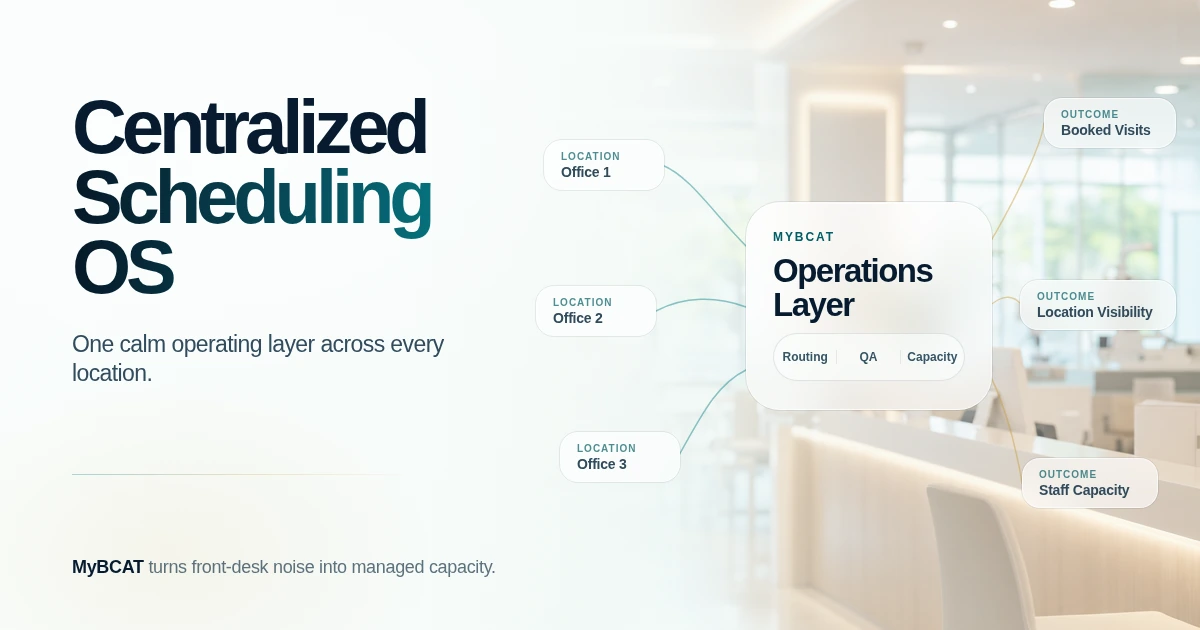
Centralized Scheduling Across Multiple Dental Offices: The Workflow-First Approach
DSOs running three or more practice management systems can centralize scheduling in 60-90 days, not 6-12 months. The 12-location dental group that cut labor costs by 40% didn’t migrate anyone off Dentrix first. They standardized the call experience across all locations, regardless of which PM system each office ran. Workflow-first centralization delivers measurable ROI while technology-first thinking delays benefits by half a year or more.
What You’ll Learn
- Why Are DSOs Still Waiting to Centralize Scheduling Across Their Dental Offices?
- The Technology-First Trap: Why PM Migrations Take 6-12 Months
- What Is Workflow-First Centralization for Dental Groups?
- 3 Centralized Scheduling Models for Multi-Location Dental Offices
- Which Model Fits Your DSO’s Scale and PM System Diversity?
- What Results Can DSOs Expect from Workflow-First Centralization?
- How Do You Calculate ROI for Centralized Dental Scheduling?
- 5 Steps to Implement Workflow-First Centralized Scheduling
- What Are the Most Common Centralization Mistakes?
- When Should You Consider Full PM System Migration?
Why Are DSOs Still Waiting to Centralize Scheduling Across Their Dental Offices?
Practice management system fragmentation defines most growing dental groups. With 35% of the dental industry now under DSO ownership and projections reaching 75-80% within 15 years, this fragmentation only accelerates. After a series of acquisitions, a typical 15-location DSO might run Dentrix at five locations, Eaglesoft at four, Open Dental at three, Curve at two, and Denticon at one. Each acquisition brought its own technology stack. Each office has staff trained only on that specific system.
Conventional wisdom says you can’t centralize scheduling until everyone runs the same software. The belief creates paralysis. Leaders know they have a scheduling problem. Front desk staff describe their daily experience as “triage mode,” constantly choosing between the ringing phone and the patient standing at the counter. The result? Research from DenteMax indicates that 30-35% of calls go unanswered at the average dental practice. Each missed call represents $350 to $1,300 in potential first-year patient revenue, with 75% of those callers never calling back.
Meanwhile, PE sponsors want operational metrics at the next board meeting. That’s 90 days away, not 12 months. They want same-store growth numbers, EBITDA improvements, and evidence that post-acquisition integration works. Technology-first thinking can’t deliver data on that timeline. Understanding how DSO patient retention strategy connects to scheduling effectiveness justifies a faster path to centralization.
Waiting has become the problem, not PM diversity.
The Technology-First Trap: Why PM Migrations Take 6-12 Months
When DSO leadership decides to standardize on a single practice management system, the project scope expands fast. Data conversion alone requires mapping patient records, insurance information, treatment histories, and scheduling templates from the legacy system to the new platform. Staff must learn entirely new software while simultaneously learning new workflows. Research from Planet DDS on M&A integration planning shows timelines ranging from 3 to 12 months depending on complexity.
During migration, nothing stays measurable. Staff learn a new system and new processes at the same time, so performance benchmarks have no stable baseline. You can’t tell the board whether call answer rates improved because you don’t have consistent data from the chaos period.
The staffing crisis compounds the challenge. According to MGMA’s 2022-2023 staffing surveys, front office support positions experienced approximately 40% annual turnover. Each replacement costs between $9,000 and $30,000 in recruiting, training, and lost productivity.
The staffing shortage isn’t cyclical. It won’t resolve when the labor market shifts. Burnout, compensation gaps, and the difficulty of the front desk role itself drive turnover structurally. If you’re constantly training new hires on a system that’s about to change anyway, you’re burning resources twice. The front desk staffing crisis demands solutions that work within current constraints, not solutions that require a perfect staffing environment that doesn’t exist.
What Is Workflow-First Centralization for Dental Groups?
Workflow-first centralization flips the conventional sequence. Instead of waiting for technology standardization, you standardize the human process first. Whether an acquired practice uses Dentrix, Eaglesoft, or Open Dental, the phone greeting, information collection, and scheduling workflow can be identical.
Here’s the key insight: the PM system is the wrong unit of analysis. The call experience is the right one. When a patient calls any location in your network, what experience should they have? What questions should the scheduling agent ask? What information should they collect? How should they handle complex scenarios like hygiene versus doctor appointments, or patients requesting a specific provider?
Workflow decisions exist independently of which software button the scheduler clicks to book the appointment. A centralized team trained on a standardized intake protocol works across multiple PM systems because the human decision tree remains consistent. Technology serves as the execution layer, nothing more.
Results arrive in 60-90 days rather than 6-12 months because you’re not waiting for data migration, software training, or system cutover. You’re training people on a process and measuring their performance immediately.
For DSOs managing multi-location healthcare intake, the workflow-first model enables faster post-acquisition integration. New practices can join the centralized scheduling team within 60-90 days of acquisition, even if their PM system migration sits a year away on the roadmap.
3 Centralized Scheduling Models for Multi-Location Dental Offices
DSOs evaluating centralization have three primary models to consider. Each has distinct advantages depending on your current scale, PM system diversity, and acquisition velocity.
Model 1: Hub-and-Spoke
In the hub-and-spoke model, a central scheduling team handles overflow calls, after-hours coverage, and new patient intake. Individual locations retain their front desk staff for in-office patient interactions and routine scheduling. The central hub covers gaps and absorbs call volume spikes without requiring each location to staff for peak demand.
Hub-and-spoke works well for DSOs with 5-15 locations that want to reduce missed calls without completely restructuring front desk operations. It preserves local relationships while capturing calls that currently go to voicemail.
Model 2: Full Centralization
Full centralization routes all incoming calls to a dedicated scheduling center. Local front desk staff focus entirely on in-person patient experience: check-ins, check-outs, treatment coordination, and patient comfort. The model eliminates “triage mode” entirely because front desk staff never have to choose between the phone and the patient standing in front of them.
DSOs with 15+ locations often find that full centralization delivers better economics and more consistent patient experience. It also provides complete visibility into call metrics across the network.
Model 3: Outsourced Centralization
Outsourced centralization partners with a specialized healthcare answering service that handles calls according to your protocols. The model eliminates the need to build and manage your own scheduling team while still achieving standardization.
For DSOs in rapid acquisition mode, outsourcing can accelerate integration timelines. The partner already has trained staff, established workflows, and experience with multiple PM systems. The trade-off: less direct control over the team and potential per-call costs that scale with volume.
Which Model Fits Your DSO’s Scale and PM System Diversity?
The right model depends on three primary factors: your current location count, your PM system diversity, and your acquisition velocity over the next 24 months.
Hub-and-Spoke
Locations: 5-15
PM Systems: 2-3 different
Acquisitions: 1-3 per year
Best for: Reducing missed calls while preserving local front desk roles
Full Centralization
Locations: 15+
PM Systems: 3+ different
Acquisitions: 3+ per year
Best for: Maximum operational visibility and consistent patient experience
Outsourced
Locations: Any scale
PM Systems: High diversity
Acquisitions: 5+ per year
Best for: Rapid scaling without building internal infrastructure
If your DSO runs fewer than 5 locations with a single PM system, centralization may be premature. Coordination overhead might exceed the benefits. Focus instead on standardizing scripts and training at each location.
If you’re acquiring practices faster than you can integrate them operationally, the outsourced model often makes sense as a bridge. You can always bring scheduling in-house later once your infrastructure catches up to your growth rate.
What Results Can DSOs Expect from Workflow-First Centralization?
The evidence for workflow-first centralization comes from DSOs that have implemented it. A 12-location dental group achieved a 40% reduction in labor costs within six months by centralizing scheduling before standardizing PM systems. The key metric was call handling consistency, not technology adoption. Cost savings funded their next two acquisitions.
A 20+ location group, Dental Depot, recovered approximately $300,000 in annual revenue and achieved 6% same-store growth. Their approach emphasized process standardization through training, scripts, and performance incentives rather than technology mandates. Each location continued using its existing PM system while the centralized team maintained consistent protocols.
At enterprise scale, a 98-location DSO working with AI-augmented scheduling achieved a 68% booking conversion rate. The case demonstrates that workflow-first principles scale effectively even when technology assists the process.
For academic context, UCSF’s dental school implemented a centralized call center, as documented in the ADEA Innovation Series. Answer rates climbed from 25% to 90%, generating $2 million in revenue against $1 million in operational costs. Even institutions outside the DSO model validate the economic case for centralization.
Results align with what centralized patient recall for multi-location healthcare demonstrates about the value of consistent patient outreach: process standardization drives outcomes more reliably than technology standardization.
How Do You Calculate ROI for Centralized Dental Scheduling?
The ROI calculation relies on quantifying the revenue you’re currently losing to missed calls and comparing it against the cost of centralization.
Start with your missed call volume. Most practices underestimate significantly. Install call tracking for 30 days before making assumptions. The industry average sits at 30-35% of calls going unanswered, but your actual number might run higher during peak hours or lower if you’re already well-staffed.
Next, calculate the value per missed call. Industry benchmarks place new patient lifetime value between $800 and $3,000 for dental practices, varying by treatment mix and payer composition. If 50% of missed calls are new patients and your average new patient value is $1,500, each missed call represents approximately $750 in potential revenue.
Multiply missed calls per month by value per call to get your monthly revenue leakage. For a 15-location DSO with 20 missed calls per day per location at $350 average value, potential annual revenue leakage reaches $26.25 million (15 locations x 20 calls x 250 working days x $350). At a realistic 10% capture rate, that translates to approximately $2.6 million in recoverable revenue.
Sample ROI Calculation: 15-Location DSO
Missed calls per day: 20 per location x 15 locations = 300
Working days per year: 250
Total annual missed calls: 75,000
Value per missed call: $350
Annual revenue leakage: $26.25 million potential, ~$2.6 million realistic capture
Centralization cost: ~$250,000-$400,000 annually (based on 8-12 FTE centralized scheduling staff)
Expected ROI: 6:1 to 10:1
The realistic capture rate acknowledges that not every recovered call converts. But even at 10% capture of leaked revenue, centralization typically delivers 5:1 or better ROI.
5 Steps to Implement Workflow-First Centralized Scheduling
Implementation follows a consistent sequence regardless of which model you select.
Step 1: Document Current State (Week 1-2). Install call tracking across all locations. Record actual answer rates, hold times, and abandonment rates. Survey front desk staff about pain points and current workflows. Baseline data supports the business case and provides comparison metrics after launch.
Step 2: Design the Standard Workflow (Week 2-4). Define the ideal call experience independent of PM systems. What greeting should every caller hear? What questions should the scheduler ask? How are appointments categorized: new patient, hygiene, emergency, specific provider request? Document decision trees for complex scenarios.
Step 3: Build or Partner for Capacity (Week 3-6). If building internally, recruit and train the centralized team on the standard workflow before training them on multiple PM systems. If outsourcing, select a partner with experience in dental scheduling across your specific PM systems.
Step 4: Pilot with 2-3 Locations (Week 5-8). Route calls from a small subset of locations to the centralized team. Measure answer rates, booking conversion, and patient satisfaction. Identify workflow gaps and refine the protocol before scaling.
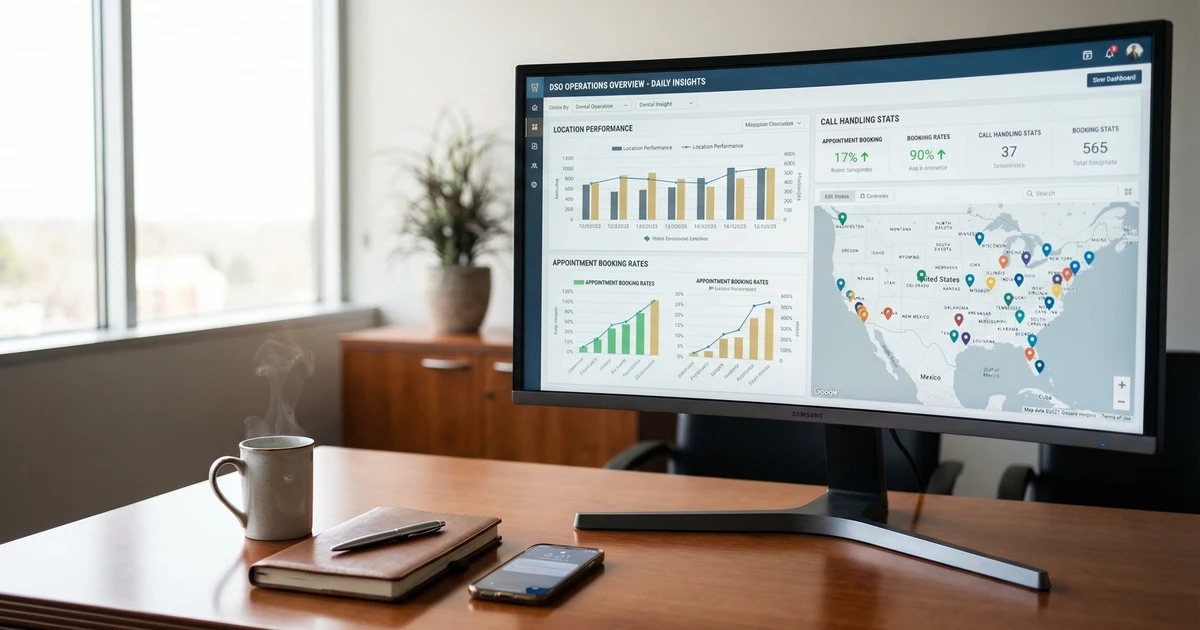
Step 5: Scale Network-Wide (Week 8-12). Roll out to remaining locations in phases. Establish real-time dashboards for leadership visibility. Set up regular performance reviews with the scheduling team.
For DSOs managing KPI dashboards across multiple locations, the centralized model simplifies data collection because all calls flow through a single point with consistent tracking.
What Are the Most Common Centralization Mistakes?
The most damaging mistake: treating centralization as a technology project rather than a process project. DSOs that focus on PM system selection before workflow design consistently underperform on timeline and ROI.
The second mistake involves insufficient training investment. A centralized scheduling team handling multiple PM systems needs thorough training protocols and ongoing coaching. Underfunding creates frustrated staff and inconsistent patient experience.
Third: failing to communicate with local teams. Front desk staff at individual locations may perceive centralization as a threat to their jobs. In reality, hub-and-spoke and full centralization models often redefine front desk roles to focus on higher-value in-person interactions. Clear communication about role evolution reduces resistance.
Fourth: launching without baseline data. If you don’t know your current missed call rate, you can’t prove improvement. Install tracking before you change anything.
Fifth: expecting technology to solve process problems. AI scheduling tools, automated booking widgets, and intelligent call routing all have value. They amplify good process rather than substituting for it. Get the workflow right first.
When Should You Consider Full PM System Migration?
PM system consolidation makes sense after workflow standardization, not before. Once your centralized scheduling team operates consistently across multiple systems, you’ve proven the process. At that point, technology consolidation becomes an efficiency play rather than a prerequisite.
The right time for PM migration arrives when administrative overhead of maintaining multiple systems exceeds the switching cost. For some DSOs, this threshold hits at 20 locations. For others with strong workflows and capable staff, it may not arrive until 50+ locations.
Consider PM consolidation when your centralized team spends significant time on system-specific workarounds. Consider it when data aggregation for reporting becomes a major burden, or when vendor support costs for legacy systems exceed reasonable thresholds.
Don’t migrate during active acquisition phases. Each acquisition brings potential new systems. Migrating everything to a standard only to acquire three more practices on different platforms wastes resources.
For organizations evaluating PE-backed healthcare operations, the workflow-first approach delivers the operational metrics sponsors want to see while preserving optionality on technology decisions.
Key Takeaways
- Workflow-first centralization delivers results in 60-90 days by standardizing the call experience across PM systems, not waiting for technology migration
- Three models exist: hub-and-spoke (5-15 locations), full centralization (15+), and outsourced (rapid scaling)
- ROI typically ranges 6:1 to 10:1 when you quantify missed call revenue leakage against centralization costs
- PM migration can wait until workflow standardization proves the process, then becomes an efficiency play
- The biggest mistake is treating centralization as a technology project instead of a process project
Ready to Centralize Your Intake Operations?
See how MyBCAT helps multi-location healthcare groups achieve 95%+ answer rates across all locations.
Sources
-
MGMA (Medical Group Management Association). “2024 Management and Staff Compensation Data Report.” Annual staffing reports documenting 40% front office turnover rates and $9,000-$30,000 replacement costs. https://www.mgma.com/
-
VMG Health. “Dental Service Organizations M&A in 2026.” Market analysis showing 35% of dental industry under DSO ownership with projections to 75-80%. https://vmghealth.com/
-
Planet DDS. “DSO M&A Planning and Timelines.” Research on dental practice acquisition integration timelines ranging from 60-90 days for small deals to 6+ months for large DSOs. https://www.planetdds.com/
-
DenteMax. “Why Missed Phone Calls Are Dental Offices’ Largest Revenue Loss.” Industry data on 30-35% missed call rates. https://www.dentemax.com/
-
Peerlogic. “Turning Missed Dental Phone Calls Into Profit.” Analysis showing $350-$1,300 per missed call in first-year revenue and 75% of missed callers never calling back. https://www.peerlogic.com/
-
Patient Prism. “Dental Depot Case Study.” Documentation of $300,000 revenue recovery and 6% same-store growth through process standardization. https://www.patientprism.com/
-
TrueLark. “What We’ve Learned from 8 Million Patient Conversations.” Analysis of 98-location DSO achieving 68% booking conversion. https://truelark.com/