
Sixty-eight percent of healthcare change initiatives fail to meet their objectives, according to research published in StatPearls. For DSO operations leaders managing patient intake centralization across 3+ locations, that statistic translates directly to wasted capital, demoralized teams, and missed EBITDA targets. The difference between the 32% that succeed and the majority that fail comes down to one factor: structured change management that addresses staff resistance before it derails the rollout.
This playbook provides the operational framework DSO COOs, VPs of Operations, and PE operating partners need to centralize intake functions across multi-location groups without triggering the staff exodus that kills most consolidation efforts.
What You’ll Learn
- Why Do Most DSO Intake Centralization Projects Fail?
- What Is Driving the Urgency to Centralize Intake Operations?
- How Does Staff Resistance Actually Manifest in Multi-Location Groups?
- What Is the 5-Phase Change Management Framework for Intake Centralization?
- How Do You Calculate the ROI of Centralized Intake?
- What Does a Realistic Implementation Timeline Look Like?
- What Are the Most Common Failure Modes and How Do You Avoid Them?
- Related Reading
- Sources
Why Do Most DSO Intake Centralization Projects Fail?
The DSO industry is projected to reach $302.54 billion by 2035, representing a compound annual growth rate of 6.87% according to Precedence Research. With up to 70% of the dental industry expected to consolidate within the next five years, intake centralization is no longer optional for groups seeking operational efficiency at scale. Yet the failure rate remains stubbornly high.
The Misalignment Between Strategy and Execution
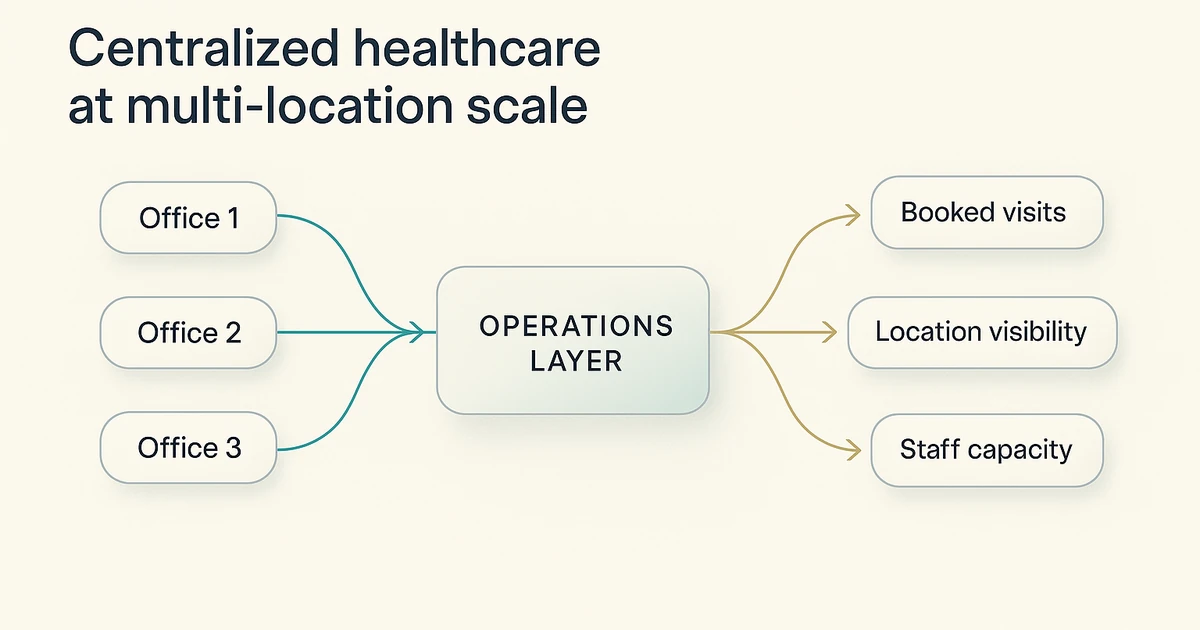
Most DSO leadership teams understand the strategic rationale for centralization. They recognize that consolidating patient scheduling, recall, and intake functions into a unified hub eliminates redundancy, improves data visibility, and reduces per-location administrative overhead. The problem is not strategic clarity. The problem is execution.
Research from Prosci shows that organizations with excellent change management achieve an 88% success rate on initiatives, compared to just 13% for organizations with poor change management. That 75-percentage-point gap represents the difference between a centralization project that delivers ROI and one that drains capital while alienating your best staff.
The execution gap typically appears in three areas:
Underestimating staff identity attachment. Front desk staff at individual locations have built relationships with patients over years. When you announce centralization, they hear “your relationships don’t matter anymore.” Without addressing this identity threat, you trigger defensive behaviors that sabotage adoption.
Skipping the analysis phase. Operations leaders under PE pressure to show results often compress timelines by eliminating the upfront analysis that identifies location-specific obstacles. This creates implementation surprises that require expensive mid-course corrections.
Treating technology as the solution rather than the enabler. Deploying a centralized scheduling platform does not constitute change management. Technology is a tool. Without the process redesign and staff capability building to use it effectively, you end up with expensive software that no one uses correctly.
The Real Cost of Failed Centralization
When intake centralization fails, the costs extend beyond the direct project investment. MGMA data shows that front office turnover in healthcare practices reached 40% in 2022, with each departure costing $9,000 to $12,000 in recruitment and training expenses. A poorly managed centralization that triggers departures across a 10-location group can easily generate $100,000+ in turnover costs before the project even completes.
Beyond turnover, failed centralization creates lasting organizational damage. Staff who remain become change-resistant, making future operational improvements more difficult. Providers lose confidence in operations leadership, reducing cooperation on subsequent initiatives. And PE sponsors begin questioning the management team’s execution capability.
What Is Driving the Urgency to Centralize Intake Operations?
The pressure to centralize intake is not a theoretical concern for future planning. DSO operations leaders face immediate, quantifiable pressures that make the status quo increasingly untenable.
The Staffing Crisis Is Structural, Not Cyclical
According to MGMA’s 2024 data, 70% of medical practices report staff turnover at the same level or higher than previous years. Front office and medical assistant roles show the highest churn, with patient access representatives particularly vulnerable due to relatively low wages and easily transferable skills to non-healthcare sectors.
This is not a temporary post-pandemic adjustment. The underlying dynamics creating staffing pressure are structural:
Wage compression. Entry-level roles in healthcare compete with retail and service positions that now offer comparable pay with less patient interaction stress. A front desk coordinator earning $17 per hour at a dental practice can earn similar wages at a coffee chain without managing angry patients or insurance verification complexity.
Distributed staffing inefficiency. A 15-location DSO with two front desk staff per location maintains 30 positions to handle intake volume that a centralized team of 12-15 could manage with proper scheduling optimization. The distributed model requires more total staff, creating more positions to fill during a labor shortage.
Training burden multiplication. Each location must independently train new staff on intake procedures, creating inconsistent patient experiences and multiplying training overhead across the organization.
Multi-Location Visibility Gaps Create Revenue Leakage
Without centralized intake, DSO leadership lacks real-time visibility into performance across locations. Missed calls represent significant revenue leakage that often goes undetected until quarterly reporting surfaces the pattern.
The visibility problem compounds across locations. When each site manages its own intake, there is no single view of:
- Call answer rates by location and time of day
- Scheduling conversion rates across the group
- Patient recall compliance by location
- Peak volume patterns that could benefit from load balancing
Enterprise healthcare groups using centralized patient access consistently report that visibility alone identifies 15-25% improvement opportunities that were invisible under distributed operations.
PE Portfolio Optimization Demands Operational Standardization
Private equity firms have driven DSO consolidation by recognizing dentistry’s stable revenue growth and high profitability. But PE sponsors increasingly expect operational standardization to accompany platform building. A 2025 Holland & Knight healthcare trend report notes that deal structures now emphasize rigorous compliance checks and operational efficiency as key value creation levers.
For COOs reporting to PE operating partners, intake centralization has become a board-level expectation rather than an optional efficiency project. The question is not whether to centralize, but how to execute without creating operational disruption that undermines the efficiency gains.
How Does Staff Resistance Actually Manifest in Multi-Location Groups?
Understanding why staff resist change is essential to designing interventions that address root causes rather than symptoms. Research from Willis Towers Watson found that 37% of employees actively resist organizational change, with specific drivers that operations leaders must address.
The Trust Deficit Problem
According to the Pollack Peacebuilding research, 41% of employees resist change due to lack of trust in leadership. In multi-location healthcare groups, this trust deficit has specific manifestations:
Headquarters skepticism. Location staff often view corporate initiatives as detached from clinical reality. When operations leadership announces centralization from headquarters, staff at individual locations assume the decision-makers do not understand their specific patient population, provider preferences, or workflow requirements.
Prior change fatigue. Many DSO staff have experienced previous technology rollouts or process changes that promised improvement but delivered disruption. Each unsuccessful change initiative depletes the trust reserve available for subsequent projects.
Communication channel breakdown. In distributed organizations, staff receive information through multiple channels with varying accuracy. By the time a centralization announcement reaches the front desk coordinator at Location 12, it may have passed through three layers of interpretation that have distorted the original message.
Awareness and Rationale Gaps
The same research shows that 39% of employees resist change because they are unaware of the rationale behind it. This is not about disagreeing with the reasoning. This is about never receiving clear explanation of why the change is happening.
In DSO intake centralization, awareness gaps typically appear as:
Incomplete communication of business drivers. Staff may hear “we’re centralizing scheduling” without understanding that the current model requires 30 positions when 15 could handle the volume, or that missed call rates are costing $50,000 monthly in lost revenue.
Missing connection to staff benefits. When staff only hear about organizational efficiency gains, they assume the benefit flows to the company while the burden falls on them. Effective communication must connect centralization to staff-level benefits: reduced scheduling stress, more predictable workloads, career advancement opportunities in the centralized team.
Absence of role clarity. Staff resistance often masks fear of job loss. Without explicit communication about how roles will evolve post-centralization, staff assume the worst and begin protective behaviors including job searching, reduced engagement, and active resistance.
Fear-Based Resistance Patterns
Twenty-seven percent of employees cite altered job roles as a change resistance driver, while 28% point to insufficient information about what the change means for them personally.
In multi-location intake centralization, fear-based resistance manifests as:
Productivity slowdowns. Staff may unconsciously or consciously reduce productivity during the transition period, creating data that suggests the new system is less efficient than the old approach.
Workaround proliferation. Rather than adopting new centralized processes, location staff create informal workarounds that maintain familiar workflows while appearing to comply with new requirements.
Information hoarding. Staff with deep patient relationship knowledge may withhold that information from the centralized team, creating service quality issues that suggest centralization is failing.
What Is the 5-Phase Change Management Framework for Intake Centralization?
The Prosci ADKAR model provides a structured framework that DSO operations leaders can adapt specifically for intake centralization. ADKAR stands for Awareness, Desire, Knowledge, Ability, and Reinforcement. Each phase requires specific interventions designed for multi-location healthcare operations.
Phase 1: Analyze and Align (Weeks 1-4)
Before announcing centralization to staff, operations leadership must complete foundational analysis that informs the entire change approach.
Define success metrics upfront. Specify exactly what centralization success looks like in measurable terms. Examples include: 95%+ call answer rate across all locations, 15% reduction in scheduling FTEs, 20% improvement in recall compliance, $X reduction in total intake operational cost. These metrics become the scorecard for tracking progress and demonstrating ROI to PE sponsors.
Map location-specific obstacles. Each location has unique characteristics that will affect centralization adoption. Conduct structured assessments covering: current staffing models, provider scheduling preferences, patient demographic patterns, technology infrastructure, and local leader change readiness. This assessment identifies which locations should pilot versus which require additional preparation.
Identify and engage key stakeholders. Operations leaders often focus on staff while underestimating provider influence. Dentists and office managers can accelerate or derail centralization based on their support level. Map stakeholders by influence and alignment, then develop engagement strategies for those who are high-influence but not yet aligned.
Build the business case document. Create a comprehensive document that quantifies current state costs, projects centralization benefits, and addresses anticipated objections. This document becomes the foundation for all subsequent communication. Include KPI benchmarks for multi-location intake to establish credible performance targets.
Phase 2: Build Awareness and Create Desire (Weeks 5-8)
With analysis complete, move to systematic communication that builds understanding and motivation for change.
Cascade communication through leadership. Do not announce centralization via email blast. Brief regional managers first, ensuring they understand the rationale and can answer location-level questions. Then have regional managers brief office managers, who brief front desk staff. Each layer adds local context that makes the message relevant.
Lead with the problem, not the solution. Instead of announcing “we’re centralizing intake,” start by presenting the problems centralization solves: “We’re losing $X monthly to missed calls. Staff turnover is costing us $Y annually. Our recall compliance varies from 60% to 85% across locations. We cannot achieve our growth targets with current operations.” Let staff understand the pain before presenting the remedy.
Connect to staff-level benefits explicitly. Translate organizational benefits into individual benefits: “Centralization means you won’t have to cover three roles when someone calls in sick. It means you can focus on the patient in front of you instead of racing to answer ringing phones. It means career paths in the centralized team for those who want to grow.”
Create forums for questions and concerns. Announce communication should not be one-directional. Hold town hall sessions where staff can voice concerns. More importantly, listen to those concerns and visibly incorporate feedback into the implementation plan. Staff support increases when they see their input affecting outcomes.
Phase 3: Transfer Knowledge and Build Skills (Weeks 9-14)
Awareness and desire create readiness. Knowledge and ability create capability.
Design role-based training programs. Different roles need different training. Front desk staff transitioning to the centralized team need comprehensive training on the new platform, multi-location protocols, and escalation procedures. Staff remaining at locations need training on the handoff processes between location and central team. Office managers need training on managing hybrid workflows.
Use phased skill building. Rather than conducting a single training session before go-live, distribute training across multiple sessions with practice periods between them. This approach improves retention and allows staff to apply learning incrementally rather than absorbing everything at once under pressure.
Train with real scenarios. Generic training using hypothetical examples fails to prepare staff for actual situations they will encounter. Build training scenarios from actual patient interactions, including the edge cases and exceptions that create confusion during live operations.
Identify and develop super-users. Select staff at each location who demonstrate aptitude and enthusiasm for the new model. Provide them with advanced training and designate them as local resources during the transition. These super-users become force multipliers for adoption support.
Phase 4: Enable Ability Through Supported Go-Live (Weeks 15-18)
The go-live period is where change management succeeds or fails. Most centralization failures occur not because the plan was wrong, but because execution support was insufficient during the critical first weeks.
Implement graduated volume ramp. Do not flip the switch to 100% centralized intake on day one. Follow a structured ramp: 50% of patient load through centralized intake on day one, 75% on day two, 100% by day three. This graduated approach allows staff to identify issues at manageable scale before full volume stress.
Station leadership on-site during initial rollout. Operations leaders should be physically present at pilot locations during the first days of go-live. This presence signals commitment, enables real-time problem-solving, and provides direct observation of what is working and what requires adjustment.
Establish immediate feedback loops. Create mechanisms for staff to report issues in real-time during go-live. A shared channel where front desk staff can flag problems, combined with operations team members monitoring and responding within minutes, prevents small issues from compounding into major frustrations.
Celebrate early wins visibly. When the centralized team successfully handles a complex scheduling request, or when a location reports reduced phone stress, communicate those wins across the organization. Early wins build momentum and demonstrate that the change is working.
Phase 5: Reinforce and Sustain (Ongoing)
Change management does not end at go-live. Without sustained reinforcement, organizations drift back toward pre-change behaviors.
Conduct structured check-ins at 30, 60, and 90 days. Survey staff at regular intervals to identify emerging issues before they become entrenched problems. Track adoption metrics to ensure usage does not decline after initial focus subsides.
Address lagging locations proactively. Data will reveal which locations are adopting effectively and which are struggling. Provide additional support to struggling locations immediately rather than waiting for problems to compound.
Update processes based on real-world learning. The initial centralized intake design was based on analysis and planning. Real-world operation will reveal improvements. Build mechanisms to capture those improvements and update standard processes accordingly.
Connect performance to incentives. Staff behavior follows incentive structures. Ensure that performance metrics, bonus structures, and advancement criteria align with centralized intake success rather than conflicting with it.
How Do You Calculate the ROI of Centralized Intake?
Operations leaders must quantify centralization ROI to justify investment, track progress, and demonstrate results to PE sponsors. The calculation incorporates both cost reduction and revenue enhancement.
Direct Cost Reduction Components
Staffing efficiency gains. Calculate current intake staffing cost across all locations (headcount × average loaded cost including benefits, taxes, and overhead). Compare to projected centralized team cost. A 15-location group with 2 intake staff per location (30 positions) paying average $45,000 loaded cost maintains $1.35 million in intake staffing. Centralization to 15 FTEs reduces this to $675,000, generating $675,000 annual savings.
Turnover cost avoidance. Apply turnover rates to current distributed positions versus projected centralized positions. With 40% turnover and $10,000 per-departure cost, 30 distributed positions generate $120,000 annual turnover cost. A centralized team of 15 with reduced turnover (typically 20-25% in well-managed centralized teams) generates $30,000-$37,500 annual turnover cost. Net avoidance: approximately $85,000 annually.
Technology consolidation. Distributed intake typically requires multiple software instances, local IT support, and fragmented vendor relationships. Centralization consolidates to single instances with unified support. Savings vary by current technology stack but typically range from $2,000-$5,000 per location annually.
Revenue Enhancement Components
Missed call recovery. Research on healthcare call center ROI consistently shows that centralized teams achieve higher answer rates than distributed staff managing multiple responsibilities. Calculate current missed call rate × call-to-appointment conversion rate × average patient value × annual call volume. A 10% improvement in answer rate for a group receiving 50,000 annual calls, with 10% of those recovered calls converting to appointments at $300 average patient value, generates $150,000 annual revenue recovery (5,000 recovered calls × 10% conversion × $300).
Recall compliance improvement. Centralized recall programs consistently outperform location-managed recall. Calculate current recall compliance rate, target rate under centralization, and revenue per reactivated patient. Centralized patient recall for multi-location groups provides detailed methodology for this calculation.
Scheduling optimization. Centralized visibility enables load balancing across locations, reducing unfilled appointment slots. Calculate current unfilled slot rate × appointment revenue × annual appointment capacity to estimate optimization potential.
ROI Benchmark Expectations
Research from Conduit Health Partners shows that centralized transfer centers achieve 3:1 to 7:1 ROI, with specialty areas like cardiology at the higher end. For DSO intake centralization, 3:1 ROI is a reasonable baseline expectation, with well-executed implementations achieving 4:1 or higher.
Payback period for initial implementation investment typically ranges from 10-18 months, with ongoing annual benefits continuing thereafter.
What Does a Realistic Implementation Timeline Look Like?
Intake centralization timelines vary based on group size, technology complexity, and organizational change readiness. The following framework applies to a typical 10-20 location DSO with moderate technology maturity.
Phase Duration Summary
Phase 1-2: Foundation
Duration: 8-12 weeks
Activities: Analysis, stakeholder alignment, communication cascade, awareness building
Phase 3-4: Build & Launch
Duration: 8-10 weeks
Activities: Training, pilot location go-live, graduated rollout
Phase 5: Scale
Duration: 12-16 weeks
Activities: Full enterprise rollout, optimization, reinforcement
Critical Timeline Decision Points
Pilot location selection. Choose 2-3 locations for initial rollout based on factors including: supportive local leadership, representative patient mix, stable current staffing, and geographic proximity for on-site support. Avoid selecting your best-performing locations, which may mask implementation issues, or worst-performing locations, which may confound centralization effects with pre-existing problems.
Go-live timing considerations. Avoid major launches during peak volume periods (return to school, year-end insurance utilization rushes) or during competing organizational initiatives. Staff cognitive bandwidth is finite; launching centralization during a simultaneous EHR upgrade creates competing priorities that undermine both efforts.
Rollout wave planning. After pilot locations demonstrate success, plan subsequent rollout in waves of 3-5 locations. This approach maintains manageable support requirements while building momentum toward full enterprise deployment.
Timeline Compression Risks
PE sponsors often pressure operations leaders to compress timelines. While understandable given capital deployment considerations, timeline compression carries significant risks:
Insufficient analysis leads to implementation surprises. Skipping the Phase 1 analysis to save 4 weeks often creates problems during Phase 4 that cost 8+ weeks to resolve.
Inadequate training creates capability gaps. Compressed training produces staff who are nominally certified but practically unprepared. These capability gaps manifest as errors, workarounds, and frustration during go-live.
Change fatigue accelerates. Rapid rollout prevents staff from adapting before the next wave begins. This accumulating stress drives turnover precisely among the staff whose retention is most important.
The 90-day integration playbook for healthcare acquisitions provides additional guidance on balancing speed with execution quality during major operational transitions.
What Are the Most Common Failure Modes and How Do You Avoid Them?
Understanding common failure patterns enables proactive mitigation. These failure modes appear consistently across DSO intake centralization projects.
Failure Mode 1: Provider Resistance Undermines Adoption
Providers who object to centralization can undermine it even without explicit opposition. Complaints about scheduling errors, requests for exceptions, and subtle non-cooperation create operational friction that erodes centralized team morale and generates management distraction.
Mitigation strategy. Engage high-influence providers early in the analysis phase. Understand their specific concerns and incorporate accommodations where reasonable. Demonstrate how centralization benefits their practice (reduced no-shows, better schedule optimization, improved patient access) rather than only organizational benefits. For providers who remain opposed, ensure their regional leadership addresses the resistance rather than allowing it to spread.
Failure Mode 2: Technology Issues Become Change Management Scapegoats
When centralization encounters difficulties, staff often blame the technology platform. “The new system is slow.” “It doesn’t work like the old system.” “I can’t find what I need.” Some of these complaints reflect genuine technology issues. Many reflect change resistance seeking acceptable expression.
Mitigation strategy. Distinguish between actual technology problems requiring technical resolution and change resistance requiring management response. Establish clear escalation paths for technology issues with defined SLAs. Track issue volume by category to identify patterns. When investigation reveals that “technology problems” are actually training gaps or resistance behaviors, address those root causes directly rather than accepting the technology framing.
Failure Mode 3: Middle Management Passive Resistance
Office managers who were not adequately engaged during planning may view centralization as a threat to their authority or relevance. Their passive resistance often appears as: delayed communication to staff, failure to address location-level problems, and failure to reinforce new processes.
Mitigation strategy. Involve office managers as change agents rather than change recipients. Provide them with information before general staff, solicit their input on implementation details, and position them as the local champions who are making centralization work at their location. Create new role definitions that clarify how office manager responsibilities evolve post-centralization, emphasizing elevated strategic contributions rather than diminished administrative tasks.
Failure Mode 4: Early Wins Fade Without Sustained Reinforcement
Many centralization projects show strong initial results followed by gradual performance decline. Answer rates improve in weeks 1-4, then slowly erode. Staff compliance with new processes is high during the “watched” period, then decreases once attention shifts elsewhere.
Mitigation strategy. Build reinforcement mechanisms that operate automatically rather than requiring ongoing manual attention. Establish automated performance dashboards that surface deviations immediately. Create incentive structures that reward sustained performance rather than launch-period metrics. Conduct scheduled audits at 60, 90, and 180 days to catch drift before it becomes entrenched.
Failure Mode 5: Scope Creep During Implementation
Successful initial rollout often generates enthusiasm for expanding centralization scope. “If we’re centralizing scheduling, why not add insurance verification?” “We should include patient recall too.” While these expansions may be valuable, introducing them mid-implementation creates moving targets that confuse staff and complicate change management.
Mitigation strategy. Define clear scope boundaries before implementation begins. Document potential Phase 2 additions that will be considered after initial scope achieves stability. Resist pressure to expand scope during implementation, even when the additions seem logical and beneficial. DSO integration playbook principles apply here: stabilize before expanding.
The Leadership Mindset for Successful Centralization
Beyond frameworks and processes, successful intake centralization requires specific leadership behaviors that distinguish effective change leaders.
Visible Commitment Through Action
Staff watch leadership behavior to assess commitment authenticity. Operations leaders who announce centralization importance but then miss implementation meetings, delegate difficult conversations, or fail to address resistance signal that centralization is not actually a priority. Effective change leadership requires visible time investment and personal engagement with difficult issues.
Empathy Without Accommodation
Acknowledging that change is difficult for staff does not mean accepting resistance behaviors. Effective leaders hold space for staff frustration while maintaining clear expectations about adoption requirements. “I understand this transition is challenging, and I appreciate you sharing your concerns. Here’s how we’re addressing those concerns. Here’s what I need from you going forward.”
Data-Informed Persistence
Centralization will encounter setbacks. Staff will complain. Metrics will dip temporarily. Leaders who abandon change initiatives at the first sign of difficulty never achieve transformation. Leaders who ignore warning signs drive failing initiatives past the point of recovery. The balance requires data-informed judgment about which difficulties are temporary implementation friction and which indicate fundamental problems requiring course correction.
Related Reading
- DSO Centralized Patient Scheduling Operations
- Healthcare Operations M&A Integration
- Enterprise Healthcare Staffing Ratios and Patient Access Optimization
- Multi-Location Healthcare EBITDA Impact
- PE-Backed Healthcare Operations
Sources
-
StatPearls, “Organizational Change,” NCBI Bookshelf, 2024. https://www.ncbi.nlm.nih.gov/books/NBK459380/
-
Precedence Research, “U.S. Dental Support Organizations Market,” 2025. https://www.precedenceresearch.com/us-dental-support-organizations-market
-
MGMA, “2024 Management and Staff Compensation Data Report,” 2024. https://www.mgma.com/getkaiasset/2a08ebc0-1594-4641-b025-3c5093f96083/2024-MGMA-Management-and-Staff-Compensation-Data-Report.pdf
-
Pollack Peacebuilding, “Change Management Statistics,” 2024. https://pollackpeacebuilding.com/blog/change-management-statistics/
-
Conduit Health Partners, “How Centralized Transfer Centers Unlock Better Outcomes and ROI,” 2024. https://www.conduithp.com/news/transfer-center/how-centralized-transfer-centers-unlock-better-outcomes-and-roi/
-
Holland & Knight, “Healthcare Trend Report: Dental Support Organizations,” 2025. https://www.hklaw.com/en/insights/publications/2025/04/healthcare-trend-report-dental-support-organizations
-
Prosci, “Change Management Trends 2024 and Beyond,” 2024. https://www.prosci.com/blog/change-management-trends-2024-and-beyond
-
Willis Towers Watson, “Global Workforce Study,” 2024. https://www.wtwco.com/en-us/insights/research-programs-and-collaborations/global-workforce-study
Ready to Centralize Intake Across 3+ Locations?
Schedule an enterprise assessment to see how multi-location groups achieve 95%+ answer rates while reducing per-location staffing costs.
Schedule Enterprise Assessment