
Table of Contents
- What Does Centralized Healthcare Mean at Enterprise Scale?
- Where Does Centralization Usually Start?
- How Should COOs Decide What To Centralize?
- What Technology Architecture Supports Centralized Healthcare?
- How Does Centralized Healthcare Change Governance?
- What Should Buying Committees Evaluate Before Rollout?
- How Should Leaders Measure Centralized Healthcare?
- What Is the Practical Enterprise Playbook?
Centralized healthcare is easy to misunderstand. For an enterprise healthcare group, it does not mean moving every decision into a corporate office or forcing each site to work the same way. It means designing shared operating layers for work that should be consistent across the network: patient access, scheduling, intake, documentation handoffs, recall, reporting, QA, and escalation.
For COOs, VPs of Operations, Directors of Patient Access, and buying committees, the question is not whether centralization sounds efficient. The question is which workflows can be standardized without weakening clinical judgment, which systems can exchange the context a central team needs, and which governance model gives leadership credible location-level visibility.
That is the enterprise lens behind this playbook and the reason centralized healthcare belongs inside a broader enterprise operating model.
A workable model usually starts with patient access because it is visible, repeatable, and measurable across every location. It then extends to scheduling rules, queue ownership, front-office follow-up, recall, and reporting.
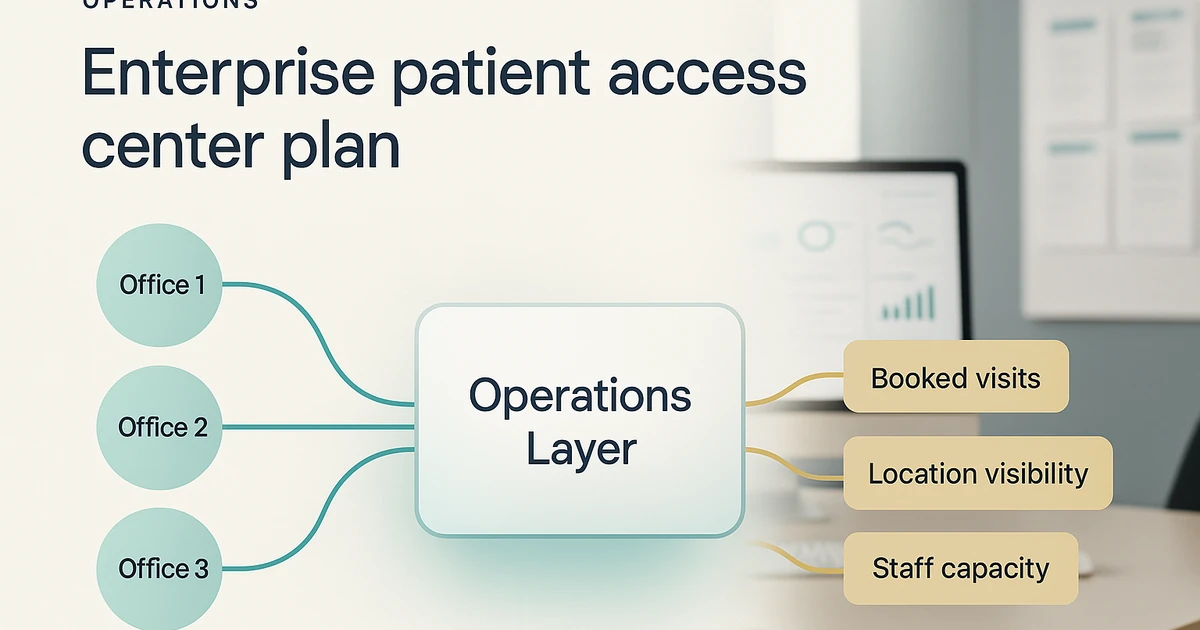
Groups evaluating a patient access center or a centralized scheduling model should treat centralization as an operating architecture, not a staffing label.
What Does Centralized Healthcare Mean at Enterprise Scale?
It Is an Operating Model, Not a Department
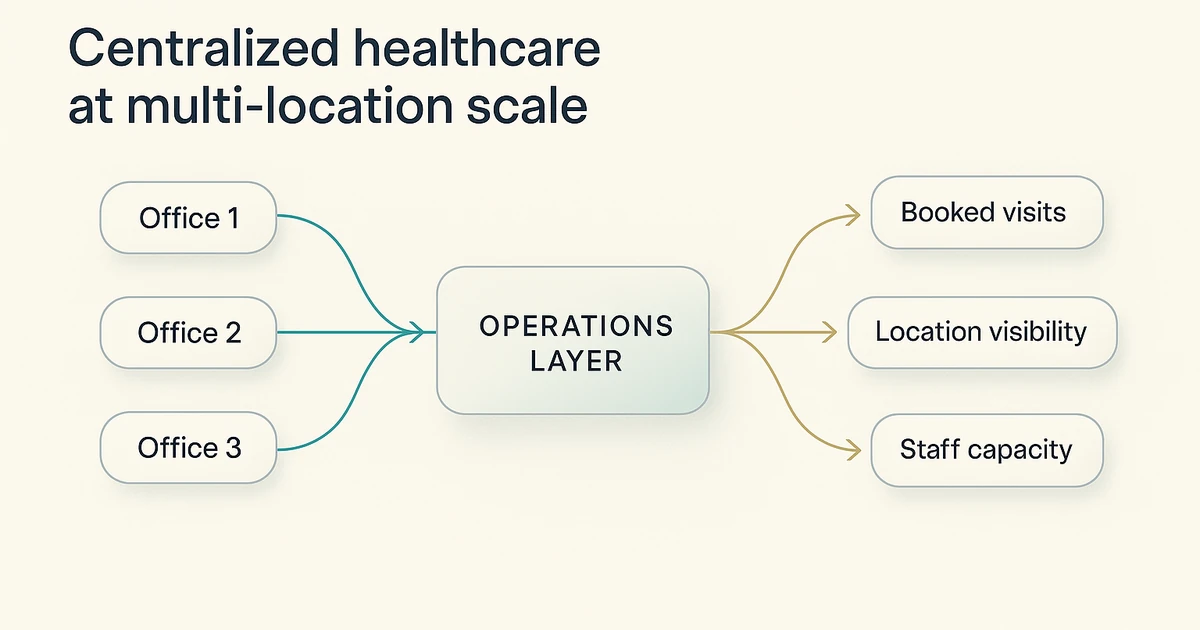
Centralized healthcare at enterprise scale means a multi-location group defines common work, common ownership, and common reporting for high-volume operational workflows. The central layer may be an internal access center, an outsourced operating partner, a shared services team, or a hybrid model. The form matters less than the operating clarity behind it.
The most important distinction is between centralizing decisions and centralizing repeatable work. A central access team can apply approved scheduling rules, document call outcomes, route exceptions, and maintain a consistent patient-facing workflow.
Clinical judgment, provider-specific decisions, and specialty escalation still need the right licensed or site-based owner. Centralization stalls when it asks an agent or administrator to improvise across boundaries that leadership has not defined.
It Connects Care Coordination to Administrative Control
CMS defines care coordination as the organization of a patient’s care across multiple health care providers and describes fragmented care as the result when providers do not communicate effectively around a patient’s care (S1: CMS).
That government framing matters for enterprise operators because fragmentation is not only clinical. It can show up in intake notes, transfer rules, scheduling categories, portal responses, callback ownership, and documentation standards.
At scale, the operational problem is consistency across sites and channels. A patient may enter through a phone call, web request, referral, recall campaign, or follow-up queue. Centralized healthcare gives the group a way to define how that request is captured, who owns the next action, which system records the outcome, and how exceptions are reviewed. It makes the handoff visible enough for leadership to manage.
Where Does Centralization Usually Start?
Patient Access and Scheduling
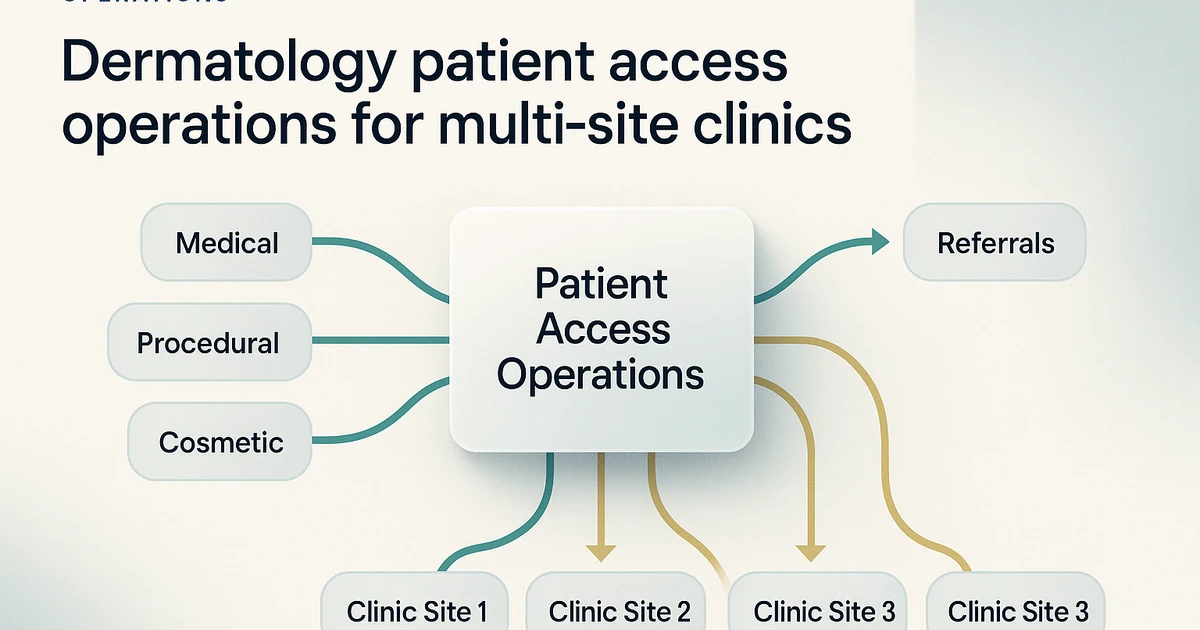
The first practical entry point is usually patient access because inbound demand exposes inconsistency quickly. If each location answers, routes, books, and documents differently, leadership has difficulty comparing performance or diagnosing bottlenecks. A centralized access function creates shared scripting, routing, scheduling rules, disposition codes, and QA review for work that repeats across the network.
MGMA profiles centralized scheduling in a large independent medical group with more than 60 locations, including the relationship between centralized scheduling, patient access, care coordination, and standardized workflows (S4: MGMA).
That example is useful because it frames scheduling as a management system. The value is not a central phone queue by itself. The value is the combination of standard rules, trained execution, escalation discipline, and reporting that can be reviewed across the enterprise.
Recall, Reactivation, and Front-Office Follow-Through
Once access and scheduling are under control, centralized healthcare often expands to recall, reactivation, appointment follow-up, after-hours routing, forms completion, benefits-related intake steps, and unresolved queue cleanup. These workflows have the same enterprise challenge: the work appears simple when viewed from one site, but variation becomes expensive to manage when every location invents its own version.
This is where links between front-desk outsourcing, patient recall, and no-show recovery matter operationally.
Buying committees should not evaluate each workflow as a separate vendor lane if the patient experience and reporting model need to connect. A centralized model should let leadership see whether demand was answered, scheduled, routed, recovered, or escalated under the same definitions.
How Should COOs Decide What To Centralize?
Use Decision Rights Before Org Charts
The executive mistake is drawing a new org chart before defining decision rights. A central team cannot perform consistently if every location keeps silent veto power over schedule rules, script language, visit-type definitions, and escalation expectations.
Before rollout, the COO or VP of Operations should clarify who owns enterprise standards, who approves exceptions, who manages the queue, and who resolves conflicts between access goals and site constraints.
Decision rights also protect the central team from becoming a general help desk. The access center should not absorb every unresolved issue simply because it answers the phone.
It needs named boundaries: what agents may complete directly, what requires site input, what requires clinical review, what goes to revenue cycle, and what returns to leadership as a policy question. The cleaner the decision map, the easier it is to train, audit, and scale.
Separate Standards from Exceptions
Standardization does not mean every site is identical. A dermatology clinic, dental location, optometry office, urgent care center, and MedSpa may all need different appointment rules. Even within the same specialty, providers may have equipment constraints, payer requirements, or service lines that affect booking. The enterprise goal is to distinguish approved variation from unmanaged variation.
A practical rule is to centralize the standard and govern the exception. The standard defines the normal path for call handling, scheduling, intake, recall, and routing. The exception defines when a request leaves the standard path, who receives it, what context must be included, and how completion is recorded.
Over time, recurring exceptions should be reviewed by operations, clinical, revenue cycle, and technology leaders so the group can decide whether the rule should change.
What Technology Architecture Supports Centralized Healthcare?
Shared Records and Interoperability
Centralized healthcare depends on information moving through approved systems with enough context for the central team to act. If agents can see only a partial schedule, incomplete patient history, or inconsistent appointment labels, the operating model is likely to create rework. If leaders cannot tie call outcomes to scheduling, recall, and location performance, the reporting layer will not support useful management conversations.
HealthIT.gov explains that electronic health information exchange supports secure data sharing, care coordination, reduced administrative burden, and better outcomes (S2: HealthIT.gov).
For a multi-location operator, the practical takeaway is governance rather than technology enthusiasm. The group needs to decide which systems are sources of truth, which data elements are necessary for each workflow, which access controls apply, and how exceptions are documented when an integration is incomplete.
Reporting, QA, and SLA Calibration
The reporting architecture should reflect work ownership. A dashboard that shows total call activity but not whether the request was scheduled, routed, deferred, escalated, or resolved will not help an operating team calibrate performance. Centralized healthcare needs reporting by location, channel, workflow, agent group, appointment category, exception reason, and unresolved status.
QA should evaluate whether the approved workflow was followed, not just whether a caller had a pleasant interaction. SLA calibration works the same way. A buying committee can define different expectations for new patient scheduling, established patient rescheduling, referral follow-up, recall outreach, after-hours messages, and clinical escalation.
Those standards should be reviewed against staffing, training, routing logic, and system access before they are treated as contractual performance commitments. The related reporting dashboard guide and multi-location QA calibration guide can help operators separate activity reporting from operating control.
How Does Centralized Healthcare Change Governance?
Compliance Review Must Be Built Into Workflow Design
Centralization concentrates operational responsibility. That makes privacy, security, and compliance review part of workflow design from the start. Each group should have its compliance team and counsel confirm what patient information is accessed, who may access it, how access is reviewed, and how patient communications are documented.
The same review should cover vendors, subcontractors, systems, call recordings, message templates, user roles, audit trails, and incident response expectations where applicable.
If the group is evaluating healthcare call center outsourcing or integrations, compliance review should be attached to the workflow, not delayed until procurement is nearly done. A central team can only follow the rules leadership has defined and trained.
Clinical Boundaries Need Named Owners
AHRQ describes the patient-centered medical home as an organized care delivery model built around comprehensive care, coordinated care, accessible services, quality, and safety (S3: AHRQ).
For enterprise operations leaders, that is a useful reminder that access design and care coordination are connected. A central operating layer should make it easier to route the right request to the right owner, but it should not blur clinical accountability.
Name the boundary conditions clearly. Clinical triage, medication questions, post-procedure concerns, provider-directed exceptions, and care-plan decisions need defined escalation paths. Administrative teams need scripts for what they may say, what they may schedule, and when they must transfer or create a task for a clinical owner. That boundary keeps the patient experience and operating model from depending on informal judgment.
What Should Buying Committees Evaluate Before Rollout?
Operating Readiness
Buying committees should start by asking whether the organization is ready to standardize. If locations use different visit names, phone dispositions, callback habits, reminder logic, and unresolved-work queues, a centralized partner may expose those inconsistencies before it solves them. That is not a vendor failure by default. It is a sign that operating definitions need cleanup before scale.
Dental groups provide a useful example. The ADA Health Policy Institute provides data on dental practice size and DSO affiliation, noting growth in large group practices and DSOs (S6: ADA HPI).
The ADA also explains that dental support organizations manage administrative, marketing, business, and other nonclinical support needs for dental practices, including multi-location groups (S7: ADA News).
For DSO and MSO buying committees, those references reinforce an important point: centralized healthcare is often about professionalizing shared nonclinical work while keeping clinical accountability where it belongs.
Vendor and Rollout Readiness
A vendor evaluation should test the operating model, not only the sales deck. Ask how the partner learns each specialty, how it documents scheduling rules, how it handles system access, how it reports exceptions, how QA is scored, and how service issues are escalated. Ask who attends calibration meetings and who has authority to change workflows after launch.
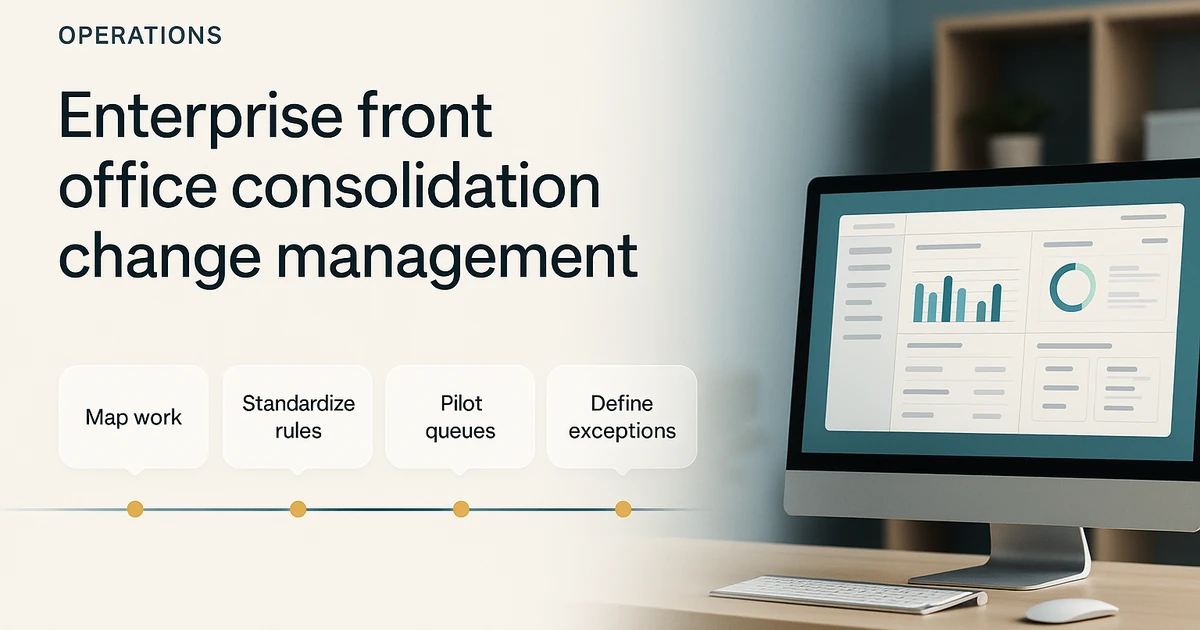
The rollout plan should also define pilot scope. A pilot is not a symbolic trial; it is a controlled operating test with specific workflows, locations, role owners, training assets, QA criteria, and reporting expectations.
Buying committees can use an enterprise patient access implementation plan and a patient-access RFP checklist to keep procurement tied to operational readiness.
How Should Leaders Measure Centralized Healthcare?
Build the Dashboard Around Work Ownership
Centralized healthcare should be measured by whether work reaches a clean operational outcome. That means the dashboard must show more than activity.
It should show demand source, request type, disposition, completion status, location, appointment category, unresolved reason, escalation owner, and QA result. The exact fields will vary by specialty and system stack, but the principle should not: every workflow needs an owner and a visible outcome.
This is especially important after acquisition. A newly integrated location may look operationally healthy if leadership reviews only aggregate activity. When the dashboard separates site-level performance and exception reasons, leaders can see where training, template cleanup, integration work, or site engagement is required.
The centralized versus distributed intake framework can help leadership decide which workflows belong in the central model and which should stay closer to site teams.
Connect Metrics to EBITDA Impact Without Overclaiming
Centralized healthcare can affect EBITDA conversations, but operators should be careful with the business case. Without verified internal data, it is risky to claim a fixed lift, standard savings rate, or standard conversion improvement.
A better approach is to connect operating metrics to finance questions: which work is duplicated across sites, which queues delay scheduling, which exceptions consume manager time, and which reporting gaps prevent intervention.
The finance team should define how operational movement will be interpreted before the pilot begins. If the group tracks answered demand, booked demand, incomplete intake, unresolved callbacks, recall outcomes, and staffing coverage under the same definitions, the EBITDA discussion becomes more credible.
The related multi-location healthcare EBITDA guide and healthcare call center ROI guide can support the internal modeling, but the final assumptions should come from the group’s own data.
What Is the Practical Enterprise Playbook?
Start With a Workflow Inventory
The first playbook step is to inventory the workflows that patients and staff experience every day. Include inbound calls, web requests, appointment changes, new patient intake, referral follow-up, recall, reactivation, after-hours routing, benefits-related intake steps, records requests, and unresolved callbacks. For each workflow, define the current owner, the system of record, the completion signal, and the common exception paths.
This inventory should be built with operations, site leadership, revenue cycle, clinical leadership, IT, and the team that actually handles the work. The goal is not to collect opinions. The goal is to discover where the group has multiple definitions for the same operating event. Those differences should be resolved before the workflow moves into a centralized queue.
Roll Out With Governance, Training, and Calibration
The rollout should start with a narrow, well-defined scope. Choose workflows that have clear rules, clear system access, and a clear escalation path. Train the central team on the approved rules, test those rules with site champions, and review real interactions through QA calibration before the operating volume expands. Centralization should grow as the rulebook proves it can absorb variation.
After launch, governance should review exceptions, unresolved work, QA patterns, and site feedback on a recurring basis. The most useful question is not whether centralization is working in the abstract. It is whether the group can explain variances and make decisions with better evidence than it had before. When centralized healthcare reaches that point, it becomes part of enterprise operating discipline rather than a temporary staffing fix.
Related Reading
Operating Models
Start with model selection before procurement. The core decision is which workflows belong in a centralized layer, which should stay site-led, and which require a hybrid model with controlled escalation.
For deeper planning, read Centralized vs Distributed Intake Framework and Enterprise Patient Access Center Implementation. These guides help operations leaders connect centralization strategy to workflow ownership and rollout sequencing.
Implementation and Metrics
Implementation quality depends on systems, reporting, and vendor governance. A centralized model with weak integration or unclear dashboards can still leave leaders managing by anecdote instead of operating evidence.
For connected execution, review EHR/PMS Integration for Centralized Scheduling, Reporting Dashboard for Multi-Site Healthcare Operations, and Healthcare Call Center Outsourcing for Multi-Location Groups.
These pieces support the technology, reporting, and vendor-evaluation layers behind a centralized operating model.