
Table of Contents
- Why Does Front Office Consolidation Change Management Matter At Scale?
- What Should Be Standardized Before The Rollout?
- How Should Leaders Sequence Consolidation Across Locations?
- How Do You Manage Staff And Provider Adoption?
- What Governance And Metrics Should Buying Committees Require?
- How Should Technology And Vendor Review Fit The Change Plan?
Front office consolidation change management is not a software rollout for enterprise healthcare groups. It is an operating-model transition that changes who owns patient access, scheduling rules, intake follow-up, service recovery, and performance reporting across every location in the platform.
AHRQ’s workflow toolkit is relevant because it connects health IT planning, design, implementation, and use with both clinical and administrative workflow in ambulatory care (AHRQ Workflow Assessment for Health IT Toolkit).
For COOs, VPs of Operations, and buying committees, the core question is not whether centralization sounds efficient. The question is whether the organization can standardize work without breaking location adoption, provider trust, and patient access continuity.
AHRQ’s health IT workflow toolkit is relevant because it treats clinical and administrative workflow as part of planning, design, implementation, and ongoing use in ambulatory care (AHRQ Workflow Assessment for Health IT Toolkit).
That framing matters for a multi-location enterprise operating model. Consolidating phones, scheduling, intake, recall, and front-office support into a central team can create stronger governance only when leaders define the workflow, training model, exception process, QA cadence, and reporting structure before volume moves. Without that foundation, consolidation can become an escalation engine rather than a management layer.
Why Does Front Office Consolidation Change Management Matter At Scale?
At scale, front office consolidation is not only about moving calls from location teams to a central team. It changes how the enterprise decides which work is standardized, which decisions remain with the site, and how exceptions are governed. The operational risk is highest when leadership announces centralization before defining the new decision model.
AHRQ defines workflow as physical and mental tasks performed by people within and between work environments, and it warns that practice changes affect both clinical and practice-management processes (AHRQ workflow definition).
That is exactly the change-management issue in front office consolidation. Scheduling, intake, reminders, and patient communication may look administrative, but they sit directly next to provider templates, payer requirements, patient preferences, and location capacity.
Centralization Changes The Operating Model
A central front office team needs authority to handle repeatable work without asking each location for permission on every routine interaction. At the same time, it needs clear boundaries for clinical escalation, provider-specific rules, payer-related exceptions, and location capacity constraints. The change plan should make those boundaries explicit before the first pilot queue opens.
This is where many enterprise initiatives drift. Leaders approve a patient access center concept, but the operating model remains vague. Agents inherit inconsistent instructions, location managers continue sending side-channel corrections, and executives receive dashboards that do not explain why work is being transferred, delayed, or reopened.
Workflow Variation Becomes A Management Risk
Before consolidation, workflow variation may be hidden inside each location. After consolidation, that variation becomes visible and harder to coordinate. One location may use different appointment names, another may require provider approval for routine changes, and another may have informal rules that were never documented.
Change management should treat that variation as a design input, not as a nuisance. The goal is not to force every site into identical behavior. The goal is to create enterprise standards for the work that should be repeatable, while creating governed exception paths for the work that legitimately depends on site context.
What Should Be Standardized Before The Rollout?
Front office consolidation should begin with workflow standardization, not vendor selection. A central team cannot perform consistently if visit types, scheduling rules, escalation paths, intake documentation, and patient communication standards are different across locations without a documented reason.
AHRQ’s workflow examples emphasize staged assessment activities across requirements, vendor selection, implementation preparation, and postimplementation adjustment (AHRQ workflow tool examples).
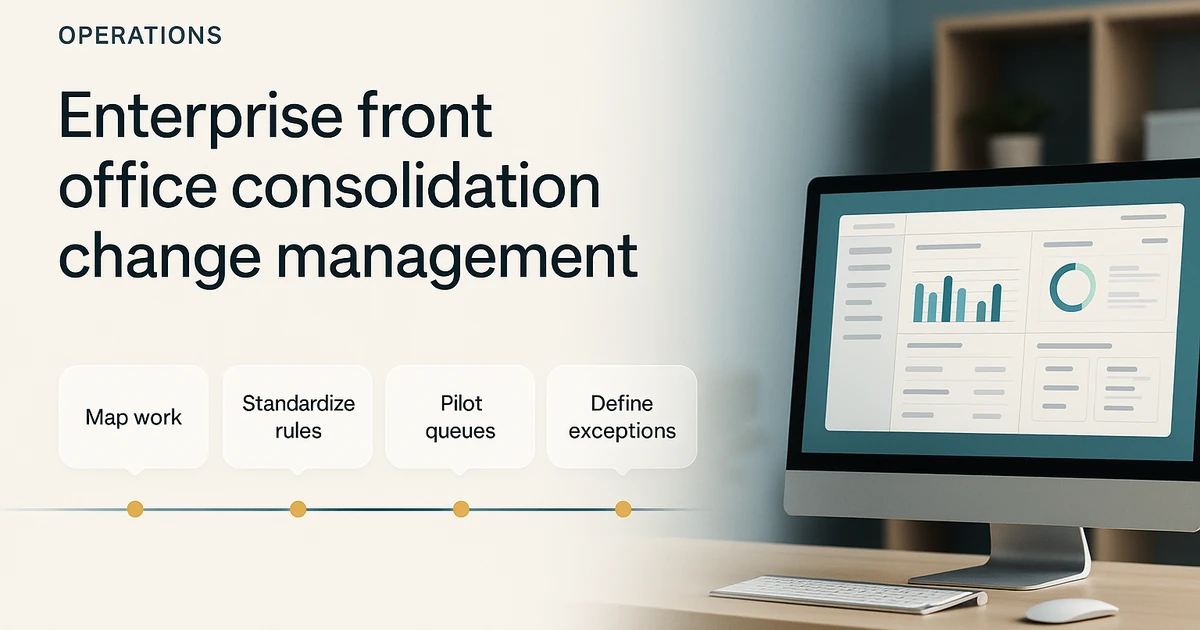
For multi-location healthcare groups, that supports a practical sequence: map the current state, define future-state ownership, test the workflow, then adjust based on live operating feedback.
Map Work Before Moving It
The consolidation team should map inbound calls, new patient scheduling, established patient scheduling, appointment changes, intake follow-up, portal follow-up, recall outreach, reactivation outreach, insurance-related handoffs, and service recovery. Each workflow needs a clear trigger, owner, system of record, escalation path, and completion definition.
This mapping should include the handoff back to the location. If a patient requires provider review, the central team should know who receives the request, how the response is documented, and how the patient is updated. If the handoff is informal, the centralized model will depend on personal relationships instead of repeatable process.
Define Decision Rights And Exceptions
Decision rights should be explicit. Operations may own queue design, scripts, staffing, and reporting definitions. Clinical leadership may own triage boundaries and provider-facing exceptions. Revenue cycle may own insurance-related intake requirements. IT may own access, integrations, and system reliability.
Exception governance is equally important. If every location can create its own rule outside the enterprise playbook, centralization slowly recreates the distributed model under a new name. If headquarters rejects every site concern, adoption suffers. A standing review process should evaluate recurring exceptions and decide whether to update the standard, retrain the team, or preserve the exception with documentation.
How Should Leaders Sequence Consolidation Across Locations?
A mature rollout sequence is built around readiness, not executive impatience. The right first workflow is the one with enough consistency to centralize responsibly and enough operational importance to prove the model to skeptical stakeholders.
The Wall Street Journal has discussed centralized patient-access centers, intelligent scheduling, digital front doors, and workflow changes as part of efforts to address patient access friction at scale (Wall Street Journal).
For enterprise healthcare groups, the lesson is not to copy another organization’s design. It is to treat access as an enterprise workflow that needs staffing, technology, governance, and patient-facing follow-through.
Start With A Bounded Pilot Scope
A pilot should define included locations, included workflows, coverage expectations, routing logic, escalation owners, QA process, and reporting cadence. It should also define what is out of scope. Without boundaries, a pilot can turn into a general support desk before the core workflow is stable.
Strong pilot candidates are not necessarily the easiest locations. They are the sites where leadership can observe real complexity without overwhelming the new model. A pilot should expose scheduling rules, access constraints, system friction, and adoption concerns while the organization still has room to adjust.
Expand By Workflow Maturity
Expansion should follow evidence from the pilot. If scheduling templates are inconsistent, the next phase should focus on centralized scheduling rules before adding more volume.
The AMA’s outpatient scheduling guidance includes practical redesign steps such as flexible scheduling, buffer time, team-based staffing, and follow-up scheduling, which can inform centralized scheduling design across locations (American Medical Association).
Workflow maturity is also channel-specific. A group may be ready to centralize overflow calls before web inquiries, or appointment reminders before recall outreach. The rollout plan should group work by complexity and readiness rather than treating all front-office tasks as interchangeable.
How Do You Manage Staff And Provider Adoption?
Front office consolidation changes identity, not only tasks. Location teams may worry that centralization removes judgment from the people closest to patients. Providers may worry that their schedules will be filled incorrectly. Managers may worry that they will be held accountable for work they no longer directly control.
Change management should answer those concerns directly. A central team can support location teams only when the operating purpose is clear: remove repeatable administrative burden from sites, standardize patient access workflows, and give leaders better visibility into demand and friction across the group.
Communicate The Operating Purpose
The message should not be “we are centralizing because it is efficient.” That is too abstract and can sound like a cost-only project. Instead, leaders should explain which workflows are moving, why they are moving, what stays with the location, how exceptions will be handled, and how staff will raise concerns.
For PE-backed platforms and DSOs, the enterprise case should also be clear. The ADA reports rising DSO affiliation and explains that DSO affiliation involves outside management of non-clinical functions such as billing, marketing, and human resources (American Dental Association).
Front office consolidation fits that operating logic when it is managed as a standardized non-clinical function, not as a loose staffing substitution.
Train For Workflow Precision
Training should be role-based and scenario-based. Agents need system navigation, scripting, scheduling rules, documentation standards, escalation paths, location differences, and QA expectations. Location teams need to know how to hand off issues, how to read central team updates, and how to request workflow changes.
Provider adoption requires a separate track. Clinical leaders and providers should review the scheduling logic, exception rules, and escalation boundaries before rollout. If providers first encounter the model through a scheduling mistake or a confused handoff, the project starts from a trust deficit.
What Governance And Metrics Should Buying Committees Require?
Governance is the mechanism that keeps front office consolidation from drifting after launch. Without a management cadence, location-specific exceptions accumulate, QA becomes subjective, and dashboards become snapshots rather than decision tools.
The ONC Health IT Playbook is relevant because it covers EHR adoption, implementation, workflow optimization, governance, staff communication, training, and change management (ONC Health IT Playbook: Electronic Health Records).
For front office consolidation, that reinforces a broad implementation view: the phone queue is only one part of an access system that includes EHR/PMS workflows, digital requests, staffing, training, and governance.
Calibrate SLAs Against Real Workflow Complexity
SLA calibration should begin with workflow classification. Routine appointment changes, new patient scheduling, portal follow-up, benefits questions, recall responses, and provider-directed exceptions should not all be managed under the same expectation. Each category needs a defined owner, response posture, escalation path, and reporting label.
Avoid copying generic service targets from outside the organization without validating workflow complexity. A credible SLA model should reflect the group’s systems, staffing model, scheduling rules, payer mix, and provider templates. The buying committee should ask how the access model will be calibrated, audited, and revised as new locations are added.
Use QA And Reporting As Management Disciplines
QA should inspect whether agents followed the approved workflow, documented the correct disposition, used appropriate escalation paths, and closed the loop with the patient or location. Reporting should show performance by workflow, channel, location, queue, and exception type.
That reporting should support operating decisions. A reporting and QA cadence can reveal whether a location needs template cleanup, whether agents need coaching, whether a system integration is creating rework, or whether a standard should be revised. The point is not surveillance. The point is enterprise learning.
How Should Technology And Vendor Review Fit The Change Plan?
Technology should support the operating model rather than define it. A phone platform, scheduling interface, knowledge base, QA tool, dashboard, and integration layer can all be useful, but none of them can compensate for unclear ownership or inconsistent rules.
ONC’s transformation support section points operators toward technical assistance and health IT training resources for transformation work (ONC Transformation Support). That is the right lens for enterprise consolidation: implementation requires training, adoption support, workflow design, and technical readiness, not only procurement.
Align EHR, PMS, Portal, And Phone Workflows
The central team needs enough system access to complete real work. That may include EHR, PMS, phone, messaging, portal, web form, recall, and reporting systems. The implementation team should define which systems are required for each workflow and what information must move between them.
For groups evaluating EHR and PMS integration for centralized scheduling, the change-management question is practical: can the agent see the right schedule, follow the approved rule, document the outcome, and trigger the next step without creating hidden rework for the location?
Review Access, Privacy, And Handoff Controls
Security and privacy review should happen before scale. Leaders should define role-based access, authentication expectations, offboarding steps, auditability, call recording rules, vendor responsibilities, and incident escalation with their compliance and legal advisors.
The workflow lens is useful here as well. If a team lacks needed access, patients get transferred unnecessarily and locations absorb hidden work. If access is too broad, the group creates avoidable risk. The right control design matches access to workflow need and keeps handoffs visible.
Related Reading
These internal resources expand on specific pieces of the front office consolidation model. They are included for navigation, not as source support for external factual claims.
Use them to go deeper on patient access architecture, centralized intake decisions, integration readiness, QA calibration, and enterprise reporting. The strongest consolidation plans connect these topics before buying committees approve a rollout.
Enterprise Access Strategy
For the broader operating model, start with Enterprise Patient Access Center Implementation and Centralized vs. Distributed Intake Framework. For change adoption in a DSO context, review DSO Change Management for Patient Access.
These resources pair well with the enterprise pillar because they move from strategy to operating design. They are most useful when the buying committee is deciding what should be centralized, what should remain location-owned, and how adoption will be governed.
Implementation, QA, And Reporting
For system readiness, read EHR PMS Integration for Centralized Scheduling. For management cadence, pair Multi-Location Call Center QA Calibration with Reporting Dashboard for Multi-Site Healthcare Operations.
These articles support the implementation layer of front office consolidation. They help operators connect system access, QA scoring, dashboard design, and exception review into one repeatable management cadence.
Sources
- AHRQ Workflow Assessment for Health IT Toolkit
- AHRQ: What Is Workflow?
- AHRQ Workflow Tool Examples
- ONC Health IT Playbook: Electronic Health Records
- ONC Transformation Support
- American Medical Association: 7 Steps to Improve Scheduling in Your Outpatient Practice
- American Dental Association: More Dentists Affiliating With DSOs
- The Wall Street Journal: Seeing a Doctor Doesn’t Have to Be So Frustrating