Table of Contents
- Why DSO QA Scorecards Need Healthcare-Specific Design
- What a DSO Contact Center QA Scorecard Should Measure
- How to Score Calls Without Creating Bad Incentives
- A Practical QA Scorecard Template for DSO Teams
- Governance for Multi-Location QA Programs
- Implementation Path for 3+ Location Groups
- Build a QA Program for Multi-Location Operations
A contact center QA scorecard for a DSO should do more than grade whether an agent sounded polite.
It should show whether patient access, scheduling accuracy, insurance conversations, privacy handling, and escalation paths are working consistently across locations.
That matters because dental service organizations often centralize non-clinical business support for multiple practices.
The Association of Dental Support Organizations describes DSOs as organizations that contract with dental practices to provide business management and non-clinical operational support, which makes patient access and scheduling workflows natural places for standardization across a group.
For COOs, VPs of Operations, and buying committees, the goal is not to build a pretty QA spreadsheet.
The goal is to create a management system that helps leaders see whether the contact center is protecting the patient experience while supporting location-level execution.
A good DSO QA scorecard answers practical questions:
- Did the caller get the right appointment path?
- Did the agent explain next steps clearly?
- Was the caller treated with courtesy and respect?
- Was the information captured accurately?
- Was protected information handled according to approved policy?
- Did the workflow support the practice instead of creating rework?
The best scorecards are simple enough for consistent coaching and structured enough for executive reporting.
Why DSO QA Scorecards Need Healthcare-Specific Design
Centralized support changes the operating model
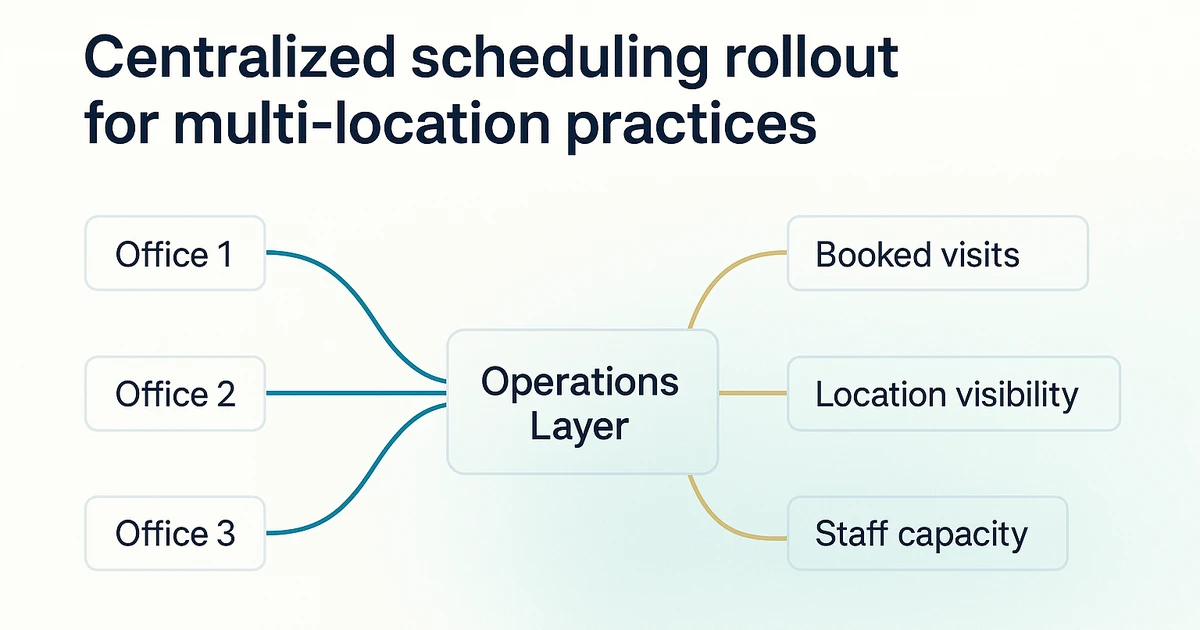
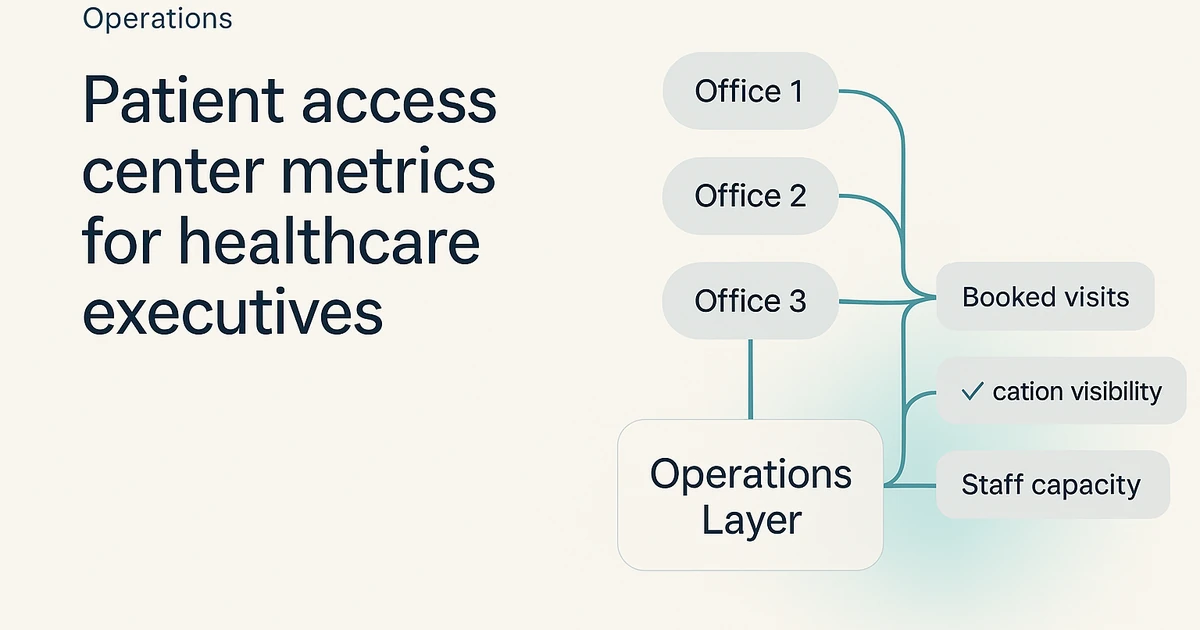
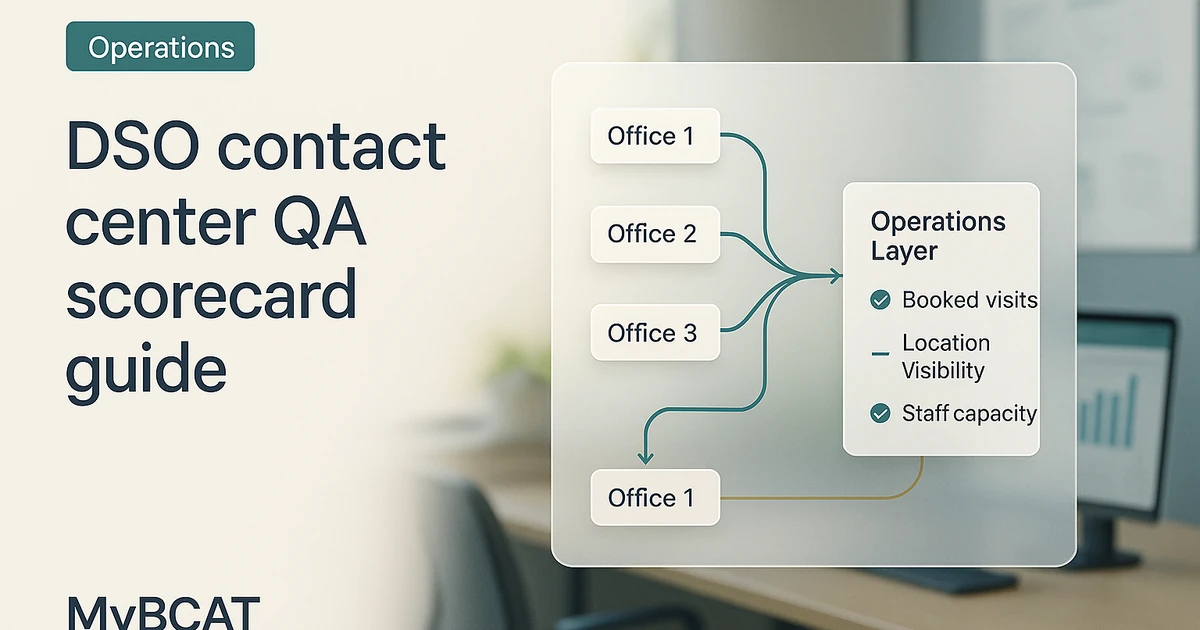
When a dental group centralizes calls, the contact center becomes a shared operating layer across locations.
That layer may touch scheduling, routing, recall, insurance questions, handoffs, and patient communication.
Even when clinical care remains local, the first operational impression may happen before the patient reaches the office.
The American Dental Association emphasizes the importance of first impressions, patient satisfaction, retention, and the role of the whole dental team in shaping the patient experience.
ADA For a multi-location group, the contact center is part of that team.
It needs standards that reflect the practice brand, the patient access model, and the operational realities of each location.
A generic customer service rubric usually misses this.
It might score enthusiasm, tone, and script adherence, but fail to catch errors that matter more in healthcare operations: wrong appointment type, missed escalation, unclear follow-up, incomplete insurance information, or unnecessary disclosure of sensitive details.
Validated experience domains make the scorecard less subjective
A DSO scorecard should not be built only from internal opinions about what a “good call” sounds like.
A stronger approach is to anchor the categories in patient experience domains already used in healthcare and dental measurement.
AHRQ’s CAHPS Dental Plan Survey identifies dental patient experience measures such as access to dental care, dental plan information and services, care from dentists and staff, and ratings of dental care.
AHRQ Dental Plan Survey AHRQ’s dental survey measures also include access to appointments, customer service helpfulness, and courtesy.
AHRQ Dental Plan Survey Measures
Those domains map cleanly to contact center QA. Access becomes scheduling and routing. Customer service helpfulness becomes problem resolution.
Courtesy becomes tone, respect, and clarity. Plan information becomes insurance and cost-related communication handled within approved boundaries.
For enterprise dental groups, that grounding helps remove some of the subjectivity from QA.
The question becomes less “Did the call feel good?” and more “Did the interaction support access, clarity, courtesy, and appropriate next steps?”
What a DSO Contact Center QA Scorecard Should Measure
Access and scheduling accuracy
Scheduling is usually the highest-impact category in a DSO scorecard because it connects the patient’s need to the practice’s capacity.
QA should evaluate whether the agent identified the caller’s reason for contacting the office, selected the appropriate appointment path, confirmed required information, and communicated next steps clearly.
This does not mean every location needs identical scheduling rules.
Some groups have different providers, hours, payer participation, specialty services, or new-patient workflows by office.
The scorecard should separate groupwide standards from location-specific rules.
Groupwide standards might include confirming the requested service, offering appropriate appointment options, and documenting the outcome.
Location-specific rules might include referral requirements, provider availability, or specialty routing.
AHRQ’s Clinician & Group Survey measures include timely appointments and same-day answers to questions, which are useful reference points for healthcare groups designing patient access QA criteria.
Courtesy, clarity, and confidence
Courtesy is not a soft extra in a healthcare contact center. It is part of whether callers feel heard, respected, and oriented.
A scorecard should evaluate whether agents listen without interrupting, use plain language, explain the next step, and avoid making the caller repeat information unnecessarily.
Clarity is especially important when a caller is confused about scheduling, insurance, paperwork, or location details.
The agent should not simply finish the call; the agent should leave the caller with a clear understanding of what will happen next.
AHRQ’s dental measures include customer service helpfulness and courtesy, while the Clinician & Group Survey includes helpful, courteous, and respectful office staff.
AHRQ Dental Measures AHRQ CG-CAHPS Measures
Insurance, plan, and cost conversations
Dental callers often ask about insurance, plan participation, coverage, estimates, or payment expectations.
QA should evaluate whether the agent stayed within approved language, captured the right information, avoided overpromising, and routed complex questions appropriately.
The scorecard should not encourage agents to improvise answers to plan-specific questions.
Instead, it should reward accurate intake, clear expectation-setting, and correct escalation.
For example, the QA standard can ask whether the agent gathered required insurance details, explained that benefits may need verification, and documented the handoff according to workflow.
AHRQ’s Dental Plan Survey includes dental plan information and services as a patient experience domain, which supports including plan-related communication in a dental contact center scorecard.
Privacy and minimum-necessary handling
Healthcare contact center QA must include privacy behavior.
A QA scorecard should therefore check whether agents follow approved authentication, disclosure, and minimum-necessary scripts.
It should also check whether agents avoid unnecessary sensitive details in notes and use approved channels for follow-up.
It is an operating control.
How to Score Calls Without Creating Bad Incentives
Use critical fails for high-risk issues
Some mistakes should not be averaged away by a good tone score.
A call can sound friendly and still create serious operational risk if the agent schedules the wrong visit type, mishandles protected information, or gives an unauthorized answer about coverage.
For that reason, DSOs should define a short list of critical fails. These are issues that trigger immediate review, coaching, or escalation.
Examples include failing to follow an approved privacy workflow, documenting sensitive information in the wrong place, or bypassing a required escalation path.
Critical fails should be tightly defined. If everything is critical, nothing is.
The point is to distinguish routine coaching from high-risk defects that need prompt correction.
Coach behaviors, not personality
Behavior-based scoring also helps with calibration.
Supervisors can listen to the same call and compare the same evidence: greeting, verification, discovery, scheduling accuracy, explanation, documentation, and close.
For contact center leaders, this is where the scorecard becomes a training system.
Each category should point to a specific behavior that can be practiced, observed, and reinforced.
Calibrate across brands, locations, and channels
Multi-location dental groups often have different practice histories, brands, systems, or local preferences.
QA calibration prevents those differences from turning into inconsistent scoring.
Calibration sessions should compare real calls against the rubric, review edge cases, and clarify scoring rules.
If a location has a unique workflow, that exception should be documented rather than passed along informally.
If a policy changes, the scorecard and training materials should change together.
A Practical QA Scorecard Template for DSO Teams
Core categories
A practical DSO scorecard can be organized around these categories:
- Opening and caller identification
- Reason for call and needs discovery
- Scheduling accuracy and routing
- Insurance or plan information handling
- Courtesy, empathy, and clarity
- Privacy and approved disclosure behavior
- Documentation quality
- Escalation and handoff accuracy
- Call close and next-step confirmation
Each category should have a plain-language standard.
The standard should tell the reviewer what “good” looks like and tell the agent what behavior is expected.
Avoid vague category names that require reviewers to guess.
For example, “professionalism” is too broad. “Explains the next step in plain language before ending the call” is clearer.
Sample evaluation prompts
A scorecard can use prompts instead of abstract labels. Prompts keep QA tied to the actual call.
Useful prompts include:
- Did the agent identify the caller’s need before offering a solution?
- Did the agent select the correct scheduling pathway based on the caller’s reason for contact?
- Did the agent explain what the caller should expect next?
- Did the agent use approved language for insurance or plan questions?
- Did the agent avoid unnecessary sensitive details in notes?
- Did the agent route unresolved questions to the correct team?
- Did the agent close the call with a clear confirmation?
These prompts are not meant to create a rigid script. They create a review structure.
Agents can still use natural language while meeting the required operating standard.
QA notes that lead to action
A stronger note might say that the agent confirmed the appointment time but did not explain what paperwork the caller should complete before the visit.
Good QA notes should identify the behavior, the impact, and the expected correction.
If the issue is caused by a workflow problem instead of agent behavior, the note should say that too.
For example, if agents repeatedly struggle with a location’s appointment rules, the solution may be a clearer scheduling guide, not repeated coaching on individual calls.
This is where QA becomes operational intelligence.
It shows whether the contact center needs training, better scripts, cleaner workflows, system updates, or location-level clarification.
Governance for Multi-Location QA Programs
Assign ownership before volume increases
A DSO QA program needs clear ownership. Someone must maintain the rubric, approve changes, run calibration, review escalations, and report trends to operations leadership.
Ownership should include both contact center leadership and practice operations.
If QA is owned only by the contact center, location-specific workflow problems may not be fixed.
If it is owned only by operations, agent coaching may become inconsistent. The strongest model gives QA a shared operating rhythm.
The governance question is simple: when QA finds a pattern, who is responsible for changing behavior, workflow, or policy?
Review vendor and outsourced team controls
If the contact center is outsourced or partially supported by a vendor, the scorecard should be part of vendor governance.
Buying committees should ask how QA is performed, how calls are selected, how coaching is documented, and how the vendor handles privacy-sensitive workflows.
The scorecard should also define what gets reported to the DSO. Executive teams do not need every call note.
They need trends, recurring failure themes, escalation patterns, and evidence that coaching is closing the loop.
For more on enterprise reporting and QA structures, see MyBCAT’s pillar page on enterprise reporting and QA.
Tie QA reporting to operating decisions
QA reporting should influence actual decisions. If scheduling errors cluster around certain visit types, operations may need to simplify routing rules.
If insurance calls create confusion, the group may need clearer approved language. If courtesy scores are inconsistent, supervisors may need more calibration.
The best executive reports do not bury leaders in call-level detail.
They summarize what is working, where defects are recurring, what actions are underway, and whether previous actions changed the pattern.
For an external reference to MyBCAT’s supported claims, evidence sources, and constraints, executive teams can review the public truth layer.
For multi-location groups, that reporting should be filterable by brand, location, workflow, agent team, call type, and escalation reason where the underlying data supports it.
Implementation Path for 3+ Location Groups
Start with the standard
Start with a groupwide scorecard that defines the behaviors every caller should receive regardless of location.
That includes respectful communication, accurate discovery, approved privacy behavior, correct documentation, and clear next-step confirmation.
Then map the workflows that differ by location. Do not let local exceptions rewrite the entire QA program.
Document them as controlled exceptions so reviewers and agents can understand when a rule changes and why.
This approach gives leadership a common standard while respecting operational reality.
Localize only where the workflow requires it
Some variation is legitimate. Different offices may have different providers, appointment types, hours, or insurance participation.
But many differences are historical rather than necessary.
QA can help expose that distinction. If agents are repeatedly marked down because a local rule is unclear, leadership can decide whether to document the exception, simplify the workflow, or standardize the process across locations.
For DSOs integrating new practices, this is especially important. The goal is not to erase every local difference immediately.
The goal is to know which differences matter and which ones create avoidable friction.
Close the loop with training and workflow fixes
QA should not stop at scoring. Every scorecard cycle should create action.
Some actions belong to agent coaching. Others belong to operations, systems, training, or location leadership.
A useful close-the-loop process includes:
- Reviewing recurring QA themes
- Separating agent behavior from workflow defects
- Updating scripts or scheduling guides when needed
- Coaching agents with call examples
- Rechecking whether the same issue continues
- Reporting unresolved blockers to operations leadership
This is how a contact center QA scorecard becomes more than a quality audit. It becomes a continuous improvement system for patient access.
Build a QA Program for Multi-Location Operations
For multi-location healthcare operators
If your dental or healthcare group has 3+ locations and needs a more consistent patient access operation, MyBCAT can help evaluate where contact center QA, reporting, scheduling workflows, and team coaching need to tighten.
Schedule a discovery call here: /contact/
What the discovery call should cover
A useful QA discovery call should focus on your current operating model, not a generic call center script.
Bring the workflows that create the most rework: scheduling rules, escalation paths, insurance questions, recall handoffs, and reporting gaps.
For a multi-location group, the right question is not whether agents can be scored.
The right question is whether the QA program can identify patterns, support coaching, and give leadership a reliable view of patient access quality across the enterprise.
Related Reading
Enterprise patient access and reporting
- Patient Access Center Metrics for Healthcare Executives
- Reporting Dashboard for Multi-Site Healthcare Operations
- Multi-Location Call Center QA Calibration for Healthcare
- Enterprise Call Answering for Healthcare
Dental group operations
- Centralized Scheduling for Dental Offices
- DSO Centralized Patient Scheduling Operations
- Dental Group Workflow Standardization
- Multi-Location Dental Group Call Center RFP
Sources
Government and patient experience sources
- Agency for Healthcare Research and Quality: CAHPS Dental Plan Survey Measures
https://www.ahrq.gov/cahps/surveys-guidance/dental/about/survey-measures.html - Agency for Healthcare Research and Quality: CAHPS Dental Plan Survey
https://www.ahrq.gov/cahps/surveys-guidance/dental/index.html - Agency for Healthcare Research and Quality: CAHPS Clinician and Group Survey 3.0 Measures
https://www.ahrq.gov/cahps/surveys-guidance/cg/about/survey-measures.html - Agency for Healthcare Research and Quality: CAHPS Clinician & Group Survey
https://www.ahrq.gov/cahps/surveys-guidance/cg/index.html - HHS: Summary of the HIPAA Privacy Rule
https://www.hhs.gov/hipaa/for-professionals/privacy/laws-regulations/index.html
Dental industry context sources
- Association of Dental Support Organizations: About DSOs
https://www.theadso.org/about-dsos - American Dental Association: Patients
https://www.ada.org/resources/practice/practice-management/patients