
Table of Contents
- Why does centralized scheduling stall in multi-location practices?
- What should be standardized before a rollout begins?
- How should the enterprise operating model be designed?
- What technology and digital-access decisions matter most?
- How should buying committees phase the rollout?
- What governance keeps the model on track after go-live?
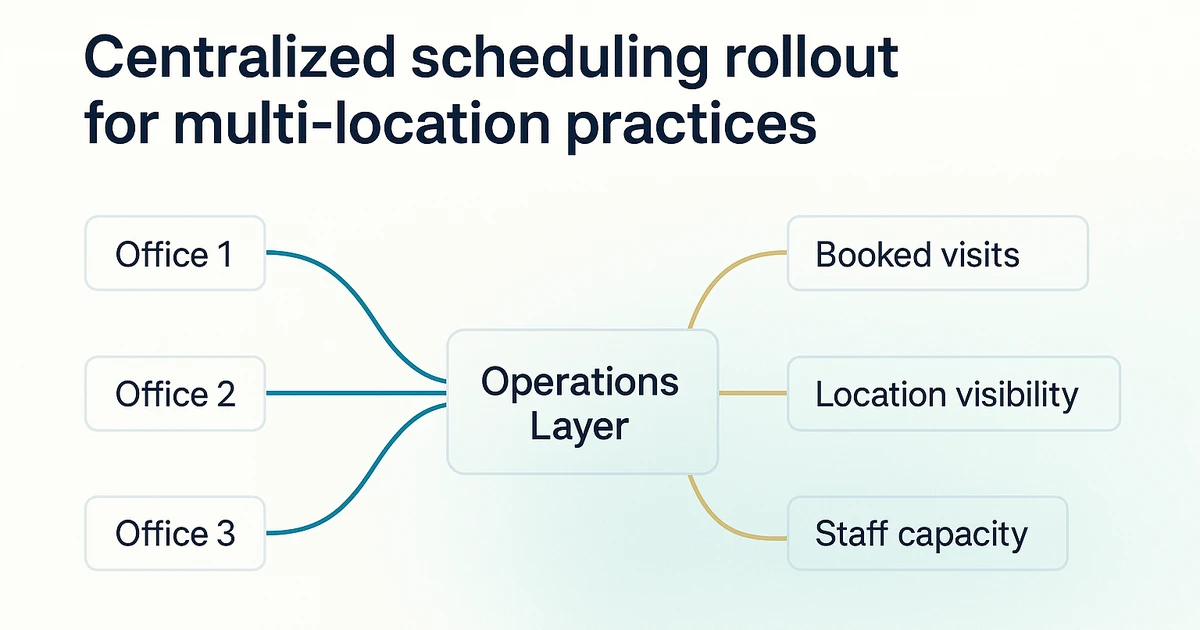
A centralized scheduling rollout for multi-location practices is not a phone-tree project. For COOs, VPs of Operations, and buying committees, it is an enterprise operating-model decision about who owns patient access, how location variance is controlled, and whether leadership gets one reporting layer it can use in staffing, SLA calibration, and EBITDA discussions.
That distinction matters because some groups still approach scheduling as a location-by-location staffing issue. One office answers its own phones, another relies on voicemail recovery, and a third pushes overflow to whoever is available. The result is not just inconsistency. It is a fragmented access layer that can make standardization harder over time.
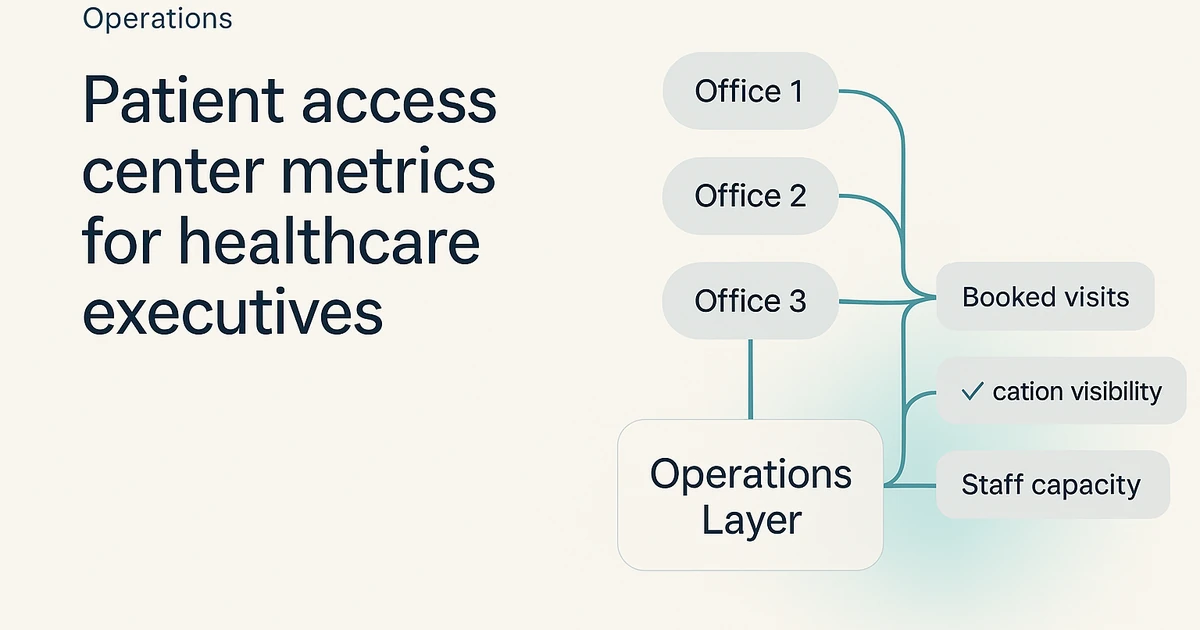
Enterprise groups usually get more traction when they connect scheduling redesign to a broader enterprise operating model, a defined centralized scheduling strategy, and a formal patient access center view of intake.
The same enterprise lens shows up in external patient-access reporting. A Wall Street Journal profile of large provider groups describes centralized access centers using “a combination of calls, texts and emails” plus intelligent scheduling to address hold times and speed appointment booking (WSJ). Federal ONC materials show patient access behavior spanning portals, smartphone apps, secure messaging, clinical notes, and multiple online records, while AMA guidance treats portal adoption as an office-workflow responsibility rather than a side project (ONC 2024; ONC 2020; AMA).
Why does centralized scheduling stall in multi-location practices?
Centralized scheduling usually stalls when leadership tries to centralize volume before it centralizes decisions. Calls may move to a shared queue, but appointment rules, escalation paths, and documentation habits still live inside each location. The organization appears centralized on paper while operating in a distributed way underneath.
That is why rollout delays are often less about technology and more about operating ambiguity. A buying committee may approve software, routing, or staffing changes, yet the model still drifts because nobody has defined which scheduling decisions belong to the center, which remain at the site, and how exceptions will be handled the same way across the network.
Why does a phone-project mindset break the rollout?
When centralization is framed as “answer more calls,” the rollout tends to stay tactical. Teams debate phone coverage, ring groups, or overflow hours, but skip the harder design work around ownership, standardization, and reporting. That can create a larger queue without creating a better operating model.
A stronger enterprise approach treats scheduling as part of patient-access architecture. It asks whether the same request is handled the same way in every location, whether the organization can audit handoffs cleanly, and whether the queue structure supports executive reporting. Groups comparing centralized versus distributed intake often find that the technical routing decision is easier than the governance decision.
Why does site autonomy create hidden variance?
Site autonomy is rarely the problem by itself. The real issue is unmanaged variance. One location may allow broad reschedule discretion, another may require manager review, and another may keep unwritten provider preferences that only long-tenured staff understand. Those differences are survivable in one office. They become expensive when repeated across a portfolio.
For acquisition-active groups, unmanaged variance also slows integration. A new location may technically join the network while still operating with its own front-office logic for months afterward. That is why centralized scheduling rollouts often need to align with broader healthcare acquisition integration work and formal change-management planning for patient access centralization. Without that alignment, the center inherits local inconsistency instead of removing it.
What should be standardized before a rollout begins?
Standardization should begin before calls move. A rollout gets materially cleaner when the organization defines the enterprise rulebook first and then asks people and systems to execute it. That sequence helps prevent the common failure mode where the center becomes a translator between conflicting site practices.
In practical terms, the pre-rollout standardization work is about language, ownership, and decision rights. Leaders need one operating view of appointment categories, one definition of what counts as resolved work, and one escalation structure that can be audited across regions and specialties. Without that foundation, SLA calibration turns into a negotiation with every site.
What belongs in the enterprise scheduling rulebook?
The rulebook should define what the center is allowed to book, reschedule, hold, escalate, or defer. It should also define which requests can stay fully centralized and which require site review because they involve provider-specific nuance, payer-specific friction, or service-line complexity. That is not administrative detail. It is the control layer for the rollout.
The rulebook also needs to cover channel logic. If the group uses phone, portal, email, text, and form-based access, those channels should not create separate scheduling standards. They should feed one access model with common decision rules. That is consistent with recent ONC and AMA materials showing that digital access depends on provider encouragement and staff workflow, not only on software availability (ONC 2024; AMA).
Why does a shared exception language matter so much?
Enterprise scheduling breaks down when exceptions are real but invisible. If one site says “needs review,” another says “provider hold,” and a third simply sends a message back to the office, leadership has no clean way to compare workload or see where friction accumulates. The queue ages, but the cause stays hidden.
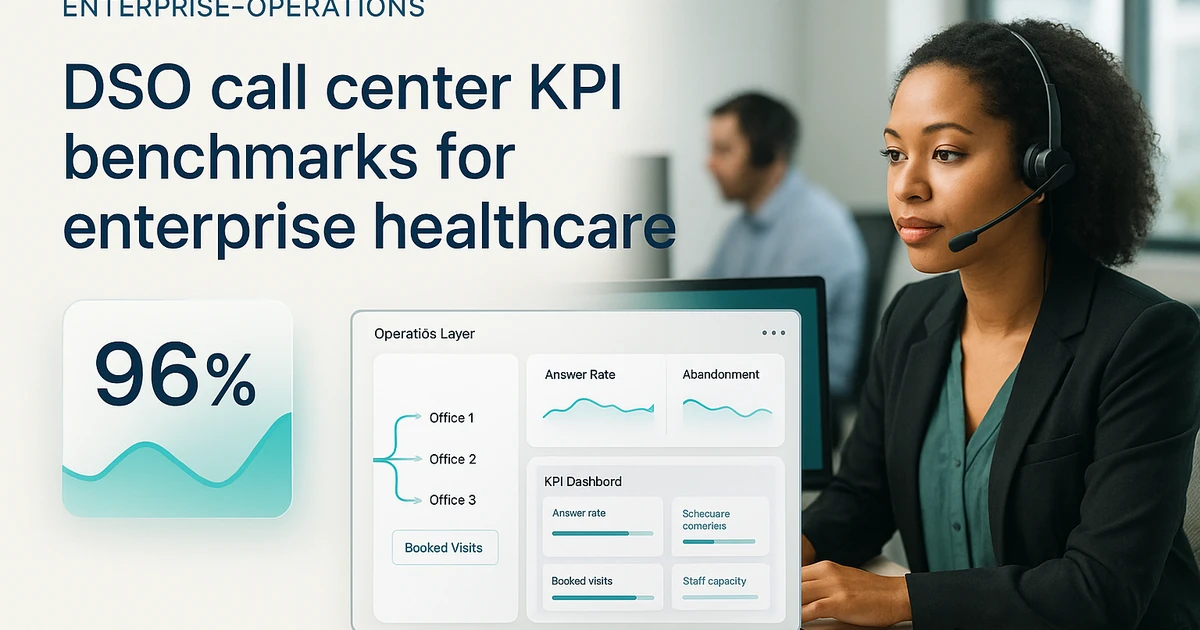
A shared exception language solves that by forcing every off-standard case into a known path. That makes QA more credible, dashboard design more useful, and site feedback easier to interpret. It also strengthens the value of a KPI dashboard for multi-location intake because the organization is measuring the same operational event instead of three site-specific versions of it.
How should the enterprise operating model be designed?
The strongest centralized scheduling models do not eliminate site involvement. They narrow it. The goal is to centralize what benefits from repeatability and to contain what truly requires location context. That balance is what keeps centralization from becoming either overcontrolled or performatively decentralized.
Buying committees usually get cleaner decisions when they design the operating model around end-to-end ownership instead of job titles. The relevant question is not whether the scheduler sits in a corporate office, a shared-service environment, or a vendor queue. The relevant question is who owns the patient request from intake to disposition, and how that ownership is measured.
What should the center own end to end?
The center usually performs best when it owns high-volume, repeatable scheduling work. That often includes new appointment requests, common reschedules, message intake, overflow recovery, and standard follow-up actions that do not require site-specific judgment. Central ownership is valuable here because it supports consistency, queue management, and one reporting layer.
That same ownership model becomes more effective when paired with a deliberate patient access center vendor evaluation process or an internal design review that asks the same questions a procurement team would ask. The point is to make sure the center is built to operate as a controlled service line, not as a larger version of the front desk.
How do you preserve location nuance without rebuilding decentralization?
Location nuance should live in controlled exception paths, not in the default workflow. A provider-specific scheduling preference, a specialty rule, or a service-recovery call may still need site input. That is reasonable. What breaks the model is when every routine request is treated like an exception because the center does not trust the rulebook or the sites do not trust the center.
A disciplined model makes those boundaries explicit. The center knows when it has authority. The site knows what it still owns. Operations leadership knows how often work leaves the central queue and why. That is also where a multi-location QA calibration model becomes useful, because QA can assess whether staff followed the operating design rather than simply whether a call sounded polished.
What technology and digital-access decisions matter most?
Technology matters, but only when it supports the operating model already defined. Enterprise groups often get into trouble when they treat the platform decision as the strategy. A new telephony stack, a new scheduling tool, or a new routing tree can help, but none of them resolves unclear ownership or weak standardization.
The more durable view is that technology should make the workflow auditable. Leaders should be able to see where requests entered, who handled them, whether they moved across teams, and how they ended. That is what turns a rollout into a governance asset rather than another administrative layer.
Why should digital access be designed with the scheduling center?
Digital access is not separate from centralized scheduling. It is part of the same front door. ONC’s patient-portal research shows that patient access behavior spans portals, smartphone apps, multiple online records, clinical notes, and secure messaging, which matters for multi-location groups trying to move beyond phone-only scheduling habits (ONC 2024; ONC 2020). AMA guidance also frames portal setup, configuration, staff training, and patient encouragement as operating work inside the practice rather than just a software feature (AMA).
That means a centralized scheduling rollout should not stop at call routing. It should also define how the group wants portal activation handled, which routine actions should stay digital when appropriate, and how those digital actions are tracked in the same reporting system as live scheduling work. AMA guidance reinforces that adoption work happens inside office workflows, not only inside software settings (AMA).
Why should integration be treated as control infrastructure?
Integration is often discussed as a convenience feature, but at enterprise scale it is closer to control infrastructure. If the center cannot see schedule data reliably, document outcomes consistently, or pass work back to sites with a clear audit trail, the organization ends up centralizing calls while decentralizing data.
That is why many groups connect rollout planning to a formal EHR and PMS integration workstream for centralized scheduling. The integration conversation is not only about connectivity. It is also about data lineage, permission design, and whether finance, operations, and compliance stakeholders can review the same underlying workflow with confidence. Groups should validate those design choices with their own compliance and security teams before broad deployment.
How should buying committees phase the rollout?
Enterprise rollout discipline usually beats speed theater. A big-bang launch can sound decisive, but it often hides whether the model actually works. A phased approach gives the committee a cleaner view of where the operating design is holding and where it still depends on heroics or local workarounds.
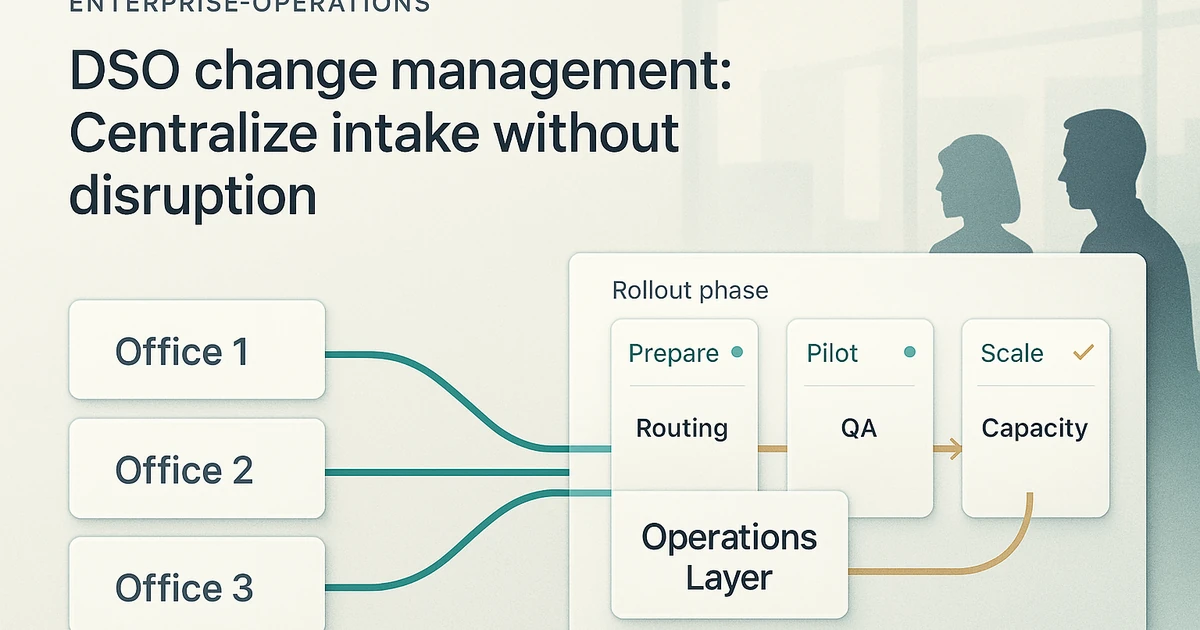
For many groups, a 30/60/90-day structure is useful because it forces clear decision gates. The timeline itself is not the point. The point is to separate design validation from scale so the organization does not confuse launch activity with operating readiness.
What should happen in the first phase?
The first phase should prove control before scale. That usually means confirming the rulebook, testing exception logic, validating reporting fields, and checking whether the center and sites are using the same operating language. If those basics are unstable in the pilot, broader deployment typically magnifies the instability.
This phase is also where buying committees should review site-readiness criteria rather than relying on hierarchy or urgency alone. A location with aligned leadership, stable workflows, and manageable exception volume is often a better pilot candidate than the loudest site or the site with the most political attention. That is one reason the DSO change-management playbook for centralizing patient access is useful well beyond dental. The core rollout logic applies across multi-location healthcare groups.
How should expansion decisions be made after the pilot?
Expansion should follow readiness and repeatability, not portfolio politics. If a location needs special treatment because of a service line, an acquisition legacy issue, or unresolved workflow variation, the committee should name that openly and treat it as a rollout condition, not as a quiet exception.
That approach also protects EBITDA conversations. When rollout waves are sequenced by operational readiness, leaders can explain where labor duplication is being reduced, where site burden is shifting, and where unresolved variation still sits in the network. When waves are sequenced by politics, the reporting story gets muddy fast and the center can be blamed for legacy issues it did not create.
What governance keeps the model on track after go-live?
Go-live is where centralized scheduling stops being a project and starts being an operating discipline. Without formal governance, even a well-designed center can drift back toward informal site exceptions, inconsistent documentation, and soft accountability. The system still functions, but it stops standardizing.
That is why post-launch governance should be designed before launch, not after it. Executive teams need a standing cadence for reviewing performance, exception patterns, site feedback, and operating changes. Otherwise every change request becomes a one-off negotiation and the rulebook slowly loses authority.
Why do metric definitions and QA cadence matter so much?
A single metric dictionary is what allows leadership to compare like with like. If one site defines completion differently from another, or if one queue closes work earlier than another, the dashboard becomes less useful no matter how polished it looks. The organization needs one definition for each core access event and one owner for changes to those definitions.
QA cadence matters for the same reason. Review is not only about tone or script discipline. It is also about whether staff used the right scheduling logic, followed the right escalation path, and documented the outcome in a way that keeps reporting clean. That is where a KPI dashboard for multi-location intake and multi-location QA calibration process can reinforce each other.
How should finance, operations, and compliance stay in the same review loop?
A centralized scheduling rollout becomes more durable when finance, operations, and compliance stakeholders review the same operating evidence. Operations may care about queue ownership and site adoption. Finance may care about labor duplication, administrative control, and EBITDA signal. Compliance may care about access patterns, documentation discipline, and oversight of shared workflows.
Those perspectives should not live in separate meetings with separate narratives. They should converge in one governance loop so the organization can decide whether it is actually standardizing or merely centralizing volume. That is often the real difference between a rollout that becomes an enterprise asset and one that remains an expensive transitional layer.
A centralized scheduling rollout for multi-location practices that leadership can trust is usually built this way. One rulebook. One operating language. One governance cadence. One controlled path for the exceptions that genuinely need local context. When those elements are in place, centralization becomes easier to scale, easier to measure, and easier to defend in executive and board-level conversations.
Related Reading
Workflow and integration
These adjacent playbooks are most useful when the rollout team is still aligning central scheduling with acquisitions, PM system diversity, and site-readiness planning. They extend the same enterprise frame from queue ownership into integration sequencing and change management.
90-Day Integration Playbook for Healthcare Acquisitions, DSO Change Management: Centralize Patient Access, and EHR/PMS Integration for Centralized Scheduling
Governance and measurement
Once the operating model is defined, leaders usually need supporting material for dashboards, QA calibration, and procurement discipline. These reads help connect centralized scheduling to broader enterprise control systems.
KPI Dashboard for Multi-Location Intake, Multi-Location Call Center QA Calibration for Healthcare, and Patient Access Center RFP Vendor Checklist for Enterprise
Sources
- Seeing a Doctor Doesn’t Have to Be So Frustrating
- Individuals’ Access and Use of Patient Portals and Smartphone Health Apps, 2024 - ONC Health IT Research & Analysis
- Individuals’ Access and Use of Patient Portals and Smartphone Health Apps, 2020 - ONC Health IT Research & Analysis
- What physicians need to know about patient portals
Managing centralized scheduling across 3+ locations? Request an Enterprise Assessment for your group.