
Table of Contents
- Why Intake Centralization Fails Without Change Management
- Building Your Change Management Framework
- Designing the Centralized Intake Model
- Managing Resistance and Building Adoption
- Sustaining Centralization Gains Long-Term
- Moving Forward with Confidence
Dental Service Organizations face a paradox when scaling operations. The same decentralized structure that allowed individual practices to thrive before acquisition becomes a liability when managing dozens of locations. Patient intake, the front door of every practice, often becomes the bottleneck that prevents DSOs from realizing the operational efficiencies that justify consolidation in the first place.
Centralizing patient intake across multiple dental locations promises consistency, cost control, and better data visibility. But the path from distributed front desks to a unified patient access center is littered with failed implementations, staff revolts, and temporary patient experience degradation. The difference between success and failure rarely comes down to technology. It comes down to change management.
According to the American Dental Association, 13% of U.S. dentists were affiliated with DSOs in 2022, up from 8.8% in 2017, with 24% of newer dentists working in practices with 10 or more locations. This consolidation trend makes centralized intake not just attractive but increasingly necessary for competitive operations.
Why Intake Centralization Fails Without Change Management
Most DSO leaders understand the operational case for centralized intake. Fewer understand why so many centralization efforts stall or fail outright. The root cause is almost never technical.
The Human Element DSOs Underestimate
Front desk staff at individual practices often view centralization as a direct threat to their jobs, their autonomy, and their relationships with patients they have served for years. This perception creates resistance that manifests in subtle but damaging ways: delayed adoption, workarounds that bypass the new system, and negative framing when patients ask about changes.
NIH research on healthcare change management emphasizes that manager and employee training requirements during technological and organizational transitions are critical success factors. Without addressing the human element, even technically superior systems fail to achieve adoption.
The practices that built your DSO had their own cultures, their own ways of handling intake, and their own definitions of what good patient service looks like. Centralizing intake without acknowledging these differences treats people as interchangeable parts rather than stakeholders whose buy-in determines success.
Technology Implementation Without Process Redesign
Many DSOs approach intake centralization as a technology project rather than a business transformation. They select a platform, configure it for multiple locations, and expect adoption to follow. This sequence puts the cart before the horse.
Effective centralization requires redesigning workflows before selecting technology. Without this step, you end up automating broken processes and encoding inconsistencies into your new system. The technology becomes a mirror of your existing dysfunction rather than a solution to it.
The Agency for Healthcare Research and Quality documents change management strategies including PDSA cycles, DMAIC, Six Sigma, and Baldrige for healthcare implementation. These methodologies share a common emphasis: process understanding must precede technology selection.
Communication Gaps Between Corporate and Practice Level
DSO leadership often announces centralization initiatives with corporate-level justifications that mean nothing to practice-level staff. Phrases like “operational efficiency,” “scalability,” and “data consolidation” may resonate in the boardroom but create anxiety at the front desk.
The communication gap works both ways. Practice-level concerns about patient relationships, local knowledge, and workflow disruptions rarely make it up to decision-makers in a form that influences implementation planning. This disconnect creates initiatives that are technically sound but practically unworkable.
Building Your Change Management Framework
Successful intake centralization requires a structured approach that treats change management as equally important to technology implementation. The framework you build should address stakeholder alignment, phased implementation, and continuous feedback integration.
Stakeholder Mapping and Engagement Strategy
Before announcing any centralization initiative, identify every group that will be affected by the change. This includes not just front desk staff but also clinical teams who interact with intake, practice managers who will lose some autonomy, and patients who will experience the transition.
For each stakeholder group, document their current state, their concerns about centralization, and what success looks like from their perspective. This mapping exercise often reveals concerns that leadership never anticipated and opportunities for engagement that would otherwise be missed.
The CDC has documented how change-management approaches guide organizations through strategic implementation and sustainability of evidence-based healthcare interventions. Their case study framework emphasizes stakeholder engagement as a prerequisite for sustainable change.
Create engagement plans tailored to each stakeholder group. Front desk staff need different messaging than practice managers, and both need different communication than patients. A one-size-fits-all announcement creates more problems than it solves.
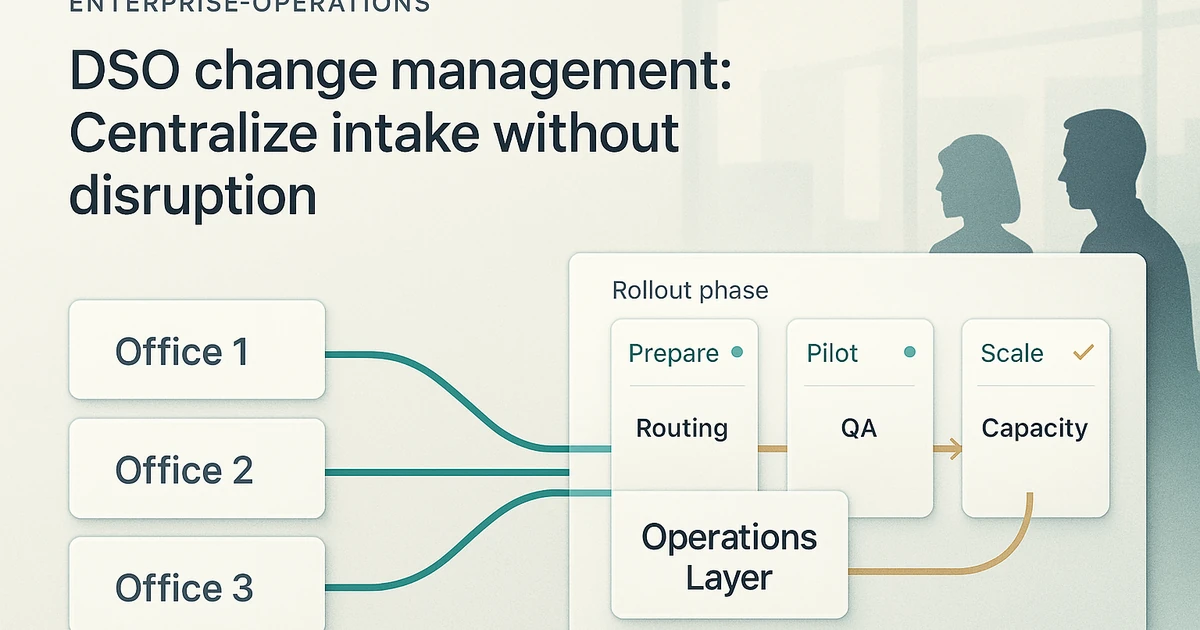
Phased Implementation Roadmap
Attempting to centralize intake across all locations simultaneously is a recipe for chaos. Phased implementation allows you to learn from early locations, adjust your approach based on real feedback, and build internal advocates who can support later rollouts.
Select pilot locations based on a combination of factors: practice manager openness to change, technical readiness, patient volume that is representative but not overwhelming, and geographic or operational characteristics that will stress-test your approach.
Define clear criteria for moving from pilot to broader rollout. These criteria should include both technical metrics (system uptime, call handling times, data accuracy) and human factors (staff confidence, patient feedback, workflow integration). Rushing to scale before pilots demonstrate success undermines the entire phased approach.
MGMA resources on implementing central scheduling emphasize that centralization efforts geared toward patient satisfaction, access, and organizational success require structured implementation phases rather than big-bang deployments.
Training and Support Infrastructure
Centralization changes what front desk staff do, how they do it, and what tools they use. This level of change requires training that goes beyond system tutorials. Staff need to understand why the change is happening, how their role fits into the new model, and what support they can access when problems arise.
NIH research emphasizes that manager and employee training requirements during technological and organizational transitions determine whether changes achieve lasting adoption. Training is not a one-time event but an ongoing process that adapts as staff encounter real-world scenarios the initial training did not cover.
Build support infrastructure that matches the scale of the change. This includes dedicated support channels during the transition period, super-users at each location who can provide peer support, and escalation paths for issues that require corporate intervention.
Designing the Centralized Intake Model
The operational model you design determines whether centralization achieves its goals or simply moves dysfunction from practices to a central location. Design decisions made early in the process have lasting implications for cost, quality, and scalability.
Hub-and-Spoke Versus Fully Centralized Architecture
Two primary models exist for centralized intake. Hub-and-spoke maintains some local intake capability while routing overflow and after-hours calls to a central hub. Fully centralized routes all patient contact through the central facility regardless of time or volume.
Hub-and-spoke preserves local knowledge and patient relationships while achieving some efficiency gains. It requires more complex routing logic and creates potential for inconsistency between local and central handling. This model often works well as a transitional step toward full centralization.
Full centralization maximizes efficiency and consistency but requires comprehensive training on all locations and robust systems for accessing location-specific information. It eliminates the safety net of local knowledge but creates the cleanest operational model.
NIH and NCBI resources on healthcare scheduling transformation document best practices for improving patient access through centralized scheduling approaches. The choice between models depends on your current state, your goals, and your tolerance for transition risk.
Workflow Standardization Across Locations
Centralization exposes every variation in how different practices handle intake. Some variations reflect legitimate local differences (insurance mix, patient demographics, clinical specialties). Others reflect legacy processes that no one has questioned.
Document current workflows at each location before designing standardized processes. This documentation serves two purposes: it identifies variations that must be preserved versus those that should be eliminated, and it creates baseline measurements against which you can assess the impact of centralization.
Standardized workflows should accommodate necessary local variation through configuration rather than workarounds. If certain locations require different insurance verification steps or different appointment types, build these variations into the system rather than expecting staff to work around a rigid process.
Quality Assurance and Performance Metrics
Centralization creates visibility into intake operations that distributed models cannot match. This visibility enables quality assurance programs that would be impractical when staff are spread across dozens of locations.
Define metrics that matter before implementation. Common intake metrics include answer rate, abandonment rate, first-call resolution, scheduling accuracy, and patient satisfaction. But metrics should also capture what you are trying to improve: consistency across locations, data quality, and capacity utilization.
Establish baseline measurements using data from your current distributed model. Without baselines, you cannot demonstrate whether centralization achieved its goals. This demonstration matters for continued investment and for addressing skeptics who question the value of the change.
For multi-location groups managing this transition, establishing clear benchmarks is essential for measuring progress and demonstrating value to stakeholders across the organization.
Managing Resistance and Building Adoption
Even well-designed centralization initiatives face resistance. Managing this resistance requires understanding its sources, addressing legitimate concerns, and converting skeptics into advocates.
Identifying and Addressing Root Causes of Resistance
Resistance to centralization stems from multiple sources that require different responses. Job security concerns require clear communication about how roles will evolve. Autonomy concerns require demonstrating that local input still matters. Workload concerns require honest assessment of whether the new model increases or decreases burden.
Some resistance reflects legitimate problems with your implementation plan. Staff who have spent years handling intake often see issues that planners miss. Create channels for this feedback to reach decision-makers and demonstrate that concerns lead to actual changes. When staff see their input affecting the implementation, resistance often transforms into engagement.
Other resistance reflects discomfort with change itself rather than specific concerns about the plan. This resistance requires patience, support, and time. Forcing adoption faster than people can adapt creates lasting resentment that undermines the system long after implementation is complete.
Creating Internal Champions and Early Advocates
Successful centralization creates advocates at the practice level who support the change with their peers. These advocates carry more credibility than corporate communications because they speak from direct experience with the new system.
Identify potential advocates during the stakeholder mapping process. These are often staff who are frustrated with current inconsistencies, interested in professional development, or naturally inclined toward new approaches. Engage them early, incorporate their feedback into planning, and give them visible roles in the implementation.
Advocates need support to be effective. This includes access to information about implementation decisions, forums to share their experiences with peers, and recognition for their contributions. Abandoning advocates after implementation leaves them exposed to peer criticism without backup.
Maintaining Momentum Through the Transition Valley
Every major change includes a period where things get worse before they get better. During centralization, this valley includes the learning curve as staff adjust to new systems, the inevitable technical issues that emerge in production, and the patient friction that occurs during any transition.
Prepare stakeholders for this valley before it arrives. If people expect perfection and experience problems, they conclude the initiative is failing. If they expect a difficult transition and experience problems, they recognize this as the anticipated temporary state.
Maintain visible executive attention during the valley. When leadership attention shifts to other priorities, staff conclude that the initiative has lost support. This conclusion becomes self-fulfilling as adoption slows and problems multiply.
Sustaining Centralization Gains Long-Term
Initial implementation success means nothing if gains erode over time. Sustaining centralization requires ongoing attention to training, optimization, and organizational integration.
Continuous Improvement Processes
Centralization creates a laboratory for intake optimization that distributed models cannot match. With consistent processes and comprehensive data, you can identify improvement opportunities and test solutions at scale.
Establish regular review cycles that examine performance data, surface emerging problems, and prioritize improvement initiatives. These reviews should include both quantitative metrics and qualitative feedback from staff and patients.
Create mechanisms for practice-level input to drive improvements. Staff who handle intake daily see opportunities and problems that aggregate data misses. When their input leads to actual changes, engagement remains high. When input disappears into a black hole, staff conclude that centralization means losing their voice.
Integrating Centralized Intake with Broader Operations
Centralized intake should not operate as an island disconnected from clinical operations, revenue cycle management, and practice performance. Integration with these functions unlocks value that standalone intake optimization cannot achieve.
Design data flows that connect intake to downstream operations. When intake captures complete, accurate information, clinical teams can prepare appropriately, billing can verify coverage proactively, and practice managers can forecast demand accurately. These connections require intentional design rather than hoping integration emerges organically.
Establish governance that keeps centralized intake aligned with practice needs. As practices evolve, adding services, changing hours, adjusting scheduling templates, centralized intake must adapt. Governance processes that are too slow or too bureaucratic create frustration that undermines the entire model.
Evolving the Model as the DSO Grows
The centralization model that works for a 15-location DSO may not work for a 50-location organization. Build flexibility into your model from the start rather than designing for current scale and hoping it adapts.
Anticipate capacity needs based on realistic growth projections. Centralized intake that struggles with current volume will collapse under acquisition-driven growth. Conversely, overbuilding creates cost structures that undermine the efficiency case for centralization.
Document decisions and their rationale so future leaders understand why the model works the way it does. Organizational memory fades quickly. Without documentation, future changes may inadvertently break what current design intentionally built.
Moving Forward with Confidence
Centralizing patient intake across a multi-location DSO represents one of the most impactful operational changes an organization can undertake. Done well, it creates consistency, efficiency, and scalability that distributed models cannot match. Done poorly, it creates chaos, staff turnover, and patient dissatisfaction.
The difference between success and failure is rarely technology. It is the change management discipline that treats people as stakeholders rather than obstacles, phases implementation to enable learning, and maintains attention through the difficult transition period.
ADA data confirms that practice modality trends continue shifting toward DSOs and multi-location groups. Organizations that master centralized operations will be positioned to capitalize on continued consolidation while those that struggle with operational basics will find growth increasingly difficult.
If your DSO or multi-location healthcare group is navigating intake centralization and needs guidance on implementation strategy, schedule a discovery call to discuss your specific situation. We work exclusively with organizations managing 3 or more locations facing the operational challenges that come with scale.
Related Reading
- DSO Integration Playbook
- Centralized Scheduling for Dental Offices
- Multi-Location Healthcare Intake Guide
- 90-Day Integration Playbook for Healthcare Acquisitions
- Healthcare Operations M&A Integration
- DSO Centralized Patient Scheduling Operations
- Centralized vs Distributed Intake Framework
Sources
-
American Dental Association. “More dentists affiliating with DSOs.” ADA News, June 2023
-
American Dental Association. “Practice modality by the numbers.” ADA New Dentist, 2024
-
Agency for Healthcare Research and Quality. “Implementation Change Management.” TeamSTEPPS Program
-
National Institutes of Health. “Managing Change in Healthcare.” PMC