
Table of Contents
- Understanding the DSO Scheduling Landscape
- Building Your Centralized Scheduling Infrastructure
- Standardizing Scheduling Protocols Across Locations
- Implementing Change Management for Centralization
- Optimizing Scheduling for Patient Access and Growth
- Integrating AI and Automation in Scheduling Operations
- Measuring Success and Driving Accountability
- Preparing for Scale and Future Growth
Dental service organizations face a fundamental operational challenge as they scale: how to deliver consistent patient access across a growing portfolio of locations while maintaining efficiency and service quality. Centralized patient scheduling has emerged as the operational backbone that separates high-performing DSOs from those struggling with fragmented workflows and inconsistent patient experiences.
This playbook provides operations leaders with a structured approach to implementing and optimizing centralized scheduling systems. Whether you are consolidating scheduling from recently acquired practices or building a centralized function from scratch, the frameworks here address the real-world complexities of multi-location dental operations.
Understanding the DSO Scheduling Landscape
Before diving into implementation tactics, operations leaders need a clear picture of how scheduling functions within the broader DSO operational model and why centralization has become a competitive necessity.
How DSOs Structure Administrative Functions
Dental service organizations provide centralized administrative, marketing, and nonclinical support to dental practices, allowing clinical teams to focus on patient care while back-office operations are handled at scale. According to the American Dental Association, DSOs handle functions including centralized billing, scheduling, and administrative operations that would otherwise burden individual practice locations.
This model creates natural efficiencies. Rather than each location maintaining its own scheduling staff, training programs, and technology stack, the DSO can invest once in infrastructure that serves the entire network. The challenge lies in implementation, centralizing without creating friction for patients or losing the personalized touch that dental practices depend on for retention.
The administrative structure of a DSO typically includes regional operations managers who oversee clusters of practices, a central administrative hub handling calls and scheduling, and location-based staff focused on clinical support and in-office patient interactions. Scheduling sits at the intersection of all three layers, making it both strategically important and operationally complex.
Why Centralization Has Become Essential
The shift toward centralized scheduling reflects broader changes in healthcare delivery and patient expectations. Patients increasingly expect seamless experiences regardless of which location they contact. They want appointment availability that matches their schedules, not the convenience of the practice.
Research from the Medical Group Management Association demonstrates that centralized scheduling improves patient access through ease of scheduling, standardization of processes, and reduction in wait times for phone access. These improvements directly impact patient acquisition and retention, critical metrics for DSOs operating in competitive markets.
Industry analysis shows that centralized scheduling, billing, and verification are critical to DSO performance, with scheduling discipline directly impacting practice growth rates. Organizations that master centralized scheduling gain advantages in capacity utilization, staff efficiency, and patient satisfaction that compound over time.
For DSOs pursuing growth through acquisition, centralized scheduling also simplifies integration. New practices can be onboarded to existing systems rather than requiring the central team to support multiple disparate scheduling workflows.
The Performance Gap in DSO Operations
Not all DSOs achieve equal results from their operational investments. A widening performance gap has emerged between organizations that execute well on centralization and those that struggle with implementation.
The difference often comes down to three factors: technology integration, staff training, and change management. DSOs that invest in all three dimensions see their centralized functions deliver measurable improvements. Those that underinvest in any dimension often find that centralization creates as many problems as it solves, frustrated patients, confused staff, and operational metrics that fail to improve.
Operations leaders must approach centralized scheduling as a transformation initiative, not simply a technology deployment or organizational restructuring. Success requires attention to people, process, and technology in equal measure.
Building Your Centralized Scheduling Infrastructure
The infrastructure supporting centralized scheduling determines both the ceiling of performance and the floor of reliability. Operations leaders must make strategic decisions about technology, staffing, and integration that will shape outcomes for years.
Technology Platform Requirements
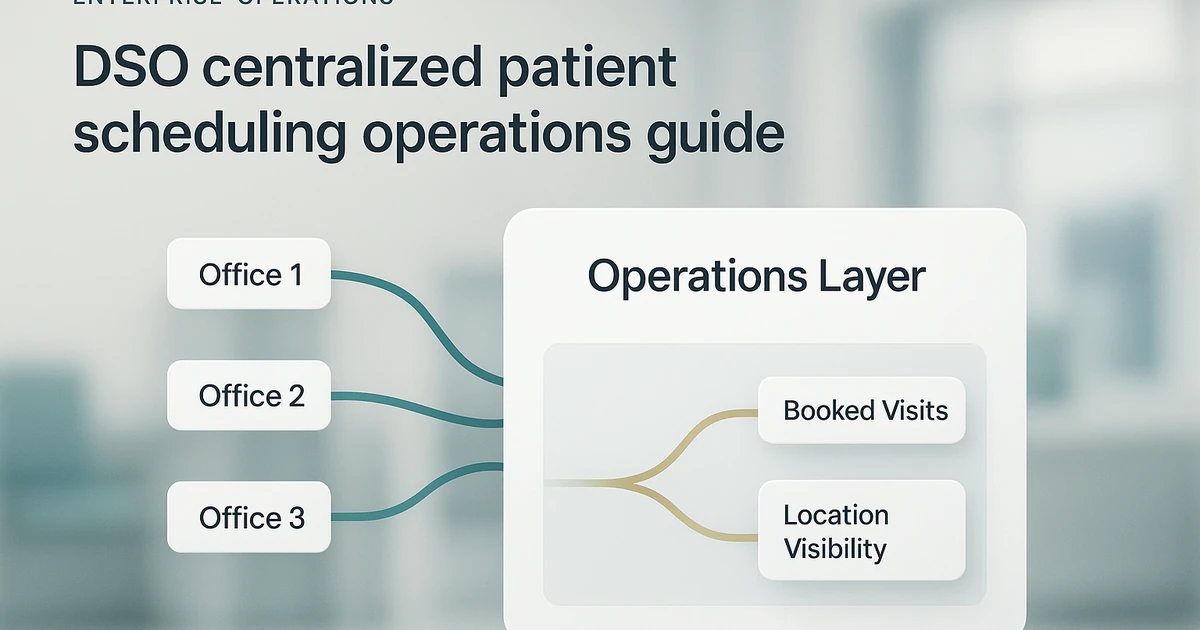
The technology stack for centralized scheduling must accomplish several objectives simultaneously. It must provide real-time visibility into appointment availability across all locations, enable agents to book efficiently without requiring deep knowledge of each practice’s nuances, and integrate with practice management systems to prevent double-booking and ensure clinical teams have the information they need.
Core platform requirements include a unified scheduling interface that aggregates availability from all locations, integration capabilities with major dental practice management systems, call routing and queue management for handling volume spikes, and reporting dashboards that surface operational metrics in real time.
Many DSOs underestimate integration complexity. Each acquired practice may run different software, and even practices on the same platform may have configured it differently. The centralized scheduling system must either normalize these differences or provide agents with context about location-specific requirements.
Healthcare consultancies emphasize that centralized scheduling call centers require standardized protocols, shared dashboards, and real-time appointment visibility across locations. Without this foundation, agents cannot deliver the consistent experience that justifies centralization.
Staffing Models and Team Structure
Centralized scheduling teams can be structured in several ways, each with tradeoffs. The most common models include dedicated teams where agents handle only scheduling, hybrid teams where agents handle scheduling alongside other patient communication functions, and tiered teams where initial contact is handled by generalists who escalate complex scheduling to specialists.
Team sizing depends on call volume, average handle time, and service level targets. Operations leaders should model staffing requirements based on historical data, accounting for volume variation by day of week and time of day. Understaffing creates long hold times that frustrate patients, while overstaffing erodes the efficiency gains that justify centralization.
Training programs for centralized scheduling staff must cover both technical skills and soft skills. Agents need proficiency with the scheduling platform, understanding of appointment types and durations across the network, and the communication abilities to handle patients who may be frustrated, confused, or anxious about dental care.
Integration with Practice Management Systems
The connection between centralized scheduling and practice management systems determines whether the operation runs smoothly or becomes mired in manual workarounds. Bidirectional integration, where the scheduling system can both read availability and write appointments, is essential for efficiency.
Common integration challenges include practices running outdated software versions that lack modern API capabilities, inconsistent data structures across locations, and security requirements that complicate data sharing. Operations leaders should audit the technology landscape across their network early in the planning process to identify integration obstacles.
When full integration is not immediately achievable, interim solutions may include standardized processes for manual synchronization, dedicated staff at each location responsible for schedule reconciliation, and phased integration timelines that prioritize highest-volume locations.
Standardizing Scheduling Protocols Across Locations
Consistency is the operational advantage that centralization enables. Without standardized protocols, a centralized team simply replicates the inconsistencies of distributed scheduling at larger scale.
Appointment Type Definitions and Duration Standards
Every practice in a DSO network should use consistent definitions for appointment types. When one location calls a procedure a “comprehensive exam” and another calls the same procedure an “initial visit,” agents cannot schedule efficiently and reporting becomes unreliable.
Creating a master appointment type library requires input from clinical leadership to ensure definitions align with actual clinical workflows. The library should specify standard durations for each appointment type, preparation requirements, and any equipment or room dependencies.
Duration standards must balance efficiency with clinical reality. Setting durations too short creates running-behind problems that frustrate patients and stress clinical teams. Setting them too long leaves capacity unused. Historical data from across the network can inform appropriate durations, accounting for variation in provider speed and patient complexity.
Scheduling Rules and Business Logic
Beyond appointment types, centralized scheduling requires codified rules for handling common scenarios. These rules address questions like: How far in advance can patients book? What is the cancellation policy and how is it enforced? How are emergency appointments accommodated? Which appointment types require specific providers or equipment?
Documenting these rules and embedding them in the scheduling platform reduces agent decision-making burden and ensures consistent patient experiences. When rules conflict, for example, when a patient requests an appointment type that requires equipment only available at certain locations, agents need clear guidance on resolution.
Government health agencies have published evidence-based guidance on scheduling methods, including open access approaches that allow patients to receive same-day appointments. DSOs may choose to implement open access for certain appointment types while maintaining traditional scheduling for others. Whatever approach is chosen, the rules must be clear and consistently applied.
Handling Exceptions and Escalations
No set of rules covers every situation. Centralized scheduling teams need defined escalation paths for scenarios that fall outside standard protocols. These might include patient complaints, requests that require clinical judgment, scheduling conflicts that cannot be resolved through normal means, and VIP patients who receive special handling.
Escalation protocols should specify who receives escalations, expected response times, and documentation requirements. Without clear escalation paths, agents either make decisions beyond their authority or leave patients waiting while they seek guidance.
Training should include scenario-based exercises that help agents recognize when escalation is appropriate. The goal is agents who confidently handle routine situations while reliably escalating the edge cases that require additional judgment or authority.
Implementing Change Management for Centralization
The transition to centralized scheduling disrupts established workflows and relationships. Change management determines whether the transition succeeds or stalls.
Stakeholder Alignment and Communication
Centralization affects multiple stakeholder groups: practice managers accustomed to controlling their schedules, clinical staff who rely on scheduling for their daily workflow, patients who may interact with new voices and processes, and central team members taking on new responsibilities.
Each group needs communication tailored to their concerns. Practice managers need to understand how centralization will affect their operations and what control they retain. Clinical staff need confidence that their schedules will be managed competently. Patients need seamless experiences that do not highlight the operational change.
Communication should begin well before implementation and continue through stabilization. Surprises create resistance. Stakeholders who feel informed and heard are more likely to support the transition even when challenges arise.
Phased Rollout Strategies
Attempting to centralize scheduling across all locations simultaneously invites chaos. Phased rollouts allow the central team to learn and adjust before scaling.
A typical phased approach starts with pilot locations selected for manageable complexity and supportive leadership. The pilot phase surfaces integration issues, training gaps, and process problems in a controlled environment. Lessons from the pilot inform adjustments before subsequent phases.
Later phases can proceed more quickly as the team gains experience, but operations leaders should resist pressure to accelerate beyond what the team can execute reliably. A failed rollout at scale is far more damaging than a delayed timeline.
Measuring and Communicating Early Wins
Change initiatives maintain momentum through visible progress. Operations leaders should identify metrics that will demonstrate improvement early in the transition and communicate wins actively.
Early metrics might include call answer rates, hold times, booking conversion rates, and patient satisfaction scores for scheduled appointments. Comparing these metrics before and after centralization provides evidence that the change is working.
Communicating wins serves multiple purposes: it validates the decision to centralize, motivates the central team, and reassures skeptical stakeholders. Even modest improvements demonstrate that the organization is moving in the right direction.
Optimizing Scheduling for Patient Access and Growth
Once centralized scheduling is operational, optimization becomes the ongoing work. The goal shifts from “make it work” to “make it work better.”
Maximizing Appointment Availability
Patient access depends on both total appointment supply and how that supply is distributed across times patients want. Centralized scheduling provides visibility to identify access gaps, times when demand exceeds supply or supply sits unused.
MGMA guidance on implementing centralized scheduling emphasizes supporting multi-location practice growth and operational efficiency. This requires proactive management of provider schedules to match patient demand patterns, strategic distribution of appointment types to balance utilization, and coordination across locations to redirect patients when their preferred location lacks availability.
Template management becomes a central function. Rather than each practice managing its own scheduling templates, the central team can standardize templates, implement best practices across locations, and make coordinated changes when demand patterns shift.
Reducing No-Shows and Cancellations
Empty appointments represent lost capacity that cannot be recovered. Centralized scheduling enables systematic approaches to reducing no-shows and filling cancelled slots.
Confirmation workflows can be standardized and automated, ensuring every patient receives reminders through their preferred channel. When cancellations occur, centralized visibility allows rapid identification of patients who could fill the slot, regardless of which location originally scheduled them.
Data from centralized systems also enables analysis of no-show patterns. If certain appointment types, times, or patient segments show elevated no-show rates, targeted interventions can address root causes rather than treating symptoms.
Leveraging Data for Continuous Improvement
Centralized scheduling generates data that distributed operations cannot match. This data becomes a strategic asset for continuous improvement.
Key metrics to track include call volume and answer rates by time period, booking conversion rates by agent and appointment type, schedule utilization by location and provider, patient wait times for appointments by type and urgency, and no-show and cancellation rates with root cause analysis.
Regular review of these metrics should inform staffing decisions, process changes, and technology investments. Operations leaders who treat scheduling data as a management tool rather than just a reporting requirement find opportunities for improvement that would otherwise remain hidden.
Integrating AI and Automation in Scheduling Operations
Technology continues to reshape what is possible in scheduling operations. DSOs that strategically adopt automation gain efficiency advantages while maintaining service quality.
Current Applications of AI in Scheduling
Industry analysis identifies AI-driven automation in scheduling and front-office workflows as essential for DSO operational efficiency and improved patient experience. Current applications include intelligent call routing that matches patients with appropriate agents, automated appointment reminders and confirmation, chatbots and voice assistants handling routine scheduling requests, and predictive analytics for demand forecasting and staffing optimization.
These technologies augment human agents rather than replacing them. Routine transactions can be automated, freeing agents to handle complex situations that require judgment and empathy. The result is both efficiency and improved service quality.
Evaluating Automation Opportunities
Not every process benefits from automation. Operations leaders should evaluate opportunities based on volume, complexity, and patient impact.
High-volume, low-complexity transactions are strong automation candidates. Simple appointment confirmations, basic availability inquiries, and routine rescheduling can often be handled through automated systems. Complex transactions, new patient intake, multi-appointment treatment planning, insurance coordination, benefit from human handling.
Patient preferences matter. Some patients welcome the convenience of self-service scheduling. Others strongly prefer human interaction. Offering multiple channels respects these preferences while capturing efficiency gains where patients accept automation.
Building Human-AI Hybrid Workflows
The most effective scheduling operations combine human and automated capabilities in workflows designed for each transaction type. Initial contact might be automated, with seamless handoff to human agents when complexity requires it.
Designing these workflows requires understanding both the capabilities of current AI technology and the value of human judgment. Automation handles the predictable well. Humans handle the exceptions, the emotional moments, and the situations where context matters.
Training programs for human agents should evolve to focus on the skills automation cannot replicate: empathy, problem-solving, and judgment. As routine transactions migrate to automated channels, the transactions that reach human agents become more complex on average.
Measuring Success and Driving Accountability
Centralized scheduling must demonstrate value to justify ongoing investment. Clear metrics and accountability structures ensure the function delivers on its promise.
Key Performance Indicators for Centralized Scheduling
Operations leaders should track metrics across multiple dimensions:
Access metrics measure how easily patients can reach scheduling and secure appointments. These include call answer rates and speed, abandonment rates, and time to next available appointment by type.
Efficiency metrics measure how well the central team utilizes resources. These include appointments booked per agent hour, schedule utilization rates, and cost per appointment scheduled.
Quality metrics measure whether scheduling delivers good patient experiences and accurate outcomes. These include patient satisfaction scores, scheduling accuracy rates, and complaint volumes.
Growth metrics measure scheduling’s contribution to organizational objectives. These include new patient booking rates, reactivation success rates, and capacity utilization improvements.
No single metric tells the complete story. Operations leaders need a balanced scorecard that prevents optimizing one dimension at the expense of others.
Creating Feedback Loops with Locations
Centralized scheduling serves locations, and location feedback is essential for continuous improvement. Formal mechanisms should capture location perspectives on scheduling quality, responsiveness, and accuracy.
Regular check-ins between central scheduling leadership and practice managers surface issues before they become crises. When locations report problems, rapid response demonstrates that the central function is accountable to its internal customers.
Feedback should flow both directions. Central scheduling often identifies process issues at locations that affect scheduling quality. Collaborative problem-solving addresses root causes rather than symptoms.
Continuous Improvement Cycles
Excellence in scheduling operations requires ongoing attention. Quarterly business reviews should assess performance against targets, identify improvement opportunities, and align priorities.
Improvement initiatives should be scoped, resourced, and tracked like any project. Vague commitments to “do better” produce vague results. Specific initiatives with clear owners, timelines, and success metrics drive actual improvement.
Benchmarking against industry standards and peer organizations provides context for performance assessment. Operations that appear strong in isolation may reveal improvement opportunities when compared to best-in-class performers.
Preparing for Scale and Future Growth
DSOs that master centralized scheduling position themselves for growth through acquisition and organic expansion. The scheduling function should be designed not just for current needs but for anticipated scale.
Designing for Acquisition Integration
Growth through acquisition is common in the DSO sector. Centralized scheduling can accelerate integration timelines when designed with acquisition in mind.
Standard integration playbooks should document how new practices are onboarded to centralized scheduling. These playbooks specify technology requirements, data migration processes, training programs, and timeline expectations.
Early engagement with acquired practices on scheduling matters. Understanding their current workflows, patient expectations, and staff capabilities informs integration planning. Practices that feel heard during integration become advocates for centralization rather than resisters.
Scaling Technology and Staffing
Growth stresses both technology and staffing. Operations leaders should model future requirements and invest ahead of need rather than scrambling to catch up.
Technology platforms should be evaluated for scalability. Can the system handle twice the current volume? Five times? Cloud-based platforms typically scale more readily than on-premises systems, but scaling limits vary.
Staffing growth requires lead time for recruiting and training. Modeling future staffing needs based on growth projections allows proactive hiring rather than reactive scrambling when volumes exceed capacity.
Building Organizational Capability
Beyond immediate operational needs, DSOs should invest in building scheduling as an organizational capability. This means developing expertise that persists even as individuals come and go.
Documentation of processes, training materials, and operational playbooks captures knowledge in accessible forms. Leadership development within the scheduling function creates a pipeline of future managers. Cross-training reduces dependency on any single individual.
Organizations that treat scheduling as a strategic capability invest accordingly. Those that treat it as merely an operational function often find their investment insufficient when growth accelerates or key personnel depart.
Ready to transform your multi-location scheduling operations?
If your DSO operates 3 or more locations and you are evaluating options for centralizing patient scheduling, our team can help you assess your current state, identify improvement opportunities, and plan your transformation.
Schedule a discovery call to discuss how centralized scheduling can drive growth and efficiency across your dental organization.
Related Reading
- DSO Integration Playbook
- Centralized Scheduling for Dental Offices
- DSO Change Management: Centralizing Patient Access
- Healthcare Call Center ROI for Enterprise
- EHR/PMS Integration for Centralized Scheduling
- DSO Call Center KPI Benchmarks
- Multi-Location Healthcare Intake Guide
- Centralized vs Distributed Intake Framework