
Table of Contents
- Why Do Multi-Location DSO KPIs Need Enterprise Design?
- Which KPI Domains Should Enterprise DSOs Standardize?
- How Should DSOs Tie KPIs to EBITDA Impact Without Overclaiming?
- What Governance Turns KPI Dashboards Into Operating Discipline?
- How Should Technology and Integrations Support the KPI Stack?
- How Should Buying Committees Roll This Out Across Locations?
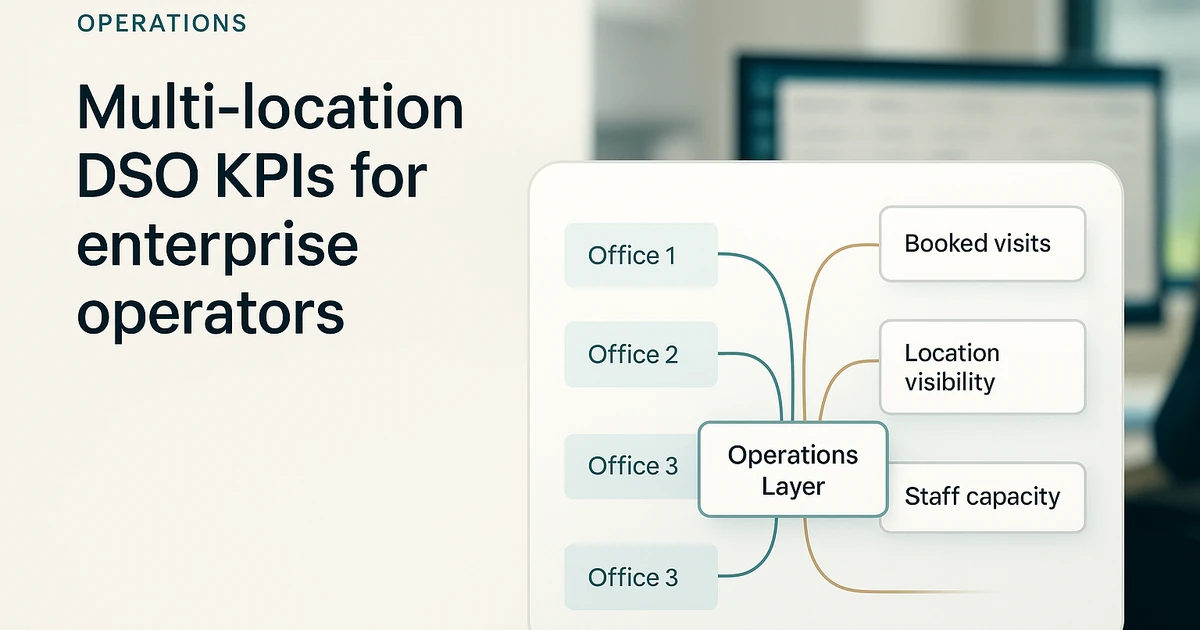
Multi-location DSO KPIs are not just a dashboard problem. For COOs, VPs of Operations, and PE operating partners, they are a control system for standardization, centralization, SLA calibration, and EBITDA impact across the platform.
A DSO KPI model should connect patient access, scheduling, recall, QA, integrations, and site-level execution into one operating cadence.
That is why the right frame is not “what should each office track?” The better question is how enterprise DSO operations should compare performance, detect variation, and act across a multi-location network.
Why Do Multi-Location DSO KPIs Need Enterprise Design?
A single metric can look useful at the site level and still be misleading at the enterprise level. If every location defines answered calls, converted appointments, recall outcomes, or escalation completion differently, the executive dashboard becomes a collection of incompatible facts.
Enterprise KPI design starts with standard definitions.
The ADA Health Policy Institute practice modality data breaks down dentist affiliation by number of practice locations and DSO status, which is a useful reminder for operators: scale and operating model are related, but they are not the same thing.
Practice Size Is Not the Same as Operating Model
ADA News summarizes HPI’s distinction between dental practice size and DSO affiliation, noting that DSO affiliation is tied to management of non-clinical functions rather than location count alone (ADA News).
That distinction matters for KPI design because a group can be multi-location without having centralized operating discipline.
For operators, this means the KPI system should measure the model the organization is trying to run, not just the locations it owns.
A DSO that has centralized scheduling, shared call handling, and standardized workflows needs metrics that show whether those shared functions are working consistently across the network.
Scale Turns Measurement Into Governance
At scale, KPIs are governance tools. They define which team owns an outcome, which exceptions require escalation, and which operating reviews should happen at the enterprise level rather than being handled informally by each site.
The KPI set should therefore separate clinical judgment from non-clinical execution. DSOs can respect clinical autonomy while still standardizing patient access workflows, call handling, recall logic, documentation practices, QA rubrics, and reporting definitions through enterprise operations.
Which KPI Domains Should Enterprise DSOs Standardize?
The strongest DSO dashboards do not overload leaders with every available metric. They organize performance into domains that match how the operating team actually manages the business.
Group Dentistry Now explains that dental groups become DSOs when non-clinical support functions are separated and centralized, including areas such as billing, marketing, HR, IT, payroll, and accounting (Group Dentistry Now).
That operating model points directly to the KPI domains leaders should standardize.
Patient Access and Scheduling Control
Patient access KPIs should show whether the organization is reachable, whether calls are routed correctly, whether scheduling rules are followed, and whether handoffs are completed according to approved workflow.
The goal is not to force every location into identical capacity rules; it is to create a shared language for access performance.
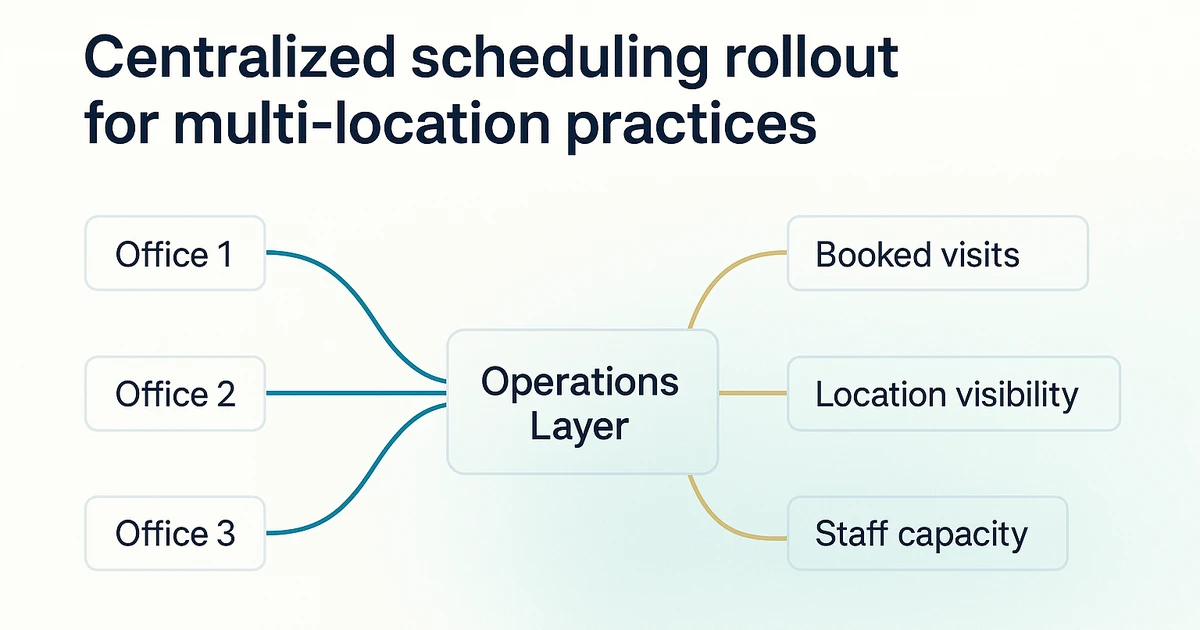
For DSOs moving toward centralized scheduling, the dashboard should separate enterprise-controlled variables from site-controlled variables.
Routing logic, contact center staffing, QA standards, and scripting may sit centrally, while provider availability and procedure-specific capacity may still vary by location.
Recall, Reactivation, and Retention Signals
Recall and reactivation KPIs should show whether the group has a consistent patient lifecycle process. The executive view should not stop at campaign volume; it should track whether outreach lists are generated consistently, statuses are coded consistently, and unresolved patient follow-up moves to the correct queue.
This is where KPI design protects EBITDA discussion from vague attribution.
Instead of making unsupported promises about revenue lift, the dashboard should show whether operating inputs are disciplined: list hygiene, outreach completion, appointment disposition, failed-contact reasons, and location-level variance in follow-through.
How Should DSOs Tie KPIs to EBITDA Impact Without Overclaiming?
Enterprise buyers care about EBITDA impact, but KPI programs should avoid inflated causal claims.
Dental Economics identifies DSO-relevant valuation and operating factors including collections, profitability, growth rate, team turnover, patient satisfaction, operating systems, and timely financial reporting (Dental Economics).
For DSO operators, that is the right level of analysis: connect KPIs to operating systems first, then evaluate financial impact through the finance team’s model.
Measure Operational Leakage as a Management Question
Operational leakage is best treated as a management question, not a slogan. Calls that do not reach the right workflow, appointments that are not confirmed correctly, recall records with unclear status, and escalations without owners all create visibility gaps for leadership.
The KPI dashboard should make those gaps explicit. For example, a location comparison should show whether variance is driven by access capacity, scheduling policy, training, PMS configuration, or site-level follow-through. That context is more useful than ranking locations without explaining what leaders can do next.
Compare Locations by Context, Not Vanity Rankings
Enterprise KPI programs often fail when dashboards become scoreboards without context. A high-performing specialty site and a newly integrated acquisition may have different workflow complexity, payer mix, system maturity, and staffing stability.
A better model groups locations by operational similarity and reviews outliers inside those peer groups. This lets the COO see where standardization is working, where exceptions are justified, and where a location is drifting away from enterprise protocol.
What Governance Turns KPI Dashboards Into Operating Discipline?
A KPI dashboard becomes useful only when it is paired with a management rhythm. Without owners, review cadence, and escalation rules, dashboards create visibility but not accountability.
For DSOs, governance should be explicit across the operating stack: executive review, regional operations review, contact center management, QA calibration, and location feedback.
The enterprise reporting and QA layer should define what is reviewed, who owns each variance, and how process changes are approved.
Define Owners, Cadence, and Escalations
Every KPI should have an owner. Patient access metrics may belong to a VP of Operations or Director of Patient Access. QA outcomes may belong to contact center leadership. PMS integration defects may belong to operations technology or IT.
Ownership should be paired with review cadence. Executive teams need trend and variance views. Operational leaders need queue-level and workflow-level detail. Site leaders need actionable exceptions rather than broad enterprise summaries they cannot influence.
Calibrate SLAs and QA Before Targets Harden
SLA calibration should happen before leadership hardens targets. If the group has not agreed on what counts as answered, resolved, transferred, abandoned, converted, escalated, or completed, targets can create behavior that looks good in reporting but weakens operational truth.
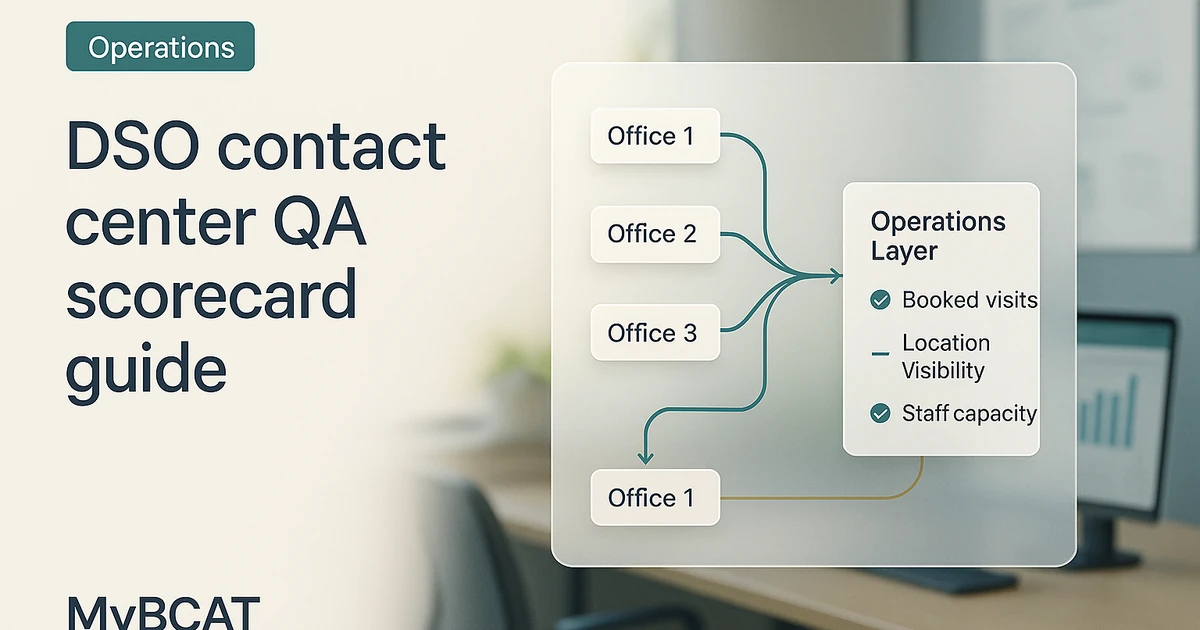
QA calibration matters for the same reason. A contact center QA scorecard for DSOs should define the behaviors that protect scheduling accuracy, courtesy, privacy-sensitive handling, documentation quality, and correct escalation. The KPI system should then report patterns from QA, not just isolated call scores.
How Should Technology and Integrations Support the KPI Stack?
DSO KPI design depends heavily on the systems that produce the data. Phone systems, PMS platforms, call recordings, recall tools, CRM workflows, and reporting layers can all define the same event differently.
Dental Economics discusses how DSOs use scale, purchasing power, marketing, payer use, referral networks, and professional management to compete (Dental Economics).
For KPI design, the implication is practical: the dashboard should be built around standardized definitions before leaders rely on it for management decisions.
Build Around the PMS and Workflow Reality
The PMS is often a central source of scheduling and patient workflow truth, but multi-location DSOs may inherit varied systems through acquisition. That makes integrations a governance issue, not just a technical project.
Where systems differ, the KPI layer should document mapping rules. For example, appointment types, recall statuses, cancellation reasons, and escalation codes should be normalized so leadership can compare performance without pretending every underlying workflow is identical.
Keep Compliance Review in the Operating Rhythm
The KPI program should not claim that a dashboard, vendor, script, or workflow satisfies a regulation on its own.
The safer operating approach is to define approved handling rules, limit unnecessary sensitive details in reports, control access to call recordings and patient information, and include privacy-related behaviors in QA review.
How Should Buying Committees Roll This Out Across Locations?
A DSO KPI program should roll out as an operating change, not a reporting upgrade. Buying committees should evaluate whether the organization has the people, workflow definitions, vendor controls, and executive cadence to use the data well.
For groups considering managed front-office support, front desk outsourcing should be evaluated through the same KPI framework. The vendor question is not just whether calls can be handled; it is whether performance can be measured, coached, reported, and governed across the group.
Start With a Controlled Pilot
A controlled pilot gives the operating team a place to test definitions, reporting logic, QA calibration, exception handling, and site feedback before the model scales. The pilot should include locations that reflect meaningful workflow variation without overwhelming the governance process.
During the pilot, leaders should document which metrics are reliable, which definitions need revision, and which workflow defects are being exposed by the data. The output should be an operating playbook, not just a prettier dashboard.
Convert Lessons Into Standard Work
After the pilot, the group should convert lessons into standard work: metric definitions, dashboard views, QA rubric updates, escalation paths, training materials, and executive review templates. This is where KPI design becomes repeatable.
Standard work also supports acquisition integration. When a new practice joins the platform, leaders can evaluate intake, scheduling, recall, QA, and reporting readiness against the same operating model instead of rebuilding expectations for each location.
Related Reading
Related reading should support the same enterprise frame: standardization, centralized management, QA calibration, and operational reporting. The goal is to give buying committees a path from KPI design into execution planning.
These resources are internal navigation links only. They are not used as factual sources for external claims in this article.
DSO Operations Guides
A DSO KPI system is strongest when it sits inside a broader operating model. Scheduling, integration, workflow standardization, and patient access management all need to be coordinated so metrics reflect how the group actually runs.
For teams building that operating model, these guides provide useful next steps:
- DSO Call Center KPI Benchmarks for Enterprise Healthcare
- DSO Centralized Patient Scheduling Operations
- DSO Integration Playbook
Reporting and QA Guides
KPI programs need reporting discipline and QA governance to avoid metric drift. A dashboard can show variance, but QA explains whether the variance reflects training, workflow, system configuration, or site-level execution.
For teams refining dashboards and scorecards, these guides are a practical next layer:
- Reporting Dashboard for Multi-Site Healthcare Operations
- Dental Group Workflow Standardization
Sources
- ADA Health Policy Institute: U.S. Dentist Affiliation by Practice Size and DSO Status
- ADA News: More Dentists Affiliating With DSOs
- Group Dentistry Now: When Does a Dental Group Practice Become a DSO?
- Dental Economics: The practices that invisible DSOs value most
- Dental Economics: ‘Invisible’ DSOs: Friend or foe?
Managing multi-location DSO KPIs across 3+ locations? Request an Enterprise Assessment for your group.