
Table of Contents
- What should an enterprise patient access center own?
- How should leaders standardize scheduling without ignoring site constraints?
- How do digital requests become completed patient-access work?
- Who makes decisions when locations need exceptions?
- What is the safest rollout sequence for a multi-location group?
- How should the access center be trained and measured?
- What controls must be ready before go-live?
For a healthcare group with three or more locations, patient access is not a front-desk task that happens to repeat across sites. It is an operating model. A patient may start with a web request, call a central number, need a benefits question resolved, and ultimately need the correct provider, location, visit type, and time. If every site handles that path differently, the group inherits inconsistent experience, uneven schedule use, fragmented reporting, and avoidable work for local teams.
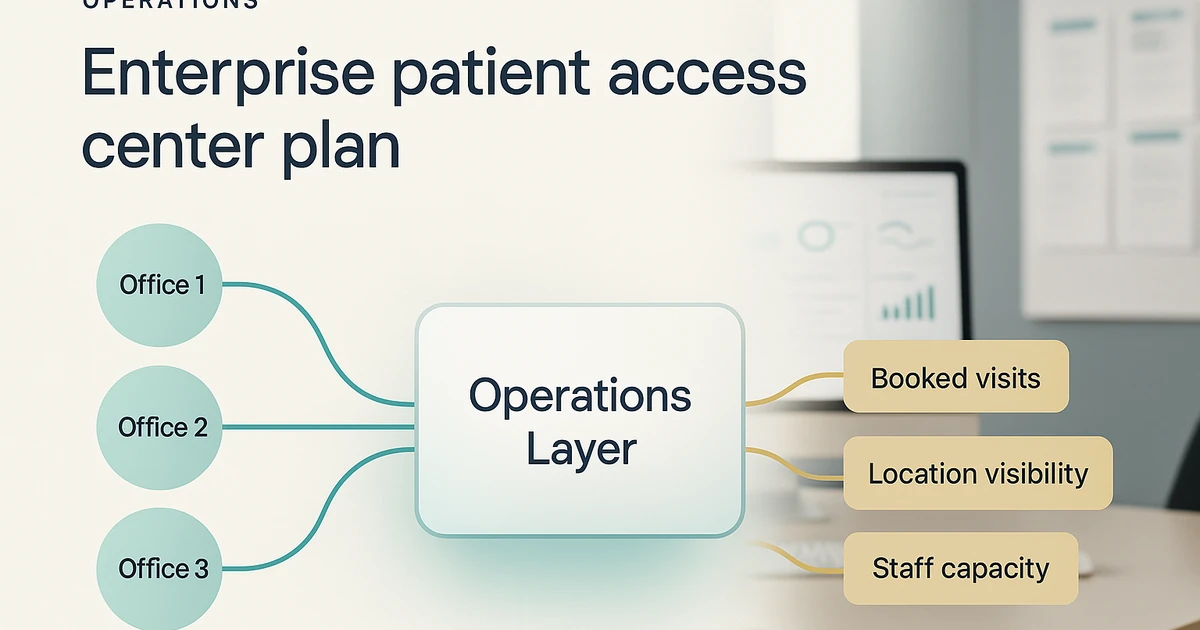
An enterprise patient access center creates one accountable layer for inbound calls, scheduling, intake follow-up, reminders, recall, reactivation, routing, and service recovery. It should not remove clinical judgment or erase legitimate local constraints. Its job is to make repeatable work consistent, make exceptions visible, and give leaders a reliable view of access performance across the network.
This implementation plan is for COOs, VPs of Operations, and cross-functional buying committees at multi-location optometry, dental, veterinary, and healthcare groups. It is designed to complement a broader enterprise operating model and a defined patient access center, not to prescribe a one-size-fits-all call-center setup.
What should an enterprise patient access center own?
Start with decision rights, not software. Many centralization efforts stall because the organization buys or configures a platform before it has agreed on what the central team owns, what remains with the location, and how work crosses that boundary.
The central model commonly owns repeatable, rules-based work: inbound call handling, new and established patient scheduling, appointment changes, reminder responses, intake follow-up, referral follow-up, recall and reactivation outreach, web inquiry handling, wait-list coordination, and basic service requests. Those workflows need a documented owner, service expectation, reason code, disposition, and next action.
The model also needs a firm list of work it does not own. Clinical triage, provider-specific clinical decisions, urgent clinical escalation, and other matters requiring licensed or site-based judgment need explicit handoffs. A central agent should never have to invent a clinical answer because the workflow failed to identify the appropriate recipient. The same principle applies to payer or location exceptions: define the handoff and the response owner before go-live.
Build a contact taxonomy during implementation. Every interaction should be classified by intent, channel, outcome, and accountable next step. That taxonomy is the shared foundation for QA, staffing, service recovery, and executive reporting. It also makes the distinction between a true access problem and a local workflow problem much easier to see.
How should leaders standardize scheduling without ignoring site constraints?
Centralized scheduling succeeds when scheduling rules are clear enough for a trained central team to apply and flexible enough to account for approved local realities. The objective is not simply to fill any open slot. It is to place the right appointment with the right provider, service, location, and preparation requirements while making exceptions governable.
Translate visit types, provider rules, appointment lengths, equipment needs, payer requirements, location hours, and patient preferences into plain-language booking rules. For every major visit type, document what information must be collected, which providers and sites are eligible, what an agent may book directly, and what requires escalation. The MGMA discussion of centralized scheduling is a useful reminder that scheduling is an operational design problem, not just a staffing change.
No template covers every situation. Create named exception paths for urgent requests, provider-directed changes, insurance limitations, accessibility or language needs, equipment constraints, and cases requiring clinical review before booking. Each exception should have a routing destination, expected response owner, and documentation requirement. Recurring exceptions should go to governance review. Otherwise, informal site rules will quietly recreate a distributed model inside the centralized one.
For additional rollout detail, use the group’s centralized scheduling rollout plan alongside the implementation work. It helps keep scheduling configuration, training, and local validation in the same sequence.
How do digital requests become completed patient-access work?
An access center is not only a phone operation. It coordinates the digital front door: online requests, portal messages, text responses, web forms, wait-list activity, and appointment-related follow-up. Federal health IT guidance on patient portals and smartphone health apps supports treating digital access as part of the overall patient-access environment rather than a separate project.
Digital self-service does not eliminate follow-through. A request may be incomplete, point to the wrong visit type, require eligibility review, or conflict with a patient’s location preference. Each digital request therefore needs a status, an owner, and a service target. Define who monitors the queue, how often it is worked, what counts as completed, and when the outreach should move from a digital channel to a call.
Automation can support reminders, confirmations, wait-list notifications, routing, and recall. It cannot replace the operating rules behind those actions. If a patient replies to a reminder, someone needs to own the response. If a slot opens, the group needs a documented rule for who is contacted first. If an online request cannot be completed, the exception must return to a visible queue rather than disappear into an inbox. Teams planning recall workflows should connect this work to their patient recall program so outreach and booking outcomes remain visible together.
Who makes decisions when locations need exceptions?
Centralization changes habits and local control, which makes governance a delivery requirement rather than an afterthought. Before rollout, name who approves scheduling standards, queue priorities, scripts, reporting definitions, system access, escalation language, and workflow changes.
In many groups, operations owns staffing and queue design; clinical leadership approves clinical boundaries and escalation language; revenue-cycle leaders define insurance-related intake requirements; and IT or security owns integration, identity, and access controls. The exact chart varies, but ambiguity cannot. A location request for a new rule, template change, or special exception should enter a change-control path, not be settled through side conversations.
Give each pilot location a named champion and assign one central operations owner for the access center. The location champion tests whether the workflow produces workable results for patients and staff. The central owner decides whether the issue calls for a standards change, training correction, system change, or a deliberate local exception. This is particularly important when the group has acquired sites with different appointment naming, communication habits, or escalation expectations.
The governance forum should review recurring exceptions, not just complaints. That turns the access center into a source of operating evidence. A recurring transfer pattern may point to unclear training; a recurring scheduling exception may show a template that does not match actual capacity. The related centralized versus distributed intake framework can help leadership decide which work belongs in the shared model.
What is the safest rollout sequence for a multi-location group?
A phased rollout gives leaders time to validate live work before the model reaches every site. The right first phase depends on the group’s current constraint. If coverage gaps and abandonment are the immediate problem, begin with after-hours or overflow calls and service recovery. If local teams are carrying repetitive outreach, recall or reminder response may be a sensible first workflow. If scheduling templates are inconsistent, standardize the rules before moving high volumes to a central queue.
Write the pilot scope down. It should state included locations, workflows, hours, routing rules, escalation contacts, reporting cadence, training completion requirements, and success criteria. The pilot should also identify what is out of scope. Informal requests to add one location-specific task can be valid, but they should be evaluated against the rollout plan instead of added automatically.
A practical 30/60/90-day view can organize the work without pretending every group moves at the same speed. The first period maps workflows, validates access, confirms security controls, and trains the pilot team. The second period tests live operations, reviews exceptions, and calibrates quality. The third period refines standards, expands only where the evidence supports it, and establishes the management cadence. The multi-location intake guide is a useful companion when defining the pilot’s location and workflow boundaries.
How should the access center be trained and measured?
Enterprise access work requires more than phone etiquette. Agents need workflow-specific training on scheduling logic, local rules, documentation, system use, escalation boundaries, and service recovery. A new-patient scheduler does not need the same depth as a recall specialist or an agent handling insurance-related intake, so training should be role-based rather than a single orientation deck.
Build training around approved scripts, prohibited language, system steps, booking rules, required documentation, and common exception scenarios. Make local differences visible inside the knowledge base or workflow tooling so agents can locate the right rule without relying on memory or repeated calls to site staff. That protects consistency while keeping legitimate site constraints available.
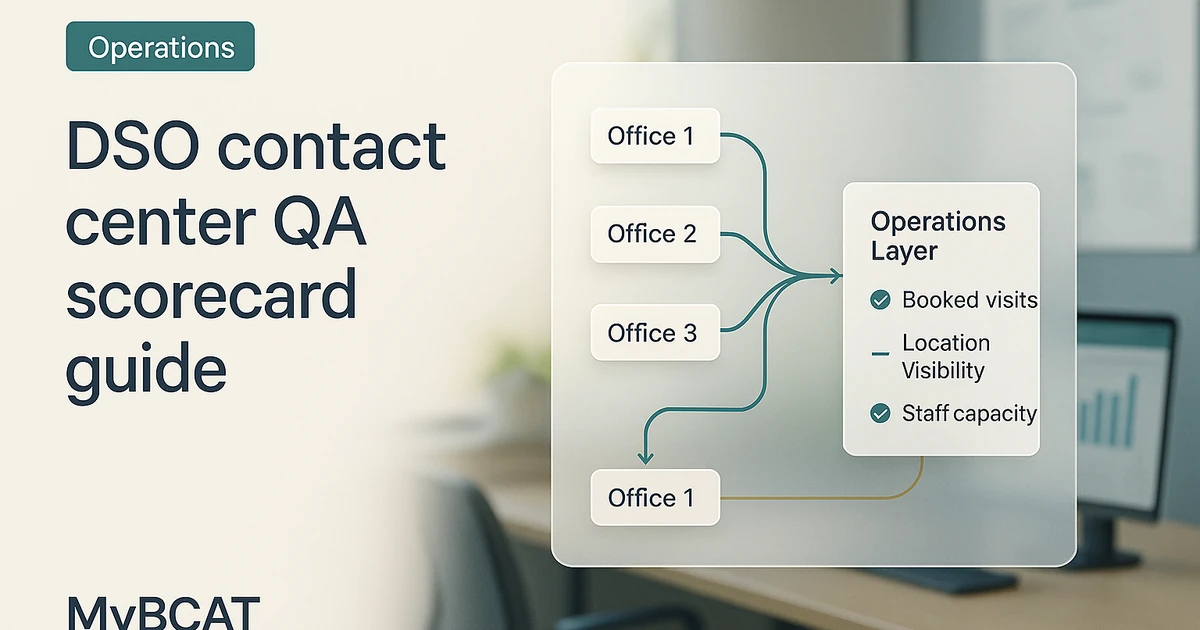
Start QA during the pilot. Supervisors, trainers, and operations leaders should review representative interactions together and align on what good execution looks like before volume grows. CMS describes CAHPS as a family of standardized patient-experience surveys; for access leaders, the relevant lesson is that speed alone is not quality. Communication clarity, ease of access, and consistent handling all deserve review.
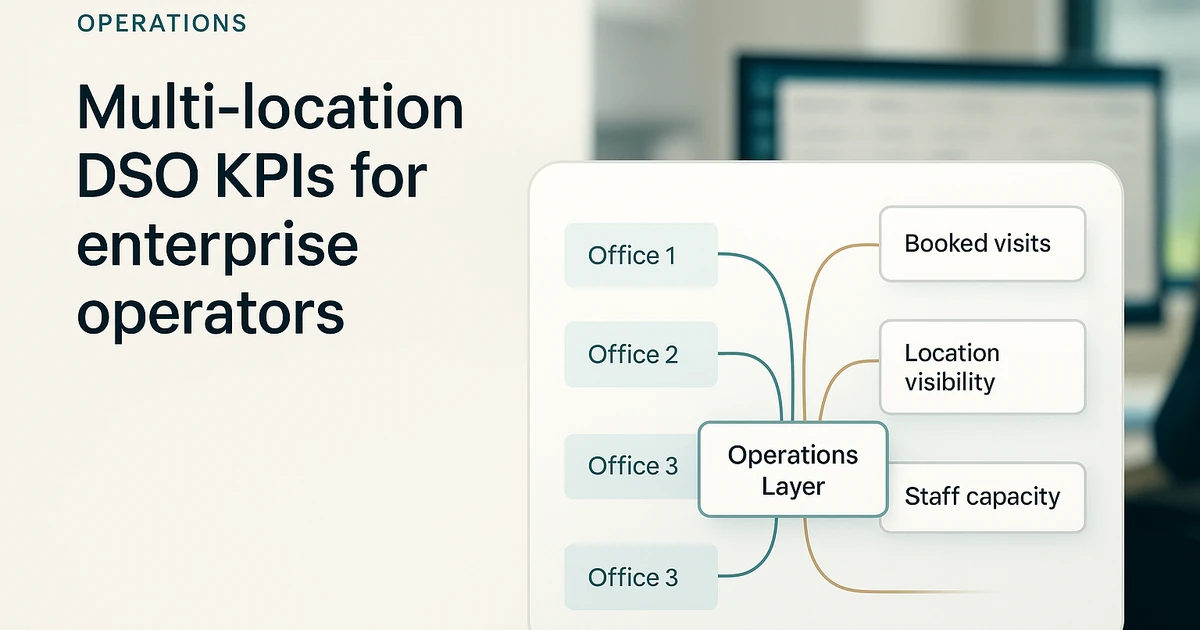
Separate executive KPIs from daily operating controls. Executives need a concise view of demand, accessibility, completion, rework, and variation by location or workflow. Supervisors need queue-level controls that help them adjust staffing, coaching, routing, or rules. Useful categories include demand by channel, unresolved-request aging, transfer reasons, scheduling outcomes, escalation volume, documentation quality, and patient-experience signals. Compare performance first against the group’s own baseline rather than importing unsupported benchmarks. The patient access center metrics guide offers a fuller executive reporting framework.
What controls must be ready before go-live?
Patient access workflows can involve protected health information, so workflow urgency cannot outrun privacy, security, and vendor controls. Before go-live, map the systems each role needs: practice-management or EHR tools, phone and text platforms, intake and portal queues, knowledge bases, workforce tools, QA systems, and reporting dashboards.
For each system, document the role, minimum access level, authentication requirement, audit trail, approval owner, and offboarding process. Do not grant broad access simply to make implementation faster. Multi-location visibility also deserves testing: switching among locations, templates, or queues can increase training time and error risk if the workflow is unclear.
Review data handling, call-recording policies, user access, vendor responsibilities, escalation documentation, and contractual obligations before scaling. The group’s enterprise patient-access compliance guidance should be part of that readiness review. Controls work best when they are embedded in the workflow design, not added after agents have developed workarounds.
How does the access center become an enterprise management layer?
After the model is stable, the access center becomes more than a support function. Its data can reveal demand and capacity mismatches, transfer patterns, scheduling friction, and workflow variation that individual sites cannot easily see. Leaders can use those signals in operating reviews to ask better questions: Is a location constrained by provider capacity, template rules, equipment availability, hours, payer requirements, or an unresolved process problem?
The access center will not solve every capacity issue. It gives the enterprise a consistent signal and a disciplined path for acting on it. Keep the rule set current as providers, hours, payer requirements, services, and communication channels change. A recurring cadence of QA calibration, exception review, location feedback, staffing review, dashboard review, and workflow-change approval keeps the system useful without turning every meeting into a redesign exercise.
Enterprise CTA
Ready to Improve Your Patient Retention?
MyBCAT helps healthcare practices recapture missed calls and automate patient scheduling so no opportunity slips through the cracks.
Related Reading
- Multi-Location DSO KPIs for Enterprise Operators
- Contact Center QA Scorecards for DSOs
- Reporting Dashboard Multi-Site Healthcare Operations