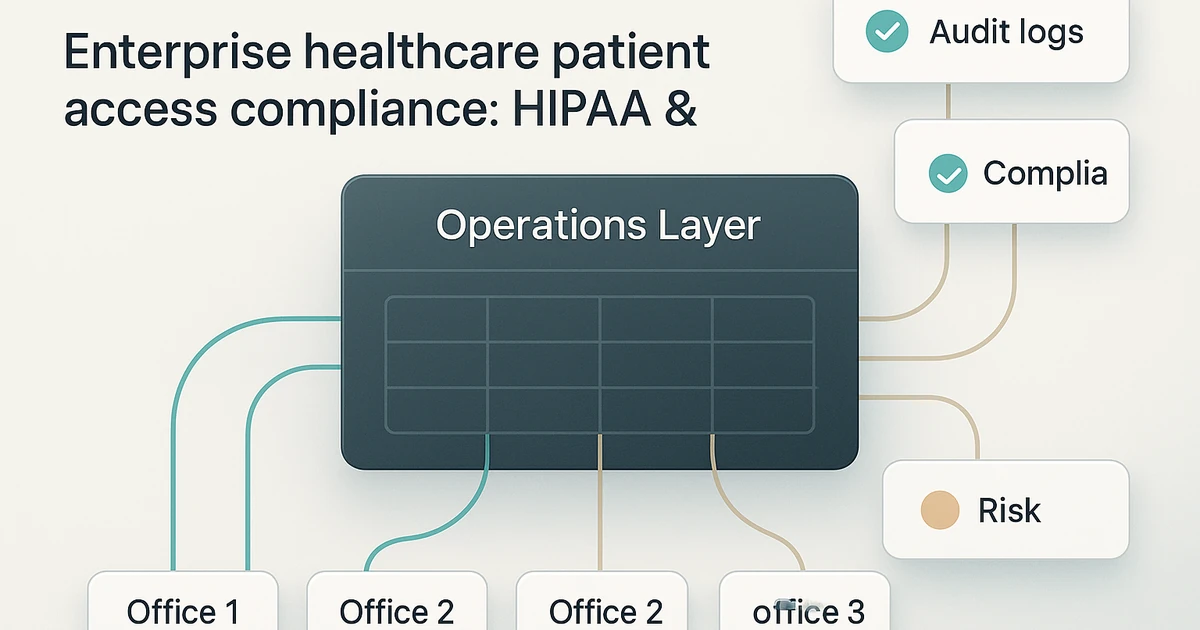


Healthcare organizations with three or more locations face a compliance challenge that single practices never encounter: the multiplication of risk across every site, every system, and every staff member who touches patient data. According to the IBM Cost of a Data Breach Report 2024, healthcare data breaches now cost an average of $9.77 million per incident, and organizations operating centralized patient access functions across multiple locations face exposure at every point where PHI moves between systems, vendors, and staff.
This guide provides the operational framework that enterprise healthcare groups, DSOs, and PE-backed platforms need to establish HIPAA and SOC2 compliant patient access operations. You will find specific requirements for Business Associate Agreements, audit trail standards, and a vendor evaluation checklist designed for procurement teams evaluating centralized intake solutions.
What You’ll Learn
- What Does Patient Access Compliance Actually Require at Enterprise Scale?
- Why Do Multi-Location Groups Face Amplified Compliance Risk?
- How Does HIPAA Apply to Centralized Patient Access Centers?
- What Makes SOC2 Type II the Gold Standard for Healthcare Vendors?
- The Compliance Cost Equation: Prevention vs. Breach
- How Should Enterprise Groups Structure Their BAA Requirements?
- Building a Compliance-First Patient Access Infrastructure
- What Audit Trail and Monitoring Standards Should Multi-Location Groups Expect?
- Vendor Evaluation: The 12-Point Compliance Checklist
What Does Patient Access Compliance Actually Require at Enterprise Scale?
Patient access compliance at the enterprise level operates on fundamentally different principles than compliance for a single practice. When your organization manages patient scheduling, intake, and communications across five, fifteen, or fifty locations, the regulatory requirements expand proportionally. The difference is not merely administrative complexity; it reflects a structural shift in how regulators view your organization’s obligations under HIPAA, state privacy laws, and industry security frameworks like SOC2.
Enterprise healthcare compliance requires establishing standardized controls that function identically across every location while maintaining the documentation and audit capabilities to prove that standardization to regulators, PE sponsors, and payer auditors. This dual requirement of operational consistency and verifiable proof creates the compliance burden that distinguishes enterprise operations from single-site management.
The Three Pillars of Healthcare Compliance
Healthcare compliance for patient access operations rests on three interconnected regulatory frameworks. HIPAA establishes the baseline requirements for protecting Protected Health Information during all patient interactions, from initial phone calls through appointment confirmations and billing communications. The HIPAA Privacy Rule governs how PHI can be used and disclosed, while the Security Rule mandates specific administrative, physical, and technical safeguards.
The second pillar involves state-specific privacy regulations that frequently exceed HIPAA requirements. California’s CCPA, Texas’s data breach notification laws, and emerging state-level health privacy statutes create a patchwork of obligations that multi-state healthcare groups must navigate. Organizations operating patient access centers that serve locations across multiple states must implement controls satisfying the most stringent applicable standard.
The third pillar encompasses voluntary but increasingly expected security frameworks, primarily SOC2 Type II certification. While not legally mandated for healthcare operations, SOC2 has become the de facto standard that enterprise buyers expect from any vendor handling PHI. According to Thoropass’s 2025 SOC2 compliance analysis, enterprise healthcare organizations increasingly require SOC2 Type II reports from patient access vendors as a prerequisite for contract discussions.
How Compliance Requirements Change Above 3 Locations
The three-location threshold marks a significant inflection point in compliance complexity. Below this threshold, most healthcare organizations can manage compliance through informal processes, with practice managers handling training documentation and IT vendors providing security controls. Above three locations, this informal approach creates unacceptable gaps.
At the enterprise level, organizations must establish centralized compliance governance including a designated compliance officer, standardized policies deployed across all locations, and systematic audit processes. The HHS Office for Civil Rights explicitly considers organizational size and complexity when evaluating compliance adequacy, meaning that multi-location groups face heightened scrutiny during audits and investigations. If you are managing centralized patient scheduling across a DSO, the expectation is that your compliance infrastructure scales with your operational footprint.
Multi-location groups also face aggregated breach notification obligations. A security incident affecting patient data from multiple locations triggers consolidated notification requirements, potentially requiring notification to thousands of patients simultaneously and attracting greater regulatory attention than an incident at a single practice.
The Regulatory Landscape in 2026
The regulatory environment for healthcare patient access continues to tighten. The HHS proposed Security Rule modifications emphasize enhanced cybersecurity requirements including real-time threat monitoring, mandatory multi-factor authentication, and more rigorous vendor oversight. These proposed rules signal that regulators expect healthcare organizations to implement controls that were previously considered best practices rather than requirements.
CMS interoperability mandates effective in 2026 add another layer of complexity for patient access operations. The Patient Access API requirements under the CMS-0057-F final rule mandate FHIR-based data sharing capabilities, requiring patient access platforms to support standardized data exchange while maintaining security controls. For multi-location groups implementing EHR and PMS integrations for centralized scheduling, these interoperability requirements create additional security considerations around API authentication, data encryption, and access logging.
Why Do Multi-Location Groups Face Amplified Compliance Risk?
The compliance challenges facing multi-location healthcare groups are not simply the single-practice challenges multiplied by location count. Enterprise operations create emergent risks that single practices never encounter, stemming from the interactions between distributed staff, inconsistent technology implementations, and the centralized data flows required for operational efficiency. Understanding these amplified risks is essential for designing compliance controls that actually protect the organization.
Multi-location operations also face heightened scrutiny from regulators, payers, and PE sponsors. An organization operating fifteen locations cannot claim ignorance of compliance requirements or plead limited resources as a defense for inadequate controls. The operational sophistication required to manage a multi-location healthcare business creates corresponding expectations about compliance maturity.
The Location Multiplier Effect
Every additional location in your healthcare network multiplies the attack surface for potential breaches and the complexity of maintaining consistent compliance controls. A single location might have ten staff members who access patient data; fifteen locations might have one hundred fifty such individuals, each representing a potential point of failure. The statistical likelihood of a security incident increases with every staff member, device, and system connection.
This multiplication extends to physical security, workstation configurations, and network access points. If your organization allows each location to manage its own IT environment, you face fifteen different firewall configurations, fifteen different sets of access credentials, and fifteen different potential gaps in security controls. Even with standardized policies, enforcement variation across locations creates compliance drift that can prove catastrophic during an incident or audit.
The multiplier effect also applies to vendor relationships. Multi-location groups typically engage numerous vendors for practice management systems, EHR platforms, payment processing, and communication tools. Each vendor relationship requires a Business Associate Agreement, ongoing security monitoring, and periodic compliance verification. Organizations operating healthcare call centers at enterprise scale must manage these vendor relationships centrally while ensuring consistent implementation across all locations.
Staff Turnover and Training Gaps Across Sites
Healthcare administrative roles experience annual turnover rates between 30% and 40% according to MGMA workforce data, creating persistent compliance training challenges for multi-location groups. When a third of your patient access staff turns over each year, maintaining consistent HIPAA training, documenting that training, and ensuring that new employees understand organization-specific compliance requirements becomes a continuous operational burden.
The challenge intensifies when training is managed at the location level. Individual office managers may prioritize operational productivity over compliance documentation, leading to gaps that surface only during audits or incidents. A centralized training program with verified completion tracking becomes essential above the three-location threshold, but implementing such programs requires infrastructure and ongoing management attention.
Training gaps create liability exposure that extends beyond regulatory fines. When an employee at one location mishandles PHI due to inadequate training, the organization’s liability is evaluated against its overall compliance posture. Regulators and plaintiffs’ attorneys will examine whether the organization maintained adequate training programs across all locations, not just whether the specific employee received training.
Technology Fragmentation Challenges
Multi-location healthcare groups frequently operate heterogeneous technology environments, particularly those that have grown through acquisition. A DSO might operate five different practice management systems across its locations, each with different security configurations, access control models, and integration capabilities. This fragmentation makes centralized compliance monitoring extremely difficult.
When patient data flows between these disparate systems, security gaps multiply. An API integration between a legacy PMS and a modern scheduling platform might expose PHI through inadequate encryption or logging. Data synchronization processes might create unencrypted copies of patient information on intermediary servers. Without standardized technology architecture, organizations cannot implement consistent security controls or maintain comprehensive audit trails.
The solution for most enterprise healthcare groups involves either technology consolidation or the implementation of middleware security layers that standardize access controls and monitoring regardless of underlying system diversity. Organizations evaluating call center solutions for multi-location dental groups should prioritize vendors that can integrate securely with heterogeneous environments while maintaining consistent compliance controls.
How Does HIPAA Apply to Centralized Patient Access Centers?
Centralized patient access centers create specific HIPAA compliance considerations that differ from traditional distributed models where each location manages its own patient communications. When calls, messages, and scheduling requests flow through a central hub before routing to individual locations, the data handling requirements and organizational responsibilities shift significantly. Understanding these specific requirements helps enterprise healthcare groups structure compliant centralized operations.
The centralization model also creates opportunities for enhanced compliance. A properly designed centralized patient access center can implement stronger controls, more consistent training, and more comprehensive monitoring than distributed location-level operations. The key is designing the centralized model with compliance requirements built into the operational architecture from the start.
The Business Associate Relationship
Any third party that handles PHI on behalf of a covered entity must execute a Business Associate Agreement before accessing patient data. For centralized patient access operations, this requirement applies whether the organization uses an external vendor, establishes a shared services subsidiary, or contracts with an affiliated management company. According to HIPAA Journal’s guidance on call center compliance, the BAA must specifically address call center operations including call recording, data transmission, and access controls.
The 2013 HIPAA Omnibus Rule made business associates directly liable for compliance violations, not just contractually liable to the covered entity. This means that patient access vendors face their own regulatory exposure for inadequate security controls or improper PHI handling. Enterprise healthcare groups should view this direct liability as a positive indicator: vendors with significant compliance exposure have strong incentives to maintain rigorous controls.
BAA requirements for centralized patient access typically include specifications for encrypted voice transmission, secure messaging platforms, role-based access to patient records, and documented procedures for call recording storage and disposal. The agreement should also address incident response procedures, audit rights, and termination data handling. Organizations seeking compliant medical answering services at enterprise scale should evaluate BAA comprehensiveness as a primary selection criterion.
Minimum Necessary and Role-Based Access
The HIPAA minimum necessary standard requires that workforce members access only the PHI necessary to perform their job functions. In centralized patient access operations, this principle drives the design of role-based access control systems. An agent handling appointment scheduling needs different data access than an agent managing prescription refill requests or an agent conducting patient recall campaigns.
Implementing minimum necessary in a multi-location context requires granular access controls that account for both job function and location scope. An agent assigned to a specific practice should only access patient records for that practice, even though the technical system might contain records from dozens of locations. This location-scoping adds complexity to access control design but is essential for demonstrating compliance.
Role-based access systems must also maintain comprehensive logs of access activity. When regulators investigate a potential breach, they will examine whether access controls were appropriately configured and whether access logs demonstrate that controls were functioning. Organizations should expect their patient access vendors to provide detailed access logs segmented by user, role, time, and data accessed.
Breach Notification Requirements
HIPAA breach notification requirements create significant obligations for centralized patient access operations. When a breach occurs at a centralized facility, the notification requirements may extend to patients across all locations served by that facility. A single incident could trigger notification to thousands of patients, mandatory reporting to HHS, and potential media disclosure requirements for breaches affecting more than 500 individuals.
The 60-day notification window for breach notification creates operational pressure that multi-location groups must prepare for in advance. Incident response plans should address how the organization will identify affected patients across multiple locations, generate notification letters, manage patient inquiries, and coordinate with state attorneys general where required. Organizations lacking established incident response procedures often struggle to meet notification deadlines, compounding regulatory exposure.
Breach notification also creates reputational and business continuity considerations. Patients notified of a breach may seek care elsewhere, and the reputational damage can affect patient acquisition across all locations. PE sponsors and acquisition targets will examine breach history during due diligence. Effective compliance controls serve business objectives beyond regulatory obligation.
What Makes SOC2 Type II the Gold Standard for Healthcare Vendors?
SOC2 Type II certification has emerged as the preferred security validation for healthcare technology vendors, despite not being a healthcare-specific standard. The framework, developed by the American Institute of Certified Public Accountants, provides independent verification that a service organization maintains effective controls over an extended period. For enterprise healthcare buyers, SOC2 Type II offers assurance that compliance claims reflect actual operational practice rather than aspirational policies.
The distinction between SOC2 and HIPAA certification is important. HIPAA does not include a formal certification program; organizations self-attest to compliance or undergo third-party assessments, but there is no official HIPAA certification. SOC2 provides the third-party validation that HIPAA lacks, making it the practical standard for demonstrating security maturity to enterprise buyers and their PE sponsors.
Understanding the Five Trust Service Criteria
SOC2 evaluations assess controls against five Trust Service Criteria, with Security being mandatory and the remaining four optional based on the service organization’s business model. Security controls address access management, system operations, change management, and risk mitigation. For patient access vendors, security controls include encryption of voice and data communications, intrusion detection, vulnerability management, and incident response capabilities.
Availability controls ensure that systems remain operational and meet performance commitments. For centralized patient access operations, availability matters because system downtime means missed calls and lost appointments. Enterprise healthcare groups should verify that patient access vendors maintain availability controls including redundant infrastructure, disaster recovery procedures, and documented uptime SLAs.
Processing Integrity ensures that data processing is complete, accurate, timely, and authorized. Confidentiality controls protect information designated as confidential beyond the requirements of specific regulations. Privacy controls address the collection, use, retention, and disposal of personal information. For healthcare operations, Privacy controls align closely with HIPAA requirements, though SOC2 privacy is broader in scope.
Type I vs. Type II: Why the Distinction Matters
SOC2 Type I reports assess control design at a specific point in time, essentially verifying that appropriate policies and procedures exist. Type II reports assess both design and operating effectiveness over a period, typically six to twelve months, verifying that controls actually function as designed. For enterprise healthcare buyers, this distinction is critical.
A vendor with only Type I certification has demonstrated that they have written policies describing appropriate security controls. They have not demonstrated that those policies are followed, that controls are consistently applied, or that the controls work under real operational conditions. Type I certification represents a minimum threshold, not a proof of security maturity.
Type II certification requires that auditors observe control operation over the audit period, test control effectiveness through sampling and inspection, and verify that exceptions and failures are appropriately addressed. This extended observation period reveals whether the vendor actually maintains the security posture they claim. Organizations evaluating patient access center vendors for enterprise healthcare should require current SOC2 Type II reports covering all five Trust Service Criteria.
What Enterprise Healthcare Buyers Should Demand
Beyond SOC2 Type II certification itself, enterprise healthcare buyers should examine the scope and findings of the certification report. The scope should cover all systems and processes relevant to patient access operations, including call recording systems, CRM platforms, EHR integrations, and remote agent infrastructure. A SOC2 report that excludes significant operational components provides limited assurance.
The auditor’s opinion and any noted exceptions warrant careful review. SOC2 reports include descriptions of any control failures or exceptions identified during the audit period. A few minor exceptions may reflect normal operational variance, but significant or recurring exceptions indicate systemic compliance issues. Buyers should request explanation of any exceptions and evidence of remediation.
Enterprise buyers should also verify that SOC2 certification covers the specific services they will use. A vendor might hold SOC2 Type II for their hosted platform but not for their managed services operations. The certification must align with the actual services being procured. Additionally, buyers should confirm that the vendor maintains current certification, as SOC2 reports are typically valid for twelve months from the audit period end date.
The Compliance Cost Equation: Prevention vs. Breach
Compliance investments represent a business decision with quantifiable return on investment, not simply a regulatory burden. Enterprise healthcare groups can calculate their specific risk exposure and compare the cost of compliance controls against the expected cost of breach incidents. This calculation typically demonstrates that compliance investments pay for themselves many times over, even before accounting for the reputational and operational disruption costs that follow breaches.
For PE-backed healthcare platforms and DSOs preparing for transactions, compliance posture directly affects valuation. Acquirers discount organizations with compliance gaps or breach history, and compliance issues discovered during due diligence can delay or derail transactions. The EBITDA impact of operational improvements extends to compliance maturity, with compliant organizations commanding premium valuations.
Healthcare Breach Costs by the Numbers
The IBM Cost of a Data Breach Report 2025 found that healthcare breach costs averaged $7.42 million per incident, with U.S. healthcare organizations experiencing average costs of $10.22 million. These figures represent direct costs including detection, notification, legal fees, regulatory fines, and credit monitoring services for affected individuals. They do not capture the full business impact of breaches.
Healthcare has maintained the highest breach costs of any industry for fourteen consecutive years. The combination of PHI value on black markets, regulatory penalty severity, and litigation exposure creates cost structures that dwarf other sectors. Financial services breaches average approximately $6.1 million, making healthcare breaches roughly 60% more expensive.
The per-record cost of healthcare breaches provides another useful metric for multi-location risk assessment. While specific per-record figures vary by breach type and size, organizations can estimate exposure based on the number of patient records accessible through centralized systems. A centralized patient access center serving 50,000 active patients across fifteen locations represents substantially greater breach exposure than a single practice with 3,000 patients.
Calculating Your Multi-Location Risk Exposure
Enterprise healthcare groups can estimate their annualized breach risk exposure by multiplying the probability of a breach by the expected breach cost. Industry data suggests that organizations without mature security controls face breach probabilities between 15% and 25% over a three-year period. Organizations with comprehensive compliance programs reduce this probability to between 5% and 10%.
For a fifteen-location DSO with centralized patient access serving 75,000 patients, a reasonable breach cost estimate might range from $8 million to $15 million depending on breach scope and organizational response effectiveness. At a 20% three-year probability for inadequate controls, the expected annualized breach cost equals approximately $500,000 to $1,000,000. This expected cost provides a benchmark for evaluating compliance investment returns.
The calculation changes significantly with centralized patient access operations. Centralization creates both risk concentration and control opportunities. A well-designed centralized system with appropriate controls can actually reduce overall risk by eliminating the inconsistencies inherent in distributed location-level operations. The key is ensuring that centralization includes corresponding control centralization.
The Hidden Costs Most Groups Overlook
Beyond direct breach costs, healthcare organizations face substantial hidden costs that rarely appear in breach cost calculations. Breach response diverts executive attention and operational resources for months, reducing organizational capacity for growth initiatives and operational improvement. The opportunity cost of this distraction frequently exceeds direct breach costs.
Patient attrition following breach notification creates long-term revenue impact. Studies suggest that 10% to 25% of notified patients may seek care elsewhere following breach disclosure. For multi-location groups, this attrition affects all locations associated with the breach, even if specific location data was not compromised. The revenue impact compounds over patient lifetime value, potentially representing millions in lost revenue.
Staff morale and turnover also increase following breaches. Employees at breached organizations report higher stress levels and lower job satisfaction, contributing to elevated turnover rates in the months following incidents. Given existing healthcare staffing challenges, additional turnover pressure creates operational strain.
How Should Enterprise Groups Structure Their BAA Requirements?
Business Associate Agreements form the contractual foundation of HIPAA compliance for outsourced patient access operations. For enterprise healthcare groups, BAA requirements must address the specific risks and operational characteristics of multi-location centralized services. Standard template BAAs developed for single-practice relationships often lack provisions necessary for enterprise-scale operations.
Effective BAA negotiation requires understanding both regulatory requirements and operational realities. The goal is not maximum restriction but rather appropriate protection balanced against operational feasibility. Overly restrictive BAAs can impede legitimate operations, while inadequate BAAs leave organizations exposed. Finding the right balance requires careful analysis of your specific operational model.
Non-Negotiable BAA Provisions
Certain BAA provisions are mandatory under HIPAA and cannot be modified regardless of negotiating leverage. The agreement must describe permitted uses and disclosures of PHI, require appropriate safeguards, mandate breach notification, ensure subcontractor compliance, and provide access to PHI records. These provisions establish minimum compliance requirements.
Beyond mandatory provisions, enterprise healthcare groups should require several additional protections. Insurance requirements should specify cyber liability coverage minimums appropriate to organizational exposure, typically $5 million to $10 million for enterprise patient access operations. Indemnification provisions should clearly allocate liability for breaches resulting from vendor failures.
Encryption requirements should specify encryption standards for data at rest and in transit, including voice communications. Access control provisions should mandate role-based access with minimum necessary enforcement. Incident response provisions should establish notification timeframes, typically requiring vendor notification within 24 to 48 hours of suspected incidents, faster than the HIPAA requirement to allow organizational response time.
Vendor Accountability and Audit Rights
Audit rights provisions enable healthcare organizations to verify vendor compliance claims. Effective audit provisions include the right to conduct on-site inspections, review security documentation, and examine compliance training records. For enterprise relationships, these rights should extend to unannounced audits with reasonable notice.
Audit provisions should also address SOC2 report sharing. Vendors should commit to providing current SOC2 Type II reports annually and notifying covered entities of any qualified opinions or significant exceptions. The right to receive bridge letters between SOC2 audits provides additional assurance of ongoing compliance.
Accountability provisions should establish specific performance metrics with consequences for failure. Response time commitments, availability SLAs, and training completion requirements become enforceable through appropriate BAA provisions. Organizations managing QA calibration across multi-location call centers should include QA metrics and monitoring rights in their BAA requirements.
Termination and Data Handling Clauses
Termination provisions address what happens to PHI when the business relationship ends. The BAA should require return or destruction of PHI within specified timeframes, typically 30 to 60 days following termination. Certification of destruction should be provided in writing, with the vendor retaining records of destruction for specified periods.
Data handling during termination presents operational complexity for multi-location groups. Patient records, call recordings, message histories, and other PHI must be systematically identified and appropriately handled. The BAA should specify formats for data return and establish the vendor’s obligations for cooperation during transition.
Termination for cause provisions should address compliance failures specifically. Material breaches of security requirements, failure to maintain required certifications, or breach incidents resulting from vendor negligence should trigger immediate termination rights with accelerated data return obligations.
Building a Compliance-First Patient Access Infrastructure
Compliance-first infrastructure design integrates security and privacy controls into operational architecture from the foundation rather than adding controls as an afterthought. For enterprise healthcare groups establishing or evaluating centralized patient access operations, compliance-first design creates sustainable compliance that scales with organizational growth.
The alternative approach of bolting compliance onto existing operations creates perpetual gaps and inconsistencies. Organizations that treat compliance as an operational add-on rather than a design principle face ongoing remediation costs and elevated breach risk. Investment in compliance-first architecture pays returns through reduced ongoing compliance burden and lower incident probability.
Technology Controls That Scale
Scalable technology controls begin with identity and access management systems designed for multi-location healthcare operations. Single sign-on with multi-factor authentication provides consistent access control across all systems while maintaining the audit trails necessary for compliance verification. Access provisioning and deprovisioning must be systematic, with automatic deactivation triggers for terminated employees.
Encryption requirements for patient access operations include voice encryption for all patient communications, transport layer encryption for data transmission, and encryption at rest for stored PHI including call recordings. Encryption key management must follow industry standards, with keys stored separately from encrypted data and rotated according to documented schedules.
Network security architecture should isolate patient access systems from general corporate infrastructure. Segmentation reduces breach impact by limiting lateral movement if any single system is compromised. Intrusion detection and prevention systems should monitor all network traffic involving PHI, with automated alerting for suspicious activity patterns.
Training Programs for Distributed Teams
HIPAA mandates ongoing workforce training, but compliance-first organizations exceed minimum requirements with comprehensive programs designed for operational context. Training for patient access staff should address not only regulatory requirements but also the specific workflows, systems, and scenarios that staff encounter daily.
Training effectiveness requires more than annual compliance modules. Role-specific training should address the PHI handling requirements for each job function. Scenario-based training should present realistic situations that staff might encounter, with guided decision-making about appropriate responses. Regular reinforcement through team meetings and compliance communications maintains awareness between formal training sessions.
Training documentation must demonstrate compliance to auditors and regulators. Learning management systems should track completion, assessment scores, and remediation for failed assessments. Managers should receive reports on team compliance and accountability for addressing gaps. This training infrastructure becomes essential above three locations where informal tracking becomes inadequate.
Documentation and Policy Standardization
Enterprise compliance requires documented policies that apply uniformly across all locations and operations. Policy documentation should address PHI handling procedures, security incident response, access control administration, and vendor management. Policies must be accessible to all workforce members and updated when regulatory requirements or operational practices change.
Standard operating procedures translate policies into operational guidance. For patient access operations, SOPs should address call handling, record access, message taking, appointment scheduling, and escalation procedures. These procedures should include specific guidance for compliance-relevant situations such as identity verification before releasing PHI and appropriate handling of voicemails containing patient information.
Policy governance processes ensure that documentation remains current and consistent. Policy review cycles should be documented, with designated owners responsible for each policy domain. Changes should follow defined approval workflows with version control. Organizations implementing centralized versus distributed intake frameworks must ensure that policy documentation reflects the chosen operational model.
What Audit Trail and Monitoring Standards Should Multi-Location Groups Expect?
Audit trails and monitoring capabilities distinguish compliance-mature organizations from those with merely documented policies. The ability to demonstrate who accessed what data, when, and why provides the evidence necessary to respond to breach investigations, regulatory audits, and patient complaints. For multi-location operations, centralized monitoring capabilities are essential for maintaining visibility across distributed operations.
Effective monitoring also enables proactive compliance management. Organizations that review audit data regularly can identify concerning patterns before they become incidents. Unusual access patterns, failed authentication attempts, or anomalous data transfers can indicate compromise attempts that monitoring can detect and stop.
Real-Time Monitoring Capabilities
Real-time monitoring for patient access operations should include call recording with automatic PHI detection, screen capture or activity logging for workstations accessing patient records, and network monitoring for data transfer anomalies. These monitoring capabilities must balance security needs against workforce privacy and operational efficiency.
Alert thresholds should be calibrated to generate actionable notifications without overwhelming security staff with false positives. Initial monitoring deployments typically require tuning over several weeks as baseline activity patterns are established. Organizations should expect their patient access vendors to maintain security operations capabilities with 24/7 alert response.
Real-time monitoring should integrate with incident response procedures. When monitoring detects a potential security event, documented procedures should guide immediate response including containment, investigation, and escalation. Response procedures should include communication templates and contact lists to enable rapid organized response.
Log Retention and Accessibility
HIPAA requires that covered entities maintain audit logs for six years, though some state regulations and contractual requirements may mandate longer retention. Log storage must maintain log integrity, preventing modification or deletion that could compromise evidentiary value. Tamper-evident logging with offsite backup provides appropriate protection.
Log accessibility matters as much as retention. Audit logs are valuable only if they can be searched, correlated, and analyzed effectively. Security information and event management platforms aggregate logs from multiple sources and enable analysis across systems. For multi-location operations, centralized log management provides the cross-location visibility necessary to detect coordinated attacks or systematic policy violations.
Retention policies should address the specific log types relevant to patient access operations. Call recordings, system access logs, authentication records, and network traffic logs all serve different evidentiary purposes and may warrant different retention periods. Organizations should document retention requirements by log type and verify that their patient access vendors maintain compliant retention practices.
Incident Response Protocols
Incident response for patient access operations must address the specific scenarios relevant to centralized PHI handling. Protocol documentation should include identification criteria for potential incidents, containment procedures to limit ongoing exposure, investigation procedures to determine breach scope, and notification procedures for regulatory compliance and stakeholder communication.
Testing incident response procedures through tabletop exercises reveals gaps before actual incidents occur. Exercises should involve all stakeholders who would participate in real incident response, including legal counsel, communications staff, and executive leadership. Annual exercises at minimum are appropriate, with additional exercises when significant operational or personnel changes occur.
Incident response should also address the coordination requirements for multi-location operations. An incident at the centralized patient access center affects all locations served. Communication protocols should address how location managers receive notification and guidance, how patient inquiries at individual locations are handled, and how post-incident communications are coordinated across the organization.
Vendor Evaluation: The 12-Point Compliance Checklist
Selecting a compliant patient access vendor requires systematic evaluation against defined criteria. The following checklist provides a framework for procurement teams evaluating centralized patient access solutions. Each criterion should be scored and documented, with vendor responses verified through documentation review and reference checks.
This checklist complements operational and financial evaluation criteria. Compliance represents one dimension of vendor selection, but a critical one that can disqualify otherwise attractive options. Organizations should establish minimum compliance thresholds below which vendors are not considered regardless of other attributes.
Security and Access Controls
The first four evaluation points address fundamental security capabilities that any patient access vendor must demonstrate.
Point one evaluates encryption implementation. The vendor should provide documentation of encryption standards for voice communications (minimum TLS 1.2 for VoIP, with end-to-end encryption preferred), data transmission (TLS 1.3 for all API and web traffic), and data at rest (AES-256 for stored PHI including call recordings). Verify that encryption extends to all environments including development and disaster recovery.
Point two examines access control architecture. The vendor should demonstrate role-based access controls with minimum necessary enforcement, support for multi-factor authentication, automatic session timeouts, and systematic access provisioning and deprovisioning procedures. Request screenshots or demonstrations of access control configurations.
Point three addresses network security. The vendor should maintain segmented network architecture with patient data isolated from other systems, intrusion detection and prevention systems, regular vulnerability scanning, and documented penetration testing by independent parties. Request recent penetration test executive summaries.
Point four covers physical security for any facilities where patient access operations occur. Data centers should maintain SOC2-compliant physical controls. Agent facilities should maintain clean desk policies, visitor controls, and secure workstation configurations. For remote agents, the vendor should demonstrate secure remote access architecture and home office security requirements.
Operational and Training Standards
Points five through eight evaluate operational practices that determine ongoing compliance effectiveness.
Point five examines training programs. The vendor should demonstrate HIPAA-specific training for all staff with access to PHI, role-specific training for patient access functions, regular refresher training, and documented training completion with assessment verification. Request sample training materials and completion reports.
Point six addresses workforce screening. The vendor should conduct background checks for all staff with PHI access, including criminal history and credential verification. For positions with elevated access, additional screening may be appropriate. Verify that screening practices extend to subcontractors and temporary staff.
Point seven evaluates quality assurance programs. Vendors should maintain call monitoring and scoring programs that include compliance elements, systematic review of access logs for policy violations, and escalation procedures for compliance concerns. Organizations implementing hybrid human-AI models for healthcare intake should verify that QA programs address both human and automated components.
Point eight examines business continuity and disaster recovery. The vendor should maintain documented plans with defined recovery time and recovery point objectives, regular testing of failover capabilities, and geographically diverse backup facilities. Request evidence of recent DR testing.
Contractual and Documentation Requirements
Points nine through twelve address the documentation and contractual requirements that formalize compliance obligations.
Point nine evaluates SOC2 certification status. The vendor should hold current SOC2 Type II certification covering all five Trust Service Criteria with a scope encompassing the services under consideration. Request the full SOC2 report and review any exceptions noted by auditors.
Point ten examines BAA terms. The vendor’s BAA should meet or exceed the provisions outlined in the BAA requirements section above, including encryption requirements, audit rights, breach notification timelines, and termination procedures. Have legal counsel review proposed BAA terms.
Point eleven addresses insurance coverage. The vendor should maintain cyber liability insurance with coverage appropriate to organizational exposure, typically $5 million to $10 million for enterprise healthcare operations. Request certificates of insurance and verify coverage terms.
Point twelve examines EHR and PMS integration security. For vendors integrating with your practice management systems, evaluate API security architecture including authentication methods, data minimization practices, and integration logging capabilities. FHIR-compliant integrations with OAuth 2.0 authentication represent current best practices.
Related Reading
For additional guidance on enterprise healthcare patient access operations and compliance considerations, explore these related resources:
- SOC2 Medical Answering Service for Enterprise Healthcare provides specific guidance on evaluating answering service vendors
- DSO Call Center KPI Benchmarks for Enterprise Healthcare establishes performance standards that include compliance metrics
- Healthcare Call Center ROI for Enterprise addresses the financial analysis framework for centralized patient access investments
- PE-Backed Healthcare Operations covers compliance considerations specific to private equity portfolio companies
- Enterprise Healthcare Staffing Ratios and Patient Access Optimization addresses workforce planning for compliant operations
Sources
-
IBM Cost of a Data Breach Report 2024 Healthcare Statistics. https://www.ibm.com/think/insights/healthcare-industry-attack-trends-2024
-
HIPAA Journal: Average Cost of a Healthcare Data Breach 2025. https://www.hipaajournal.com/average-cost-of-a-healthcare-data-breach-2025/
-
HIPAA Journal: HIPAA Compliance for Call Centers. https://www.hipaajournal.com/hipaa-compliance-for-call-centers/
-
Thoropass: About SOC 2 Compliance in 2025. https://www.thoropass.com/blog/about-soc-2-compliance-in-2025
-
HHS HIPAA Regulatory Initiatives. https://www.hhs.gov/hipaa/for-professionals/regulatory-initiatives/index.html
-
CMS Patient Access API Requirements. https://www.cms.gov/priorities/burden-reduction/overview/interoperability/frequently-asked-questions/patient-access-api
-
Azalea Health: SOC 1 vs SOC 2 Healthcare Guide. https://azaleahealth.com/blog/soc-1-vs-soc-2-type-1-vs-type-2-healthcare-guide/
Managing Compliance Across 3+ Locations?
Request an enterprise assessment to evaluate your patient access compliance posture and identify gaps before your next audit or acquisition event.
Request Enterprise Assessment