
Table of Contents
- What Is Appointment Scheduling Outsourcing at Scale?
- Why Does Outsourced Scheduling Need Enterprise Governance?
- Which Workflows Should Be Included in Scope?
- How Should Compliance and Procurement Evaluate Vendors?
- What Technology Model Prevents Operational Drift?
- How Should a Multi-Location Rollout Be Sequenced?
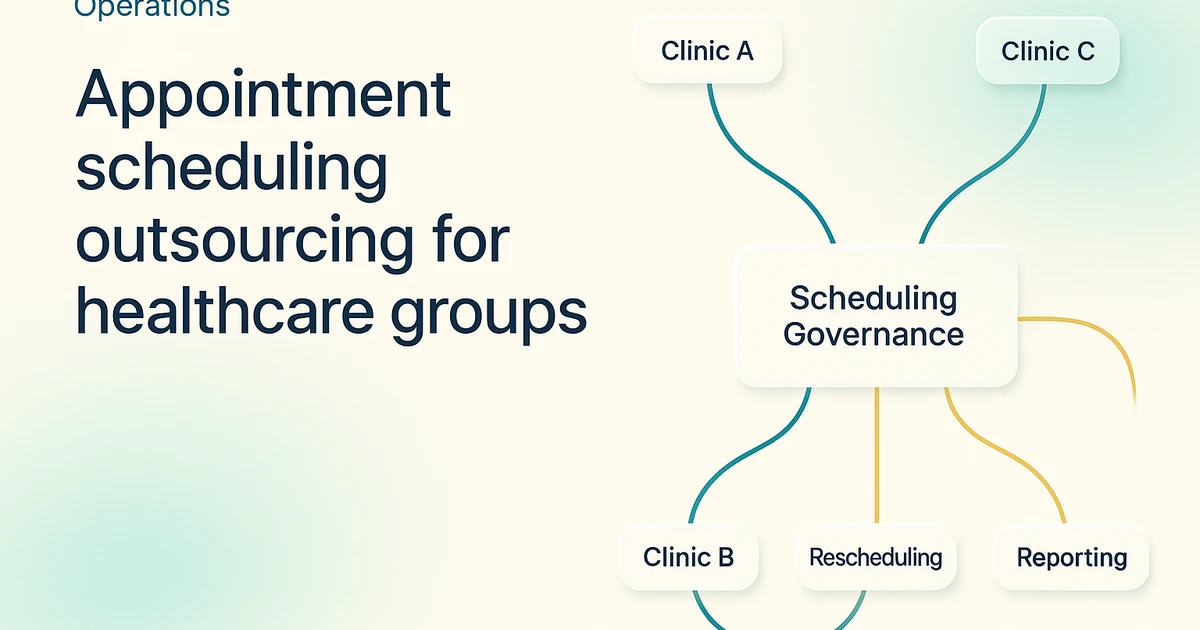
Appointment scheduling outsourcing is not a receptionist coverage decision for enterprise healthcare groups. For COOs, VPs of Operations, and buying committees, it is a patient access operating model that affects scheduling rules, EHR/PMS access, QA review, site-level escalation, and the way leadership interprets demand across 3+ locations.
The enterprise question is not whether an outside team can answer calls. It is whether a managed scheduling function can operate inside the group’s governance model without creating disconnected calendars, inconsistent patient communication, or unclear ownership when a request cannot be completed.
That is why appointment scheduling outsourcing belongs in the same conversation as front desk outsourcing, centralized intake design, integration planning, and EBITDA impact review.
This playbook is written for healthcare groups that need standardization across multiple locations, not isolated staffing decisions. It explains how to define scope, evaluate vendors, calibrate SLAs, and govern rollout so outsourced scheduling becomes a controlled operating layer rather than another source of workflow variation.
What Is Appointment Scheduling Outsourcing at Scale?
At scale, appointment scheduling outsourcing means assigning defined scheduling workflows to a managed external operation under enterprise oversight. The external team may book, reschedule, cancel, confirm, or route appointment requests, but the healthcare group still owns the scheduling policy, access priorities, compliance review, and change-control process.
That distinction matters because scheduling is where patient demand meets provider capacity. A multi-location group may have different specialties, payer requirements, provider templates, and operating preferences across its footprint.
Outsourcing without a standard rulebook can reproduce those differences in a larger queue, while outsourcing with governance can make the differences visible enough to manage.
Centralized Function, Not Overflow Coverage
A serious outsourced scheduling program should look more like a centralized patient access function than a temporary overflow arrangement.
Becker’s Hospital Review discusses healthcare call centers, patient scheduling friction, one-call resolution, and the benefits and risks of outsourcing call center operations, which is a relevant frame for groups evaluating access work at scale (S7: Becker’s Hospital Review).
For enterprise operators, the outside team should not become a separate island. It should use approved scripts, approved routing rules, defined system access, documented escalation paths, and reporting that rolls into the group’s operating cadence. The goal is a managed access layer that can be inspected and calibrated, not a hidden queue that absorbs calls without creating useful management evidence.
Rules Before Staffing Capacity
Scheduling accuracy depends on rules that are explicit enough for trained agents to apply consistently. Those rules should cover visit-type definitions, provider and location constraints, cancellation handling, reminder preferences, information that must be captured, and events that require escalation to the group.
MGMA summarizes research on patient scheduling channels, scheduling complexity, administrative staffing, call centers, online booking, and patient communication.
That makes scheduling outsourcing a staffing and access strategy for multi-location practices, not just a labor substitution decision (S3: MGMA).
A buying committee should therefore ask whether the vendor can execute the group’s rules before asking how much call volume it can absorb.
Why Does Outsourced Scheduling Need Enterprise Governance?
Outsourced scheduling needs governance because the vendor will inherit whatever operating model the group gives it. If each location uses its own appointment taxonomy, exception rules, confirmation habits, and documentation practices, the outsourced team has to translate those differences during live patient interactions.
Enterprise governance gives the vendor a controlled way to work. It defines who can change scheduling rules, how new rules are trained, how QA reviewers interpret exceptions, and how site leaders request updates without bypassing the centralized model. Without that structure, outsourcing can centralize activity while leaving decision rights fragmented.
Standardization Across Locations
Standardization starts with a shared scheduling vocabulary. A group should know whether a new-patient visit, hygiene visit, diagnostic appointment, referral request, follow-up, recall booking, or urgent concern means the same thing across locations and systems. Where the rules differ for clinical or operational reasons, the difference should be documented rather than carried through informal site knowledge.
The MGMA fellowship paper on centralized scheduling evaluates a large ambulatory group model that includes standardization, phone wait times, economies of scale, staffing, and ROI considerations (S4: MGMA Fellowship Paper).
The practical lesson for appointment scheduling outsourcing is that centralization is not merely a phone-routing choice. It is an operating design that depends on common rules and visible performance management.
Accountability Across Operations, IT, and Compliance
The buying committee should assign clear ownership before the first pilot location goes live. Operations should own scope, workflows, QA priorities, and escalation design. IT should own access, integration dependencies, user provisioning, and system constraints. Compliance and legal stakeholders should review PHI flows, patient communication channels, contracts, and vendor diligence.
That role clarity protects the rollout from becoming vendor-led by default. A vendor can recommend workflows, but the healthcare group should decide which patient access promises it wants to make, which tasks may be completed externally, and which exceptions must return to an internal owner.
This is where centralized scheduling rollout planning becomes more valuable than a generic service comparison.
Which Workflows Should Be Included in Scope?
Scope should be defined by workflow type, system access, risk profile, and measurability. A narrow starting scope may focus on inbound appointment requests and reschedules for selected locations. A broader scope may include confirmations, reminder follow-up, waitlist coordination, cancellation recovery, recall booking, or administrative handoffs that support patient access.
The mistake is treating every front-office interruption as a scheduling task. Some work is repeatable and rules-based. Some work requires clinical judgment, payer interpretation, service recovery, or site leadership. The outsourced model should make those boundaries explicit so agents know when to complete the task and when to route it.
Core Scheduling Work
Core scheduling work includes identifying the reason for the appointment request, selecting the approved visit type, matching location and provider constraints, confirming patient preferences, and documenting the outcome in the approved system. The vendor should be able to describe how agents handle incomplete information, template conflicts, unavailable appointment types, and requests that cross locations.
This is where integrations matter. If the outsourced team books in a separate tracker and the site later re-enters the appointment, the group has created extra reconciliation work. A better operating boundary is clear: the approved scheduling system remains the source of truth, and the outsourced team works inside the permissions and documentation standards the group defines.
Adjacent Access Work
Adjacent workflows often sit close to scheduling because they use the same contact data, appointment context, and communication preferences. Appointment confirmations, reminders, recall booking, and waitlist outreach may fit the same managed access model when the rules are standardized and the group has reviewed the communication pathway.
ADA guidance on appointment confirmations discusses phone, email, and text confirmations, HIPAA considerations, TCPA issues, and due diligence when hiring an outside confirmation service (S5: ADA).
That is directly relevant for DSOs and dental groups, and it is also a useful operating signal for other healthcare groups: channel decisions should be governed before they are delegated.
How Should Compliance and Procurement Evaluate Vendors?
Appointment scheduling outsourcing can involve PHI, scheduling-system access, call recordings, patient messages, and task documentation.
HHS explains when third-party vendors that handle PHI are HIPAA business associates, including vendors that provide medical reminders and appointment scheduling (S1: HHS). That gives the procurement process a compliance dimension from the start.
The buying committee should map what information the vendor will create, receive, maintain, transmit, record, or store before selecting the model. The review should include legal, compliance, privacy, IT, operations, and revenue-cycle stakeholders where appropriate.
Each group should confirm its interpretation with its own compliance team and counsel. The article can frame diligence areas, but it should not be read as legal advice or as a substitute for the group’s internal review.
Business Associate Review
HHS explains when third-party vendors that handle PHI are HIPAA business associates, including vendors that provide medical reminders and appointment scheduling (S1: HHS).
For scheduling outsourcing, that makes business associate review a first-order procurement issue rather than a contract detail to revisit after vendor selection.
A practical diligence packet should clarify permitted uses of information, access controls, subcontractor involvement, training evidence, audit cooperation, incident reporting, retention expectations, and offboarding. The group should also define minimum necessary access for scheduling work instead of giving broader visibility than the workflow requires.
Channel Governance and Vendor Diligence
Patient communication should be reviewed as a channel system, not as a collection of scripts. A scheduling vendor may touch phone conversations, voicemail workflows, email confirmations, text reminders, and follow-up tasks. Each channel can carry different consent, privacy, and documentation considerations, so the group should decide what is approved before volume shifts to the vendor.
The ADA’s appointment confirmation guidance is useful here because it connects confirmation channels, HIPAA considerations, TCPA issues, and outside-service diligence in one operational discussion (S5: ADA).
Becker’s discussion of outsourcing benefits and risks also reinforces why buying committees should review the service model, not just the staffing pitch (S7: Becker’s Hospital Review).
What Technology Model Prevents Operational Drift?
The technology model should prevent the outsourced team from becoming a second system of record. Enterprise groups need a clear path for reading availability, booking or routing according to permission, documenting dispositions, and surfacing exceptions back to the right owner.
Operational drift usually appears when agents work from stale documents, informal messages, or spreadsheets that sit outside normal management review. Those tools may look convenient during launch, but they make it harder to audit work, compare locations, and decide whether a problem belongs to staffing, training, templates, or systems.
System-of-Record Discipline
System-of-record discipline means the official appointment record stays in the approved EHR, PMS, or scheduling platform. The outsourced team may use knowledge bases, call tools, and QA systems, but the final scheduling action and documentation standard should return to the system the group governs.
That discipline protects cross-functional accountability. IT can evaluate access and integration constraints. Operations can compare outcomes by workflow and location. Compliance can review information flow. Site teams can trust that a documented appointment or escalation has a defined owner rather than wondering whether work is waiting in a separate vendor queue.
Reporting, QA, and SLA Calibration
Reporting should separate demand from execution. Demand includes appointment requests, routing patterns, cancellations, reminder responses, and exceptions. Execution includes documentation quality, disposition accuracy, script adherence, escalation selection, and whether the task closed in the expected workflow.
MGMA reports on medical groups changing phone systems, contact centers, centralized scheduling, answering services, AI call handling, and offshore after-hours patient engagement, which shows how patient access operations are being reconsidered at scale (S2: MGMA).
A scheduling outsourcing program should therefore include QA calibration and executive reporting from launch, not after the first operational dispute.
How Should a Multi-Location Rollout Be Sequenced?
A rollout should test the operating model, not just the vendor’s ability to answer a clean queue. The pilot should expose the types of variation that will exist after expansion: different scheduling systems, provider templates, site habits, specialty rules, reminder norms, and escalation patterns.
A pilot that avoids real complexity may look orderly while teaching the group very little. A better pilot gives leadership enough evidence to refine the playbook, update training, resolve ownership gaps, and calibrate SLAs before adding more locations or workflows.
Pilot Around Real Variation
The first phase should include locations or workflows that reveal meaningful operational differences. That does not mean choosing the hardest possible scenario. It means selecting a pilot scope that tests whether the rulebook is clear, the technology model is workable, and site teams know how to receive escalated work.
The pilot should also define how decisions will be made during the test. If an agent finds conflicting instructions, who resolves them? If a site requests a script change, who approves it? If a scheduling system creates friction, who owns the workaround and the long-term fix? Those governance answers matter more than a polished launch checklist.
Expansion Governance
Expansion should follow evidence, not enthusiasm. Before adding locations, the group should review QA findings, unresolved exception categories, site feedback, reporting usefulness, and system constraints. The question is whether the model is becoming more standardized and more visible as it grows.
This is also where adjacent workflows can be sequenced. A group may connect scheduling outsourcing to patient recall, no-show recovery, or a broader centralized versus distributed intake decision after the core scheduling model is stable enough for governance review.
The rollout should expand when the operating model can carry the next workflow without hiding new exceptions.
Related Reading
The following internal links are included for navigation and planning context. They are not used as factual sources for claims in this article. Use them to compare scheduling outsourcing with adjacent enterprise patient access workstreams.
For buying committees, related reading is most useful when it clarifies the next decision. Scheduling outsourcing touches centralization, vendor selection, dashboard design, and front-office operating models. These links help organize that work without mixing internal navigation with external source support.
Scheduling and Intake Planning
Scheduling and intake planning should start with the operating model. A group needs to decide what belongs in a shared queue, what remains with site teams, and how exceptions are documented before a vendor or technology platform can execute consistently.
These articles are useful when the team is still defining the future-state model. They help frame appointment scheduling outsourcing as part of centralized patient access rather than as a stand-alone staffing purchase.
- Centralized scheduling rollout for multi-location practices
- Centralized versus distributed intake framework
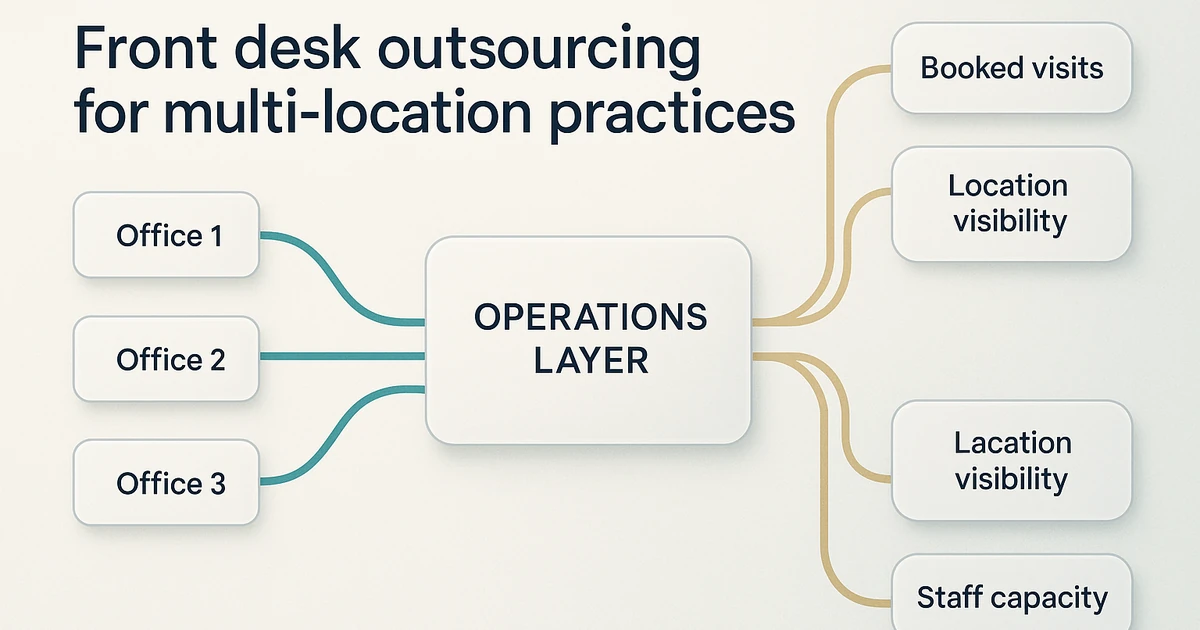
- Front desk outsourcing for multi-location practices
Vendor and Reporting Governance
Vendor and reporting governance should be designed before contract execution. The group should know what evidence it needs from a vendor, how performance will be reviewed, and which dashboards leadership will use to inspect patient access trends.
These articles are useful once the buying committee moves from concept to evaluation. They focus on procurement, RFP structure, and operational visibility across a multi-location footprint.
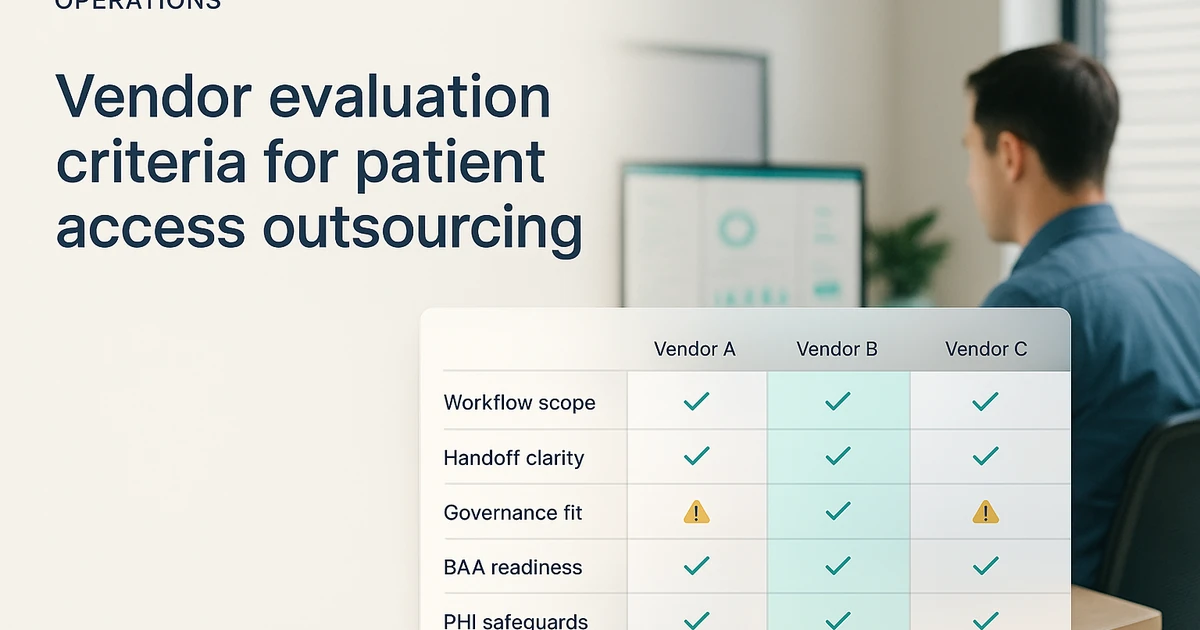
- Vendor evaluation for patient access outsourcing
- Patient access center RFP vendor checklist
- KPI dashboard for multi-location intake
Sources
- HHS: Business Associates
- MGMA: Phone systems, contact centers in focus for medical groups to engage patients, fill appointments
- MGMA: Optimizing provider staffing, patient scheduling and communication for improved patient access
- MGMA: Improving Access to Care for Patients and Referring Providers through Centralized Scheduling
- ADA: Appointment Confirmations
- Becker’s Hospital Review: One call away: The all-too common mistake hospitals make with customer relationships