
Table of Contents
- Why does front desk outsourcing change at multi-location scale?
- Which workflows belong in an outsourced front desk model?
- How should operators design governance for consistent execution?
- What technology and rollout decisions matter most?
- How should a buying committee judge success after go-live?
Front desk outsourcing for multi-location practices is not a staffing shortcut. For a COO, VP of Operations, or buying committee, it is a decision about how the organization standardizes patient access across sites, how shared teams interact with site-level exceptions, and how leadership gets one reporting layer it can actually manage.
When the conversation stays at “we need more phone coverage,” the operating model can stay fragmented.
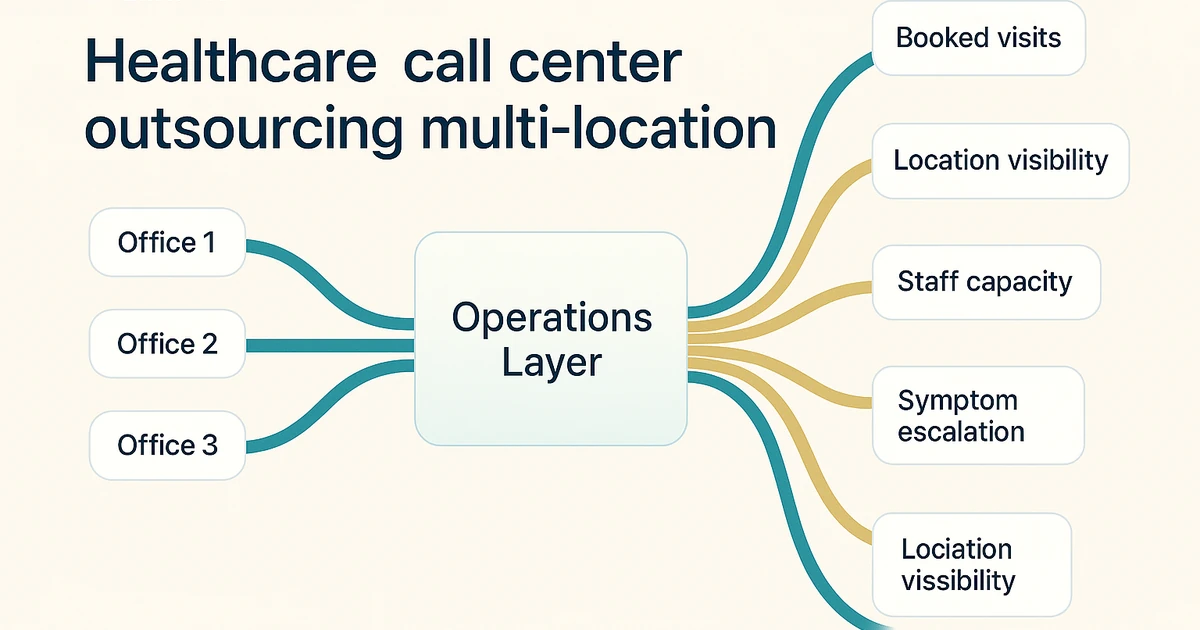
That is why enterprise groups compare outsourcing with centralized versus distributed intake design and with the broader front desk outsourcing solution rather than treating it as a simple vendor swap.
The enterprise question is whether the model creates consistent queue ownership, clear escalation rules, and cleaner accountability across the network.
ONC’s patient engagement guidance is useful here because it links access workflow design to staff time and phone volume.
The playbook says online booking can save staff time because phone scheduling takes a little more than 8 minutes on average, and it notes that secure messaging can reduce phone calls (Chapter 2 - Patient Engagement Playbook).
For multi-location groups, that points to a combined design of outsourced coverage, self-service access, and centralized governance.
Why does front desk outsourcing change at multi-location scale?
When a group moves from one office to several sites, front-desk work stops being a single-desk problem. Each location has its own scripts, staffing habits, routing rules, and definition of what counts as resolved. A decentralized model can appear manageable until leadership tries to compare answer coverage, booking ownership, or handoff quality across the full organization.
Outsourcing becomes attractive in that environment because it offers pooled capacity. But pooled capacity alone is not an enterprise operating model. The value comes from whether the group uses outsourcing to enforce standardization, centralize reporting, and set the same service design across every site.
The real problem is variation between sites
In many portfolios, one location routes every scheduling call through the front desk, another relies on voicemail callbacks, and a third sends routine questions to whoever is least busy. That variation creates hidden work because the organization cannot tell whether a problem lives in staffing, routing, scripts, or site leadership.
An outsourced front desk team can become the first place those differences are exposed. If the partner receives inconsistent scripts, conflicting appointment rules, or unclear escalation paths, the vendor simply inherits the same fragmentation. The enterprise gain typically appears only when the organization standardizes the work before asking anyone else to execute it.
Outsourcing only works when the model is centralized
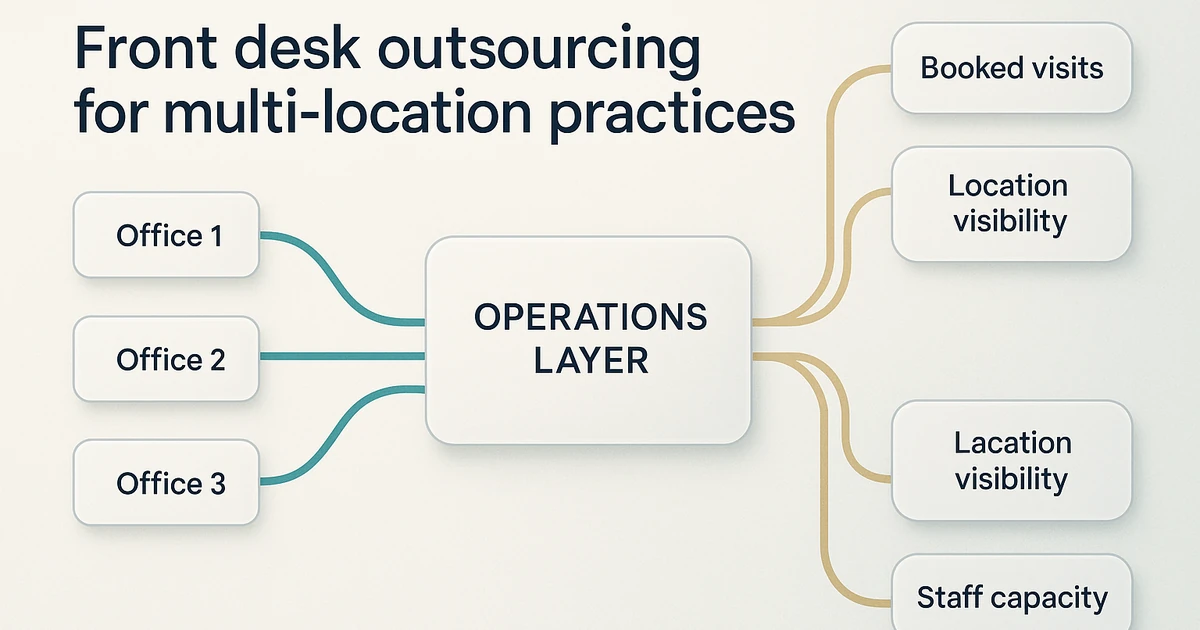
The most durable programs often treat outsourced front-desk coverage as a centralized operating layer with controlled site exceptions. Shared teams can own routine intake, common scheduling, confirmation workflows, and queue management. Site teams can retain authority where provider preferences, capacity limits, or service recovery require direct context.
That is the same reason many operators pair outsourcing decisions with related work on healthcare call center outsourcing for multi-location groups and enterprise call answering for healthcare. The vendor matters, but the operating design matters more.
Which workflows belong in an outsourced front desk model?
Front desk work looks simple until leadership breaks it into component workflows. Some tasks are repeatable and can be centralized cleanly. Others carry enough site nuance that they should remain on a controlled exception path, even if the first contact starts in a shared queue.
Buying committees usually get better results when they define workflow boundaries before they review pricing or coverage models.
ADA’s Managing Dental Teams resource is relevant here because it covers recruiting, staffing, meetings, and team structure for dental offices, making it useful when larger groups review centralized support for recurring staffing burdens across locations (Managing Dental Teams).
Standardize routine access work first
Routine access work is usually the best starting point because it follows repeatable logic. Appointment requests, confirmations, basic reschedules, message intake, portal questions, and common administrative requests fit a shared process more easily than provider-specific judgment calls.
ONC materials are relevant here because one data brief covers how consumers use online medical records to make appointments and request refills, while another reports that over half of non-federal acute care hospitals allowed patients to schedule appointments and refill prescriptions through portals in 2017 (Consumers’ use of online medical records and devices for health needs; [Electronic Capabilities for Patient Engagement among U.S.
Non-Federal Acute Care Hospitals: 2013-2017](https://healthit.gov/data/data-briefs/electronic-capabilities-patient-engagement-among-us-non-federal-acute-care)). That helps operators judge which routine demand can move into self-service instead of landing on every office phone line.
This is where outsourcing and digital access should be designed together. If routine work stays entirely phone-based, the group may end up paying a partner to absorb demand that better workflow design could route elsewhere.
If routine work is standardized and digitally supported, the outsourced team can focus on controlled execution instead of acting as a larger version of a fragmented front desk.
Keep site-specific exceptions on a controlled path
Some front-desk tasks should not be flattened into one generic script. Provider availability quirks, service-line triage, specialty scheduling rules, unresolved financial conversations, and recovery calls after a poor patient experience often need bounded site involvement.
The mistake is not keeping those exceptions local. The mistake is letting the exception path become the default path.
A controlled exception model usually requires explicit ownership. The shared team needs a defined reason code, a named escalation target, and a reportable end state. That design keeps site nuance inside enterprise governance instead of letting every location rewrite the process in real time.
It also pairs well with EHR and PMS integration planning for enterprise scheduling, because escalation rules are only credible when the underlying workflow data is visible.
How should operators design governance for consistent execution?
A front desk outsourcing program becomes hard to manage when governance is postponed until after go-live. Leadership may know the desired outcome in general terms, but without calibrated service definitions the partner, the sites, and the executive team all end up using different standards for what good performance looks like.
Enterprise governance starts with service design, not dashboards. Operators need clear definitions for which requests belong in the shared queue, what qualifies as a handoff, who owns unresolved work at the end of the day, and how site exceptions are reviewed without turning every decision into a local negotiation.
Without that, every monthly review can turn into an argument about definitions.
Build SLA calibration before vendor launch
SLA calibration should reflect workflow type, not a single blanket target. Routine scheduling requests, voicemail recovery, digital message follow-up, and location handoffs each create different kinds of work. If all of them sit under one broad promise, the organization may appear aligned while the actual queue behaves very differently from site to site.
ONC’s Patient Engagement Playbook explains that online scheduling, secure messaging, and reminders can strengthen real-time engagement and reduce practice workload (Chapter 1 - Patient Engagement Playbook).
That is operationally important for SLA design: the more clearly a group defines which issues can move through digital triage, the more realistic its live front-desk service model can become.
Use QA and reporting to manage by location
QA should not be limited to tone or script adherence. At multi-location scale, QA is also the discipline that checks whether agents used the right scheduling logic, chose the right escalation path, and documented the outcome in a way that site leaders and corporate operators both understand. That is how standardization survives growth, acquisitions, and staffing turnover.
Reporting should surface location variance, not just network averages. A stable portfolio view can hide one site with weak handoff discipline or one region that keeps routing too much work back to offices.
This is why many groups pair outsourcing with multi-location call center QA calibration and a KPI dashboard for multi-location intake.
What technology and rollout decisions matter most?
Technology decisions matter because front desk outsourcing is not only a people model. It is also a workflow model that depends on how patients enter the system, how staff see the same information, and how the organization controls work before it hits a human queue.
Groups that skip this layer can overpay for complexity. Shared teams may end up handling avoidable volume, site managers may work around missing integrations, and leadership may blame the outsourcing model for problems that actually started with weak activation or disconnected systems.
Digital activation has to start before the call queue
Front desk redesign begins before a patient calls. ONC’s chapter on portal enrollment is relevant because it treats enrollment as an operational responsibility and notes that both large health systems and small practices can drive adoption (Chapter 1 - Patient Engagement Playbook).
For enterprise groups, that means the outsourced model tends to work better when patients already have a working digital path for confirmations, questions, and routine follow-up.
Enrollment and self-service are especially important after acquisitions or rapid expansion. If newly added sites still rely on office-by-office habits for portal use, reminder handling, and callback ownership, the shared front-desk team inherits unstable inputs.
A better rollout links outsourcing with digital activation, script standardization, and a staged integration playbook for healthcare acquisitions.
Integration and change management determine scaling risk
A multi-location rollout generally needs one source of truth for schedules, reason codes, and final statuses, even when the organization operates more than one system. That does not always mean immediate technology consolidation. It does mean the buying committee should insist on clear workflow mappings, queue ownership, and location-level exception handling before expansion.
Change management matters just as much. Site leaders need to know which work is moving, which work is staying, how feedback gets escalated, and how performance reviews will be handled.
That is why procurement teams often test the model with patient access center RFP criteria before broad rollout, especially when multiple stakeholders own scheduling, operations, and integration decisions.
How should a buying committee judge success after go-live?
The most reliable post-launch reviews focus on control first and outcomes second. If leadership cannot explain how work moves through the system, which sites create the most exceptions, or where unresolved items accumulate, the organization is not ready to make strong claims about success.
This is also where enterprise tone matters. Buying committees are not grading a vendor only on friendliness or raw coverage. They are evaluating whether the model creates a repeatable operating layer that supports reporting discipline, site accountability, and cleaner decision-making across the network.
Finance, operations, and site leadership should be able to read the same reporting package and reach the same conclusion about what needs intervention.
Measure control before promising outcomes
Early scorecards should answer operational questions. Are routine requests entering the right queue. Are sites accepting handoffs inside the defined rules. Are escalation reasons consistent across locations. Are site leaders and the shared team using the same status language. Those are the signals that tell a COO whether standardization is real or only documented.
Once those controls are stable, leadership can use the model to make better workforce and workflow decisions.
It becomes easier to compare site performance, identify where office teams are still absorbing work that belongs in the center, and decide whether the organization should deepen centralization or keep a hybrid structure. That review loop is often what turns anecdotal site complaints into actionable operating decisions.
Treat outsourcing as an EBITDA discipline, not a staffing patch
Enterprise operators usually evaluate front desk outsourcing through EBITDA impact because the real value sits in repeatability. Standardized coverage, clearer queue ownership, and centralized reporting give leadership a more credible picture of administrative load across locations.
It also gives PE-backed platforms a cleaner operating narrative when they review administrative consistency across the portfolio.
Seen that way, front desk outsourcing is less about replacing a receptionist and more about building a managed access layer. Groups that frame it as a temporary staffing patch often keep the same fragmentation under a different label. Groups that frame it as an operating model have a clearer basis for standardization, centralized visibility, and more disciplined scale.
Related Reading
- Healthcare Call Center Outsourcing for Multi-Location Groups
- Centralized vs. Distributed Intake Framework
- KPI Dashboard for Multi-Location Intake
- Multi-Location Call Center QA Calibration for Healthcare
- Patient Access Center RFP Vendor Checklist for Enterprise
Sources
- Chapter 2 - Patient Engagement Playbook
- Managing Dental Teams
- Consumers’ use of online medical records and devices for health needs
- Electronic Capabilities for Patient Engagement among U.S. Non-Federal Acute Care Hospitals: 2013-2017
- Chapter 1 - Patient Engagement Playbook
Managing front desk outsourcing across 3+ locations? Request an Enterprise Assessment for your group.