
Table of Contents
- What should a multi-location group define before comparing vendors?
- How should the buying committee assess PHI and compliance controls?
- What proves a vendor can execute scheduling and access workflows?
- Which staffing and management questions reveal service depth?
- How should executives evaluate technology and reporting?
- What commercial terms should the group test before selection?
- How should a group run a pilot and make the final decision?
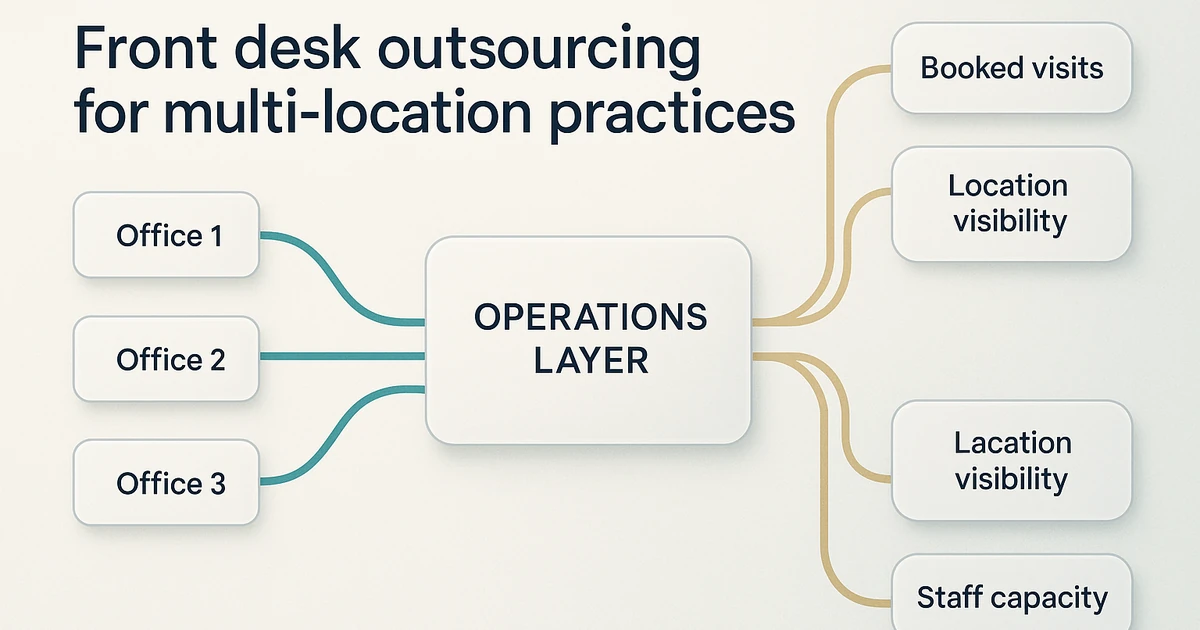
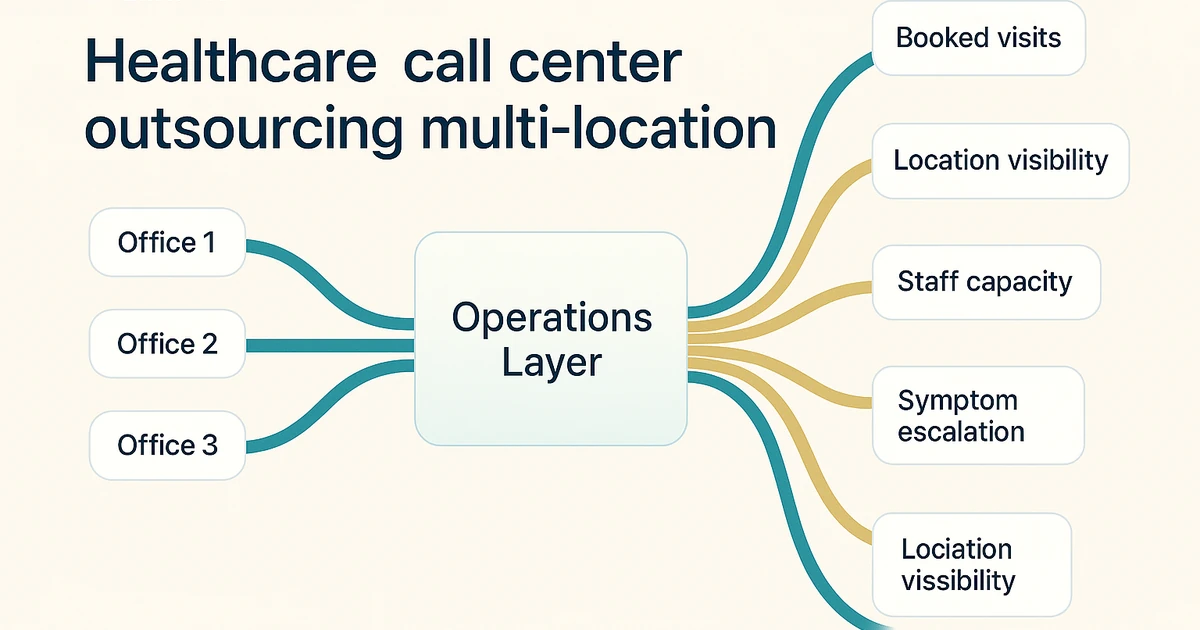
For a multi-location healthcare group, patient access outsourcing is not a call-center purchase. It changes how patients reach the organization, how appointments are routed, how site teams receive unresolved work, and how leaders see demand across the portfolio. The vendor therefore becomes part of the operating model, not simply a source of extra phone coverage.
That distinction matters when a group has three or more locations. A weak partner can centralize inconsistency: agents receive conflicting scheduling rules, local teams inherit unclear callbacks, and executives get activity counts without a view of whether work was actually completed. A well-governed model can give the organization a shared queue, controlled exceptions, clearer escalation, and comparable reporting.
This guide is for COOs, VPs of Operations, patient-access leaders, and procurement teams evaluating an outsourced access function. It focuses on the evidence a vendor should provide before a contract, pilot, or expansion. For the broader operating model behind the decision, start with MyBCAT’s front desk outsourcing solution.
What should a multi-location group define before comparing vendors?
Do not ask vendors to design the problem for you. Before demos begin, the group should define the patient-access work it wants to centralize, the work that remains local, and the outcomes leadership expects to improve. Without that foundation, each stakeholder evaluates proposals against a different future state.
Start with a workflow inventory rather than a generic request for call coverage. List new-patient scheduling, established-patient scheduling, recalls, confirmations, reschedules, message intake, referral routing, insurance-related intake, portal support, and after-hours handling separately. For each workflow, name the initiating event, the system of record, the required information, the permissible agent action, and the owner if the task cannot be completed.
The inventory should also distinguish repeatable work from location-specific exceptions. A shared team may be able to handle common appointment requests under a standard playbook. A provider-specific template restriction, a service-recovery callback, or a clinical question may require a controlled handoff. The goal is not to force every activity into one queue. It is to prevent exceptions from becoming undocumented local workarounds.
This is also the right time to decide whether the organization is pursuing centralized access or simply adding flexible capacity to site teams. Those are different models with different management needs. The centralized versus distributed intake framework can help a buying committee make that distinction before it compares staffing models or pricing.
Ask every vendor to map its proposed scope to your workflow inventory. A credible response makes clear what the team can do today, what needs configuration or training, what requires access to a specific system, and what falls outside the proposed service. Broad assurances that a team can “handle anything” are not a substitute for an explicit operating boundary.
How should the buying committee assess PHI and compliance controls?
Patient-access work can involve appointment context, contact details, insurance information, call recordings, and messages connected to care. That makes privacy and security review a working part of vendor selection, not a last legal step after the commercial decision is made. The Office of the National Coordinator’s privacy, security, and HIPAA guidance is a useful starting point for discussing how health information should be protected within health IT workflows.
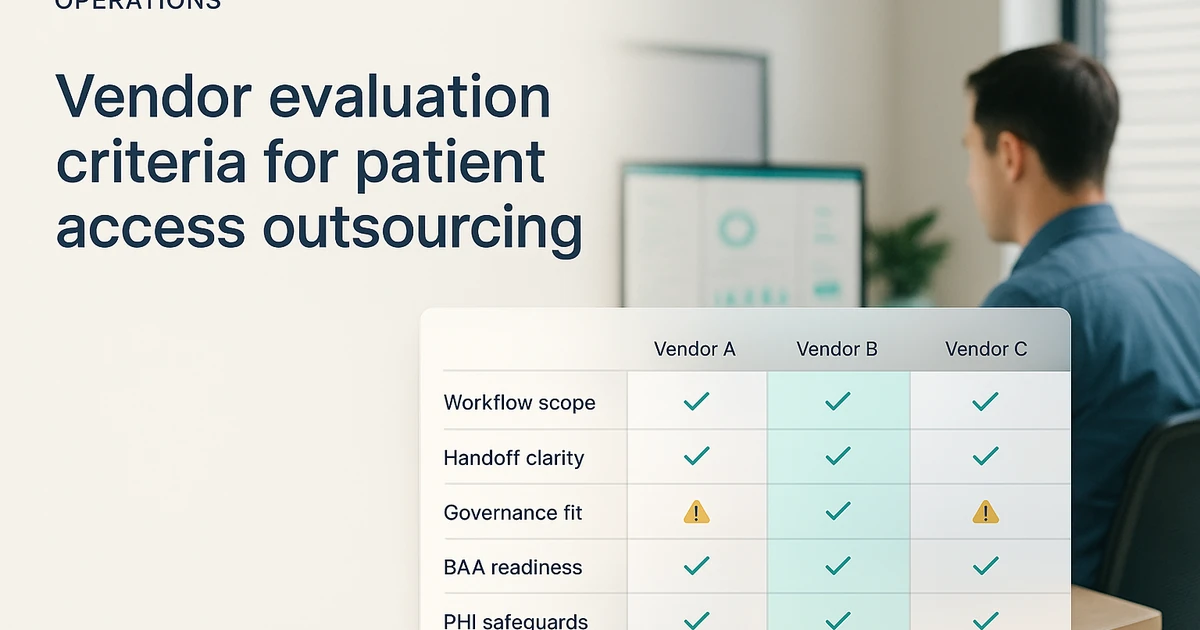
The group should involve its compliance and legal stakeholders early enough to review the proposed data flow. Ask where agents will work, what systems they will access, how permissions are assigned, how access is removed, how notes and recordings are stored, and how the vendor reports a suspected incident. A business associate agreement may be necessary when the arrangement involves protected health information; the group’s legal and compliance teams should determine the applicable contract requirements for the proposed scope.
The practical test is whether the vendor can explain controls in the context of a real call. For example, if a caller requests an appointment at a different location, the vendor should be able to describe what an agent may view, where the outcome is documented, which team receives an exception, and how the group can audit the activity. A statement that staff receive privacy training does not answer those questions by itself.
Review third parties as well. Telephony, recording, workforce-management, QA, analytics, messaging, and knowledge-base tools can all affect the information flow. Request a current list of material subcontractors and platforms used in delivery, then ask who owns vendor oversight, incident coordination, and offboarding. This discussion should include the boundary between group-owned systems and vendor-owned tools.
For groups with several brands, locations, or practice-management environments, test for wrong-location risk. Agents need reliable identifiers, routing rules, and permission boundaries so they do not rely on memory or informal chat messages. The vendor’s answer should show a controlled process for access, not merely confidence that errors will be caught later.
What proves a vendor can execute scheduling and access workflows?
The clearest evidence is a scenario exercise. A polished dashboard and a staffing chart reveal little about whether an agent can find the correct scheduling rule, document a callback, or escalate an exception without creating a second task for the local office.
Give finalists the same short set of non-PHI scenarios. Include a new patient seeking the earliest appropriate appointment across locations, an established patient who needs a particular visit type, a caller with incomplete insurance information, a provider schedule change, and a request that must be routed to a clinical team. Ask the vendor to explain the agent path, system action, documentation standard, escalation point, and final owner for each one.
Watch for the details that determine operational quality. How does an agent know which location has the right availability? What happens when two systems show different information? Can the agent use a defined reason code when a task cannot be resolved? How long can the task remain open, and who sees it? If the vendor cannot answer those questions during a controlled exercise, the issue will not become simpler after launch.
Central scheduling is a useful reference point because it requires disciplined rules rather than good intentions. MGMA’s resource on implementing central scheduling emphasizes the operational considerations involved in supporting practice growth through a centralized model. For a group evaluating outsourcing, the question is whether the vendor can operate inside those rules and surface the exceptions that need an internal decision.
Do not turn the outsourced team into a clinical decision maker. The group should define when calls must be transferred or routed to qualified internal personnel, and the vendor should demonstrate that those thresholds are clear in training, scripts, and QA. An access partner can support the administrative workflow around an escalation; it should not be selected on claims that it can replace clinical judgment.
Which staffing and management questions reveal service depth?
Outsourced patient access remains a people-intensive service. Technology can route, document, and report work, but agent training, supervision, QA calibration, and change management determine whether the service is consistent across locations.
Ask how the vendor trains agents on your specialty, brands, locations, scheduling templates, systems, privacy requirements, and escalation logic. Initial onboarding is only the first test. Multi-location groups acquire offices, add providers, change templates, update payer rules, and modify scripts. The vendor should show how an approved change reaches agents, how its knowledge base is versioned, and how supervisors confirm that the new rule is being followed.
Then ask about the management layer. Who monitors queues? Who reviews recordings or documented interactions? Who coaches an agent after an error? Who owns the root-cause analysis if the same routing failure appears in several locations? A managed service should offer more than a roster of people. It should include named operating roles, a cadence for review, and a process for preventing a recurring problem from becoming normal.
Request examples of the vendor’s QA scorecard before selection. The scorecard should distinguish courtesy or basic call handling from operational accuracy. Useful categories can include adherence to the approved workflow, correct location routing, documentation completeness, required escalation, and closure of follow-up tasks. Your internal team should be able to calibrate the scorecard with the vendor, which is why multi-location call center QA calibration belongs in the implementation plan rather than after it.
Finally, evaluate communication during the sales process. Does the vendor ask for the details needed to execute the model? Does it identify assumptions and dependencies? Does it explain where a request exceeds its current capability? Those behaviors give the buying committee evidence beyond generic assurances about experience.
How should executives evaluate technology and reporting?
Technology fit is not a list of logos. It is the ability to create one reliable record of each workflow outcome and to give leaders information they can act on. A vendor may work effectively in a group-owned EHR, PMS, phone system, ticketing platform, or reporting environment, but the responsibility for each step must be explicit.
For every in-scope call type, document the system of record. If an appointment is booked, where does it appear? If a callback is required, who creates the task and where can the receiving office see it? If an agent cannot complete an insurance-related intake step, what note is required and how is aging tracked? A temporary workaround may be acceptable during a limited pilot, but it should not become a permanent hidden spreadsheet or inbox.
Reporting should connect service activity to operating decisions. Call volume, answer rate, handle time, and staffing coverage can show queue conditions. They do not tell an executive whether patients were scheduled correctly, whether callbacks are aging, whether one location creates unusual escalations, or whether a template problem is causing repeated friction.
Ask to see a sample executive report and a sample operations report. The executive view should make patterns visible across locations. The operations view should support action through outcome categories, unresolved-task aging, escalation reasons, QA findings, and location-level exceptions. The group should be able to trace an issue from a portfolio trend to a workflow owner without asking the vendor to build a custom report every time.
Interoperability also deserves a direct discussion. ONC’s health IT basics explains the role health IT plays in exchanging and using health information. In a vendor evaluation, that translates to practical questions: What integrations already exist? What data is exchanged? What remains manual? Who validates the workflow before launch? The related EHR and PMS integration planning guide can help teams put those questions into a rollout checklist.
What commercial terms should the group test before selection?
Do not compare proposals only by a per-call, per-hour, or per-seat figure. The useful comparison is total cost for a defined service level and workload profile. A model that looks attractive at base volume may become difficult to manage if outbound work, after-hours coverage, bilingual support, reporting, training refreshes, or system changes are treated as unplanned extras.
Ask each finalist to price the same assumptions. Define call types, expected hours, workload variation, locations, systems, reporting cadence, implementation work, and management coverage. Then ask what changes the fee, what is included, what requires a statement of work, and what happens when the group adds a location or service line. This makes proposals comparable and gives finance a clearer view of exposure.
Avoid buying based on broad outcome promises. A vendor cannot responsibly predict results that depend on appointment supply, payer rules, site adoption, provider schedules, or the group’s own escalation response. Instead, require observable operating evidence: scenario performance, documented workflow controls, QA design, reporting samples, referenceable implementation experience, and a plan for issue resolution.
The contract should also define governance, not just pricing. Establish the service-review cadence, report ownership, escalation contacts, change-control process, access-removal requirements, records handling, and transition support if the relationship ends. A capable vendor and a clear agreement give the organization a better basis for accountability than a broad service description alone.
How should a group run a pilot and make the final decision?
A pilot should answer a limited set of important questions, not postpone every decision. Choose a representative but contained scope, such as a defined set of scheduling and message-intake workflows for a small group of locations. Do not use a pilot to test a broad, undefined promise of “better service.”
Before go-live, agree on the scorecard, baselines where available, review dates, decision owners, and exit criteria. The first review may focus on access setup, agent readiness, permissions, and documentation quality. The next can assess whether escalations close correctly and whether location teams receive usable work. The final review can determine whether the service has demonstrated the control needed for expansion.
Include site leaders, the central access owner, technology, compliance, and finance in the review structure, but give each metric a named decision owner. A meeting with many stakeholders and no owner can turn a straightforward operational issue into a debate. The patient access center RFP vendor checklist provides a useful companion for setting requirements and assigning those responsibilities before selection.
At the end of the pilot, assess more than volume. Did agents follow the defined rules? Were wrong-location or incomplete-documentation issues identified and corrected? Did the vendor surface recurring bottlenecks? Could the group use the reporting to make an operating decision? Is there a practical plan for adding locations without creating a new exception process at each one?
The right decision may be a broader rollout, a narrower scope, a remediation period, or a different vendor. What matters is that the decision follows evidence from the operating model the group intends to run. For enterprise buyers, that discipline is more valuable than choosing the fastest sales process.
Evaluating patient access outsourcing across 3+ locations? Request an Enterprise Assessment for your group.
Related Reading
- Healthcare Call Center Outsourcing for Multi-Location Groups
- Patient Access Center Metrics for Healthcare Executives
- Centralized Scheduling Rollout for Multi-Location Practices
- Enterprise Patient Access Center