
For a multi-location healthcare group, the choice between an AI receptionist, a virtual front desk, and a traditional answering service is not a branding exercise. It determines who owns a patient inquiry, how appointment requests are resolved, when a call is escalated, and whether leadership can see the same operating picture across every location.
The useful question is not whether AI or people are better. It is which call types can be handled safely and consistently by automation, which require a trained person, and which must reach the practice team. Groups with three or more locations need that answer in a documented routing model, not in a vendor demo.
Table of Contents
- What is the difference between an AI receptionist, virtual front desk, and answering service?
- Which calls should AI handle, and which need a person?
- When does an AI receptionist fit a multi-location group?
- When is a virtual front desk the better choice?
- Why does a traditional answering service often create more work?
- How should a group design a hybrid patient-access model?
- What should executives measure before selecting a model?
- How should a multi-location group implement the change?
- FAQ
What is the difference between an AI receptionist, virtual front desk, and answering service?
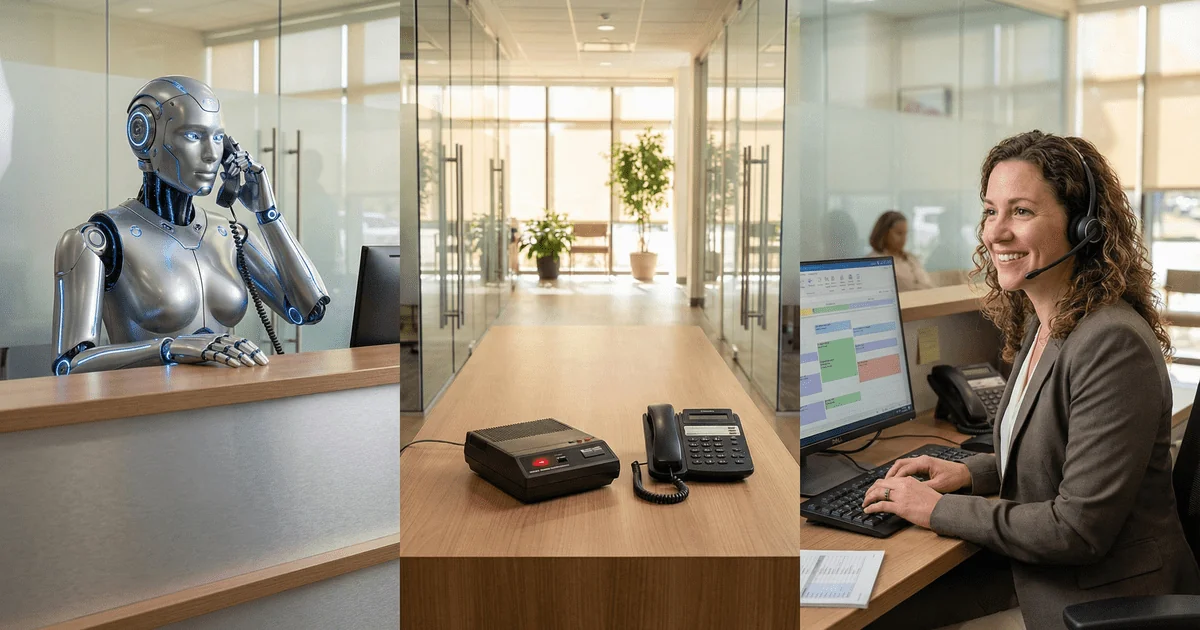
These labels are used loosely, so compare the operating capability rather than the product name. The practical distinction is whether the caller receives a resolved next step, a well-managed handoff, or only a message.
An AI receptionist is software that answers voice or chat interactions, identifies an intent, retrieves approved information, and can complete constrained tasks such as appointment confirmation or a simple booking flow. It can be available at all hours and handle several conversations at once. Its limits appear when the request falls outside the configured workflow, the caller is distressed, or the system needs human judgment to select the next action.
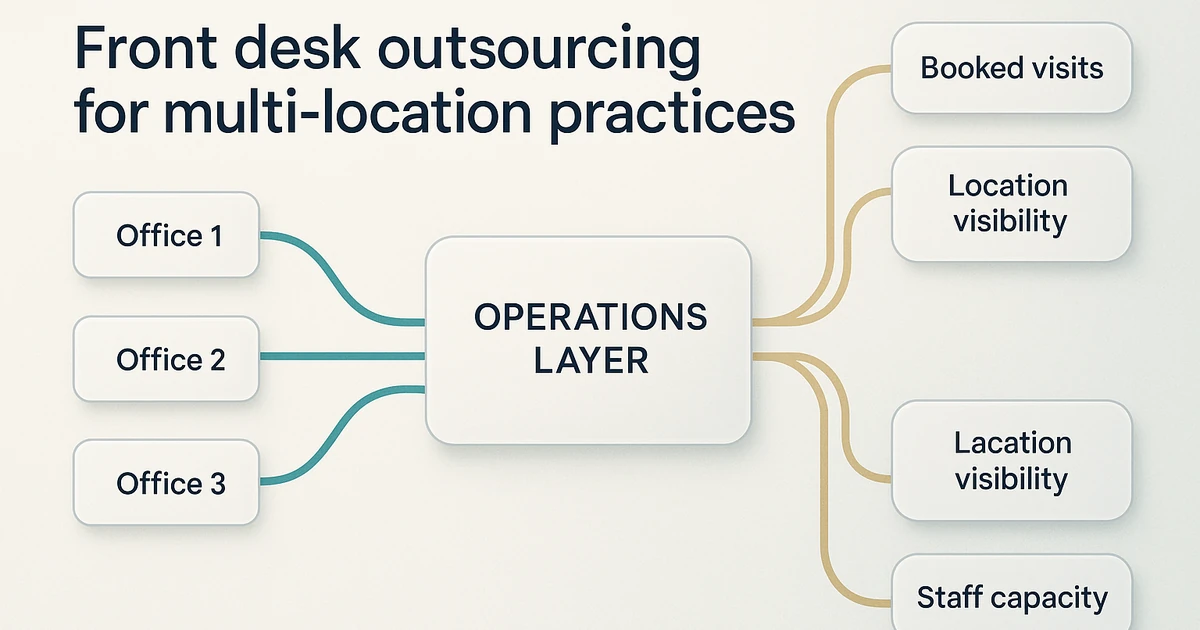
A virtual front desk is a trained remote team that works from the group’s approved protocols and scheduling rules. The team may answer as the location, book within authorized appointment types, handle routine insurance or administrative questions, and create a managed escalation when it cannot resolve the request. For enterprise groups, its value is not merely a person answering the phone. It is the combination of coverage, documented workflows, QA, and reporting across sites. See the broader front desk outsourcing model for the managed-service operating layer behind that work.
A traditional answering service usually answers overflow or after-hours calls, captures a message, and forwards it to staff. That can be appropriate for narrowly defined coverage. It does not automatically mean the service can schedule in the practice management system, apply location-specific rules, or close the loop on a patient request.
| Model | Best at | Typical limitation | Enterprise question |
|---|---|---|---|
| AI receptionist | Structured, repeatable requests | Exception handling and rapport | Does the system transfer with context when confidence drops? |
| Virtual front desk | Scheduling, nuanced conversations, controlled escalation | Requires training and active QA | Can the partner apply one standard with site-aware rules? |
| Answering service | Basic message capture and coverage | May create a callback queue | Who owns the message until the patient has a next step? |
The difference matters because a group can report that every call was answered while still leaving appointments, questions, and follow-up work unresolved. Answer rate is a useful measure, but it is not a complete access outcome.
Which calls should AI handle, and which need a person?
The safest way to make this decision is to classify the call before classifying the technology. Start with the level of judgment, clinical sensitivity, scheduling complexity, and relationship risk involved.
AI is usually a reasonable first handler for simple, bounded requests: office hours, directions, confirmation of an existing appointment, a routine reschedule inside an approved template, or a request to send a standard form. These interactions have a clear intent and a controlled response. The system should still offer an easy path to a person.
Trained humans are usually the better first handler for new-patient conversion, family or multi-provider scheduling, insurance questions that require record context, complaints, repeat contacts, accessibility needs, and callers who are frustrated or confused. A person can ask a clarifying question, recognize when the scripted path is wrong, and explain what will happen next.
Clinical questions, urgent symptoms, and emergency concerns require an approved practice protocol and rapid escalation to the appropriate clinical or on-call resource. Neither an AI receptionist nor a non-clinical call team should make a diagnosis or independently decide a patient’s care. Telephone triage research is a reminder that protocol design, supervision, and escalation boundaries matter more than a simple human-versus-technology label (Safety of clinical and non-clinical decision makers in telephone triage).
For a group, a call taxonomy should identify at least four outcomes: resolved in the shared queue, scheduled, escalated to a named owner, or pending with a time-bound follow-up. That taxonomy makes it possible to compare locations without hiding unresolved work in a general message bucket.
When does an AI receptionist fit a multi-location group?
AI fits when the organization has already made routine access work predictable. That means current provider schedules, approved answers, clear appointment rules, and a defined fallback when the system does not understand the request. It is strongest as capacity for repetitive demand, not as a substitute for an unowned front-desk process.
Consider AI for appointment confirmations, standard location questions, common service information, simple self-service routing, and after-hours intake that creates a clear next-day work item. It can also support a human team by summarizing context or identifying routine requests before transfer. ONC’s patient engagement guidance discusses how digital access tools can reduce phone burden, which supports a broader design that gives patients appropriate self-service paths while preserving human access for work that needs it (ONC Patient Engagement Playbook, Chapter 2).
An AI-first model is a poor fit when every location has different appointment rules, staff rely on undocumented exceptions, or the group cannot reliably route a transfer. In those conditions, the tool exposes workflow fragmentation rather than fixing it. The call may be answered quickly, yet the patient still has to repeat the story to a location that has no context.
Before expanding AI across the network, run a controlled pilot with an explicit transfer rule. Review what the system completed, where it escalated, what callers repeated, and whether site teams closed the loop. The purpose of the pilot is to validate a scalable workflow, not to produce an attractive automation percentage.
When is a virtual front desk the better choice?
A virtual front desk is often the stronger primary model when the group needs real scheduling support, complex request handling, and consistent coverage across locations. It is particularly useful when front-desk teams are interrupted by in-office work, growth has created uneven coverage, or different sites lack a shared way to manage calls.
The team needs more than a greeting script. It needs role-based system access, an approved scheduling matrix, a directory of location and provider exceptions, escalation contacts, and defined authority. An agent should know what can be booked directly, what must be sent to the clinical team, and how to document a handoff so the caller does not start over.
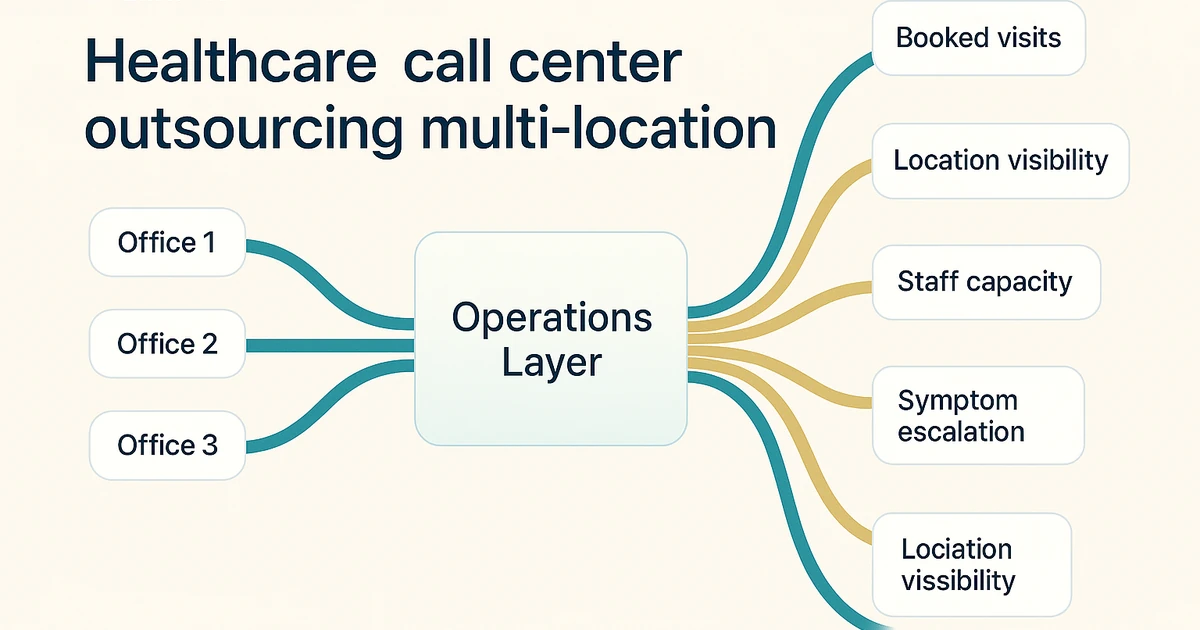
For multi-location operators, management discipline is the differentiator. A partner should provide regular QA calibration, disposition reporting, exception review, and a method for updating scripts when a site changes a service, schedule, or provider rule. That is why groups evaluating a shared team should also examine healthcare call center outsourcing for multi-location groups rather than treating the purchase as a staffing decision alone.
The virtual front desk is not meant to absorb every conversation. Requests involving clinical judgment, treatment decisions, payments beyond approved protocols, or a high-risk service recovery should follow the group’s escalation path. A well-run front desk makes that boundary visible and dependable.
Why does a traditional answering service often create more work?
Message-taking coverage is sometimes the right answer, especially for a narrow after-hours use case. The problem begins when executives assume a message is the same as a resolved access request.
If a patient calls to schedule and the answering service only records a callback request, the location still owns contact, scheduling, documentation, and follow-up. That can create an unmeasured queue that competes with in-office work the next morning. At network scale, each location may also interpret message urgency differently, weakening consistency.
Groups should ask a simple operational question: after the service sends a message, who owns the next step, by when, and where is the outcome recorded? If the answer is unclear, the model may be shifting the phone burden rather than reducing it.
Traditional answering can still support a broader patient-access design when it uses approved call categories, time-bound escalation rules, and a reportable disposition. For a group with variable coverage, the better long-term comparison is often between message capture and a centralized patient access center that can manage scheduling, routing, and visibility as an integrated workflow.
How should a group design a hybrid patient-access model?
For many healthcare groups, hybrid is not a compromise. It is an intentional division of labor. Automation handles well-defined, lower-risk tasks; trained people handle requests that need explanation, flexibility, or emotional awareness; practice teams retain clinical and site-specific authority.
The first design decision is the front door. Calls should enter through a common routing layer that recognizes the location, service line, time of day, and stated reason for calling. The next decision is the transfer contract: when an AI interaction moves to a person, the receiving team should get the caller’s stated need and the information already collected. Repetition is a patient-experience failure and a useful QA signal.
The second decision is who owns each queue. New-patient calls may route directly to trained humans. Routine confirmations may stay automated. Unusual scheduling can go to a virtual front desk with a defined exception route. Symptom-related questions should follow clinical protocols, not a generic conversational flow. The human-AI hybrid intake framework offers a more detailed view of this routing design.
The third decision is governance. Corporate operations should own the core call taxonomy, service definitions, QA rubric, and change-control process. Local leaders should own documented site exceptions, current provider constraints, and escalation contacts. This creates centralized governance with location-aware execution, rather than forcing every location into one rigid script or allowing every location to invent its own system.
What should executives measure before selecting a model?
Start with a baseline, not a pricing sheet. Pull a representative sample of calls by location and classify why patients called, whether they reached a person or system, whether the request was resolved, how often a callback was required, and where handoffs failed. Review peak periods separately from average days, because a model that works on a quiet afternoon may fail when several locations receive simultaneous demand.
The core scorecard should include answer rate, speed to answer, abandonment, appointment requests resolved, first-contact resolution, transfer rate, callback completion, and QA results by location and call type. Pair those measures with qualitative call review. A technically completed call may still be poor if a caller had to repeat information, was transferred without context, or received an unclear next step.
Executives should also measure operational variance. If two locations receive comparable call types but one creates far more callbacks, the issue may be staffing, scheduling rules, training, or local documentation. Network averages can conceal those differences. This is the rationale behind multi-location call center QA calibration: the point is not simply to score agents, but to find which part of the system is producing inconsistent outcomes.
Cost should be evaluated as total operating cost, including internal management time, technology, training, coverage gaps, and the work created by unresolved calls. MGMA’s work on centralized scheduling is relevant because centralization is an operational design choice that requires planning for growth, not merely a change in where calls are answered (MGMA: Implementing Central Scheduling to Support Practice Growth).
How should a multi-location group implement the change?
Implementation begins with workflow discovery. Document each location’s appointment types, provider rules, escalation contacts, existing phone paths, system access requirements, and exceptions. This work can feel slow, but it prevents a vendor or AI tool from becoming the unreviewed source of policy.
Then pilot the future-state model at a small set of representative locations. Choose sites with different call patterns or systems, not only the easiest sites. Use the same routing logic, QA rubric, reporting definitions, and escalation rules that the organization expects to use at scale. During the pilot, review call samples and unresolved work weekly with both site and central operations owners.
Expand only after the group can show that callers are reaching the right handler, transfers carry context, and exceptions are visible in reporting. New acquisitions or newly added sites should enter through the same documented onboarding process. The front desk outsourcing playbook for multi-location practices explains the governance questions that keep a shared model from becoming a collection of site-specific workarounds.
No model removes the need for accountable owners. AI needs monitoring and a human fallback. A virtual front desk needs training, QA, and current rules. An answering service needs a defined message-closure process. The right choice is the one that makes those responsibilities explicit across the full group.
FAQ
Is an AI receptionist the same as a virtual receptionist?
No. An AI receptionist is software that handles structured conversations and tasks within its configuration. A virtual receptionist or virtual front desk is a remote human team that can apply approved protocols, handle nuanced conversations, and manage controlled escalations. Some vendors combine both, so groups should ask exactly which calls each layer owns.
Which model is best for a dental, optometry, or veterinary group?
The specialty matters, but the call type matters more. Groups should keep clinical or urgent concerns on an approved human escalation path. Dental and optometry groups may centralize routine scheduling and administrative work, while veterinary groups may need especially clear after-hours and urgent-call protocols. The appropriate model follows the documented routing and escalation requirements of the organization.
Can an answering service schedule appointments?
Some can, but message-taking alone does not establish scheduling capability. Verify whether the service has authorized practice-management-system access, current appointment rules, location-specific scheduling knowledge, and a way to document completed bookings and exceptions.
What should a group ask vendors during evaluation?
Ask which calls are resolved directly, which require a callback, how transfers carry context, what happens when a caller requests a person, how the team handles urgent or clinical concerns, how QA is calibrated, and how reporting separates locations and call types. Also ask who owns script changes and how acquired locations are added without creating a separate operating model.
Sources
- Safety of clinical and non-clinical decision makers in telephone triage: a narrative review
- ONC Patient Engagement Playbook, Chapter 2
- MGMA: Implementing Central Scheduling to Support Practice Growth
Managing patient access across 3+ locations? Request an Enterprise Assessment for your group.