
Table of Contents
- Why Does a Location-by-Location After-Hours SLA Break at Scale?
- What Should an Enterprise After-Hours SLA Actually Define?
- How Should Group Practices Separate Answering From Triage?
- Which SLA Measures Matter Most to Operations Leaders?
- How Should a Multi-Location Rollout Be Staged?
- What Should Buying Committees Ask Before Approval?
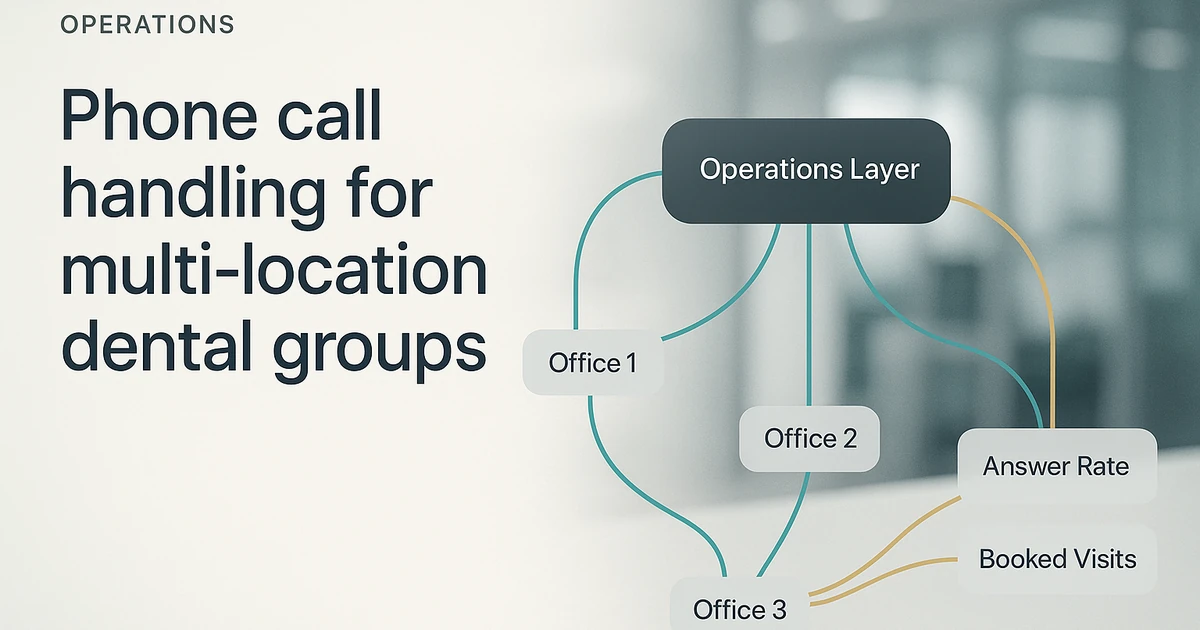
Multi-location healthcare groups can struggle after hours not because they lack a phone vendor, but because access rules, escalation logic, documentation standards, and reporting expectations are defined differently by site.
In a three-location group, that inconsistency can create friction. In a larger platform, it can become a standardization problem with patient-access, QA, and operating implications.
For a COO, VP of Operations, or buying committee, the practical question is often not whether an after-hours program exists. The question is whether the organization has an after-hours SLA that can be deployed across locations, audited centrally, and recalibrated after acquisitions or service-line changes.
A medical answering service can support that model, but only if the operating rules are clear before the phones roll over.
The primary care access frameworks behind this work are not new.
AHRQ describes accessible patient-centered medical home services as including shorter waits for urgent needs, enhanced hours, around-the-clock telephone or electronic access, and alternative communication methods. A Health Affairs study found that having a medical home that is “accessible and helps coordinate care” was associated with more positive experiences, with country differences in after-hours care (AHRQ, Health Affairs study).
For enterprise operators, the implication is straightforward: after-hours access belongs inside the operating model, not outside it.
Why Does a Location-by-Location After-Hours SLA Break at Scale?
A location-by-location approach can look acceptable on paper because every site can say it has coverage. The problem is that coverage is not the same as a shared standard. One office may treat after-hours answering as message taking, another may treat it as light triage, and a third may escalate nearly every call to an on-call clinician.
That drift can make centralized oversight difficult.
HRSA frames PCMH recognition around “national standards for primary care that emphasize care coordination and on-going quality improvement,” which is a useful lens for enterprise groups trying to define one access model across multiple sites (HRSA).
Standardization Breaks Before Volume Does
Many groups focus first on call volume. In practice, one common failure point is standardization. Different after-hours scripts, different escalation contacts, and different definitions of urgency create a portfolio where leadership may struggle to tell whether each site is delivering the same patient experience.
That is why after-hours answering is often better treated as a centralized patient-access policy, not a site preference.
Teams evaluating enterprise call answering for healthcare usually find that the real value is not call coverage alone. It is central control over what “covered” actually means.
Fragmented Reporting Weakens Central Control
When each site or vendor reports differently, SLA review can turn into a manual reconciliation exercise. Operations leaders may see raw call counts, but not a consistent view of abandonment, escalation mix, documentation quality, or unresolved follow-up items by location.
That reporting gap can matter in acquisition-heavy environments. A group may struggle to calibrate staffing, vendor scope, or QA if after-hours activity is trapped in disconnected dashboards.
A similar reporting issue appears in broader healthcare call center outsourcing for multi-location groups: volume without standard definitions is not real visibility.
What Should an Enterprise After-Hours SLA Actually Define?
An after-hours SLA should function as an operating document shared by operations, clinical leadership, compliance, and whoever owns the morning follow-up workflow. If it lives only in a vendor contract, it will usually be too narrow to support enterprise governance.
That broader definition aligns with accreditation and recognition frameworks.
HRSA positions PCMH recognition around coordinated care and quality improvement, and NCQA’s current PCMH concepts guide practices toward convenient access to clinical advice and continuity of care (HRSA, NCQA).
Separate Access Promises From Clinical Rules
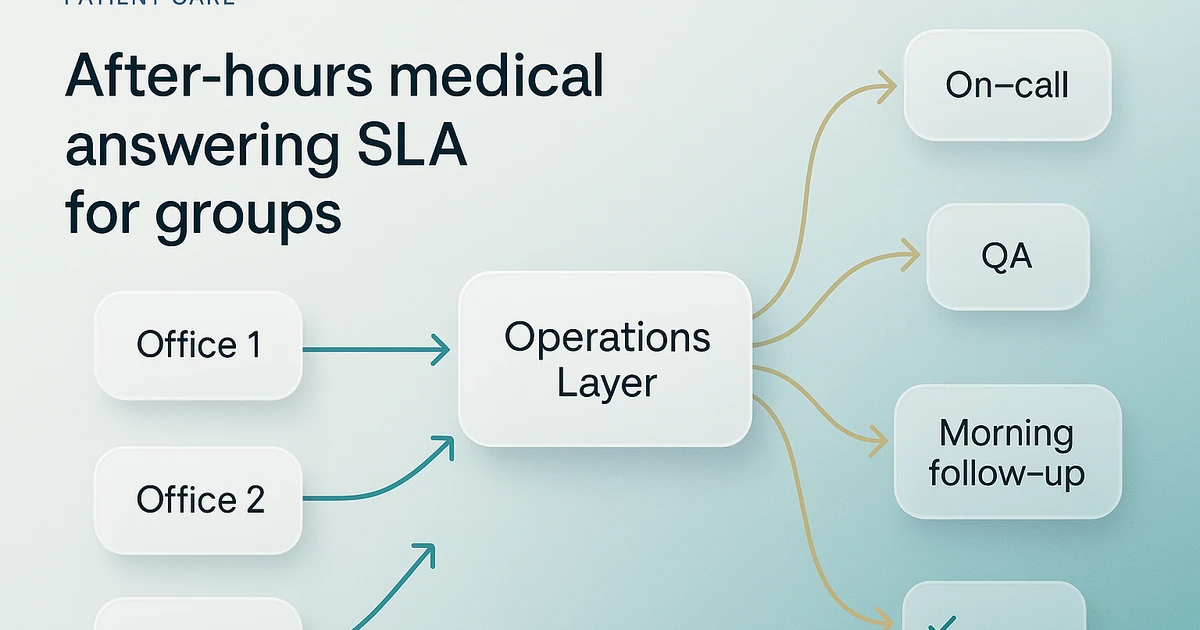
A usable enterprise SLA distinguishes between operational access promises and clinical escalation rules. Access promises cover who answers, what gets documented, where routine requests go, how location identity is presented, and which outcomes must be visible in reporting.
Clinical rules belong in a separate but linked layer.
NCQA’s current PCMH concepts pair patient-centered access and continuity with performance measurement and quality improvement (NCQA).
That is the right posture for after-hours answering at scale: documented process first, measurable execution second.
Document Location Exceptions Inside One Standard
Enterprise groups still need location-level differences. A subspecialty clinic may use a different on-call roster than a primary care site. A newly acquired practice may need a temporary routing variation while systems are consolidated. Those differences are normal.
What often creates problems is allowing those differences to live outside the enterprise standard. A better model is one master SLA with controlled appendices for site-specific exceptions, service-line nuances, and approved escalation contacts. That preserves centralization while giving the operations team clean change control.
How Should Group Practices Separate Answering From Triage?
This is a section buying committees sometimes skip, and it is where risk can concentrate.
The out-of-hours literature focuses less on brand labels and more on protocol design, supervision, and decision boundaries (Huibers et al., Wheeler et al.).
For multi-location groups, that distinction can matter because the wrong scope definition creates operational noise. If non-clinical answering staff are asked to improvise clinical judgment, the SLA is likely underspecified. If every ambiguous call is pushed to a clinician, the SLA may not really be controlling workload at all.
Use Message Taking for Routine Access Workflows
Routine access workflows can often be standardized cleanly. Scheduling requests, non-urgent callbacks, location questions, and requests that belong in the next available follow-up queue usually fit well inside a non-clinical after-hours answering model.
That model becomes more manageable when every location uses the same reason-code taxonomy and the same morning ownership rules.
It also pairs well with the enterprise operating assumptions described in our post on after-hours medical answering service benefits, where the real value comes from centralized consistency rather than isolated site coverage.
Route Clinical Judgment Through Explicit Escalation Paths
The clinical side should be narrower and more explicit.
The telephone-triage literature supports careful attention to who is making decisions and under what protocols, especially when comparing clinical and non-clinical decision makers (Wheeler et al., Huibers et al.).
In practical terms, that means the SLA should specify what must be escalated, who receives it, how the handoff is documented, and how exceptions are reviewed.
The goal is not to turn a vendor into a clinical endpoint. The goal is to create a controlled routing layer that supports the clinical team without asking it to absorb unnecessary noise.
Which SLA Measures Matter Most to Operations Leaders?
Many groups overfocus on vendor responsiveness and underfocus on operating usefulness. A fast answer can mean little if call notes are incomplete, location routing is inaccurate, or follow-up ownership is unclear the next business day. An enterprise SLA needs measures that connect answering behavior to the patient-access workflow.
That is also where SLA calibration becomes an executive issue. NCQA’s current PCMH concepts treat patient-centered access and continuity alongside performance measurement and quality improvement (NCQA).
For multi-location operators, the same logic applies: if the measure cannot support correction, staffing decisions, or leadership reporting, it is probably the wrong measure.
Track Access, Not Just Raw Call Counts
A strong metric set starts with access outcomes rather than vanity activity. Leaders usually need a consistent view of answered versus unanswered demand, documented disposition, callback completion, booked follow-up where appropriate, and unresolved items by location or service line.
That structure makes SLA review more useful than a vendor scorecard. It also aligns well with broader patient access center metrics for healthcare executives, where the value comes from comparing operating performance across the network instead of debating anecdotal site feedback.
Calibrate Quality and Documentation Across Sites
Quality review is just as important as volume reporting. If the same call would be documented one way at one location and another way somewhere else, the network does not actually have one after-hours standard. It has multiple undocumented ones.
That is why enterprise groups often need a shared QA rubric, shared note-completeness expectations, and recurring SLA calibration meetings with operations and clinical stakeholders.
The mechanics are similar to the discipline outlined in multi-location call center QA calibration for healthcare: central scoring, controlled exceptions, and portfolio-wide feedback loops.
How Should a Multi-Location Rollout Be Staged?
An after-hours rollout should be treated as an operating-model deployment, not a phone-forwarding task. If the pilot works only because one office manager is manually holding the process together, the group has not validated a scalable design. It has validated a temporary workaround.
That distinction can matter most in organizations with active M&A or location expansion. A rollout model that may not survive integration pressure can create rework later, especially when the platform needs tighter centralization and clearer reporting.
Pilot the Governance Model You Plan to Scale
A good pilot uses the same ownership model, QA method, escalation logic, and reporting definitions that the organization intends to use after expansion. The point of the pilot is to pressure-test governance, not to create a polished exception that disappears once the next locations go live.
Buying committees sometimes miss this and judge the project too narrowly. A better question is whether the pilot proves the future operating model for 3+ locations. If not, the group should refine the SLA before rollout rather than scale ambiguity.
Align Integrations and Next-Step Handoffs Early
After-hours answering becomes much more manageable when dispositions, follow-up tasks, and ownership rules can flow into the daytime workflow without manual reconstruction. That does not require every integration on day one, but it does require agreement on where notes land, who closes loops, and how location leadership sees open work.
This is why integration planning belongs early in the project, not after vendor selection. Groups that treat handoff design as a late-stage task often discover that the reporting model cannot support the operating model.
Our guide to EHR/PMS integration for centralized scheduling is useful here because the same integration discipline applies to after-hours routing.
What Should Buying Committees Ask Before Approval?
Buying committees should pressure-test whether the proposed SLA will still make sense after staffing turnover, new site onboarding, or service-line additions. If the model depends on one site champion or one vendor manager to remember unwritten rules, it may not hold its shape for long.
That review should stay cross-functional. Operations may own the budget and the rollout path, but clinical leadership, compliance stakeholders, and integration owners all influence whether the SLA is usable.
The question is not whether the document looks complete. The question is whether the model remains governable as the platform changes.
Pressure-Test the Operating Model
Before approval, committees should ask who owns the SLA, who approves exceptions, how quality is reviewed, and how location leaders receive feedback without rewriting the standard locally. Those are governance questions, not vendor questions, and they should be answered before contract language is finalized.
This is also the point where enterprise teams usually clarify whether the model is meant for pooled answering, overflow support, or a broader centralized access layer. Each approach can work. The risk comes from pretending those are the same operating model when they are not.
Pressure-Test Vendor Fit After Acquisitions
Vendor evaluation should extend beyond the current footprint. Committees should understand how new locations are added, how service-line rules are introduced, how reporting is segmented by site, and how the vendor participates in change control when the platform evolves.
That is the enterprise difference. A vendor may handle today’s coverage well and still be a weak fit for tomorrow’s rollout pressure.
Operators comparing options often find it useful to pair this review with adjacent reading on enterprise call answering for healthcare and healthcare call center outsourcing for multi-location groups so the after-hours SLA is evaluated as infrastructure, not as a narrow staffing patch.
The best outcome is not a prettier after-hours script. It is a standard that lets leadership compare sites, control exceptions, define escalation cleanly, and keep the access model stable as the organization grows. That is what turns after-hours answering from a site-level workaround into an enterprise patient-communications asset.
Related Reading
- After-Hours Medical Answering Service Benefits
- Enterprise Call Answering for Healthcare
- Healthcare Call Center Outsourcing for Multi-Location Groups
- Multi-Location Call Center QA Calibration for Healthcare
- Patient Access Center Metrics for Healthcare Executives
Sources
- HRSA Accreditation and Patient-Centered Medical Home Recognition Initiative
- AHRQ: Defining the Patient Centered Medical Home
- NCQA: Patient-Centered Medical Home Concepts
- Safety of telephone triage in out-of-hours care: a systematic review
- Safety of clinical and non-clinical decision makers in telephone triage: a narrative review
- Toward higher-performance health systems: adults’ health care experiences in seven countries, 2007
Managing after-hours answering across 3+ locations? Request an Enterprise Assessment for your group.