
Reactivation campaigns without KPI tracking are guesswork. Multi-location healthcare groups running campaigns across 10, 20, or 50 sites need standardized metrics to identify what works, where performance lags, and how to improve. If you are building a campaign from scratch, start with the dormant patient reactivation playbook for the full strategic framework. This guide defines the eight KPIs that matter most for patient reactivation, provides benchmarks for each, and includes a weekly tracking framework for operations leaders.
Table of Contents
- Why Do KPIs Matter for Reactivation?
- What Are the 8 Essential Reactivation KPIs?
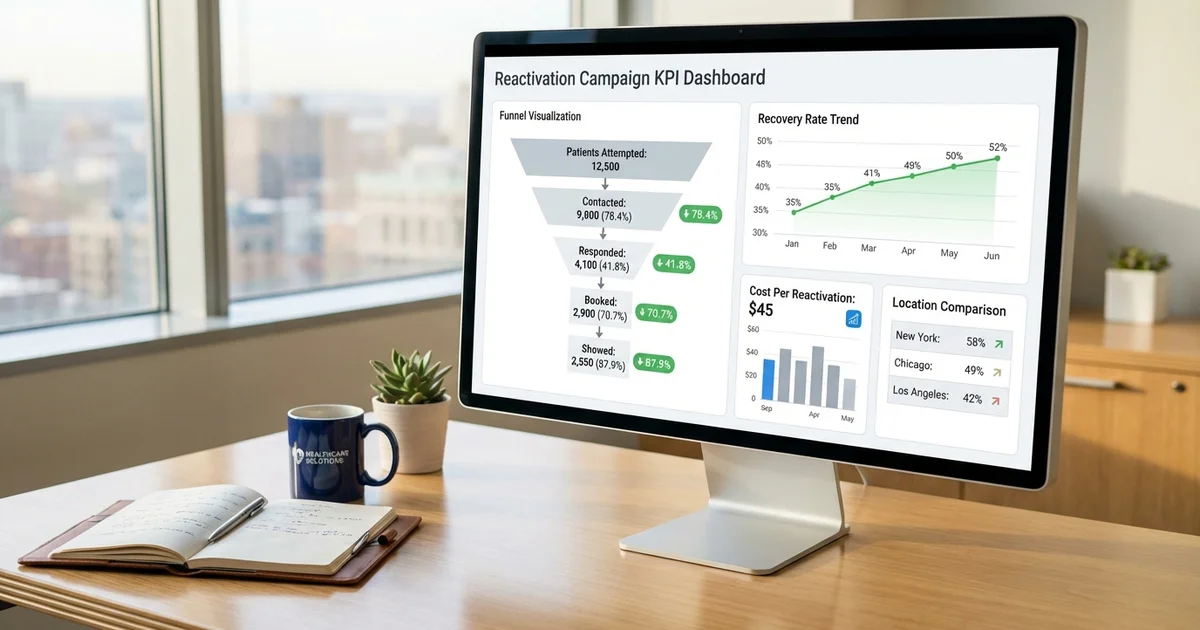
- How Does the Reactivation Funnel Connect KPIs?
- What Does the Weekly Tracking Framework Look Like?
- How Should You Segment KPIs by Patient Type?
- What Are the Common KPI Mistakes?
- What Technology Do You Need for KPI Tracking?
Why Do KPIs Matter for Reactivation?
Without measurement, you cannot answer basic questions:
- Which locations run effective reactivation campaigns?
- Is our contact rate improving or declining?
- Are we converting contacts to appointments?
- What is the ROI of our reactivation investment?
Research shows practices that track reactivation KPIs weekly achieve 10-20% recovery rates, while those operating without metrics often fall below 10%. The difference is visibility and accountability.
What Are the 8 Essential Reactivation KPIs?
1. Contact Rate
Definition: Percentage of outreach attempts that successfully reach patients (answered calls, opened texts, clicked emails).
Formula: Patients Reached / Patients Attempted × 100
Benchmark:
| Channel | Target Contact Rate |
|---|---|
| Phone calls | 25-40% |
| SMS/Text | 85-95% (delivery), 15-25% (response) |
| 20-30% (open rate) |
Why it matters: Low contact rate means wasted outreach effort. If you cannot reach patients, nothing else matters. Track by channel to identify where contact methods need improvement.
2. Response Rate
Definition: Percentage of contacted patients who respond in any way (reply, callback, click).
Formula: Patients Who Responded / Patients Contacted × 100
Benchmark: 15-25% for multi-channel campaigns
Why it matters: Response indicates engagement. Patients who respond but do not book need follow-up with different messaging or channel.
3. Booking Rate
Definition: Percentage of contacted patients who schedule an appointment.
Formula: Appointments Booked / Patients Contacted × 100
Benchmark: 30-50% of contacts should convert to bookings
Example: If you contact 500 patients and 175 book appointments, your booking rate is 35%.
Why it matters: Booking rate measures conversion effectiveness. Low booking rate despite high contact rate suggests messaging or scheduling friction issues.
4. Show Rate
Definition: Percentage of booked appointments that patients actually attend.
Formula: Appointments Completed / Appointments Booked × 100
Benchmark: 85%+ (target 90% for reactivation appointments)
Why it matters: Booking without showing is wasted effort. Reactivated patients may have higher no-show risk than active patients. Track separately and implement confirmation protocols.
5. Recovery Rate (Reactivation Rate)
Definition: Percentage of dormant patients successfully returned to active status (completed at least one appointment).
Formula: Patients Reactivated / Total Dormant Patients × 100
Benchmark:
| Campaign Type | Target Recovery Rate |
|---|---|
| Single campaign | 10-15% |
| Sustained program (12 months) | 15-25% |
Why it matters: This is your headline metric. Recovery rate represents actual patients returned to your practice, combining all funnel stages.
6. Cost Per Reactivation
Definition: Total campaign cost divided by number of patients successfully reactivated.
Formula: Total Campaign Cost / Patients Reactivated
Benchmark: $5-15 per reactivated patient (varies by channel mix)
Cost breakdown example:
| Channel | Cost Per Attempt | Typical Conversion | Effective Cost/Reactivation |
|---|---|---|---|
| SMS | $0.03-0.05 | 5-8% | $0.40-1.00 |
| Phone call | $2-5 | 15-25% | $8-33 |
| Direct mail | $0.50-1.00 | 1-3% | $17-100 |
Why it matters: Cost efficiency determines scalability. High cost per reactivation may still deliver positive ROI if patient lifetime value exceeds cost.
7. Revenue Recovered
Definition: Total revenue generated from reactivated patients within a defined period (typically 12 months).
Formula: Number of Reactivated Patients × Average Revenue Per Patient
Benchmark: Varies by specialty. A dental practice might see $500-800 in first-year revenue per reactivated patient; optometry $300-500.
Why it matters: Revenue recovered is the ultimate measure of campaign value. Compare against campaign cost to calculate ROI.
8. Campaign ROI
Definition: Return on investment from reactivation campaign spend.
Formula: (Revenue Recovered - Campaign Cost) / Campaign Cost × 100
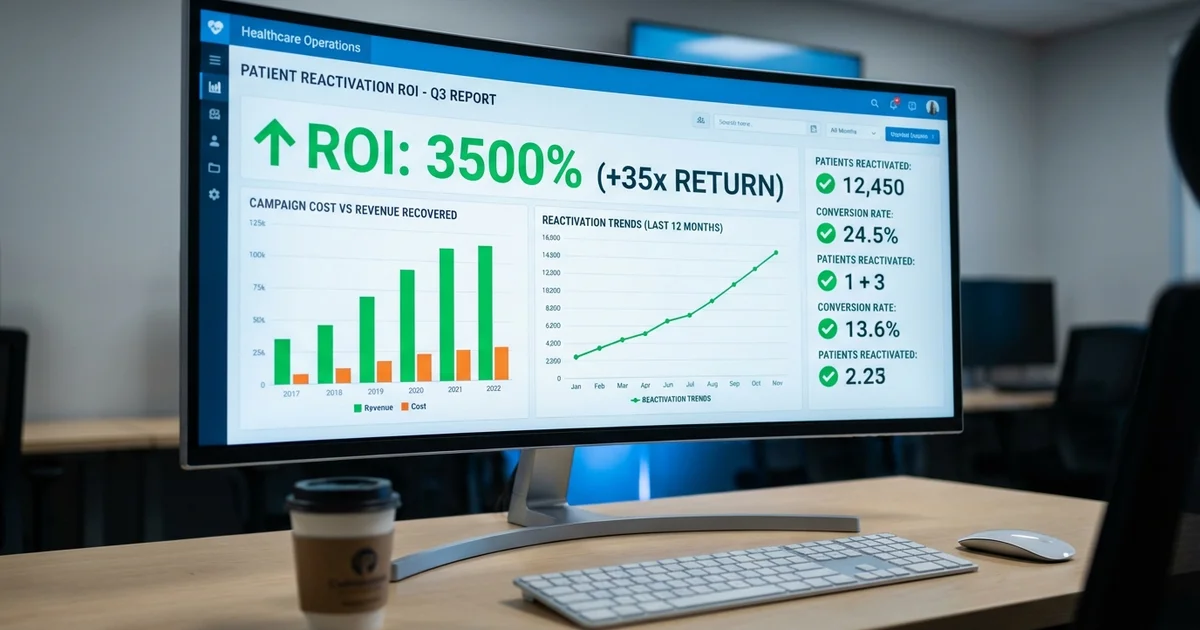
Benchmark: 500-3500% ROI is typical for well-executed campaigns
Example:
- Campaign cost: $2,500
- Patients reactivated: 150
- Average first-year revenue: $600
- Revenue recovered: $90,000
- ROI: ($90,000 - $2,500) / $2,500 = 3,500%
Why it matters: ROI justifies investment and helps secure budget for expanded programs.
How Does the Reactivation Funnel Connect KPIs?
Understanding how metrics flow through the funnel helps diagnose problems:
Funnel diagnosis:
- Low contact rate → improve phone numbers, try different channels
- Low response rate → improve messaging, timing, personalization
- Low booking rate → reduce scheduling friction, train staff on objection handling
- Low show rate → improve confirmation process, send reminders
What Does the Weekly Tracking Framework Look Like?
Operations leaders should review reactivation KPIs weekly during active campaigns. Here is a tracking template:
What Should the Weekly Dashboard Include?
| Metric | Week 1 | Week 2 | Week 3 | Week 4 | Target |
|---|---|---|---|---|---|
| Patients in campaign | N/A | ||||
| Outreach attempts | 100% | ||||
| Contact rate | 35%+ | ||||
| Response rate | 20%+ | ||||
| Appointments booked | N/A | ||||
| Booking rate | 40%+ | ||||
| Appointments completed | N/A | ||||
| Show rate | 85%+ | ||||
| Patients reactivated | N/A | ||||
| Recovery rate (cumulative) | 15%+ | ||||
| Cost to date | N/A | ||||
| Cost per reactivation | <$15 |
How Should You Benchmark at the Location Level?
For multi-location groups, track each site against network averages:
| Location | Contact Rate | Booking Rate | Recovery Rate | vs. Network Avg |
|---|---|---|---|---|
| Site A | 38% | 45% | 17% | +2% |
| Site B | 32% | 38% | 12% | -3% |
| Site C | 41% | 52% | 21% | +6% |
| Network Avg | 37% | 45% | 15% | N/A |
Action triggers:
- Site performing 5%+ below network average → investigate root cause
- Site performing 5%+ above network average → document best practices for replication
How Should You Segment KPIs by Patient Type?
Not all dormant patients are equal. Track KPIs separately for key segments:
By Dormancy Duration
| Segment | Typical Recovery Rate | Cost Per Reactivation |
|---|---|---|
| 6-12 months dormant | 20-30% | $3-8 |
| 12-18 months dormant | 12-18% | $8-15 |
| 18-24 months dormant | 8-12% | $12-25 |
| 24+ months dormant | 3-8% | $20-50 |
Implication: Allocate more resources to recently dormant patients where ROI is highest.
By Patient Value
| Segment | Typical Recovery Rate | Investment Level |
|---|---|---|
| High-value ($2,000+ LTV) | 15-25% | High (phone calls, personalized outreach) |
| Medium-value ($500-2,000 LTV) | 12-18% | Medium (hybrid approach) |
| Lower-value (<$500 LTV) | 8-15% | Low (automated only) |
What Are the Common KPI Mistakes?
Tracking bookings instead of show rate: A campaign that books 200 appointments but only 140 show has different ROI than one that books 150 with 140 showing. Always track through to completion.
Ignoring cost per reactivation: A campaign with 25% recovery rate but $50 cost per reactivation may underperform a campaign with 15% recovery rate and $8 cost per reactivation.
Measuring single campaigns, not sustained programs: Recovery rate compounds over time. A 12-month sustained program achieves higher cumulative recovery than four separate quarterly campaigns.
Not segmenting by location: Network averages mask performance variation. Location-level tracking creates accountability and identifies best practices.
What Technology Do You Need for KPI Tracking?
Effective KPI tracking requires integrated systems:
Essential capabilities:
- PM/EHR integration for patient data and appointment status
- Campaign management platform with funnel tracking
- Multi-location dashboard with comparative views
- Automated reporting (daily/weekly email summaries)
Metrics to automate:
- Contact rate by channel
- Booking rate by channel and segment
- Show rate with automatic calculation from PM data
- Revenue recovered (requires integration with billing)
Key Takeaways
Reactivation campaign success depends on consistent KPI tracking:
- Contact rate: Target 25-40% for phone, 85%+ delivery for SMS
- Booking rate: Target 30-50% of contacts converting to appointments
- Show rate: Target 85%+ (90% for reactivated patients)
- Recovery rate: Target 10-15% per campaign, 15-25% for sustained programs
- Cost per reactivation: Target $5-15 depending on channel mix
- Campaign ROI: Expect 500-3000% for well-executed campaigns
- Track weekly during active campaigns, monthly for sustained programs
- Segment by location, dormancy duration, and patient value
- Use location benchmarking to identify outliers and best practices
The groups achieving the best reactivation results combine systematic KPI tracking with rapid iteration based on what the data reveals.
For the complete reactivation playbook, see our 30-day dormant patient reactivation guide. For ROI calculation methodology, review our patient reactivation ROI guide.
Related Reading
- Patient Recall Solution
- Reactivation Call Centers for Multi-Location Medical Groups
- Reactivation Text Templates: SMS Scripts That Work
- Patient Recall Segmentation: Who to Call First (and Why)
Reactivating dormant patients is one of the highest-ROI investments a practice can make. Talk to our team about how MyBCAT combines call answering with patient recall to keep your schedule full.