
Reactivating a dormant patient costs 5-25x less than acquiring a new one. Yet most practices cannot quantify the return on their reactivation efforts. If you are building your first campaign, start with our dormant patient reactivation playbook for the strategic framework. This guide provides the calculation framework to measure patient reactivation ROI, benchmark your results against top performers, and build the business case for dedicated reactivation resources.
Table of Contents
- What Is the Financial Case for Reactivation?
- What Is the Basic ROI Formula?
- What Are the ROI Calculation Components?
- What Do Good Benchmarks Look Like?
- What Is the Cost of Not Reactivating?
- How Do You Build Your ROI Calculator?
- How Does ROI Differ by Patient Segment?
- What Are the Multi-Location ROI Considerations?
- How Do You Present ROI to Leadership?
What Is the Financial Case for Reactivation?
Before reviewing calculations, understand why reactivation investment matters:
Reactivation vs. acquisition economics:
| Metric | Reactivation | New Acquisition |
|---|---|---|
| Cost per patient | $5-15 | $100-300+ |
| Conversion rate | 10-30% | 5-20% |
| Time to revenue | Immediate | 3-6 months |
| Lifetime value | Known history | Unknown |
| Trust level | Pre-established | Must build |
The retention multiplier: A 5% increase in patient retention can boost profits by 25-95%. This happens because:
- Retained patients already know and trust your practice
- No marketing cost to re-establish the relationship
- Higher conversion on additional services
- Referral likelihood increases with tenure
What Is the Basic ROI Formula?
Patient reactivation ROI follows a straightforward calculation:
Patient Reactivation ROI Formula
ROI = (Revenue Generated - Campaign Cost) / Campaign Cost x 100
Example calculation:
- Patients reactivated: 150
- Average first-year revenue per patient: $600
- Total revenue generated: $90,000
- Campaign cost: $2,500
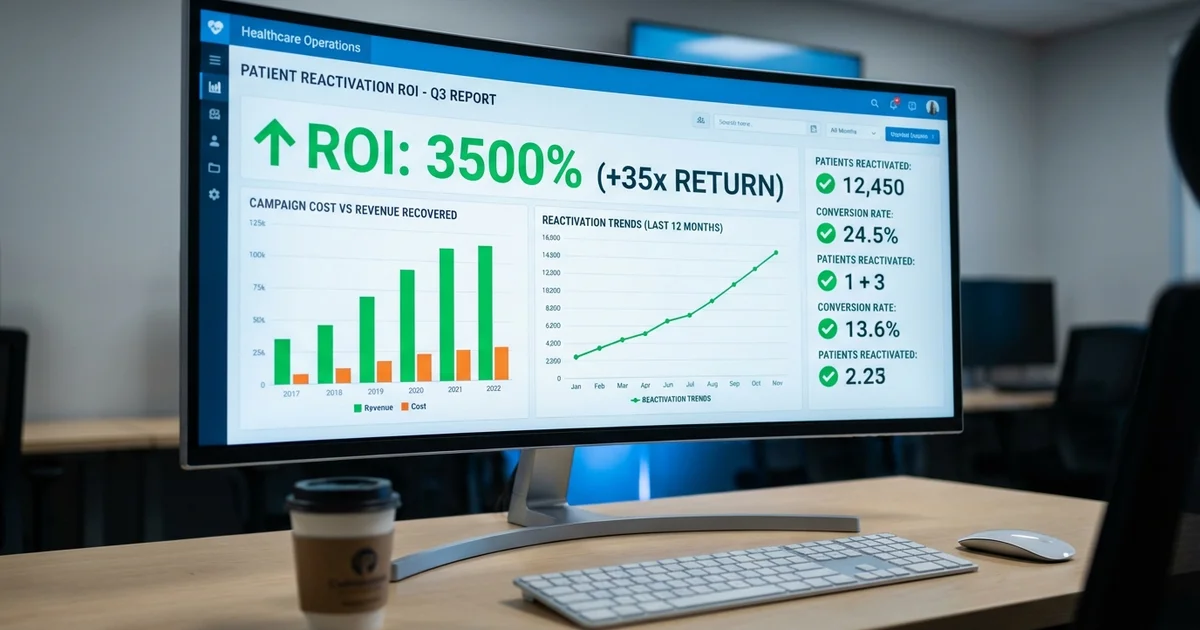
- ROI = ($90,000 - $2,500) / $2,500 x 100 = 3,500% (or 35x)
What Are the ROI Calculation Components?
1. Campaign Costs
Track all costs associated with your reactivation effort:
Direct costs:
| Cost Type | Typical Range | Notes |
|---|---|---|
| SMS/Text messaging | $0.03-0.05/message | Include full sequence |
| Phone staff time | $15-25/hour | Track time per patient |
| Email platform | Often included in PM | Marginal cost minimal |
| Postcards | $0.50-1.00 each | Design, print, postage |
| Calling service (outsourced) | $2-5/connected call | If using external team |
Indirect costs (often overlooked):
- Staff training time
- Campaign setup and management
- PM system configuration
- Reporting and analysis time
Sample campaign cost breakdown:
| Item | Quantity | Unit Cost | Total |
|---|---|---|---|
| SMS messages (4-touch sequence) | 2,000 | $0.04 | $80 |
| Phone calls (to non-responders) | 500 | $3.00 | $1,500 |
| Postcards (unreachables) | 200 | $0.75 | $150 |
| Staff management time | 10 hours | $25/hr | $250 |
| Total campaign cost | $1,980 |
2. Revenue Generated
Revenue from reactivated patients includes multiple components:
Immediate revenue:
- First appointment fee
- Procedures performed at visit
- Products sold (eyewear, oral care, etc.)
Extended revenue (first 12 months):
- Follow-up appointments
- Ongoing treatment plans
- Referrals from reactivated patients
Sample revenue calculation:
| Revenue Type | Per Patient | Patients | Total |
|---|---|---|---|
| Initial exam | $150 | 150 | $22,500 |
| Additional services (50% uptake) | $300 | 75 | $22,500 |
| Products/materials (30% uptake) | $400 | 45 | $18,000 |
| Second visit within year (40%) | $200 | 60 | $12,000 |
| Total first-year revenue | $75,000 |
ROI = ($75,000 - $1,980) / $1,980 x 100 = 3,687% (37x)
3. Patient Lifetime Value (LTV)
For a complete picture, consider lifetime value beyond the first year:
LTV calculation:
Lifetime Value Formula
LTV = Average Annual Revenue x Average Patient Tenure
By specialty:
| Specialty | Avg Annual Revenue | Avg Tenure | LTV |
|---|---|---|---|
| Dental | $500-800 | 5-7 years | $2,500-5,600 |
| Optometry | $300-500 | 4-6 years | $1,200-3,000 |
| Primary care | $400-700 | 6-10 years | $2,400-7,000 |
LTV-adjusted ROI: If you reactivate 150 patients with $3,500 average LTV and spend $1,980:
- Total lifetime value: $525,000
- Campaign cost: $1,980
- LTV-adjusted ROI: 26,415% (264x)
What Do Good Benchmarks Look Like?
Compare your results against industry benchmarks:
Campaign-level benchmarks:
| Metric | Below Average | Average | Good | Excellent |
|---|---|---|---|---|
| Reactivation rate | <10% | 10-15% | 15-20% | 20-30% |
| Cost per reactivation | >$20 | $10-20 | $5-10 | <$5 |
| First-year ROI | <10x | 10-30x | 30-50x | 50x+ |
| LTV-adjusted ROI | <50x | 50-100x | 100-200x | 200x+ |
Real-world results:
| Case | Patients Reactivated | Revenue | Cost | ROI |
|---|---|---|---|---|
| SENTA Partners | 1,000 | $220,000 | ~$10,000 | 22x |
| Optometry practice | 59 | $49,456 | $350 | 140x |
| Dental DSO (per location) | 75 | $52,500 | $1,500 | 35x |
What Is the Cost of Not Reactivating?
Understanding opportunity cost strengthens the business case:
Annual attrition impact: For a practice with 2,000 active patients:
- Industry attrition: 10-17% annually
- Patients lost per year: 200-340
- Average LTV: $4,200
- Annual revenue at risk: $840,000-$1,428,000
The math: If a $5,000 reactivation campaign recovers even 50 patients (15% of lapsed):
- Revenue recovered: $30,000 first year (at $600/patient)
- LTV recovered: $210,000 (at $4,200 LTV)
- ROI on first-year revenue: 500%
- ROI on LTV: 4,100%
How Do You Build Your ROI Calculator?
Create a simple spreadsheet to track reactivation ROI:
Input variables:
- Number of dormant patients targeted
- Campaign costs (itemized)
- Reactivation rate achieved
- Average revenue per reactivated patient
- Average patient tenure (for LTV)
Output metrics:
- Patients reactivated
- Total campaign cost
- Cost per reactivation
- First-year revenue generated
- First-year ROI
- Estimated LTV recovered
- LTV-adjusted ROI
Sample calculator structure:
Reactivation ROI Calculator
INPUTS
Dormant patients targeted: 1,000
SMS cost per patient: $0.16 (4-msg sequence)
Phone cost per patient: $1.50 (non-responders only)
Postcard cost per patient: $0.10 (unreachables only)
Reactivation rate: 15%
First-year revenue/patient: $600
Average patient tenure: 5 years
Annual revenue/patient: $500
OUTPUTS
Patients reactivated: 150
Total SMS cost: $160
Total phone cost: $1,050 (70% called)
Total postcard cost: $20 (20% mailed)
Total campaign cost: $1,230
Cost per reactivation: $8.20
First-year revenue: $90,000
First-year ROI: 7,217% (72x)
Lifetime value recovered: $375,000
LTV-adjusted ROI: 30,388% (304x)
How Does ROI Differ by Patient Segment?
Not all dormant patients deliver equal ROI. Segment your analysis:
By dormancy duration:
| Segment | Reactivation Rate | Avg Cost | Avg Revenue | ROI |
|---|---|---|---|---|
| 6-12 months | 20-30% | $5-8 | $600 | 75-120x |
| 12-18 months | 12-18% | $8-12 | $550 | 45-70x |
| 18-24 months | 8-12% | $12-18 | $500 | 25-40x |
| 24+ months | 3-8% | $18-30 | $450 | 12-25x |
Implication: Focus resources on recently dormant patients for highest ROI.
By patient value:
| Segment | Reactivation Investment | Expected ROI |
|---|---|---|
| High LTV ($5,000+) | High (phone calls) | 50-100x |
| Medium LTV ($2,000-5,000) | Medium (hybrid) | 40-80x |
| Lower LTV (<$2,000) | Low (automated only) | 30-60x |
What Are the Multi-Location ROI Considerations?
For healthcare groups operating multiple sites:
Aggregate vs. location-level analysis:
- Track ROI at both network and individual location levels
- Identify best and worst performers
- Share practices from high-ROI locations
Network-level example:
| Location | Dormant | Reactivated | Cost | Revenue | ROI |
|---|---|---|---|---|---|
| Site A | 500 | 85 (17%) | $1,200 | $51,000 | 43x |
| Site B | 800 | 96 (12%) | $1,800 | $57,600 | 32x |
| Site C | 400 | 72 (18%) | $900 | $43,200 | 48x |
| Network | 1,700 | 253 (15%) | $3,900 | $151,800 | 39x |
Variance analysis questions:
- Why does Site C achieve 18% reactivation vs. Site B’s 12%?
- What scripts or timing does Site A use?
- How can we bring Site B up to network average?
How Do You Present ROI to Leadership?
Frame your reactivation ROI for executive audiences:
What leadership wants to know:
- How much did we invest?
- What did we get back?
- What would happen if we did more?
- What happens if we do nothing?
Executive summary template:
Reactivation Campaign Results: Q1 2026
Investment: $3,900 (multi-channel outreach)
Patients reactivated: 253
First-year revenue recovered: $151,800
ROI: 39x (3,800%)
With additional investment:
$10,000 budget → projected 650 reactivations, $390,000 revenue
ROI projection: 39x maintained at scale
Cost of inaction:
Annual attrition: 500 patients
Revenue at risk: $300,000/year
LTV at risk: $2,100,000
Key Takeaways
Patient reactivation delivers measurable, substantial ROI when tracked properly:
- Basic ROI formula: (Revenue - Cost) / Cost x 100
- Typical ROI range: 30-140x for well-executed campaigns
- Cost per reactivation benchmark: $5-15 (vs. $100-300 for new acquisition)
- LTV multiplier: Include lifetime value for full picture (often 5-10x first-year ROI)
- Segment analysis: Recently dormant patients deliver highest ROI
- Track by location: Identify best practices from top performers
The practices that invest in reactivation systematically, measuring, optimizing, and scaling, capture revenue that competitors leave on the table. A $2,000 campaign that returns $60,000+ is not an expense; it is the highest-ROI investment most practices can make.
For the metrics to track during campaigns, see our reactivation campaign KPIs guide. For the complete campaign playbook, review our 30-day dormant patient reactivation guide.
Related Reading
- Patient Recall Solution
- Reactivation Call Centers for Multi-Location Medical Groups
- Reactivation Text Templates: SMS Scripts That Work
- Reactivation Campaign KPIs: Metrics for Multi-Location Groups
Patient recall and reactivation programs produce the highest return on investment when they combine multiple communication channels with consistent follow-up sequences. Phone outreach reaches patients who may not respond to text or email, while automated messaging provides touchpoints at scale that would be impossible with phone calls alone. The practices seeing the strongest results use data to segment their patient populations and tailor their outreach strategy to each segment. Patients who have been inactive for six months require a different approach than those who missed a single recall appointment. Similarly, high-value patients who bring family members to the practice warrant more intensive outreach efforts than patients with lower lifetime value. This data-driven approach to recall management transforms what many practices treat as an administrative task into a genuine revenue growth engine.
Reactivating dormant patients is one of the highest-ROI investments a practice can make. Talk to our team about how MyBCAT combines call answering with patient recall to keep your schedule full.
What Factors Drive Variation in Reactivation ROI?
Several factors explain why reactivation ROI varies significantly between practices, even those using similar strategies. Patient demographics play a major role because younger patients with fewer health concerns require different outreach approaches than older patients with chronic conditions. The length of dormancy also matters because patients who have been inactive for six months respond to different messages than patients who have been away for two years or more.
Geographic factors influence reactivation success as well. Practices in areas with high population growth may find that many dormant patients have simply moved away, reducing the effective pool of reactivatable patients. Conversely, practices in stable communities with limited alternatives tend to see higher recovery rates because patients have fewer competing options. Understanding your local market dynamics helps set realistic ROI expectations and focus resources on the segments most likely to respond.
The quality of patient contact information in your practice management system also significantly affects campaign results. Practices that maintain current phone numbers, email addresses, and mailing addresses for their patient base achieve contact rates two to three times higher than those with outdated records. This is why data hygiene should be a continuous operational practice rather than something addressed only when launching a reactivation campaign.
Sources
- MGMA: Foundational Benchmarks and KPIs for Medical Practice Operations
- Prospyr Med: Ultimate Guide to Patient Reactivation
- Boyd Biomedical: Patient Engagement ROI Calculator
- DemandHub: ROI Calculator for Patient Recall and Reactivation
- Healos AI: Healthcare Automation ROI Calculator
- TotalMed: Maximizing ROI in Healthcare Workforce Solutions