
Centralized scheduling for dental offices delivers measurable operational gains: DSOs implementing unified scheduling systems report 20% increases in patient visits and 90%+ call answer rates across locations. For multi-location dental groups managing 3, 15, or 50+ sites, centralization transforms scheduling from a fragmented liability into a competitive advantage that directly impacts EBITDA.
What You’ll Learn
- Why Does Decentralized Scheduling Fail at Scale?
- What Makes Centralized Scheduling Different for DSOs?
- How Do You Calculate the ROI of Centralized Scheduling?
- What Technology Stack Supports Multi-Location Scheduling?
- How Should DSOs Structure Their Centralized Scheduling Team?
- What KPIs Should Operations Leaders Track?
- Implementation Timeline: 90-Day Rollout Framework
Why Does Decentralized Scheduling Fail at Scale?
The per-location scheduling model that works for independent practices becomes a operational bottleneck the moment a dental group expands beyond three locations. Each site operates as an island with its own phone lines, scheduling protocols, and staffing challenges. The result is inconsistent patient experiences and significant revenue leakage.
According to research from the American Dental Education Association, dental organizations operating decentralized scheduling systems answer only 25% of incoming calls during peak hours. The remaining 75% of callers encounter voicemail, hold times exceeding two minutes, or abandoned calls. Each unanswered call represents a potential new patient worth $800-1,200 in first-year production.
The staffing math compounds the problem. A single front desk employee at one location cannot handle call spikes that occur predictably at 8:30 AM, 12:00 PM, and 4:30 PM. When that employee takes PTO, calls sick, or quits (industry turnover exceeds 30% annually), the entire location’s scheduling capacity collapses. Multiply this vulnerability across 10 locations, and the operational risk becomes unacceptable for PE-backed groups focused on EBITDA performance.
Multi-location dental groups also face technology fragmentation. Acquisitions bring different practice management systems, scheduling workflows, and data formats. Without centralization, operations leaders lack visibility into true scheduling performance across the portfolio. They cannot identify which locations underperform, which time slots go unfilled, or which patient segments require targeted outreach.
What Makes Centralized Scheduling Different for DSOs?
Centralized scheduling consolidates patient access functions into a single operations hub that serves all locations simultaneously. Instead of 15 locations each handling their own phones with varying skill levels, a dedicated scheduling team manages the entire call volume with standardized protocols, unified technology, and professional oversight.
The UCSF School of Dentistry implemented this model in late 2023 and documented the results. Their centralized call center achieved 90%+ first-call answer rates and generated $2 million in additional annual revenue against a $1 million operational cost. Patient visit volume increased 20% within the first nine months. The University of Michigan saw similar results with 6% more appointments scheduled after centralizing.
Decentralized Model
Answer Rate: 25-40%
Staffing: 1-2 per location (variable skill)
Coverage Gaps: PTO, lunch, turnover
Visibility: Per-location only
Centralized Model
Answer Rate: 90-98%
Staffing: Pooled team with QA
Coverage Gaps: Eliminated
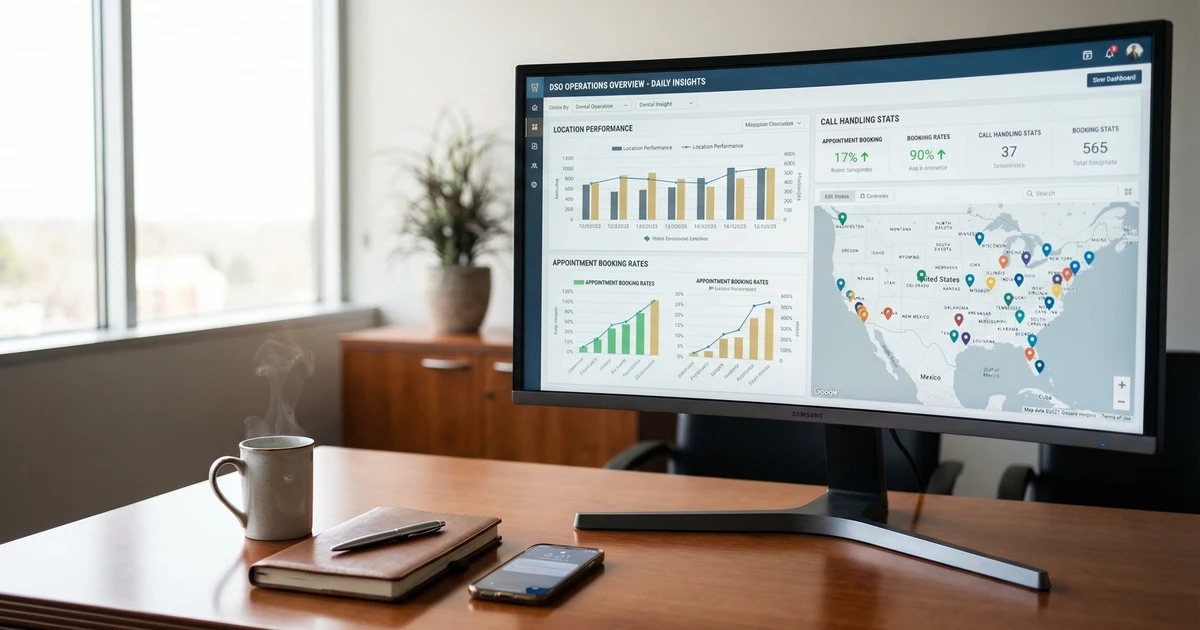
Visibility: Portfolio-wide dashboard
For DSOs specifically, centralization enables operational standardization that PE sponsors require. Every patient receives the same professional greeting, the same verification process, and the same scheduling experience regardless of which location they call. This consistency becomes a defensible competitive advantage and a key value driver during exit preparation.
The centralized model also supports multi-location intake strategies that simply cannot exist in decentralized environments. Cross-booking patients to locations with availability, managing waitlists across the network, and executing recall campaigns at scale all require centralized coordination.
How Do You Calculate the ROI of Centralized Scheduling?
The financial case for centralized scheduling rests on three primary drivers: recovered revenue from answered calls, reduced labor costs through pooling, and increased production through optimized scheduling.
Recovered Revenue Calculation: Most multi-location dental groups miss 20-40 calls per location daily during peak periods. At a conservative $100 average lifetime value per new patient inquiry, a 10-location group losing 30 calls per location daily bleeds $30,000 in weekly opportunity cost. Centralized scheduling recovering just 60% of those calls produces $936,000 in annual recovered revenue.
Labor Cost Reduction: Decentralized scheduling requires 1.5-2 FTEs per location for adequate coverage. A 10-location group employs 15-20 front desk staff partially dedicated to phones. Centralized scheduling typically requires 4-6 dedicated agents to handle equivalent volume with better service levels, freeing local staff for patient-facing duties and reducing total headcount requirements.
Production Optimization: Top-performing dental practices schedule 107 appointments daily and maintain 94% reappointment rates compared to the 77% industry average. Centralized scheduling with proactive outreach, waitlist management, and no-show reduction protocols closes this performance gap. A 10% improvement in scheduling efficiency across a $20 million revenue group produces $2 million in incremental production.
For detailed ROI modeling, the healthcare call center ROI framework provides enterprise-specific calculations that account for DSO operational structures.
What Technology Stack Supports Multi-Location Scheduling?
Effective centralized scheduling requires technology integration across three layers: telephony and routing, practice management connectivity, and performance analytics.
Telephony Infrastructure: The phone system must route calls intelligently based on caller ID, time of day, location association, and agent availability. Cloud-based systems enable this routing while providing call recording, quality monitoring, and overflow handling. The system should support both inbound scheduling and outbound campaigns for recalls and confirmations.
PMS Integration: Centralized agents need real-time access to all location schedules within a unified interface. This requires API integration with the practice management systems across your portfolio. For DSOs operating multiple PMS platforms post-acquisition, middleware solutions can provide a normalized scheduling view. The EHR/PMS integration guide for enterprise scheduling details the technical requirements and vendor evaluation criteria.
Analytics Platform: Operations leaders require dashboard visibility into call volume patterns, answer rates, booking conversion rates, and agent performance across all locations. The analytics layer should support both real-time monitoring and historical trend analysis for capacity planning. Key reports include:
- Call volume by location, hour, and day of week
- Answer rate and abandonment rate trends
- Booking conversion rates by call type
- Agent productivity and quality scores
- Schedule fill rates and gap analysis
Without this analytics layer, centralization provides efficiency gains but not the operational intelligence that drives continuous improvement.
How Should DSOs Structure Their Centralized Scheduling Team?
Team structure depends on call volume, location count, and service level targets. Most DSOs begin with a staffing ratio of one dedicated scheduling agent per 3-5 locations, adjusted based on average daily call volume per site.
Core Team Roles:
Scheduling Agents: Handle inbound calls, book appointments, verify insurance, and manage patient communications. Each agent should be trained on all location schedules, provider preferences, and scheduling protocols. Cross-training eliminates single points of failure.
Quality Assurance Specialist: Reviews call recordings, calibrates scoring criteria, and provides coaching feedback. For groups with 10+ locations, a dedicated QA role ensures consistent service delivery. The multi-location call center QA calibration framework outlines calibration protocols.
Team Lead/Manager: Oversees daily operations, handles escalations, manages staffing and scheduling for the centralized team, and reports on KPIs. This role serves as the bridge between the scheduling function and practice operations leadership.
Shift Coverage Model: Design shifts to match call volume patterns. Dental practices typically see call peaks at market open (8:00-9:30 AM), lunch transition (11:30 AM-1:00 PM), and end of day (4:00-5:30 PM). Staff coverage should exceed minimum requirements during these windows. Consider extended hours for patient convenience since many working patients prefer calling before 8 AM or after 5 PM.
Training Requirements: Centralized agents need deeper training than traditional front desk staff because they represent your entire organization, not just one location. Training should cover dental terminology, insurance verification, location-specific details (directions, parking, special instructions), and brand-consistent communication standards. Plan for 2-3 weeks of initial training with ongoing education.
What KPIs Should Operations Leaders Track?
Centralized scheduling creates opportunities for measurement that simply do not exist in decentralized models. Operations leaders should establish baseline metrics during implementation and track improvement trajectories.
| KPI | Target | Why It Matters |
|---|---|---|
| Answer Rate | 95%+ | Primary service quality indicator |
| Average Speed to Answer | Under 20 seconds | Patient experience driver |
| Abandonment Rate | Under 3% | Indicates capacity issues |
| Booking Conversion Rate | 80%+ for new patients | Revenue impact metric |
| Schedule Fill Rate | 95%+ | Production optimization |
| No-Show Rate | Under 5% | Confirmation effectiveness |
| Reappointment Rate | 90%+ | Retention indicator |
The KPI dashboard for multi-location intake provides visualization templates and benchmark comparisons for enterprise dental groups. These metrics should flow into executive dashboards alongside production and financial performance data.
Track metrics at the aggregate level and by individual location. Centralized scheduling should improve performance across all sites, but persistent underperformance at specific locations may indicate local issues requiring intervention beyond scheduling optimization.
Implementation Timeline: 90-Day Rollout Framework
Centralization is a change management initiative, not just a technology project. DSOs that rush implementation without stakeholder alignment face resistance from practice managers accustomed to controlling their own scheduling.
Days 1-30: Foundation
- Audit current call volumes and answer rates across all locations
- Document existing scheduling protocols and identify best practices
- Select technology platform and begin integration work
- Design staffing model and begin recruitment
- Develop change management communication plan
Days 31-60: Build
- Complete technology integration and testing
- Hire and train initial scheduling team
- Create standardized protocols and call scripts
- Pilot with 2-3 locations to validate processes
- Refine workflows based on pilot learnings
Days 61-90: Scale
- Roll out to remaining locations in waves
- Implement QA monitoring and coaching programs
- Establish executive dashboard reporting
- Document processes for ongoing operations
- Conduct post-implementation review
The DSO change management guide for centralizing patient access provides detailed playbooks for each phase, including communication templates and stakeholder management strategies.
For groups concurrently managing acquisitions, the DSO integration playbook covers how to bring newly acquired practices onto centralized systems during the integration period.
The Operational Imperative for Multi-Location Dental Groups
The U.S. DSO market reached $31.34 billion in 2024 with projections toward $144 billion by 2034. This growth trajectory means more competition, more consolidation, and higher expectations for operational excellence. DSOs that continue operating fragmented scheduling systems sacrifice efficiency gains that directly impact profitability and exit valuations.
Centralized scheduling is no longer an innovation. It is table stakes for multi-location dental groups serious about scale. The organizations documenting 90%+ answer rates and 20% visit increases have already made the transition. The question for operations leaders is not whether to centralize, but how quickly they can execute the transformation.
The technology exists. The staffing models are proven. The ROI calculations are straightforward. What remains is the decision to act and the discipline to implement correctly.
Related Reading
- Dental Software Integrations: A 90-Day Roadmap for DSOs
- Dental Answering Service California | DSO Solutions
- DSO Case Study: 81% Fewer Missed Calls Across 15 Locations
Sources
-
ADEA Innovation Article: Centralized Call Centers at Dental School Clinics - Research on centralized scheduling implementation at UCSF and U-M dental schools with documented ROI data.
-
Becker’s Dental Review: Where Dental Practices Stand on Scheduling - Industry benchmarks on appointment scheduling, no-show rates, and top performer metrics.
-
Grand View Research: U.S. Dental Service Organization Market Report - Market size data and growth projections for the DSO sector.
Ready to Centralize Scheduling Across Your Dental Group?
Managing scheduling across 3+ locations? Request an enterprise assessment to see how centralized scheduling can impact your group's performance.