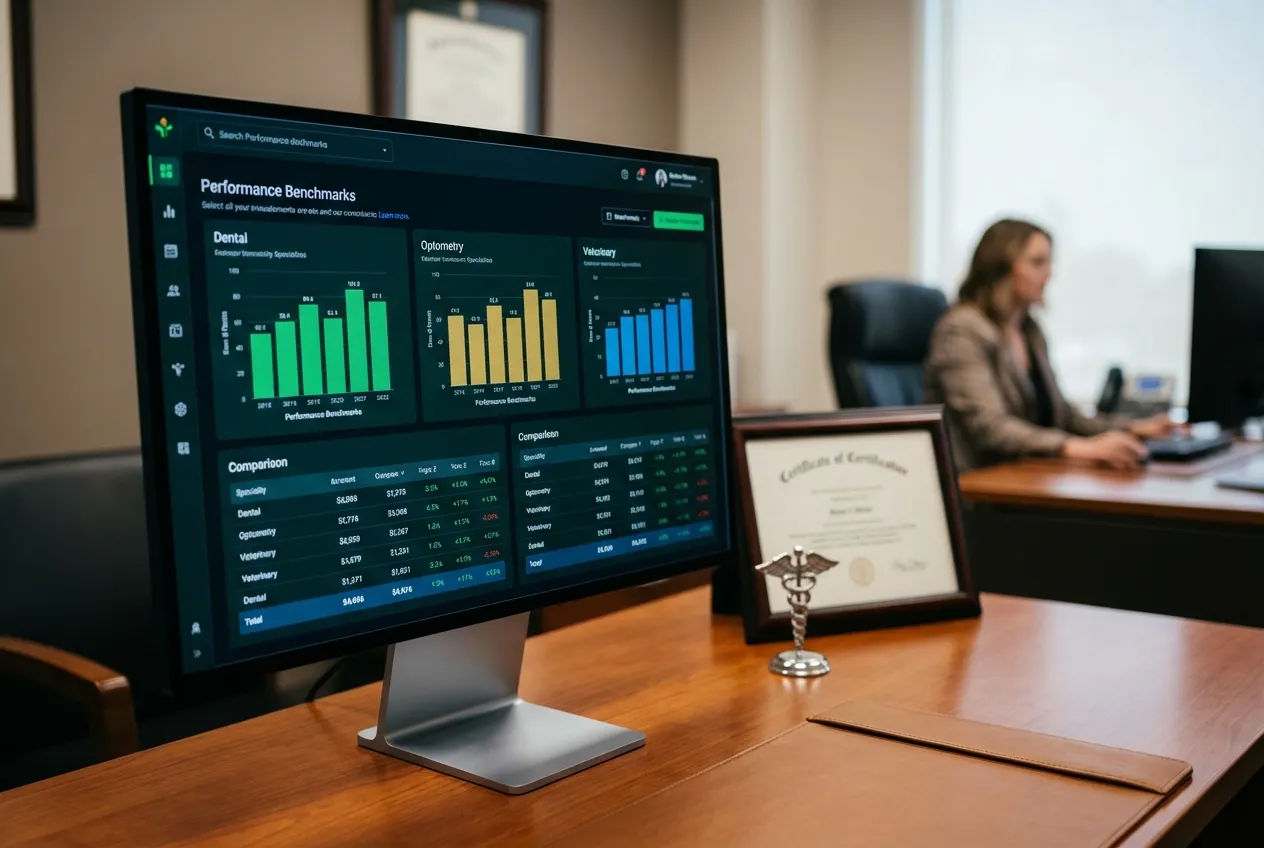


Most multi-location healthcare groups track revenue per location but cannot tell you their call answer rate, new patient conversion rate, or average time to appointment. The result: marketing spend increases while patient acquisition efficiency stays flat. Here are the 10 intake KPIs that top-performing groups track, with benchmarks for dental, optometry, and veterinary practices. For groups seeking comprehensive intake visibility, our enterprise reporting and QA solution delivers real-time dashboards across all locations.
Table of Contents
- Why Are Intake Metrics the Missing Link?
- What Are the 10 Essential Intake KPIs?
- What Are the Benchmarks by Specialty?
- What Are the Benchmarks by Location Count?
- How Do You Build an Effective Dashboard?
- How Do You Compare Locations Fairly?
- How Do You Move from Metrics to Action?
- What Are the Most Common Measurement Mistakes?
- What Technology Do You Need for Intake Measurement?
- Key Takeaways
Why Are Intake Metrics the Missing Link?
Healthcare groups invest heavily in marketing to drive phone calls. They invest in providers and equipment to deliver care. But the connection between those two investments, the intake process that converts calls into patients, often operates without measurement.
Consider the math: A dental group spends $50,000 monthly on marketing across 10 locations. Marketing generates 2,000 calls. But if 25% of those calls go unanswered and only 60% of answered calls convert to appointments, the group is capturing 900 appointments from 2,000 opportunities. That is a 45% yield on marketing spend.
Improving answer rate to 95% and conversion to 70% would capture 1,330 appointments from the same 2,000 calls. Same marketing spend, 48% more patients.
Without intake metrics, you cannot see this opportunity. With intake metrics, you can quantify it, track it, and improve it.
What Is the Visibility Gap?
Most multi-location operators face three visibility challenges:
No standardized measurement. Each location tracks different things in different ways. One location counts answered calls, another counts total calls, a third tracks nothing at all.
No benchmarks for comparison. Even when data exists, operators do not know what “good” looks like. Is 85% answer rate acceptable? Excellent? Terrible? Without benchmarks, data lacks context.
No connection to outcomes. Call data sits in phone systems. Appointment data sits in practice management. Revenue data sits in accounting. Connecting intake activity to business outcomes requires integration that most groups lack.
What Are the 10 Essential Intake KPIs?
These are the metrics that matter for multi-location intake operations. Each serves a specific purpose in understanding and improving performance.
1. Call Answer Rate
Definition: Percentage of incoming calls answered by a live person within a defined ring threshold (typically 3-4 rings or 15-20 seconds).
Formula: (Calls Answered / Total Incoming Calls) x 100
Why It Matters: This is the primary gate. Calls that are not answered cannot convert to patients. Every point of improvement in answer rate translates directly to more appointment opportunities.
Target: 95%+ for high-performing groups
2. Abandonment Rate
Definition: Percentage of callers who hang up before their call is answered or before completing their purpose.
Formula: (Abandoned Calls / Total Incoming Calls) x 100
Why It Matters: Abandonment represents active revenue leakage. These are patients who wanted to schedule but gave up. High abandonment often indicates long hold times or inadequate staffing.
Target: Less than 5%
3. Average Speed to Answer
Definition: Average time in seconds from first ring to call being answered.
Formula: Total Ring Time for Answered Calls / Number of Answered Calls
Why It Matters: Speed impacts both answer rate and caller satisfaction. Callers who wait too long either hang up or start the conversation frustrated.
Target: Under 20 seconds
4. New Patient Conversion Rate
Definition: Percentage of new patient inquiry calls that result in a scheduled appointment.
Formula: (New Patient Appointments Scheduled / New Patient Inquiry Calls) x 100
Why It Matters: This measures how effectively your team converts interest into action. Low conversion with high call volume suggests training or process issues.
Target: 70%+ for dental, 68%+ for optometry, 60%+ for veterinary
5. Appointment Fill Rate
Definition: Percentage of available appointment slots that are filled.
Formula: (Scheduled Appointments / Total Available Slots) x 100
Why It Matters: Empty slots represent lost revenue. Fill rate shows whether intake is keeping pace with provider capacity.
Target: 90%+ utilization of available slots
6. After-Hours Call Volume
Definition: Number and percentage of calls received outside business hours.
Formula: After-Hours Calls / Total Calls x 100
Why It Matters: Significant after-hours volume that goes to voicemail represents missed opportunities. This metric informs after-hours coverage decisions.
Benchmark: Typically 15-25% of total call volume
7. Call Volume by Time
Definition: Distribution of call volume by hour, day of week, and month.
Why It Matters: Understanding call patterns enables staffing optimization. Peak times need adequate coverage; slow times may allow reduced staffing.
Use: Identify peak hours (typically 9-11 AM, 2-4 PM) and high-volume days
8. Time to First Available
Definition: Number of days until the next available appointment for a new patient.
Why It Matters: Long wait times drive patients to competitors. This metric indicates capacity constraints and impacts conversion rates.
Target: Under 5 days for dental, under 7 days for optometry, under 3 days for urgent veterinary
9. Revenue Per Call
Definition: Total revenue generated divided by total incoming calls.
Formula: Total Revenue / Total Incoming Calls
Why It Matters: This composite metric captures the entire intake funnel efficiency. Improvements in answer rate, conversion, and average transaction value all flow into revenue per call.
Use: Track trends over time rather than absolute values
10. Average Handle Time
Definition: Average duration of calls from answer to completion.
Why It Matters: Handle time affects capacity. Excessively long calls may indicate training needs; very short calls may indicate rushed interactions that hurt conversion.
Target: 3-5 minutes for routine scheduling calls
What Are the Benchmarks by Specialty?
Different healthcare verticals have different intake characteristics. These benchmarks reflect top-quartile performance for each specialty.
Dental Practice Benchmarks
| KPI | Target | Top Performer |
|---|---|---|
| Call Answer Rate | 92%+ | 97%+ |
| Abandonment Rate | <5% | <3% |
| Speed to Answer | <20 sec | <12 sec |
| New Patient Conversion | 70%+ | 80%+ |
| Time to First Available | <5 days | <3 days |
| After-Hours Volume | 18-22% | N/A |
Dental practices typically see higher call volumes with shorter handle times. Insurance verification questions are common and can extend calls.
Optometry Practice Benchmarks
| KPI | Target | Top Performer |
|---|---|---|
| Call Answer Rate | 90%+ | 95%+ |
| Abandonment Rate | <6% | <4% |
| Speed to Answer | <25 sec | <15 sec |
| New Patient Conversion | 68%+ | 75%+ |
| Time to First Available | <7 days | <5 days |
| After-Hours Volume | 15-20% | N/A |
Optometry has seasonal patterns with higher volume during back-to-school and year-end benefits periods. Insurance and benefits questions are frequent.
Veterinary Practice Benchmarks
| KPI | Target | Top Performer |
|---|---|---|
| Call Answer Rate | 88%+ | 94%+ |
| Abandonment Rate | <8% | <5% |
| Speed to Answer | <30 sec | <20 sec |
| New Patient Conversion | 60%+ | 72%+ |
| Time to First Available | <3 days | Same day |
| After-Hours Volume | 25-35% | N/A |
Veterinary practices face higher after-hours volume due to emergency nature. Triage complexity can extend handle times and requires specialized training.
What Are the Benchmarks by Location Count?
Scale changes expectations. Larger groups should achieve better metrics through standardization and resource use.
| KPI | 5 Locations | 10 Locations | 25+ Locations |
|---|---|---|---|
| Answer Rate Target | 90% | 92% | 95% |
| Standardization Level | Moderate | High | Essential |
| Central Oversight | Optional | Recommended | Required |
| Real-Time Visibility | Nice to have | Important | Critical |
| Dedicated Intake Staff | Unlikely | Possible | Common |
Why Do Expectations Increase with Scale?
Pooled resources: Larger groups can share intake resources across locations, covering gaps at individual sites.
Specialized roles: At scale, dedicated intake coordinators and quality monitors become economically viable.
Technology investment: Enterprise phone systems, analytics platforms, and automation tools have ROI at larger scale.
Brand consistency: Larger groups typically have stronger brand standards that extend to intake experience.
How Do You Build an Effective Dashboard?
An effective intake dashboard provides at-a-glance visibility into performance while enabling drill-down for investigation.
What Is the Ideal Dashboard Structure?
Level 1: Executive Summary
- Total call volume (period)
- Overall answer rate
- Overall conversion rate
- Revenue per call trend
- Red/yellow/green status by location
Level 2: Location Comparison
- Side-by-side metrics for all locations
- Ranking by each KPI
- Trend arrows (improving/declining)
- Variance from target
Level 3: Location Detail
- Hourly/daily patterns for specific location
- Staff-level metrics (if applicable)
- Call type breakdown
- Exception log (missed calls, complaints)
How Often Should Dashboards Refresh?
| Dashboard Level | Refresh Rate | Audience |
|---|---|---|
| Executive Summary | Daily | C-suite, owners |
| Location Comparison | Daily | Regional managers |
| Location Detail | Real-time | Location managers |
What Are Visualization Best Practices?
Use consistent color coding. Green for at/above target, yellow for within 10% of target, red for below threshold.
Show trends, not just snapshots. A location at 88% answer rate that was at 78% last month tells a different story than one that was at 95%.
Include context. Call volume matters. A location with 95% answer rate on 50 calls is less impressive than one with 92% on 500 calls.
Make action obvious. Dashboard users should immediately know which locations need attention and why.
How Do You Compare Locations Fairly?
Raw metrics can be misleading. Fair comparison requires normalization for factors outside location control.
What Factors Should You Normalize?
Call volume: High-volume locations face different challenges than low-volume locations. Percentage metrics help, but absolute numbers matter for staffing.
Patient mix: Locations with more new patients may have lower conversion rates simply due to longer sales cycles.
Staffing model: A location with dedicated intake staff should outperform one where clinical staff answer phones between patients.
Market characteristics: A location in a highly competitive market may face more price shoppers and lower conversion.
Hours of operation: Extended hours locations capture more calls but may have lower after-hours metrics.
What Comparison Methods Work Best?
Percentile ranking: Rank locations by each metric. Consistently bottom-quartile locations need investigation.
Target variance: Measure distance from target rather than absolute performance. A location at 88% against a 90% target is closer than one at 90% against a 95% target.
Trend comparison: Compare improvement trajectories. A location improving 5 points per quarter is outperforming one that is flat, even if absolute numbers differ.
Composite scoring: Create a weighted score across multiple KPIs to identify overall strongest and weakest performers.
How Do You Move from Metrics to Action?
Data without action is just overhead. Here is how to operationalize intake metrics.
Weekly Review Cadence
Monday: Review prior week metrics by location. Identify any locations that missed targets.
Tuesday-Thursday: Location managers address specific issues. Regional oversight for locations consistently below target.
Friday: Update any process changes. Document what was tried and results.
Intervention Triggers
| Trigger | Immediate Action | Follow-up |
|---|---|---|
| Answer rate drops 5+ points | Check staffing, call routing | Review call patterns for root cause |
| Conversion drops 10+ points | Listen to call recordings | Coaching or retraining |
| Abandonment spikes | Check hold times, queue depth | Consider overflow routing |
| Handle time increases 30%+ | Review call recordings | Identify process or knowledge gaps |
How Do You Investigate Root Causes?
When metrics decline, investigate in this order:
- Staffing: Were scheduled staff actually present? Was call volume higher than expected?
- Technology: Were systems functioning? Any outages or issues?
- Process: Did something change in how calls are handled?
- Training: Are there specific staff members struggling?
- External: Did something in the market or patient population change?
What Are the Most Common Measurement Mistakes?
Avoid these errors that undermine intake measurement programs.
Mistake 1: Measuring Only What Is Easy
Phone systems report call volume and answer rate automatically. Conversion rate requires connecting phone data to scheduling data. Many groups track only the easy metrics and miss the most important ones.
Fix: Invest in integration between phone and practice management systems.
Mistake 2: Setting Unrealistic Targets
Targets set too high create frustration and gaming. Targets set too low provide false comfort.
Fix: Base targets on industry benchmarks and your own historical performance. Stretch goals should be achievable with effort.
Mistake 3: Ignoring Context
A location missed target because two staff called in sick. Treating this the same as a location that consistently underperforms with full staffing wastes management attention.
Fix: Include context in reporting. Flag anomalies and exceptions.
Mistake 4: Measuring Without Acting
Dashboards that no one reviews or acts on are worse than no dashboards. They consume resources and create cynicism.
Fix: Assign clear ownership for each metric. Require documented action plans for underperformance.
Mistake 5: Gaming Metrics
If answer rate is measured but conversion is not, staff may rush calls to keep answer rate high while hurting conversion.
Fix: Track balanced metrics. No single number should be optimized in isolation.
What Technology Do You Need for Intake Measurement?
Accurate measurement requires the right technology foundation.
What Capabilities Are Required?
Call tracking with analytics: Phone system must capture answer rate, abandonment, speed to answer, and handle time by location and time period.
Call recording: Recordings enable quality review and root cause investigation.
CRM or scheduling integration: Connecting call data to appointment data enables conversion tracking.
Reporting and dashboards: Data must be accessible in usable formats without manual compilation.
What Are the Technology Options?
| Approach | Pros | Cons |
|---|---|---|
| Modern VoIP with analytics | Built-in reporting, cloud-based, integrations available | May require phone system change |
| Call tracking overlay | Works with existing phones, focused analytics | Additional cost, integration complexity |
| Practice management reporting | Uses existing system | Limited call-specific metrics |
| Third-party analytics platform | Comprehensive, customizable | Implementation effort, cost |
What Are the Integration Requirements?
For conversion tracking, your phone system must pass caller information to your scheduling system, and scheduling outcomes must flow back for reporting. This typically requires:
- Caller ID capture and matching
- Call disposition logging
- API integration between systems
- Unique identifiers to match calls to appointments
Multi-location healthcare groups need standardized intake across every site. Talk to our team about how MyBCAT provides centralized call answering and patient access for growing organizations.
Key Takeaways
-
Track 10 essential KPIs covering call handling (answer rate, abandonment, speed), conversion (new patient conversion, fill rate), capacity (after-hours volume, time to first available), and efficiency (revenue per call, handle time).
-
Set specialty-specific benchmarks. Dental, optometry, and veterinary practices have different performance expectations based on call patterns and complexity.
-
Expect more from larger groups. 25+ location groups should achieve 95%+ answer rates through resource pooling and standardization that smaller groups cannot match.
-
Build dashboards at three levels. Executive summary for leadership, location comparison for regional managers, location detail for site managers.
-
Compare locations fairly. Normalize for call volume, patient mix, staffing model, and market factors before ranking performance.
-
Act on data. Weekly review cadence, clear intervention triggers, and root cause investigation processes turn metrics into improvement.
-
Avoid common mistakes. Measure conversion (not just calls), set realistic targets, include context, and ensure metrics drive action rather than gaming.
For healthcare groups ready to implement enterprise-grade intake measurement, a patient access center with centralized scheduling provides the infrastructure for consistent, measurable performance across all locations.