Essential Optometric Practice Equipment: A Complete Guide
Starting an optometry practice requires an investment of $150,000 to $400,000 in optometric practice equipment alone. The choices you make during this phase will determine your clinical capabilities, patient experience, and profitability for years to come. This guide breaks down exactly what you need, what you can delay, and how to maximize your equipment budget without compromising patient care.
Table of Contents
- Why Does Your Equipment Strategy Matter More Than You Think?
- What Core Optometric Practice Equipment Does Every Exam Lane Need?
- Which Diagnostic Equipment Drives Revenue?
- What Optical Dispensary Equipment Do You Need?
- What Technology Infrastructure Does a Modern Practice Require?
- What Equipment Purchasing Strategies Save Money?
- How Should You Build Your Equipment Acquisition Timeline?
- How Do You Protect Your Equipment Investment?
- How Do You Make Your Practice Easy to Reach?
Why Does Your Equipment Strategy Matter More Than You Think?
New practice owners often approach equipment purchases one of two ways: they either overspend on premium gear they rarely use, or they cut corners and lose patients to competitors with better diagnostic capabilities. Neither approach serves your long-term goals.
The equipment in your optometry practice does more than enable exams. It signals your competence to patients, influences your referral relationships, and directly impacts your revenue per patient visit. A practice with advanced retinal imaging can bill for additional procedures and detect conditions earlier. A practice without these tools leaves money on the table and may miss critical diagnoses.
Consider this reality: practices with comprehensive diagnostic equipment report 23% higher patient retention rates. Patients increasingly expect modern technology, and they research practices before booking. Your equipment becomes part of your marketing message, and the choices you make early in your practice’s life will influence referral patterns, competitive positioning, and clinical reputation for years. Getting these decisions right requires balancing clinical ambition against financial prudence, and this guide provides the framework for making those tradeoffs intelligently.
What Core Optometric Practice Equipment Does Every Exam Lane Need?
Before exploring advanced diagnostics, you need to build a functional exam lane. This represents the foundation of your clinical operations, and the quality of these core components determines the baseline efficiency and patient experience of every appointment you conduct. Investing appropriately in exam lane essentials pays dividends through faster exam times, more accurate measurements, and a professional environment that patients notice and appreciate.
What Should You Look for in an Examination Chair and Stand?
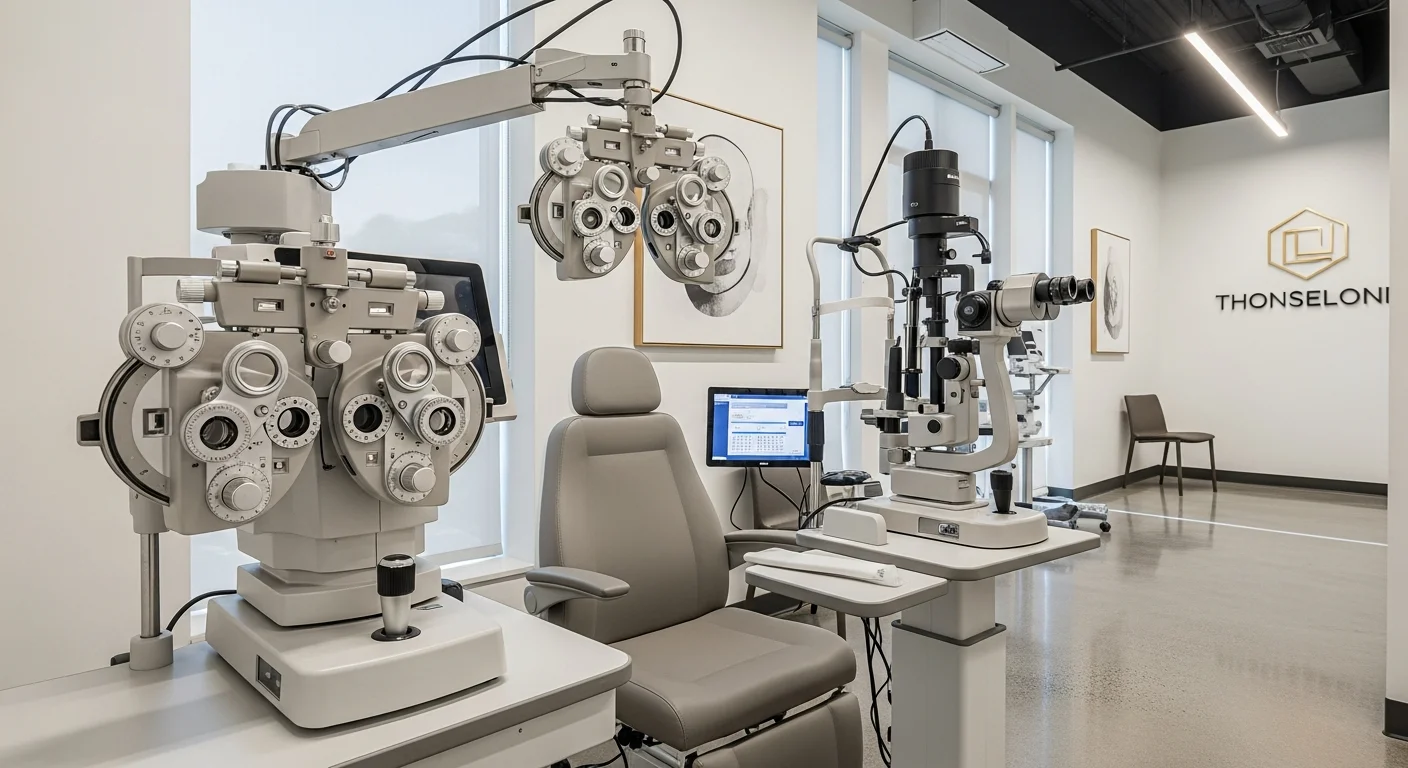
Your exam chair and instrument stand anchor the entire lane. Invest in quality here because this equipment sees constant daily use. A motorized chair with smooth height adjustment costs between $3,000 and $6,000 but dramatically improves workflow efficiency.
The instrument stand should accommodate your phoropter, slit lamp, and projector or digital acuity system. Combination units that integrate multiple instruments save space and create a cleaner appearance. Budget $4,000 to $8,000 for a quality stand system.
Which Phoropter and Refraction System Is Right for You?
The phoropter remains the centerpiece of subjective refraction. Manual phoropters start around $3,500, while digital phoropters range from $12,000 to $25,000. Digital systems integrate with your EHR and speed up refractions by 2 to 3 minutes per patient.
For new practices, a quality manual phoropter often makes more sense initially. You can upgrade to digital refraction technology once your patient volume justifies the investment.
Slit Lamp Biomicroscope
Every exam lane needs a slit lamp for anterior segment examination. Entry-level models from reputable manufacturers cost $4,000 to $7,000. Features to prioritize include good optics, reliable illumination, and comfortable positioning for both doctor and patient.
Add a digital imaging attachment later to document findings and improve patient education. This addition runs $2,000 to $5,000 but significantly enhances your ability to show patients what you see.
Visual Acuity Testing
Digital acuity systems have largely replaced projector charts in modern practices. Systems like the Marco DVA or Topcon CV-5000 offer consistent testing, randomized optotypes, and integration with your refraction workflow. Expect to spend $6,000 to $12,000 per lane.
The investment pays off through faster exams, easier staff training, and a more professional appearance that patients notice.
Which Diagnostic Equipment Drives Revenue?
Beyond basic exam lane equipment, your diagnostic capabilities determine what services you can offer and bill. These instruments generate direct revenue while improving patient outcomes.
The diagnostic equipment you select also shapes your referral relationships with ophthalmologists and primary care physicians.
Practices with comprehensive diagnostic suites receive more referrals because referring providers trust that the diagnostic workup will be thorough and well-documented.
This referral benefit often exceeds the direct billing revenue from the equipment itself.
Why Is an Autorefractor and Keratometer Worth the Investment?
An autorefractor provides starting point measurements for refraction and saves chair time. Combination autorefractor/keratometer units run $8,000 to $15,000 and give you corneal curvature data essential for contact lens fitting.
This equipment typically pays for itself within the first year through improved efficiency. Staff can obtain preliminary measurements while you complete the previous exam, maximizing your patient flow.
What Tonometer Options Are Available?
Intraocular pressure measurement is non-negotiable for comprehensive eye exams. You have several options:
Goldmann applanation tonometry remains the gold standard at around $2,500. Non-contact tonometers cost $5,000 to $10,000 and eliminate the need for anesthetic drops. Handheld tonometers like iCare provide portability at $4,000 to $6,000.
Many practices use non-contact tonometry for screening and reserve Goldmann for patients requiring precise pressure monitoring.
Why Is Optical Coherence Tomography Essential?
OCT technology has become essential for modern optometric practice. These instruments provide cross-sectional retinal imaging that transforms glaucoma and macular disease management. Entry-level OCT systems start around $30,000, while premium systems reach $80,000 or more.
If budget constraints require prioritization, OCT should rank near the top of your list. This technology enables earlier disease detection, improves documentation, and opens billing opportunities for imaging procedures. Practices report that OCT imaging adds $40,000 to $80,000 in annual revenue through procedure billing and improved disease management.
What Do You Need for Fundus Camera and Retinal Imaging?
Retinal photography documents the posterior segment and creates a baseline for monitoring change over time. Options range from tabletop fundus cameras ($15,000 to $40,000) to ultra-widefield systems ($50,000 plus).
For new practices, a good tabletop fundus camera covers most clinical needs. Ultra-widefield technology becomes valuable as your practice grows and you develop specialty services.
Which Visual Field Analyzer Should You Choose?
Perimetry is essential for glaucoma management and neurological evaluation. The Humphrey Field Analyzer dominates this category, with units running $15,000 to $25,000 depending on features.
Frequency doubling technology (FDT) perimeters offer a lower-cost alternative for screening at $8,000 to $12,000. Some practices use FDT for initial testing and reserve threshold perimetry for confirmed glaucoma patients.
What Optical Dispensary Equipment Do You Need?
Your dispensary generates 30% to 50% of practice revenue, making it one of the most financially important areas of your practice. Equipping this space properly supports efficient operations and a positive patient experience. The dispensary is also where patients form their lasting impressions of your practice because they spend more time there than in any other area, browsing frames, discussing lens options, and waiting for adjustments. Investing in a well-designed, properly equipped dispensary pays dividends through higher capture rates, larger average transactions, and stronger patient loyalty that drives referrals and return visits.
Lensometer
A lensometer verifies lens prescriptions and measures existing eyewear. Manual lensometers cost $1,500 to $3,000, while automatic versions run $3,000 to $6,000. Automatic lensometers reduce training time and measurement errors.
Frame Displays and Inventory
Budget $5,000 to $15,000 for initial frame inventory and displays. The specific amount depends on your practice positioning and target demographics. Higher-end practices require larger frame investments.
Frame boards and displays influence patient perception of your optical. Clean, well-lit displays with logical organization help patients find frames they love.
Edging and Finishing Equipment
Decide early whether to finish lenses in-house or use an outside lab. In-house finishing requires a lens edger ($15,000 to $40,000), frame heater, hand tools, and trained staff. The investment makes sense for high-volume practices but may not pencil out initially.
Most new practices partner with a quality optical lab and reconsider in-house finishing once they reach 15 to 20 pairs of glasses per day.
What Technology Infrastructure Does a Modern Practice Require?
Your technology stack impacts efficiency as much as your clinical equipment. These systems work behind the scenes to keep your practice running smoothly, connecting your diagnostic instruments, patient records, billing workflows, and communication channels into a cohesive operational platform. The right technology choices reduce manual work, minimize errors, and free your clinical staff to focus on patient care rather than administrative tasks. Practices that invest thoughtfully in technology infrastructure during their first year report faster ramp-up times and stronger financial performance compared to those that defer these decisions.
Practice Management and EHR Software
Cloud-based practice management systems handle scheduling, billing, and clinical documentation. Monthly costs range from $300 to $800 depending on features and number of users. Popular options include Crystal PM, RevolutionEHR, and Eyefinity.
Choose a system with optical inventory management, automated patient communications, and strong reporting. Integration with your diagnostic equipment saves time and reduces transcription errors.
Patient Communication Systems
Missed calls cost optometry practices $50,000 or more annually in lost appointments. A reliable phone system with call tracking helps you understand patient communication patterns. Learn about the financial impact of missed calls to protect your investment in equipment and marketing.
Modern practices increasingly adopt AI-powered communication tools that answer calls 24/7, schedule appointments, and never put patients on hold. These systems ensure that your equipment investment generates maximum returns by capturing every potential patient inquiry.
Digital Imaging Storage
Your diagnostic equipment generates large image files that require secure storage. Budget for HIPAA-compliant cloud storage or on-premises servers. Most practices spend $100 to $300 monthly on image storage and backup solutions.
What Equipment Purchasing Strategies Save Money?
Smart purchasing decisions stretch your equipment budget significantly. Use these strategies to maximize value.
Should You Buy New or Pre-Owned Equipment?
Certified pre-owned equipment from reputable dealers offers substantial savings. Expect to pay 40% to 60% less than new prices for equipment that functions identically. Priority candidates for pre-owned purchase include:
Slit lamps (optical quality rarely degrades). Phoropters (mechanical durability is excellent). Fundus cameras (solid-state optics last decades). Visual field analyzers (software updates keep them current).
Avoid pre-owned equipment for items with high service requirements or rapidly evolving technology like OCT systems.
What Financing Options Are Available?
Most equipment vendors offer financing with terms from 36 to 72 months. Compare interest rates against available cash and potential investment returns. Some key considerations:
Section 179 deductions allow you to deduct the full purchase price of qualifying equipment in the year of purchase. This tax benefit often makes purchasing more attractive than leasing.
Equipment leases may offer lower monthly payments but typically cost more over time. They work well for technology you plan to upgrade in 3 to 5 years.
Package Deals and Timing
Vendors offer significant discounts for package purchases. Buying a complete exam lane from one manufacturer typically saves 10% to 20% compared to purchasing components separately.
Year-end timing often produces the best deals as sales representatives work to meet annual quotas. Trade shows also present negotiating opportunities with multiple vendors competing for your business.
How Should You Build Your Equipment Acquisition Timeline?
Not all equipment needs to arrive on day one. A phased approach preserves capital while building clinical capabilities over time.
Before Opening
Prioritize the equipment you need to perform comprehensive eye exams and dispense eyewear. This includes your exam lane essentials, autorefractor, tonometer, lensometer, and basic frame inventory. Budget approximately $100,000 to $150,000 for this phase.
First Six Months
Add diagnostic capabilities based on patient demand and your clinical interests. OCT technology, fundus photography, and visual field testing typically enter the practice during this phase. This investment runs $50,000 to $100,000.
Year Two and Beyond
Expand specialty equipment aligned with your practice focus. Corneal topography for contact lens specialty, myopia management technology, dry eye treatment devices, and additional exam lanes all become options as revenue supports further investment.
How Do You Protect Your Equipment Investment?
Quality equipment requires proper maintenance to deliver years of reliable service. The cost of neglecting maintenance far exceeds the cost of preventive care, as emergency repairs typically run three to five times higher than scheduled service visits. Equipment downtime also carries an indirect cost in lost patient revenue and disrupted scheduling that compounds the direct repair expense. Practices that establish maintenance calendars for all major instruments report significantly fewer unexpected breakdowns and longer useful equipment lifespans.
Protect your investment with these practices:
Schedule preventive maintenance according to manufacturer recommendations. Most diagnostic equipment benefits from annual calibration and inspection.
Train all staff on proper equipment operation. User error causes more equipment damage than normal wear.
Maintain service contracts for complex instruments like OCT systems. The cost of a service contract is far less than emergency repairs.
Document serial numbers, purchase dates, and warranty terms for all equipment. This information proves essential for insurance claims and future trade-in negotiations.
How Do You Make Your Practice Easy to Reach?
The best-equipped practice means nothing if patients cannot book appointments. Phone system optimization ensures your investment in clinical equipment translates to scheduled patients.
Modern practices recognize that patient access matters as much as clinical capability. When patients call and reach voicemail, 30% never call back. They book with a competitor who answered. Your equipment sits unused while revenue walks out the door.
Consider how automated patient communication fits into your overall practice infrastructure. These systems complement your clinical equipment by maximizing chair time utilization and practice revenue.
Key Takeaways
Building an optometry practice requires strategic equipment investment. Focus your initial budget on core exam lane components and essential diagnostics. Add advanced technology as patient volume and revenue justify expansion.
Remember these principles. Prioritize equipment that enables billing for procedures, not just basic exams, because diagnostic imaging and specialty testing create revenue streams that basic refraction alone cannot match. Consider certified pre-owned options for durable instruments with stable technology, as equipment like slit lamps and phoropters retain their functionality for decades. Phase your purchases to preserve working capital during the critical first year when patient volume is still ramping up. Maintain equipment properly to maximize useful life, since preventive maintenance costs a fraction of emergency repairs or premature replacement. Finally, ensure patients can actually reach you to book appointments on that equipment, because the most advanced diagnostic suite generates no revenue when calls go to voicemail.
Your equipment choices shape your clinical capabilities and patient experience for years. Invest thoughtfully, plan for growth, and build the practice you envision.
Keeping every appointment slot filled starts with answering every call. Talk to our team about how MyBCAT helps optometry practices capture more patients and reduce revenue leakage.
Related Reading
Optometry Practice Staffing: Build Your Dream Team. Optometry Practice Location: How to Choose the Right Site. Optometry Practice Finances: A Complete Guide.