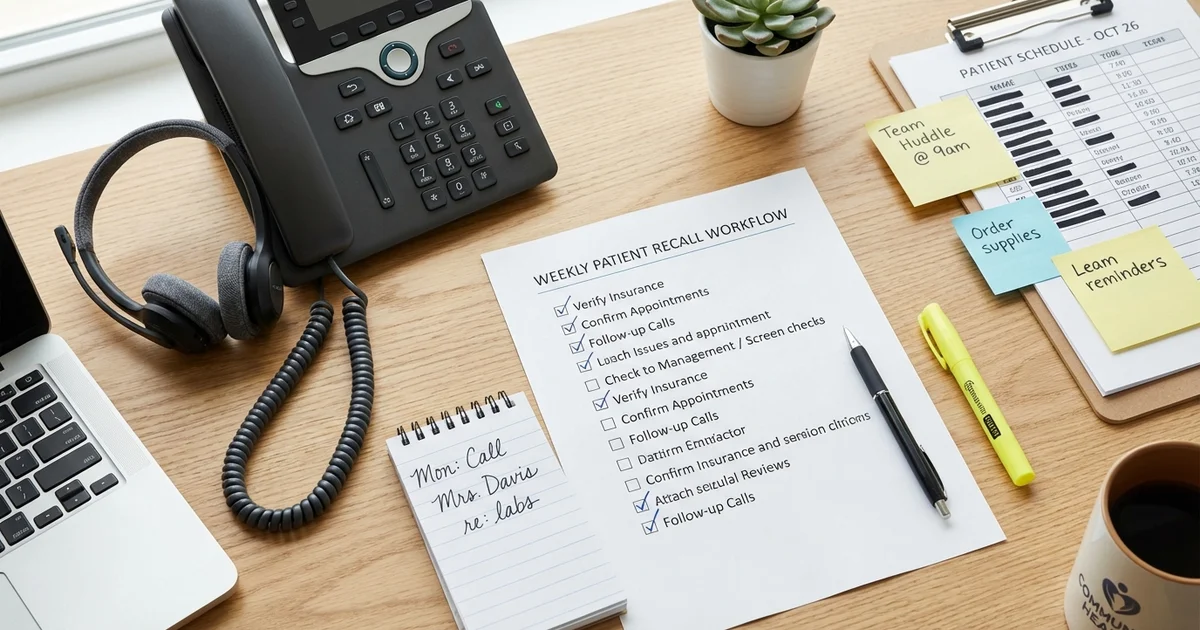


Your database holds $150,000 to $400,000 in dormant patient revenue per location, assuming 3-4 campaign cycles annually. Recovery costs $5-15 per patient compared to $100-300 for new acquisition. Yet most multi-location groups recover just 3-8% of inactive patients because they treat reactivation as a marketing campaign instead of operational infrastructure. This guide provides the tiered playbook that top-performing DSOs use to achieve 15-25% recovery rates across all locations.
What You’ll Learn
- Why Do Most Patient Reactivation Campaigns Fail?
- What Separates 25% Recovery from 3% Recovery?
- The Dormancy Segmentation Framework: 3 Tiers, 3 Strategies
- How Should You Structure a 30-Day Patient Reactivation Campaign?
- What Is the Right Multi-Touch Sequence for Each Dormancy Tier?
- When Should Automation Hand Off to Phone Outreach?
- How Do You Standardize Patient Reactivation Campaigns Across 10-50 Locations?
- What KPIs and Benchmarks Matter for PE-Backed Groups?
- 5 Mistakes That Kill Reactivation Results (and How to Avoid Them)
- Implementation Checklist: Your First 30 Days
Why Do Most Patient Reactivation Campaigns Fail?
The average multi-location healthcare group sits on 300-500 dormant patients per location. For a 15-location organization, that means 4,500-7,500 inactive patients and millions in at-risk revenue. Despite this opportunity, most reactivation attempts fail because organizations make the same structural mistakes.
Single-touch outreach produces the most predictable failure. Groups send one SMS blast, see an 8-12% response rate, and conclude reactivation doesn’t work. They miss that response rates compound with repeated, strategic contact. A structured multi-touch campaign over 30 days achieves 20-28% recovery, more than double the single-touch result. The problem isn’t the message. It’s stopping too soon.
Front desk bandwidth creates the second failure point. Reactivation outreach competes directly with same-day patient demands, and same-day always wins. When recall calls depend on spare moments between check-ins and phone inquiries, those calls never happen. The work requires dedicated recall processes rather than hoping staff find extra time.
Segmentation failures waste resources systematically. Most groups treat a patient who missed their last appointment six months ago identically to one who hasn’t visited in three years. These populations require fundamentally different approaches. The six-month dormant patient needs a simple reminder. The three-year dormant patient needs re-engagement that addresses why they left. Sending the same message to both wastes effort on low-probability recoveries while under-investing in high-probability ones.
Missing escalation protocols create another gap. When the first SMS goes unanswered, what happens next? Most organizations have no defined handoff from automated outreach to phone calls. Automation handles the easy wins while harder-to-reach patients receive no follow-up.
Perhaps most damaging: no ROI tracking infrastructure. Without cost-per-reactivation metrics, campaigns feel like guesswork to leadership. There’s no feedback loop to identify what works, no data to justify continued investment, and no proof of value for board presentations. This absence of measurement leads to underfunding and eventual abandonment of reactivation efforts.
What Separates 25% Recovery from 3% Recovery?
Organizations using feature-identical platforms produce wildly different outcomes. One location achieves 24% recovery while another, using the same Weave or Solutionreach setup, manages just 4%. Technology isn’t the variable. The operational architecture around that technology determines success.
Three pillars separate high performers from low performers. The first is segmentation discipline: stratifying dormant patients by how long they’ve been inactive and applying tier-specific strategies. The second is systematic escalation: clear rules for when automated outreach hands off to phone calls and who makes those calls. The third is cross-location standardization: every site follows the same playbook with the same KPIs.
Research confirms the importance of multi-channel, human-involved approaches. A Cochrane systematic review found that person-to-person phone reminders ranked as the most effective intervention for patient recall, outperforming letters, postcards, and computerized messages (PMC6491344). This doesn’t mean automation has no place. It means automation alone caps your recovery ceiling.
Groups that depend entirely on automated outreach typically achieve 15-20% recovery at best. Automation handles the easy wins: patients already predisposed to return who needed a prompt. The harder-to-reach segment requires human engagement. Top performers use hybrid models: automation for scale and live calls for conversion.
The feedback loop completes the picture. Without cost-per-reactivation tracking, organizations can’t identify which channels perform best, which message timing works, or which patient segments respond to which approaches. Every campaign becomes a guess rather than an iteration. High-performing groups track cost-per-reactivation ($5-15 is typical), compare it to acquisition costs ($100-300 per new patient), and use that data to continuously refine their approach.
Understanding the difference between marketing problems and operations problems changes everything. A marketing problem requires better copy, better creative, or better timing. An operations problem requires standardized processes, defined roles, and measurable KPIs. Most reactivation failures are operations problems disguised as marketing problems. Organizations keep testing new message templates when they should build systematic infrastructure.
The Dormancy Segmentation Framework: 3 Tiers, 3 Strategies
Not all dormant patients deserve equal investment. A tiered approach allocates resources based on recovery probability, maximizing return on reactivation spend. The framework segments patients into three tiers based on time since last visit, with each tier receiving a distinct strategy.
Tier 1: 6-12 Months - Recovery Rate: 22-28%, Cost per Reactivation: $5-8. Strategy: Automated multi-touch with light phone backup. Highest ROI, lowest effort.
Tier 2: 12-24 Months - Recovery Rate: 12-18%, Cost per Reactivation: $10-15. Strategy: Automated sequence plus phone escalation required. Good ROI, moderate effort.
Tier 3: 24+ Months - Recovery Rate: 8-12%, Cost per Reactivation: $15-25. Strategy: Phone-first with special offers, address barriers. Lower ROI, worth pursuing quarterly.
Tier 1 patients (dormant 6-12 months) represent your highest-probability recoveries. These patients likely still consider your practice their provider. They may have forgotten to schedule, gotten busy, or had a minor life disruption. A well-timed reminder often suffices. Automated SMS and email sequences work well here, with phone outreach reserved for non-responders after the initial automated touches.
Tier 2 patients (dormant 12-24 months) require more persistent effort. The relationship has cooled but hasn’t disappeared. These patients need multiple touches across multiple channels, and phone outreach becomes essential rather than optional. Consider whether insurance changes, provider departures, or service gaps contributed to their absence. The message should acknowledge the time lapse and offer a clear value proposition for returning.
Tier 3 patients (dormant 24+ months) have likely moved on mentally. Many have found other providers. Recovery rates drop significantly, and cost-per-reactivation increases. However, these patients still warrant periodic outreach, perhaps quarterly rather than monthly. Phone-first strategies work better here because automated messages blend into noise. Special offers, service updates, or changes at the practice (new providers, new technology, expanded hours) give these patients a reason to reconsider.
This segmentation approach prevents the most common resource misallocation: spending equal effort on a patient who missed one cleaning and a patient who hasn’t visited in three years. The dormant patient recovery strategies that work for recent inactives differ fundamentally from those needed for long-term churned patients.
How Should You Structure a 30-Day Patient Reactivation Campaign?
The 30-day window balances persistence with respect for patient attention. Shorter campaigns underperform because they don’t allow enough touches. Longer campaigns risk fatigue and diminishing returns. The structure below applies to Tier 1 and Tier 2 patients, with Tier 3 receiving a modified version focused more heavily on phone outreach.
30-Day Campaign Timeline:
- Day 1 - SMS + Email: Personalized reminder with direct scheduling link. Keep it brief, mention time since last visit.
- Day 4 - Email: Value-focused message highlighting what they’re missing (preventive care benefits, new services, seasonal relevance).
- Day 8 - SMS: Simple check-in with appointment availability. Reference specific openings.
- Day 12 - Phone Call (Tier 2+ or non-responders): Live outreach for patients who haven’t engaged with automated touches.
- Day 16 - Email: Social proof or testimonial-based message. What other patients value about returning.
- Day 21 - Phone Call: Second call attempt for non-responders. Different time of day than first attempt.
- Day 25 - SMS: Final automated touch. Create gentle urgency without pressure.
- Day 30 - Campaign Close: Move non-responders to next tier or mark for future campaign cycle.
Timing matters as much as content. Research shows that text reminders yield 48% higher appointment attendance likelihood compared to no reminders (BMC Health Services Research). However, message fatigue is real. Spacing touches 3-5 days apart maintains presence without creating annoyance.
Personalization differentiates high-performing campaigns from generic blasts. Research indicates that 96% of consumers respond to personalized marketing while approximately 80% ignore impersonal messages. At minimum, messages should include the patient’s name, reference their last visit date or provider, and link to online scheduling when possible. More sophisticated personalization might reference the specific service they’re due for or acknowledge their history with the practice.
The campaign must integrate with your scheduling infrastructure. Every message should include a direct path to booking: an online scheduling link, a text-to-schedule keyword, or a direct phone number. Friction between “I want to schedule” and “I have scheduled” kills conversion. This ties directly to reducing no-shows through automated recall since the same infrastructure supports both reactivation and prevention.
What Is the Right Multi-Touch Sequence for Each Dormancy Tier?
Channel mix and touch frequency should vary by tier. Tier 1 patients need fewer touches and can rely more heavily on automation. Tier 3 patients need more touches, different messaging, and earlier phone intervention.
For Tier 1 patients (6-12 months dormant), the sequence emphasizes convenience and low friction. These patients haven’t consciously decided to leave. They drifted. The messaging tone should be warm and assumptive, treating the appointment as something they meant to schedule. A sequence of 4-5 automated touches over 30 days typically suffices, with phone backup only for the final non-responders.
Tier 2 patients (12-24 months dormant) require acknowledgment that time has passed. Opening with “It’s been a while since we’ve seen you” validates their perception while signaling that you noticed their absence. These patients benefit from value reminders: what they gain from regular care that they might not receive elsewhere. Phone calls should begin around Day 12 rather than waiting until the end of the campaign.
Tier 3 patients (24+ months dormant) need a different approach entirely. Start with phone outreach rather than waiting for automation to fail. These patients receive many automated messages from many sources. Yours won’t stand out without human contact. The phone conversation should explore barriers to return: did they move, change insurance, have a negative experience, or find another provider? This intelligence helps you either recover the patient or understand why recovery isn’t possible.
Message content should shift based on what you learn. Patients who cite schedule conflicts need evening or weekend availability. Patients who mention cost concerns may respond to payment plan options. Patients who had negative experiences need service recovery before reactivation. Operational efficiency in healthcare groups means gathering and acting on this feedback rather than sending generic messages to everyone.
When Should Automation Hand Off to Phone Outreach?
The transition from automated to human outreach is where most reactivation campaigns break down. Either the handoff never happens, or it happens inconsistently across locations. Defining clear triggers prevents both failures.
The primary trigger for phone escalation should be non-response to automated touches. If a patient received 2-3 automated messages without engagement (no opens, no clicks, no replies), automation has likely reached its limit. For Tier 1 patients, this threshold might fall around Day 12-15 of the campaign. For Tier 2 patients, phone calls should begin earlier, around Day 8-10.
Engagement signals can modify this timing. A patient who opens every email but never schedules is engaged but stuck. A phone call can uncover the barrier. A patient who replies “not interested” to an SMS should be removed from the automated sequence and either called for service recovery or marked as unrecoverable.
Who makes the calls matters as much as when. Dedicated recall specialists outperform front desk staff handling calls between other duties. The math supports this investment. If a dedicated recall specialist recovers 20 additional patients per week at $600 average lifetime value, that represents $12,000 in weekly recovered revenue. A full-time specialist costing $45,000-55,000 annually pays for themselves many times over.
For organizations not ready to hire dedicated staff, centralized patient operations offer an alternative. Centralizing recall calls across locations allows a smaller team to cover more ground, achieving specialization benefits without requiring each location to hire.
The conversation itself requires structure. Open with identification and context: “This is [Name] from [Practice]. I’m reaching out because we noticed you haven’t been in since [Date].” Pause for their response. Common responses include “I forgot,” “I’ve been busy,” “I switched providers,” or “I had a bad experience.” Each response requires a different follow-up. Scripts should guide staff through these branches without making the conversation feel robotic.
How Do You Standardize Patient Reactivation Campaigns Across 10-50 Locations?
Scale introduces coordination challenges that single-location practices never face. When 15 locations all run reactivation differently, aggregate results become impossible to measure, best practices can’t spread, and underperforming sites remain hidden.
Standardization begins with a shared playbook. This document defines the campaign timeline, message templates, escalation triggers, and success metrics. Every location receives the same playbook and the same expectation of adherence. Variations should require explicit approval and documentation, not emerge from individual discretion.
Technology enables consistent execution. The same automated sequences should deploy from a centralized platform, ensuring message timing and content remain consistent. Reporting should aggregate to a dashboard visible at both location and corporate levels. When leaders can see that Location A achieves 22% recovery while Location B achieves 6%, they can investigate the difference and spread what works.
The centralized versus decentralized operations question surfaces prominently in reactivation campaigns. Fully decentralized approaches, where each location handles its own recalls, produce inconsistent results and make benchmarking difficult. Fully centralized approaches, where a corporate team handles all recalls, may lack local context and patient relationships. Hybrid models often perform best: centralized playbooks and technology with location-level execution and accountability.
Training deserves ongoing investment. A playbook implemented once and never reinforced will decay. Monthly reviews of reactivation metrics, quarterly refreshers on phone scripts, and annual playbook updates based on performance keep the program effective.
Accountability closes the loop. Each location should have a named owner for reactivation metrics. Weekly or monthly reporting should include reactivation KPIs alongside production and collection metrics. When reactivation performance factors into location manager evaluations, attention follows.
What KPIs and Benchmarks Matter for PE-Backed Groups?
For PE-backed healthcare organizations, reactivation connects directly to valuation metrics. Understanding which KPIs matter allows operations leaders to speak the language of financial sponsors and justify continued investment.
Reactivation KPIs Dashboard:
| Metric | Definition | Benchmark |
|---|---|---|
| Recovery Rate | Reactivated patients / Total patients contacted | 20-28% (Tier 1), 12-18% (Tier 2), 8-12% (Tier 3) |
| Cost per Reactivation | Total campaign cost / Number reactivated | $5-15 (vs. $100-300 acquisition) |
| Revenue Recovered | Reactivated patients x Average patient value | $150,000-$400,000 per location annually |
| Same-Store Growth Contribution | Reactivation revenue / Total location revenue growth | 15-25% of organic growth |
| Dormant Rate Trend | Month-over-month change in dormant patient percentage | Declining by 1-2% per quarter |
Same-store growth has become the critical narrative for PE-backed healthcare. According to the Bain Global Healthcare PE Report, operational improvements must now drive 80%+ of returns as multiple expansion opportunities compress. Patient reactivation demonstrates same-store value creation without acquisition spend: exactly the story PE sponsors want to tell.
The ROI comparison makes the case clearly. At $5-15 cost per reactivation versus $100-300 per new patient acquisition, reactivation delivers 10-20x better economics. A 15-location group recovering 150 patients per location annually (10 per month) at $600 average lifetime value generates $1.35 million in recovered revenue. If the total program cost runs $150,000 (technology, staff time, campaign costs), the ROI exceeds 800%.
Retention metrics connect to exit valuations. Private equity buyers during due diligence increasingly request documentation of same-store growth drivers. Organizations that can demonstrate systematic reactivation programs with documented results command premium valuations compared to those relying solely on acquisition-driven growth.
Monthly reporting should include reactivation metrics alongside traditional production and collection data. Dashboards should show recovery rates by location, cost-per-reactivation trends, and dormant population changes over time. This visibility enables continuous improvement and demonstrates operational discipline to financial sponsors.
5 Mistakes That Kill Reactivation Results (and How to Avoid Them)
Even organizations that understand the theory often fail in execution. Five mistakes appear consistently across underperforming reactivation programs.
Mistake 1: Treating reactivation as a one-time campaign rather than an ongoing system. Organizations run a burst of outreach, see results taper off, and conclude the program is complete. In reality, patients become dormant continuously. Reactivation requires persistent, systematic effort with new patients entering the pipeline as quickly as others are recovered or removed.
Mistake 2: Insufficient follow-up. Single-touch outreach yields 8-12% response. Multi-touch campaigns yield 20-28%. The difference is persistence. Organizations uncomfortable with repeated outreach leave recoverable patients on the table. The key: vary message content and channel rather than repeating the same message.
Mistake 3: Channel monotony. Relying exclusively on SMS, or exclusively on email, or exclusively on calls limits reach. Different patients respond to different channels. A multi-channel approach that includes SMS, email, and phone covers more ground and gives patients options for how to engage.
Mistake 4: Ignoring feedback. When patients cite reasons for not returning, that intelligence should flow into service improvement, not disappear. If multiple patients mention long wait times, address wait times. If multiple patients mention a departed provider, acknowledge that loss in outreach to affected patients. Reactivation campaigns double as patient feedback mechanisms when designed correctly.
Mistake 5: Lack of accountability. When no one owns reactivation metrics, no one prioritizes reactivation work. Assigning named ownership, setting explicit targets, and reviewing performance regularly ensures the program receives sustained attention. This connects to broader healthcare operations management principles of clear accountability and measurement.
Implementation Checklist: Your First 30 Days
Moving from understanding to action requires a structured launch. The following checklist provides a 30-day implementation roadmap for organizations starting or resetting their patient reactivation campaigns.
Week 1: Foundation
Extract your dormant patient list from your practice management system. Segment patients into three tiers based on months since last visit. Calculate your dormant population size and potential revenue recovery to build the business case for investment. Identify or assign an owner for the reactivation program: someone with both accountability and authority to execute.
Week 2: Infrastructure
Configure your automated outreach platform with the 30-day campaign sequence. Create message templates for SMS and email, personalized with merge fields for patient name and last visit date. Build or update phone scripts for the escalation phase. Establish the reporting dashboard to track campaign metrics.
Week 3: Pilot Launch
Launch the campaign with Tier 1 patients at 2-3 pilot locations. Monitor engagement metrics (open rates, response rates, schedule rates) daily. Make rapid adjustments to message timing or content based on early signals. Document learnings for the broader rollout.
Week 4: Scale and Iterate
Expand to all locations and all patient tiers based on pilot results. Establish weekly reporting cadence with location managers. Set a 90-day review checkpoint to assess program performance and plan refinements. Begin building reactivation metrics into standard operational reviews.
Success in patient reactivation campaigns comes from treating the work as operational infrastructure, not marketing. Segment patients by dormancy tier, apply systematic multi-touch campaigns, escalate to phone outreach based on defined triggers, standardize execution across locations, and measure results with PE-ready KPIs. The dormant patients in your database represent recoverable revenue waiting for systematic attention. The playbook exists. Execution determines results.
Need help reactivating dormant patients across your locations? Schedule a consultation to learn how MyBCAT’s reactivation campaigns recover 15-25% of inactive patients for multi-location healthcare groups.
Related Reading
- Front Desk Recall Workflow: A Simple Weekly Routine That Works
- Reactivation Without Discounts: Scripts and Offers That Work
- Case Study: 12-Location Optometry Group Recovered $312K
Sources
- Cochrane Systematic Review on Patient Reminders and Immunization/Recall Effectiveness: PMC6491344
- BMC Health Services Research on SMS Reminder Effectiveness: PMC3419880
- MGMA Patient Access Priorities Survey (2025): Medical Group Management Association industry polling on patient access priorities
- ADA Health Policy Institute Q4 2025 Report: American Dental Association data on practice volume concerns