The instinct when patients stop coming is to offer a discount. “20% off your next cleaning” feels like an easy win. But discounting trains patients to wait for deals, erodes your margins, and devalues the care you provide. The good news: the most effective dormant patient reactivation strategies do not rely on discounts at all. This guide provides the scripts, offers, and approaches — complementing our patient recall scripts library — that bring patients back while protecting your practice’s value.
Why Are Discounts a Problem for Reactivation?
Discounts have hidden costs beyond the immediate margin reduction:
The discount trap:
| Short-Term Gain | Long-Term Cost |
|---|---|
| Patient books appointment | Patient now expects discounts |
| Schedule gap filled | Full-price patients feel undervalued |
| Quick win for marketing | Margin compression across base |
| Easy to implement | Difficult to stop once started |
The math of discount erosion:
100 reactivated patients at 20% discount:
- Normal revenue: $35,000 (100 × $350)
- Discounted revenue: $28,000
- Immediate loss: $7,000

But if 50% become "discount-dependent":
- Future appointments at discount expectation
- Lifetime value reduction: 20% × years of visits
- True cost: Tens of thousands over patient lifetime
Discounts are not free. They are borrowed from future revenue.
What Is a Value-Based Reactivation Framework?
Effective reactivation focuses on value delivery, not price reduction:
What Is the Value Hierarchy?
Patients respond to value signals in this order:
Personal connection - “We miss you” / “Dr. Smith asked about you”. Health relevance - “Preventive care catches issues early”. Convenience - “We have flexible scheduling” / “New online booking”. Practice improvements - “New technology” / “Enhanced comfort options”. Special access - “Priority scheduling for returning patients”. Monetary incentive - Discount (last resort).
The principle: Work down the hierarchy. Most patients respond before reaching discount territory.
What Value Propositions Work Without Discounts?
| Value Proposition | Message Example | Best For |
|---|---|---|
| Personal connection | ”Dr. Smith mentioned he’d love to see you again” | Long-term patients |
| Health urgency | ”Regular exams catch 80% of issues before they become painful” | Health-conscious patients |
| Convenience | ”We now offer Saturday appointments and same-day booking” | Busy professionals |
| Technology | ”Our new digital X-rays are 70% faster with less radiation” | Tech-aware patients |
| Comfort | ”We’ve added comfort amenities. Ask about our relaxation options” | Anxious patients |
| Expertise | ”Our team just completed advanced training in [specialty]“ | Quality-focused patients |
What Scripts Work Without Discounts?
SMS Scripts
Initial Outreach (Warm, Personal):
Hi [Name], it's [Staff] from [Practice Name]. We realized it's been
a while since we've seen you, and Dr. [Name] asked me to reach out
personally. We'd love to get your next checkup scheduled. When works
best? Reply or call [Phone].
Health-Focused Follow-Up:
Hi [Name], just a friendly reminder that regular [dental/eye] exams
help catch small issues before they become bigger (and more expensive)
problems. We have openings this week. Text back a day that works!
Convenience-Focused:
Hi [Name]! We've expanded our hours. Now open Saturdays and evenings.
Makes getting your checkup easier. Ready to schedule? Reply YES or
call [Phone]. Looking forward to seeing you!
Email Scripts
Personal Connection Email:
Subject: We miss you, [Name]!

Hi [Name],

It's been [X months] since your last visit, and we've been thinking
about you! Our team genuinely enjoys seeing familiar faces, and
Dr. [Name] asked me to reach out.

We know life gets busy, but your [dental/eye] health is important.
Regular checkups help us catch any concerns early. Before they become
costly or uncomfortable.

We've made it easier than ever to schedule:
→ Book online: [link]
→ Call us: [phone]
→ Reply to this email

We'd love to see you again soon.

Warmly,
[Staff Name]
[Practice Name]
Practice Updates Email:
Subject: What's new at [Practice Name] (and we'd love to see you!)

Hi [Name],

A lot has changed since your last visit! We wanted to share some
updates and see if we can get you back on the schedule:

What's new:
• [New technology/equipment] for faster, more comfortable visits
• Extended hours. Now open [new hours]
• Online scheduling available 24/7
• [Any other improvements]

Your last visit was [X months ago] for [service]. It's time to
make sure everything is still looking great.

Click here to schedule: [link]

We look forward to showing you the improvements!

Best,
The [Practice Name] Team
Health Education Email:
Subject: A quick health reminder from Dr. [Name]

Hi [Name],

Did you know that [relevant health statistic, e.g., "80% of dental
issues are preventable with regular checkups" or "annual eye exams
can detect early signs of diabetes and high blood pressure"]?

It's been [X months] since your last visit, and we want to make
sure you're staying ahead of any potential concerns.

Preventive care is always easier (and less expensive) than reactive
treatment. We'd love to see you for a checkup soon.

Schedule now: [link]

To your health,
Dr. [Name] and the [Practice Name] Team
Phone Scripts
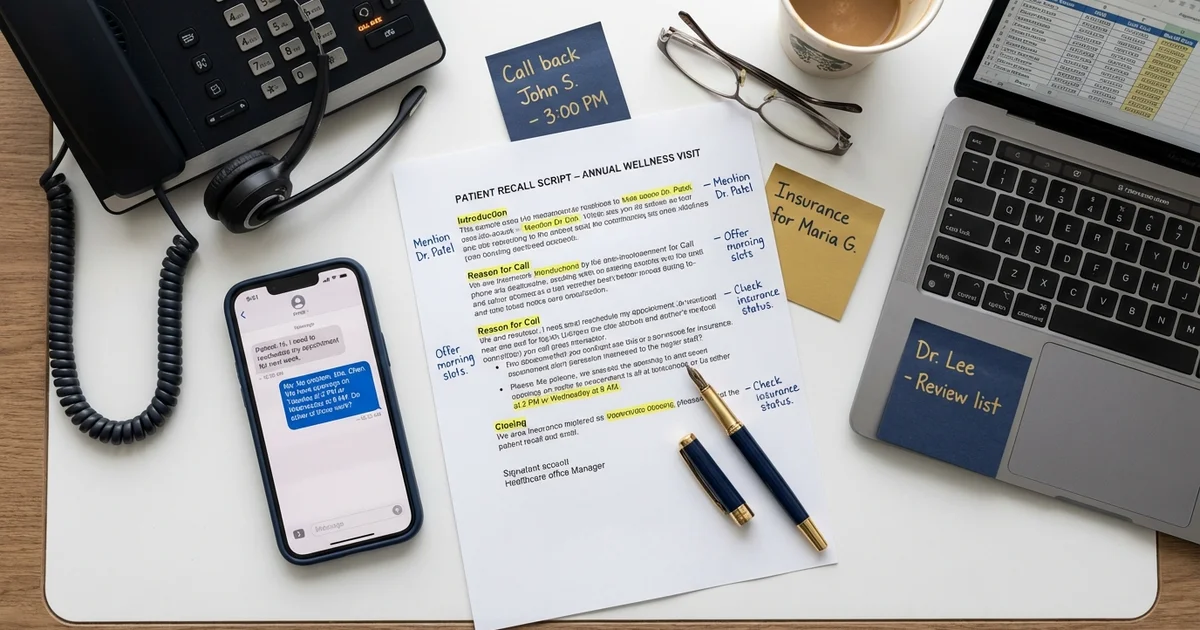
Opening Script:
"Hi [Name], this is [Your Name] calling from [Practice Name].
How are you doing today?

[Pause for response]

Great! I'm reaching out because Dr. [Name] noticed it's been
a while since we've seen you, and wanted me to check in personally.
We'd love to get you back on the schedule for a checkup.

Do you have a few minutes to find a time that works?"
Handling “I’ll think about it”:
"I completely understand. Life gets busy! Just so you know, we do
have some openings coming up, and I'd hate for you to have to wait
too long once you're ready.

How about I pencil you in for [date], and you can always adjust if
something comes up? That way you have a spot secured."
Handling “I’ve been going somewhere else”:
"We appreciate you letting us know! We'd love to have you back
whenever you're ready. Is there anything specific that led you to
try somewhere else? [Listen]

We've actually made some changes recently, including [relevant
improvement]. If things change, we'd love to see you again."
Direct Mail Scripts
Postcard Front:
We Miss You, [Name]!

It's been too long since your last visit.
Your smile (and your health) deserve attention.
Postcard Back:
[Practice Logo]

Dear [Name],

We've noticed you haven't been in for a while, and we wanted to
reach out. Regular checkups help us keep your [dental/eye] health
on track.

Schedule your visit:
📞 Call: [Phone]
💻 Online: [Short URL or QR code]

We look forward to seeing you soon!

[Practice Name]
[Address]
What Non-Discount Offers Actually Work?
When you need something more than messaging but want to avoid discounts:
Priority/Exclusive Access
Offer: “Priority scheduling for returning patients”
Script:
"As a valued patient who hasn't been in for a while, we're offering
you priority scheduling. That means first choice of appointment times,
including our most popular slots. Would you like me to reserve a
prime time for you?"
Why it works: Creates exclusivity without reducing price.
Convenience Add-Ons
Offer: Free appointment reminders, online scheduling, text confirmations
Script:
"We've made it much easier to stay on track with your appointments.
Now you can book online anytime, get text reminders, and even
complete paperwork before you arrive. Want me to set up your
appointment with all the convenience features?"
Why it works: Reduces friction, which is often the real barrier.
Health Assessment
Offer: Comprehensive evaluation at standard price with detailed report
Script:
"Since it's been a while, Dr. [Name] wants to offer you a comprehensive
health assessment at your next visit. We'll do a thorough evaluation
and provide you with a detailed report on your [dental/eye] health.
Same appointment fee, just more thorough care."
Why it works: Adds value without reducing price.
Educational Content
Offer: Guide, checklist, or information specific to their situation
Script:
"I'm sending you our guide on [relevant topic. E.g., 'Protecting Your
Teeth as You Age' or 'What Your Eyes Can Tell You About Your Health'].
Dr. [Name] thought you'd find it valuable. We'd also love to discuss
any questions when you come in for your checkup."
Why it works: Provides value, positions practice as expert.
Referral Acknowledgment
Offer: Recognition for past referrals or loyalty
Script:
"I was looking at your file and saw that you've referred several
friends and family members to us over the years. We really appreciate
that! As a thank you, I wanted to personally reach out and make sure
we get your next appointment scheduled at a time that's perfect for you."
Why it works: Acknowledges relationship value, not transactional.
When Should You Consider Incentives?
Some situations may warrant non-discount incentives:
Appropriate Use Cases
| Situation | Acceptable Incentive | Avoid |
|---|---|---|
| 24+ months dormant | Small gift with visit | Percentage discount |
| Completing incomplete treatment | Flexible payment plan | Treatment discount |
| Multi-family reactivation | Family scheduling convenience | Per-person discounts |
| Seasonal slow period | Value-add service included | Core service discount |
What Non-Discount Incentives Can You Offer?
Gift card drawing: “Schedule by [date] to be entered in our monthly drawing”. Complimentary add-on: “We’ll include a complimentary [fluoride/photo review] with your visit”. Charity tie-in: “For every returning patient this month, we donate to [local charity]”. Milestone recognition: “We’d like to celebrate your 10th year as our patient”.
How Should You Handle Discount Requests?
When patients ask for discounts directly:
Response Framework
Acknowledge → Redirect → Offer Value
Example:
Patient: "Do you have any specials or discounts for people who
haven't been in for a while?"

Response: "I appreciate you asking! We actually don't discount
our services because we want to make sure every patient gets the
same high-quality care. What we can do is make sure we find the
most convenient time for you and include [value-add] with your
visit. Would [date/time] work for your schedule?"
How Should You Respond to Common Objections?
| Objection | Response |
|---|---|
| ”Your competitor offers 20% off" | "We focus on providing consistent quality care rather than promotional pricing. Our patients tell us the experience is worth it. Let’s find a time that works for you." |
| "I’ll come back when there’s a special" | "We don’t typically run specials, but I understand. Just know that the longer you wait, the more likely small issues become larger ones. I’d hate for you to end up needing more extensive treatment." |
| "I’m not sure I can afford it" | "I understand budget is a concern. We do offer [payment plans/insurance verification/treatment phasing]. Let me check what your benefits cover before your visit.” |
Key Takeaways
Reactivating patients without discounts requires focus on value:
Message hierarchy:
- Personal connection first
- Health relevance second
- Convenience third
- Practice improvements fourth
- Special access fifth
- Monetary incentive only as last resort
Script essentials:
- Personalize with patient name and history
- Lead with warmth, not salesmanship
- Emphasize health benefits
- Make scheduling easy
- Avoid pressure or guilt
Non-discount offers:
- Priority scheduling access
- Convenience features
- Comprehensive assessments
- Educational resources
- Loyalty recognition
When patients ask for discounts:
- Acknowledge the question
- Redirect to value
- Offer alternatives
The practices with the best reactivation rates are not those offering the biggest discounts. They are those communicating the most compelling value.
For the complete script library, see our patient recall scripts guide. For the strategic approach to dormant patients, review our dormant patient reactivation guide.
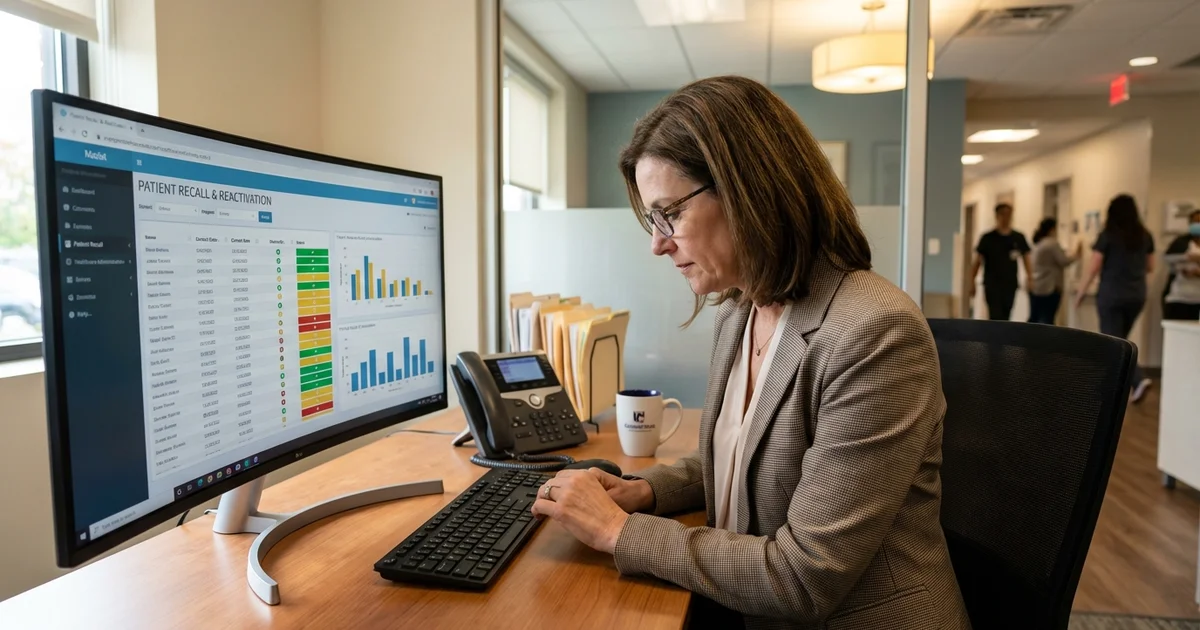
Patient recall and reactivation programs produce the highest return on investment when they combine multiple communication channels with consistent follow-up sequences. Phone outreach reaches patients who may not respond to text or email, while automated messaging provides touchpoints at scale that would be impossible with phone calls alone. The practices seeing the strongest results use data to segment their patient populations and tailor their outreach strategy to each segment. Patients who have been inactive for six months require a different approach than those who missed a single recall appointment. Similarly, high-value patients who bring family members to the practice warrant more intensive outreach efforts than patients with lower lifetime value. This data-driven approach to recall management transforms what many practices treat as an administrative task into a genuine revenue growth engine.
Reactivating dormant patients is one of the highest-ROI investments a practice can make. Talk to our team about how MyBCAT combines call answering with patient recall to keep your schedule full.
Why Do Discounts Undermine Long-Term Patient Relationships?
Discount-based reactivation creates a problematic precedent that shapes patient expectations for every future interaction with your practice. When patients learn that disappearing for a period of time earns them a discount on their return visit, you create a perverse incentive that works against the consistent appointment cadence your practice depends on. The patients you most want to retain are those who value the quality of care, the convenience of your location, and their relationship with your providers. These patients respond to service-based reactivation messages that remind them of what they value, not price promotions that reduce their perceived value of the appointment.
The financial math also favors non-discount reactivation strategies when you account for the full patient lifetime value. A patient who returns at full fee contributes more revenue per visit and is more likely to maintain regular appointments going forward compared to a patient whose return was triggered by a temporary price reduction. Practices that track reactivation cohort behavior over twelve months consistently find that patients recovered through value-based messaging show better retention rates than those recovered through discounts.
How Do You Build Urgency Without Price Incentives?
Creating a sense of urgency is important for reactivation, but the urgency should center on health outcomes rather than expiring offers. Messages that reference the recommended exam interval for the patient’s specific conditions, the availability of new diagnostic technology, or changes in their insurance benefits that affect coverage create legitimate reasons to schedule promptly. This approach works because it aligns the practice’s outreach with the patient’s genuine health interests rather than creating artificial pressure through limited-time pricing.
Seasonal relevance also creates natural urgency that does not require discounts. Back-to-school eye exams, spring allergy season, and new-year insurance resets all provide timely reasons for patients to reconnect with your practice. Practices that align their reactivation campaigns with these natural health triggers see higher response rates because the message feels relevant and helpful rather than promotional.
Related Reading
- Case Study: 12-Location Optometry Group Recovered $312K
- Centralized Patient Recall for Multi-Location Healthcare
- Optometry Recall Campaign: Beat the January Slump
Sources
Dental Marketing Heroes: Ultimate Guide to Patient Reactivation. Kickstart Dental: How to Reactivate Dormant Patients. Adit: Quick Guide to Dental Patient Reactivation. ProspyrMed: Ultimate Guide to Patient Reactivation. RevenueWell: How to Run Effective Dental Reactivation. 1Touchpoint: Patient Reactivation Strategies. mConsent: Patient Reactivation Engagement Strategies.