
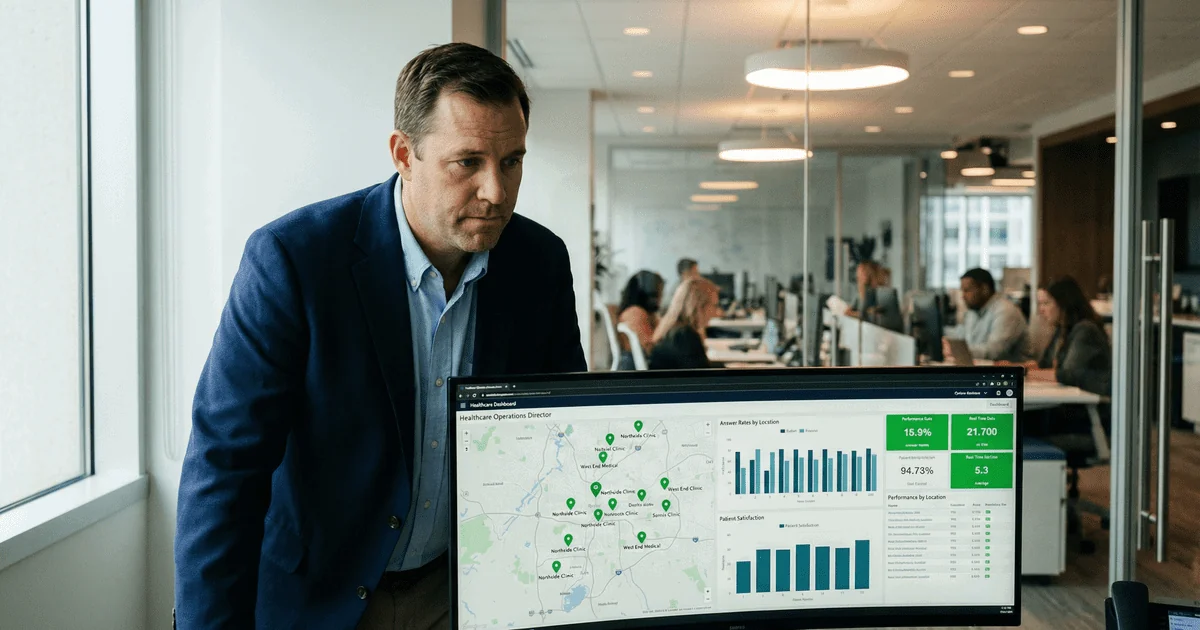
Multi-location healthcare groups lose $500,000-$1,500,000 annually to intake inefficiencies, and most don’t know it. Use our missed call revenue calculator to see your specific number. This guide provides the complete framework for evaluating, selecting, and implementing enterprise intake solutions for healthcare groups with 3-50+ locations.
The core insight: Multi-location intake is not a technology problem. It’s an operational architecture decision that determines whether you can scale profitably.
Table of Contents
- Why Is Multi-Location Intake Different?
- The Multi-Location Intake Maturity Model
- Centralized vs. Distributed Intake: Decision Framework
- What Types of Intake Solutions Are Available?
- What Technology Stack Do You Need?
- How Long Does Implementation Take?
- Vertical Considerations: Dental, Optometry, Veterinary
- What KPIs Should You Track?
- What Are the Most Common Mistakes?
- Evaluating Vendors: 15 Questions
- Making the Decision: Next Steps
- Key Takeaways
- Frequently Asked Questions
Why Is Multi-Location Intake Different?
Single-location practices have phone challenges. Multi-location groups have phone crises. The difference isn’t just scale. It’s fundamental operational complexity that single-site solutions can’t address.
What Are the Unique Challenges of Scale?
Peak Volume Synchronization
When your 15 locations all experience Monday morning rush hour simultaneously, you need 15 front desks performing perfectly in parallel. A solo practice experiencing high volume can have the optician grab overflow calls. A 25-location DSO can’t maintain that flexibility without standardized systems and overflow infrastructure.
The data tells the story: based on our analysis of call patterns across healthcare groups, multi-location organizations experience significantly higher call abandonment rates during peak hours compared to single-site practices, precisely because they can’t flex local resources across sites.
Staffing Math Breaks Down
At a single location, you can overhire slightly to ensure coverage. At 25 locations, that “slight overhire” becomes 25 unnecessary FTEs: $750,000+ in annual labor costs. But understaff even marginally, and you’re hemorrhaging revenue across every site.
The staffing equation that works for solo practices fails at scale:
| Locations | Calls/Day | If Overstaffed by 0.5 FTE/Location* | If Understaffed (Miss 15% Calls)** |
|---|---|---|---|
| 5 | 300 | +$125,000/year in labor | -$450,000/year in revenue |
| 15 | 900 | +$375,000/year in labor | -$1,350,000/year in revenue |
| 50 | 3,000 | +$1,250,000/year in labor | -$4,500,000/year in revenue |
*Based on $50,000 fully-loaded annual cost per FTE (includes benefits and overhead) **Assumes 260 business days/year, 35% new patient call mix, 65% conversion rate, $1,200 average first-year patient value. Revenue figures reflect EBITDA impact (approximately 14% of gross patient revenue).
The staffing challenges go beyond simple math. For a deeper analysis, see our guide on the healthcare front desk staffing crisis.
Neither extreme works. Multi-location groups need variable capacity that scales with actual demand.
Visibility Gaps Compound
Most multi-location operators can tell you revenue per location, collections rate, and patient volume. But ask them:
- What’s the call answer rate at each location?
- Which location has the longest average speed to answer?
- How many new patient calls went to voicemail last week?
- What’s the phone-to-appointment conversion rate by location?
The silence is deafening. Without centralized visibility, you can’t identify underperforming locations until patients have already gone to competitors.
Acquisition Integration Chaos
For DSOs and PE-backed groups acquiring 3-8 practices per year, every acquisition brings:
- A different phone system (8x8, RingCentral, legacy PBX, or something you’ve never heard of)
- A different practice management system (Dentrix, Eaglesoft, Open Dental, or one of 40+ others)
- Different call handling culture (“We never answer during lunch” vs. “We never miss a call”)
- Different patient communication preferences
Integration takes 12-18 months using traditional approaches. Revenue leaks the entire time. Based on our analysis of healthcare M&A outcomes, a significant portion of expected synergies from practice acquisitions are lost due to operational integration delays, and phone system chaos is a leading contributor. For a week-by-week integration framework, see our DSO integration playbook.
The Multi-Location Intake Maturity Model
Not all multi-location groups are at the same operational stage. The path from 3 locations to 50+ requires progressively sophisticated intake infrastructure. Based on our work with multi-location healthcare groups across dental, optometry, and veterinary, we’ve identified five distinct maturity levels:
Level 1: Reactive (3-5 Locations)
Characteristics:
- Each location handles its own phones independently
- No centralized visibility into call metrics
- Overflow goes to voicemail
- Owners aware of “phone problems” but no data to quantify impact
Common Symptoms:
- “Our staff says they answer every call” (they don’t)
- No idea how many calls are missed daily
- Marketing feels expensive but patient flow isn’t growing proportionally
Risk: At this stage, you’re likely losing $200,000-$400,000 annually to missed calls without knowing it.
Level 2: Aware (5-10 Locations)
Characteristics:
- Basic call reporting from phone system
- Awareness that missed calls are a problem
- Some locations better than others (no standardization)
- Considering solutions but unsure what fits
Common Symptoms:
- Call data shows 70-80% answer rates
- Wide variation between locations (60% to 90%)
- Staff turnover disrupts phone coverage
- Beginning to calculate cost of missed calls
Risk: At this scale, annual revenue loss typically reaches $400,000-$800,000. More importantly, operational inconsistency creates drag as you try to grow.
Level 3: Systematized (10-20 Locations)
Characteristics:
- Centralized call tracking across all locations
- Standardized phone handling protocols
- Some form of overflow solution (in-house centralized team or outsourced)
- Regular reporting on phone KPIs
Common Symptoms:
- Answer rates improving to 85-90%
- Can identify problem locations quickly
- Still struggling with after-hours and peak coverage
- Integration of new acquisitions takes 6-12 months
Risk: While per-location losses are smaller due to better systems, you’re still leaving $500,000-$900,000 on the table through residual coverage gaps and slow acquisition integration. The larger location count means absolute dollars at risk remain significant.
Level 4: Optimized (20-35 Locations)
Characteristics:
- 90%+ answer rates across all locations
- Real-time dashboards visible to operations leadership
- Centralized or hybrid intake handling peak and overflow
- New acquisitions integrated into phone systems within 60-90 days
- After-hours coverage in place
Common Symptoms:
- Phone metrics are a regular board/investor discussion topic
- Clear correlation between phone performance and revenue
- Competing on patient experience, not just clinical quality
- Still manual processes for some integrations
Risk: Minimal revenue leakage from phone issues. Primary risk is complacency. Maintaining these metrics requires ongoing attention.
Level 5: Excellence (35+ Locations)
Characteristics:
- 95%+ answer rates sustained across all locations
- Sub-20-second average speed to answer
- AI-assisted triage and scheduling where appropriate
- Automated integration playbook for acquisitions (30 days or less)
- Predictive staffing based on call pattern analysis
Common Symptoms:
- Phone operations is a competitive advantage
- Patient acquisition cost below industry benchmarks
- High staff satisfaction (phones aren’t a burden)
- Investors cite operational excellence in due diligence
Risk: At this level, the risk is external: competitors copying your playbook. The opportunity is expansion into new verticals or geographies with proven intake infrastructure.
How Do You Assess Your Current Level?
Honest assessment is the first step. Ask yourself:
- Do you know your answer rate across all locations right now? (If no: Level 1-2)
- Is your answer rate consistently above 85%? (If no: Level 2-3)
- Can you integrate a new acquisition’s phones in under 90 days? (If no: Level 3-4)
- Do you have real-time visibility into call volume and answer rates? (If no: Level 3-4)
- Is your answer rate consistently above 95%? (If no: Level 4-5)
Most growing multi-location groups sit between Level 2 and Level 3. The good news: moving from Level 2 to Level 4 typically recovers $500,000-$1,500,000 in annual revenue, far exceeding the investment required.
Centralized vs. Distributed Intake: Decision Framework
The most consequential decision in multi-location intake architecture is whether to centralize call handling or keep it distributed at each location. There’s no universally right answer, but there is a right answer for your specific situation.
The Centralized Model
How It Works: All inbound calls route to a centralized team (in-house or outsourced) that handles scheduling, basic inquiries, and triage across all locations. Calls requiring location-specific knowledge transfer to local staff.
Best For:
- Groups with 15+ locations
- High call volume variability across sites
- Aggressive acquisition pace (3+ practices/year)
- Locations with inconsistent front desk quality
- After-hours coverage needs
Advantages:
- Consistent quality regardless of local staffing
- Economies of scale in training and management
- Faster acquisition integration
- Predictable cost per call
- Better coverage during staff PTO, turnover, sick days
Disadvantages:
- Some patients prefer “their” practice
- Requires reliable technology integration
- Less local knowledge without good systems
- Initial setup complexity
Typical Metrics (Well-Implemented):
- 95%+ answer rate
- <15 seconds average speed to answer
- 75%+ first-call resolution
- $4-8 per call fully loaded cost
The Distributed Model
How It Works: Each location handles its own calls with local staff. Overflow may route to voicemail, a secondary line, or a minimal backup system.
Best For:
- Groups with <10 locations
- Locations with strong, stable front desk teams
- High-touch practices where relationships matter
- Limited acquisition activity
- Practices with unique scheduling complexity
Advantages:
- Deep local knowledge
- Patient relationships with specific staff
- Simpler technology requirements
- Lower setup costs
Disadvantages:
- Quality varies by location
- Coverage gaps during PTO/turnover
- Scales poorly (each new location = new staffing challenge)
- No built-in redundancy
- Harder to maintain consistent KPIs
Typical Metrics (Best Case):
- 80-90% answer rate (varies by location)
- 20-45 seconds average speed to answer
- High first-call resolution for returning patients
- $15-25 per hour labor cost (plus overhead)
The Hybrid Model
How It Works: Local staff handle calls during normal hours when available. Overflow, after-hours, and peak volume automatically route to a centralized team.
Best For:
- Groups with 10-25 locations
- Organizations valuing local relationships but needing consistency
- Practices transitioning from distributed to centralized
- Groups with significant after-hours call volume
Advantages:
- Maintains local presence while ensuring coverage
- Flexes to actual demand
- Smooth transition path from distributed
- Optimizes cost (local staff for routine, centralized for overflow)
Disadvantages:
- More complex call routing
- Requires clear handoff protocols
- Staff must embrace “backup” without resentment
- Two systems to manage
Typical Metrics:
- 90-95% answer rate
- <20 seconds average speed to answer
- Balanced cost structure
Decision Matrix
| Factor | Favor Centralized | Favor Distributed | Favor Hybrid |
|---|---|---|---|
| Location count | 15+ | <10 | 10-25 |
| Staff stability | High turnover | Low turnover | Variable |
| Acquisition pace | 3+/year | <1/year | 1-3/year |
| After-hours volume | >20% of calls | <10% of calls | 10-20% |
| Patient demographics | Younger, digital-native | Older, relationship-focused | Mixed |
| Budget | Predictable cost priority | Minimize upfront investment | Flexible |
What Types of Intake Solutions Are Available?
Once you’ve determined your architectural approach, you need to select the right solution type. Here’s an objective comparison:
In-House Staff (Distributed or Centralized)
What It Is: Your employees answering phones, either at each location or in a centralized internal call center.
Pros:
- Complete control over quality and training
- Deep institutional knowledge
- No third-party dependencies
Cons:
- Highest fixed costs (salary, benefits, overhead)
- Coverage gaps during PTO, turnover, absences
- Management overhead scales with headcount
- Recruitment challenges in current labor market
True Cost:
- Front desk: $18-25/hour + 30% benefits/overhead = $23-33/hour loaded
- Centralized agent: $16-22/hour + 30% = $21-29/hour loaded
- At 40 calls/day per agent = $5.25-8.25/call
Best For: Groups with stable staffing, strong training infrastructure, and preference for total control.
Traditional Answering Services
What It Is: Third-party services that answer overflow or after-hours calls with basic message-taking and warm transfers.
Pros:
- Low cost per call
- Always available (24/7)
- No management overhead
- Easy to implement
Cons:
- Limited healthcare knowledge
- Can’t access scheduling systems
- Generic caller experience
- Just message-taking, not problem-solving
True Cost:
- $0.75-1.50/call for message-taking
- Limited by what they can actually do
Best For: After-hours message-taking, very basic overflow during peaks.
Virtual Receptionist / Virtual Front Desk
What It Is: Trained healthcare receptionists (remote, often outsourced) who can access your PM system, schedule appointments, answer clinical questions per protocols, and handle calls as your staff would.
Pros:
- Fully functional call handling (not just messages)
- Healthcare-trained staff
- PM system integration for scheduling
- Scalable without proportional management
- Covers overflow, after-hours, and PTO
Cons:
- Less local knowledge than on-site staff
- Requires technology integration
- Ongoing cost (though often lower than in-house). See our build vs buy analysis for a detailed cost comparison.
True Cost:
- $4-8/call fully loaded for quality providers
- Or $15-25/hour for dedicated agents
Best For: Multi-location groups wanting full call handling without proportional headcount growth.
AI Receptionists
What It Is: Conversational AI that answers calls, gathers information, and can handle basic scheduling and FAQs without human intervention.
Pros:
- Unlimited scalability
- 24/7 availability
- Consistent experience
- Lowest marginal cost per call
- Improving rapidly
Cons:
- Patient acceptance varies (especially older demographics)
- Limited handling of complex situations
- Can’t handle emotional calls well
- Requires fallback to humans for exceptions
True Cost:
- $0.50-2.00/call (varies by complexity handled)
Best For: High-volume, routine calls; after-hours triage; young demographic practices.
Comparison Matrix
| Factor | In-House | Answering Service | Virtual Front Desk | AI Receptionist |
|---|---|---|---|---|
| Cost per call | $5-8+ | $0.75-1.50 | $4-8 | $0.50-2.00 |
| Can schedule | Yes | No | Yes | Basic yes |
| Healthcare training | Varies | Minimal | Strong | Programmed |
| PM integration | Yes | No | Yes | Varies |
| 24/7 available | If staffed | Yes | Yes | Yes |
| Complex calls | Best | Poor | Good | Improving |
| Patient acceptance | Highest | Low | High | Mixed |
| Scalability | Low | High | High | Highest |
The Right Answer: Usually a Combination
Most successful multi-location groups use a combination:
- In-house staff for in-person patients and location-specific issues
- Virtual front desk for overflow, after-hours, and acquisition integration via a patient access center
- AI triage for initial intake and routing of high-volume call types
The question isn’t “which one” but “what mix optimizes cost, quality, and patient experience for our specific situation.” For a detailed comparison of these options, see our AI receptionist vs. virtual front desk vs. answering service decision framework.
Once you’ve determined the right mix of intake resources, you’ll need the technology infrastructure to enable it. Your tech stack requirements evolve significantly with scale.
What Technology Stack Do You Need by Location Count?
Your intake technology needs evolve as you scale. Here’s what you actually need at each stage:
5-10 Locations: Foundation
Essential:
- Cloud phone system with basic reporting (RingCentral, 8x8, Nextiva)
- Call tracking by location
- Basic IVR for routing
- Voicemail-to-email
Nice to Have:
- Screen pop with caller ID
- PM system integration for scheduling
- Call recording
Investment: $50-150/location/month for phone system
10-25 Locations: Integration
Essential:
- Everything above, plus:
- Centralized reporting dashboard
- PM system integration (screen pop + scheduling)
- Call recording with searchable storage
- Skills-based routing
- Overflow routing capability
Nice to Have:
- Speech analytics for QA
- Automated callback queue
- Real-time supervisor dashboard
- Multi-location scheduling capability
Investment: $100-200/location/month + integration costs ($5,000-20,000 one-time)
25-50+ Locations: Enterprise
Essential:
- Everything above, plus:
- Real-time wallboard/dashboard visibility
- Advanced analytics and reporting
- Workforce management integration
- Automated QA and compliance recording
- Disaster recovery/failover
- API access for custom integrations
Nice to Have:
- AI-assisted call scoring
- Predictive staffing recommendations
- Patient communication platform integration
- Automated post-call surveys
Investment: $150-300/location/month + enterprise licensing + dedicated support
PM System Integration Reality Check
If you’re running multiple PM systems across acquired practices (common in DSOs), factor in integration complexity:
| # of PM Systems | Integration Timeline | Recommended Approach |
|---|---|---|
| 1-2 | 30-60 days | Direct integration |
| 3-5 | 60-120 days | Middleware approach |
| 6+ | 120-180 days | Unified platform migration or accept limitations |
The groups that scale fastest often bite the bullet and standardize on one PM system. But that’s a separate strategic decision with its own trade-offs.
How Long Does Multi-Location Intake Implementation Take?
Vendor sales materials promise 30-day implementations. Here’s what actually happens:
Centralized/Virtual Front Desk Implementation
Vendor Claim: “4-6 weeks to full implementation”
Reality for Multi-Location Groups:
| Phase | Timeline | What Actually Happens |
|---|---|---|
| Discovery | 2-3 weeks | Document all location specifics, PM systems, scheduling rules |
| Technology setup | 2-4 weeks | Phone routing, PM integrations, testing |
| Training | 3-4 weeks | Initial training + ongoing refinement based on real calls |
| Pilot | 2-4 weeks | Start with 2-3 locations, work out issues |
| Rollout | 1-2 weeks per batch | Add remaining locations in waves |
| Optimization | Ongoing | First 90 days require active tuning |
Realistic Timeline (10-location group): 3-4 months to full, optimized operation
Realistic Timeline (25+ location group): 4-6 months
What Accelerates Implementation
- Standardized PM system across locations
- Documented scheduling rules and protocols
- Internal champion with authority to make decisions
- Clean phone system architecture (not 5 different legacy systems)
- Executive sponsorship to drive staff adoption
What Delays Implementation
- Multiple PM systems requiring separate integrations
- Undocumented tribal knowledge about “how we do things”
- Staff resistance to change
- Decision-by-committee on every detail
- Unrealistic expectations leading to scope creep
Post-Acquisition Integration Timeline
For groups acquiring practices, phone integration should be part of your 90-day playbook:
Days 1-14: Discovery
- Document existing phone system and PM software
- Identify key call types and volumes
- Map scheduling rules and special handling
Days 15-30: Technology Cutover
- Port numbers or set up forwarding
- Establish PM system access (even if temporary)
- Begin routing to centralized/overflow system
Days 31-60: Optimization
- Refine scripts based on practice-specific needs
- Train on unique scheduling complexity
- Monitor quality and iterate
Days 61-90: Integration Complete
- Full functionality
- Local staff cross-trained on new protocols
- Metrics baseline established
The best-performing DSOs have this playbook documented and can integrate new acquisitions in under 60 days. Most take 6-12 months because they approach each acquisition ad hoc.
Vertical Considerations: Dental, Optometry, Veterinary
While multi-location intake principles apply across healthcare, each vertical has specific nuances:
Dental / DSO
Unique Factors:
- Highest PM system fragmentation (Dentrix, Eaglesoft, Open Dental, Curve, Denticon, etc.)
- Complex scheduling (hygiene vs. doctor, operatory constraints)
- Insurance verification often handled on calls
- Emergency/urgent slots need special handling
- High new patient call value ($1,500-5,000+ LTV)
Recommended Approach:
- Centralized model often best given DSO scale
- PM integration critical for scheduling
- Dedicated dental-trained agents through a specialized medical answering service
- Clear emergency protocols
Key Metrics to Track:
- New patient scheduling rate
- Hygiene recare confirmation rate
- Treatment plan follow-up completion
- Insurance verification accuracy
Optometry
Unique Factors:
- Dual business (exams + optical retail)
- Exam scheduling tied to doctor availability
- Glasses/contact lens inquiries common
- Vision insurance vs. medical insurance complexity
- Family scheduling (multiple patients, one call)
- Capture rate optimization starts with the phone
Recommended Approach:
- Hybrid model often works well
- Agents need optical product knowledge
- Insurance routing critical
- Family scheduling capabilities important
Key Metrics to Track:
- Exam booking rate
- Optical callback conversion
- Insurance verification accuracy
- Family member capture rate
- Call-to-capture correlation
Veterinary
Unique Factors:
- Emergency triage is critical and high-value. A pet owner calling about potential bloat or toxin ingestion represents $2,000-$5,000+ in immediate revenue
- After-hours volume is 30-40% of total (unlike dental/optometry)
- Emotional callers (sick/injured pets) require empathy that pure AI struggles to deliver
- Species-specific protocols (dog vs. cat vs. exotic vs. large animal) add complexity
- Boarding/grooming scheduling often shares the same phone line as medical calls
- DVM shortage (projected deficit by 2030) makes coverage gaps more damaging. You can’t just “hire more vets”
- Multi-location veterinary groups often span general practice, specialty, and emergency, each with different call handling needs
PM System Landscape: Common systems include AVImark, Cornerstone, eVetPractice, Shepherd, and Impromed. Integration complexity is moderate. Most support basic scheduling integration, but real-time availability visibility varies significantly.
Recommended Approach:
- 24/7 coverage is non-negotiable. Missing an after-hours emergency call means losing a client for life
- Triage protocols must be clinically sound and DVM-approved; liability concerns are real
- Empathy training is critical. Callers are often distressed, and robotic responses backfire
- Clear escalation paths for true emergencies (when to wake the on-call DVM)
- Consider separate handling for boarding/grooming vs. medical calls
Key Metrics to Track:
- Emergency triage accuracy (did we correctly identify urgency?)
- After-hours booking rate (not just messages, but actual appointments scheduled)
- Client retention rate (especially after emergency interactions)
- Emergency vs. routine call classification accuracy
- Time to callback for urgent non-emergencies
- DVM interruption rate (are we protecting DVM time appropriately?)
Cross-Vertical Comparison
| Factor | Dental | Optometry | Veterinary |
|---|---|---|---|
| Avg. LTV | $2,000-10,000 | $4,000-8,000 | $5,000-10,000 |
| PM systems | Highly fragmented | Moderately fragmented | Fragmented |
| After-hours volume | 10-15% | 10-20% | 30-40% |
| Emergency component | Low | Low | High |
| Scheduling complexity | High | Medium | Medium-High |
| Insurance complexity | High | High | Low |
| Recommended model | Centralized | Hybrid | Centralized 24/7 |
What KPIs Should You Track for Multi-Location Intake?
What gets measured gets managed. Here are the metrics that matter:
The 4 Metrics That Matter Most:
- Answer Rate: Target 95%+ (85% minimum acceptable)
- Average Speed to Answer: Target <20 seconds
- Abandonment Rate: Target <5%
- New Patient Scheduling Rate: Target 65-75%
Primary KPIs
1. Answer Rate
- Definition: Percentage of calls answered by a live person
- Benchmark: 95%+ for top performers; 85% is minimum acceptable
- Measurement: Total answered ÷ Total presented calls
2. Average Speed to Answer (ASA)
- Definition: Average time between call connection and live answer
- Benchmark: <20 seconds for top performers; <45 seconds minimum
- Note: Longer than 20 seconds and abandonment rates spike
3. Abandonment Rate
- Definition: Percentage of callers who hang up before being answered
- Benchmark: <5% for top performers; <10% acceptable
- Warning: High abandonment during business hours indicates staffing/routing issues
4. First-Call Resolution (FCR)
- Definition: Percentage of calls resolved without callback or transfer
- Benchmark: 75%+ for top performers
- Note: Lower FCR means higher call volume and patient frustration
Secondary KPIs
5. New Patient Scheduling Rate
- Definition: Percentage of new patient inquiry calls that result in scheduled appointments
- Benchmark: 65-75% for top performers
- Note: This is where revenue is won or lost
6. Call-to-Appointment Conversion
- Definition: Overall percentage of calls that result in appointments (new + existing)
- Benchmark: Varies by call mix; track trends over time
7. After-Hours Capture Rate
- Definition: Percentage of after-hours calls handled live (vs. voicemail)
- Benchmark: 100% if you have after-hours coverage; track if coverage is worth it
8. Location Variance
- Definition: Standard deviation of answer rates across locations
- Benchmark: <5% variance indicates consistent operations
- Note: High variance signals training or staffing issues at specific locations
Building Your Dashboard
At minimum, your operations team should see weekly:
| Metric | Group Average | Best Location | Worst Location | Trend |
|---|---|---|---|---|
| Answer Rate | 92% | 98% (Location A) | 84% (Location F) | ↑ 2% |
| ASA | 18 sec | 11 sec | 35 sec | → |
| Abandonment | 6% | 2% | 12% | ↓ 1% |
| New Pt Scheduled | 68% | 78% | 55% | ↑ 3% |
This visibility enables targeted intervention. If Location F consistently underperforms, you can address it specifically rather than implementing group-wide changes.
What Are the Most Common Mistakes in Multi-Location Intake?
We’ve seen multi-location groups make the same mistakes repeatedly. Learn from others’ pain:
Mistake 1: Implementing Without Data
What Happens: Groups implement intake solutions based on gut feel about where problems exist.
The Cost: Solving the wrong problems while real issues persist.
The Fix: Before any implementation, pull 90 days of call data. Identify actual answer rates, peak times, and problem locations. Let data drive decisions.
Mistake 2: Choosing Technology First
What Happens: Leadership buys a phone system or AI solution based on demos and features, then tries to fit operations around it.
The Cost: Expensive technology that doesn’t match operational needs. In our experience, technology-first implementations fail at significantly higher rates than those that start with operational requirements.
The Fix: Define your operational model (centralized, distributed, hybrid) and requirements first. Then find technology that enables that model.
Mistake 3: Underestimating Integration Complexity
What Happens: “Our PM integration will be done in two weeks” becomes six months of workarounds.
The Cost: Delayed ROI, staff frustration, dual-system chaos.
The Fix: Add 50% to any integration timeline estimate. Plan for interim manual processes. Budget for integration specialists if running multiple PM systems.
Mistake 4: Ignoring Staff Change Management
What Happens: Front desk staff see new intake systems as threats to their jobs or criticism of their work.
The Cost: Active resistance, poor handoffs, quality deterioration.
The Fix: Position intake solutions as supporting staff, not replacing them. Involve front desk leaders in planning. Show how their jobs get easier (fewer interruptions, backup during crunch times).
Mistake 5: Set-It-and-Forget-It Mentality
What Happens: After initial implementation, nobody monitors intake metrics or refines processes.
The Cost: Performance degrades to pre-implementation levels within 6-12 months.
The Fix: Assign ownership for intake KPIs. Review metrics weekly. Schedule quarterly process reviews. Treat intake as an ongoing operational discipline, not a one-time project.
Mistake 6: Optimizing for Cost Instead of Value
What Happens: Groups choose the cheapest per-call option regardless of quality impact.
The Cost: Poor patient experience, lower conversion rates, reputation damage. The $1 saved per call costs $50 in lost patient lifetime value.
The Fix: Calculate value per call (new patient conversion × LTV). Invest accordingly. A $6/call solution with 70% scheduling rate beats a $2/call solution with 40% scheduling rate.
Mistake 7: No Acquisition Integration Playbook
What Happens: Each acquired practice is integrated ad hoc, re-learning lessons from previous acquisitions.
The Cost: 6-12 months of revenue leakage per acquisition instead of 60-90 days.
The Fix: Document your acquisition phone integration playbook after each deal. Create templates for common PM systems. Aim to reduce integration time with each subsequent acquisition.
Evaluating Vendors: 15 Questions to Ask
When evaluating intake solutions for your multi-location group, demand answers to these questions:
Capability Questions
-
How many multi-location healthcare groups do you currently serve?
- Look for specific experience with groups your size and vertical
-
Which practice management systems do you integrate with? What’s the depth of integration?
- “We integrate with Dentrix” can mean anything from basic call logging to full two-way scheduling
-
Can you handle scheduling across multiple locations from a single call?
- Essential for groups where patients may be routed to the nearest available location
-
What’s your approach to after-hours coverage?
- Understand who handles calls, their training, and escalation protocols
-
How do you handle emergency/urgent triage?
- Critical for veterinary; important for dental emergencies
Performance Questions
-
What answer rate do your healthcare clients typically achieve?
- Get specifics, not marketing claims. Ask for references.
-
What’s the average speed to answer across your client base?
- Should be <20 seconds for a quality provider
-
What’s your staff turnover rate?
- High turnover = inconsistent quality. Ask for the number.
-
How do you measure and ensure quality?
- Look for QA programs, call scoring, ongoing training
Implementation Questions
-
Walk me through a recent multi-location implementation timeline.
- Get specific examples, not optimistic projections
-
What resources do we need to dedicate internally during implementation?
- Understand the true commitment required
-
How do you handle acquired practices being added mid-contract?
- Important for growth-oriented groups
Operational Questions
-
What reporting and dashboards do you provide?
- Ask for demo access to see actual reporting
-
How do you handle location-specific variations (different hours, different services)?
- Multi-location groups need flexibility
-
What’s your escalation process when something goes wrong?
- Problems will occur. Understand how they’re handled.
Red Flags to Watch For
- No multi-location references: They may be learning on your dime
- Vague integration answers: “We can integrate with anything” usually means manual workarounds
- Guaranteed metrics without assessment: Responsible vendors assess before promising
- Long contracts with minimal exit provisions: Quality providers earn your business monthly
- No healthcare specialization: Generic call center skills don’t translate to healthcare scheduling
Making the Decision: Next Steps
If You’re at Level 1-2 (Under 10 Locations)
-
Get your data first. Pull call reports. Calculate your actual answer rate and missed call cost using our missed call revenue calculator.
-
Establish baseline metrics. You can’t improve what you don’t measure. Start tracking answer rate, ASA, and abandonment weekly.
-
Evaluate hybrid approach. You likely don’t need full centralization yet, but overflow coverage during peaks and after-hours would immediately capture revenue you’re currently losing.
If You’re at Level 3 (10-20 Locations)
-
Audit your current solution. Is your 85% answer rate costing you $500,000+ annually? Calculate the gap to 95%.
-
Assess integration speed. How long does it take to integrate acquired practices? If over 90 days, this is a competitive disadvantage.
-
Evaluate centralized model benefits. At this scale, the economics of centralization start making sense. Run the numbers.
If You’re at Level 4-5 (20+ Locations)
-
Benchmark against excellence. You should be at 95%+ answer rate. If not, identify the specific gaps.
-
Focus on optimization. Marginal improvements in new patient conversion rate have outsized revenue impact at your scale. An enterprise reporting and QA solution provides the visibility needed to identify and close these gaps.
-
Build your acquisition playbook. Every acquisition should integrate faster than the last. Document and systematize. Centralized scheduling capabilities accelerate integration timelines.
Key Takeaways
-
Multi-location intake is an operational architecture decision, not just a technology purchase. The groups that scale successfully treat intake as a strategic capability.
-
The Multi-Location Intake Maturity Model has five levels from Reactive to Excellence. Most growing groups are at Level 2-3 and leaving $500,000-$1,500,000 on the table.
-
Centralized, distributed, or hybrid? The right model depends on your location count, acquisition pace, staff stability, and patient demographics. Most groups above 15 locations benefit from centralization or hybrid approaches.
-
Top performers achieve 95%+ answer rates with sub-20-second average speed to answer. The gap between your current performance and this benchmark represents recoverable revenue.
-
Implementation takes longer than vendors claim. Budget 3-4 months for a 10-location group, 4-6 months for 25+ locations. Technology-first implementations fail at significantly higher rates than operations-first approaches.
-
Each vertical has specific needs: Dental requires complex PM integration, optometry needs family scheduling capabilities, veterinary demands 24/7 emergency triage.
-
The economics are compelling: Moving from an 80% to 95% answer rate at a 20-location group typically recovers $800,000-$1,200,000 annually, far exceeding any reasonable implementation cost.
Frequently Asked Questions
What is the best intake solution for a 10+ location dental group?
For dental groups with 10+ locations, a centralized or hybrid model typically delivers the best results. The key factors are PM system integration (critical for scheduling), dedicated dental-trained agents who understand hygiene vs. doctor appointments, and clear emergency protocols. Groups at this scale usually see 90-95% answer rates with properly implemented centralized solutions, compared to 70-80% with distributed models.
How long does it really take to implement a centralized intake system?
Expect 3-4 months for a 10-location group and 4-6 months for 25+ locations to reach full, optimized operation. This includes discovery (2-3 weeks), technology setup (2-4 weeks), training (3-4 weeks), pilot with 2-3 locations (2-4 weeks), and phased rollout. Vendor claims of “4-6 week implementation” rarely account for multi-location complexity and PM system integration.
What answer rate should multi-location healthcare groups target?
Top-performing groups achieve 95%+ answer rates with sub-20-second average speed to answer. The minimum acceptable threshold is 85%. Every percentage point below 95% represents lost revenue. For a 20-location group, the gap between 85% and 95% answer rates typically equals $800,000-$1,200,000 in annual revenue.
Should we use AI receptionists or human virtual receptionists?
Most successful groups use a combination. AI receptionists excel at high-volume, routine calls and after-hours triage (cost: $0.50-2.00/call). Human virtual receptionists handle complex scheduling, emotional callers, and situations requiring judgment (cost: $4-8/call). The right mix depends on your patient demographics. Older patients often prefer humans, while younger demographics accept AI readily.
How do we integrate acquired practices into our intake system quickly?
Build a documented 90-day integration playbook. Days 1-14: Discovery (document existing systems). Days 15-30: Technology cutover (port numbers, establish PM access). Days 31-60: Optimization (refine scripts, train on specifics). Days 61-90: Full integration with metrics baseline. The best-performing DSOs can integrate acquisitions in under 60 days; most take 6-12 months due to ad hoc approaches.
What’s the difference between centralized, distributed, and hybrid intake models?
Distributed: Each location handles its own calls. Best for <10 locations with stable staff. Typical answer rate: 80-90%.
Centralized: All calls route to a central team. Best for 15+ locations or high-growth groups. Typical answer rate: 95%+.
Hybrid: Local staff handle routine calls; overflow and after-hours route to central team. Best for 10-25 locations transitioning to scale. Typical answer rate: 90-95%.
How much does poor intake cost a multi-location healthcare group?
Based on the revenue leak analysis, multi-location groups typically lose:
- 5 locations: $400,000-$600,000/year
- 10 locations: $800,000-$1,200,000/year
- 25 locations: $2,000,000-$3,000,000/year
This assumes 29% missed call rate (industry average), 35% new patient call mix, and $1,200 average first-year patient value.
Related Resources
- The $1.2M Leak: How Multi-Location Healthcare Groups Lose Revenue to Missed Calls - Detailed analysis of the revenue math behind missed calls
Want a Custom Recommendation for Your Group?
Last Updated: January 2026