

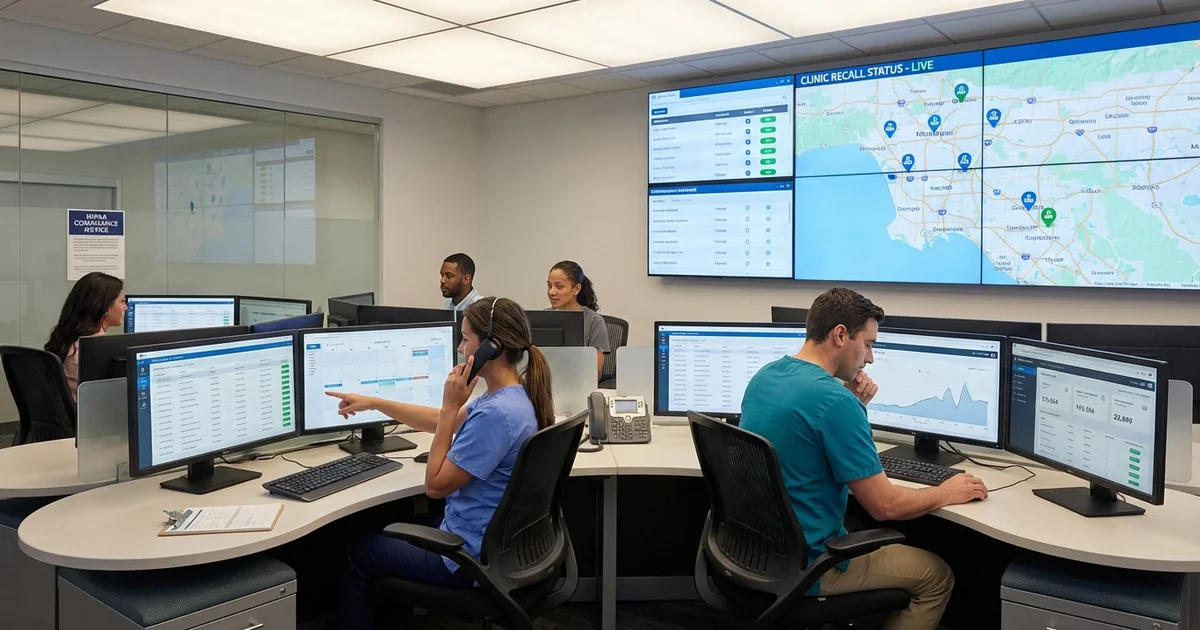
When patient recall operates independently at each location, performance varies widely. Top locations achieve 80%+ recall rates while struggling sites hover at 55%. Centralization addresses this variance through standardized technology, unified workflows, and network-wide accountability. For the foundational campaign structure, see our patient recall campaign framework. This guide provides the implementation roadmap for centralizing patient recall across multiple healthcare locations from technology architecture to change management.
Table of Contents
- Why Centralize Patient Recall?
- What Does the Centralization Framework Look Like?
- How Should You Plan the Implementation Roadmap?
- What Technology Infrastructure Do You Need?
- How Should You Design Recall Workflows?
- What Staffing and Training Are Required?
- How Do You Manage the Change?
- How Do You Measure Success?
- Key Takeaways
Why Centralize Patient Recall?
Centralized recall delivers measurable advantages over location-by-location approaches:
Performance comparison:
| Factor | Decentralized | Centralized |
|---|---|---|
| Average recall rate | 55-70% | 75-85% |
| Performance variance | High (20-30% spread) | Low (5-10% spread) |
| Cost per recall contact | $3-8 | $1-3 |
| Staff time per patient | 12-18 min | 4-8 min |
| Data quality | Inconsistent | Standardized |
| Scalability | Linear cost growth | Economies of scale |
The centralization math:
For a 20-location healthcare group:
Decentralized State
- 20 staff doing partial recall work
- Average 65% recall rate
- 60,000 patients, 39,000 compliant annually
- Estimated cost: $240,000/year
Centralized State
- 4-5 dedicated recall specialists
- Average 82% recall rate
- 60,000 patients, 49,200 compliant annually
- Estimated cost: $180,000/year
Results
10,200 additional compliant patients · $60,000 cost savings
Revenue impact: 10,200 × $300 = $3,060,000 additional annual revenue
What Does the Centralization Framework Look Like?
Successful centralization requires alignment across four dimensions:
What Technology Infrastructure Is Needed?
The core platform must provide an enterprise-wide patient database or a data integration layer that unifies records across all locations. It needs a multi-channel communication platform capable of sending SMS, email, and voice messages at scale while remaining HIPAA-compliant. Scheduling integration with every practice management system in the network is essential so that agents can book directly into any location. Centralized reporting and analytics give leadership visibility into performance at every level, from individual agents to the network as a whole. Finally, workflow management and task tracking ensure that every patient in the recall pipeline receives the right touches at the right time, with nothing falling through the cracks.
Technology architecture options:
| Architecture | Description | Best For |
|---|---|---|
| Single enterprise PMS | All locations on same PMS | Established groups, DSOs |
| Integration layer | Middleware connecting disparate PMS | Acquired practices, multi-vendor |
| Standalone recall platform | Dedicated recall system pulling from PMS | Any configuration |
How Should You Structure the Organization?
Staffing models:
| Model | Structure | Advantages | Challenges |
|---|---|---|---|
| Fully centralized | All recall staff in one location | Maximum control, consistency | No local relationships |
| Hub and spoke | Central team with local coordinators | Balance of scale and local touch | Coordination complexity |
| Regional centers | Recall centers serving clusters | Time zone coverage, regional nuance | Multiple centers to manage |
Staffing ratios vary depending on the scope of outreach. A digital-only model using SMS and email typically requires one FTE per 15,000 to 20,000 patients, since automation handles most of the volume. When phone outreach is added to the mix, the ratio drops to one FTE per 8,000 to 12,000 patients because live conversations take more time but convert at higher rates. A full-service model that includes digital channels, phone calls, and escalation handling requires one FTE per 5,000 to 8,000 patients. Most multi-location groups find that the full-service model delivers the best results because it reaches patients across every channel and handles the exceptions that automation cannot resolve. For more on how to structure effective phone and digital recall scripts, see our scripting guide.
Which Workflows and Standards Should Be Standardized?
Certain elements must be standardized across the network to ensure consistency. Recall timing and cadence rules define when each touchpoint fires so that every patient receives the same structured outreach regardless of location. Message templates and brand voice keep communication professional and on-brand, while still allowing the provider’s name and location details to be personalized. Escalation pathways for non-responders ensure that patients who do not respond to digital outreach are routed to phone calls and eventually to provider-level intervention. Exception handling procedures cover edge cases such as deceased patients, moved patients, or patients who have opted out. Quality assurance protocols give supervisors a framework for monitoring call recordings, message effectiveness, and overall team performance.
At the same time, some elements must remain localized. Provider-specific personalization ensures that messages reference the actual doctor the patient has a relationship with, which research shows improves response rates significantly. Appointment availability varies by location since each practice has its own schedule, providers, and capacity. Regional messaging variations may be needed for markets with different demographics or communication preferences. Location-specific contact preferences, such as whether patients prefer text or phone calls, should be captured and honored to maximize engagement.
How Do You Establish Governance and Accountability?
The governance structure should define clear ownership at every level. Central recall leadership owns reporting and strategy, setting network-wide targets and allocating resources. Location management provides execution support, ensuring that local staff follow the standardized workflows and address site-specific issues. Clinical leadership aligns recall protocols with care standards, ensuring that recall cadences match clinical recommendations for each patient type. IT and operations manage the platform, integrations, and data quality that underpin the entire system.
Accountability mechanisms keep the system performing over time. Weekly performance scorecards by location create visibility and healthy competition across the network, similar to how healthcare operations benchmarks reveal performance gaps in other areas of multi-location management. Monthly location leadership reviews allow managers to discuss trends, address challenges, and share best practices. Quarterly network performance analysis provides the strategic view needed to identify systemic issues and plan improvements. Annual strategic planning sessions align recall goals with broader organizational objectives for the coming year.
How Should You Plan the Implementation Roadmap?
Phase 1: Discovery and Planning (Weeks 1-6)
Week 1-2: Current State Assessment
Document for each location:
- Current recall rate and methodology
- Technology systems in use
- Staff roles and time allocation
- Patient population characteristics
- Performance gaps and pain points
Assessment checklist:
- Recall rate by location (last 12 months)
- PMS/EHR systems inventory
- Communication channels in use
- Current staff allocation
- Data quality assessment
- Patient contact information validity
Week 3-4: Requirements Definition
Define requirements across categories:
| Category | Requirements |
|---|---|
| Functional | Recall automation, multi-channel, scheduling integration |
| Technical | PMS integration, data security, scalability |
| Operational | Workflow flexibility, reporting, exception handling |
| Financial | Budget constraints, ROI targets |
Week 5-6: Solution Design
The solution design phase produces the critical deliverables that guide the rest of the implementation. These include a technology architecture diagram showing how systems connect, a staffing model recommendation based on patient volume and outreach scope, comprehensive workflow documentation, a detailed implementation timeline with milestones, a budget and resource plan, and a risk assessment with mitigation strategies for the most likely failure points.
Phase 2: Technology Foundation (Weeks 7-14)
Week 7-8: Platform Selection/Configuration
If selecting new platform:
- Issue RFP to qualified vendors
- Conduct demos with key stakeholders
- Check references (similar size/complexity)
- Negotiate contract terms
If configuring existing platform:
- Assess current capabilities
- Identify configuration requirements
- Plan customizations or integrations
- Document technical specifications
Week 9-12: Integration Development
Integration priorities:
- Patient data sync from all PMS systems
- Appointment scheduling API connections
- Communication platform configuration
- Reporting and analytics setup
Integration checklist:
- Patient demographic data flowing
- Appointment data syncing
- Contact preferences captured
- Opt-out status respected
- Provider assignments accurate
- Location data correct
Week 13-14: Testing and Validation
Testing protocol:
- Unit testing (each integration point)
- End-to-end testing (full recall workflow)
- User acceptance testing (staff verification)
- Load testing (scale simulation)
- Security testing (data protection)
Phase 3: Pilot Implementation (Weeks 15-22)
Week 15-16: Pilot Site Selection and Preparation
Select 2-3 pilot locations based on:
- Engaged local leadership
- Representative patient population
- Average current performance (not best or worst)
- Stable staffing
Pilot preparation:
- Staff training completed
- Workflows documented
- Success metrics defined
- Escalation paths established
- Rollback plan documented
Week 17-20: Pilot Execution
Pilot launch checklist:
- Data migration complete
- Communication templates approved
- Staff access configured
- Monitoring dashboards active
- Support contacts identified
Daily monitoring during pilot:
- Message delivery rates
- Response rates
- Appointment booking rates
- Exception volumes
- Staff feedback
Week 21-22: Pilot Evaluation
Pilot assessment criteria:
| Metric | Target | Pilot Result | Status |
|---|---|---|---|
| Recall rate improvement | +10% | ||
| Message delivery rate | 95%+ | ||
| Response rate | 20%+ | ||
| Staff satisfaction | 7/10+ | ||
| Patient feedback | Positive |
Phase 4: Network Rollout (Weeks 23-36)
Rollout approaches:
| Approach | Timeline | Risk | Best For |
|---|---|---|---|
| Big bang | All at once | High | Small networks, strong prep |
| Phased by region | 4-6 week waves | Medium | Regional clusters |
| Location by location | 1-2 per week | Low | Large variance, limited resources |
Rollout checklist per location:
- Data migration complete
- Staff trained
- Local leadership briefed
- Go-live communication sent
- First-week support scheduled
- Performance baseline documented
Week-by-week activities:
- Week 23-24: Wave 1 (3-4 locations)
- Week 25-26: Stabilize Wave 1, launch Wave 2
- Week 27-28: Continue waves
- Week 29-32: Complete all locations
- Week 33-36: Stabilization and optimization
Phase 5: Optimization and Sustainability (Ongoing)
Monthly optimization cycle:
- Review network performance vs. targets
- Identify top and bottom performers
- Extract best practices from high performers
- Develop improvement plans for underperformers
- Update workflows and training as needed
Quarterly strategic reviews:
- Technology platform assessment
- Staffing adequacy evaluation
- ROI measurement and reporting
- Strategic initiative planning
What Technology Infrastructure Do You Need?
What Are the Communication Platform Requirements?
Must-have capabilities:
| Capability | Requirement |
|---|---|
| SMS messaging | Two-way, automated, HIPAA-compliant |
| Email campaigns | Templated, personalized, trackable |
| Voice/IVR | Outbound calls, voicemail, callback |
| Multi-channel orchestration | Sequential, trigger-based |
| Opt-out management | Centralized, real-time |
Beyond the baseline requirements, advanced capabilities can further improve recall performance. AI-powered send time optimization analyzes patient response patterns to deliver messages when each individual is most likely to engage. Natural language response processing allows the system to interpret free-text replies and route them appropriately without human intervention. Sentiment analysis flags negative responses for immediate escalation to a supervisor. Predictive analytics for response likelihood helps the team prioritize phone outreach toward patients who are least likely to respond to digital channels alone.
How Should You Architect the Integration?
Standard integration pattern:
Data flow requirements vary by urgency. Patient demographics need daily synchronization at minimum to keep names, addresses, and insurance information current. Appointment data requires real-time or near-real-time syncing so that the recall system reflects the latest scheduling changes. Contact preferences must sync in real-time because a patient who opts out at one location must be respected instantly across all channels. Recall status needs bidirectional synchronization so that both the central system and each location’s PMS reflect the current state of every patient’s recall journey.
How Do You Manage Data Quality?
Critical data fields:
| Field | Quality Standard | Validation |
|---|---|---|
| Mobile phone | 10-digit valid | Carrier lookup |
| Valid format | Deliverability check | |
| Address | USPS standardized | Address verification |
| Provider assignment | Current | PMS sync |
| Recall interval | Defined | Protocol mapping |
Data quality workflows should run continuously in the background. Invalid phone detection identifies numbers that have been disconnected or reassigned, routing those patients to email or mail channels instead. Email bounce processing catches undeliverable addresses and triggers alternative outreach. Address verification for direct mail ensures that postcards reach the intended recipients. Duplicate patient identification prevents the same person from receiving multiple outreach sequences, which damages the patient experience and wastes resources. Deceased patient flagging removes patients who should no longer receive communication, a compliance necessity that also protects the practice’s reputation.
How Should You Design Recall Workflows?
What Does the Standard Recall Sequence Look Like?
Pre-due reminder sequence (14 days before due date):
| Day | Channel | Action |
|---|---|---|
| -14 | SMS | Initial reminder with booking link |
| -10 | Detailed reminder with insurance benefits | |
| -7 | SMS | Follow-up reminder |
| -3 | Phone | Call non-responders (high-value patients) |
| -1 | SMS | Final reminder |
Overdue sequence (after due date):
| Day | Channel | Action |
|---|---|---|
| +7 | SMS | Overdue notification |
| +14 | Value-focused message | |
| +21 | Phone | Personal outreach |
| +30 | SMS | Final digital attempt |
| +45 | Postcard | Direct mail (if no valid digital) |
| +60 | Move to dormant | Change status for reactivation campaigns |
When Should You Escalate?
Escalation triggers:
| Trigger | Escalation Action |
|---|---|
| No response to 3 digital touches | Phone call |
| Invalid phone number | Email + postcard |
| Invalid email + phone | Postcard only |
| High-value patient non-response | Provider notification |
| Patient complaint | Manager review |
How Do You Handle Exceptions?
Common exceptions and handling:
| Exception | Handling |
|---|---|
| Patient requests no contact | Add to opt-out list, document |
| Patient deceased | Update status, remove from recall |
| Patient moved/transferred | Update location or archive |
| Insurance changed | Update record, verify benefits |
| Provider departed | Reassign to new provider |
What Staffing and Training Are Required?
How Should You Structure the Central Recall Team?
For a 50,000-patient network:
| Role | FTE | Responsibilities |
|---|---|---|
| Recall Manager | 1.0 | Strategy, reporting, escalations |
| Senior Specialists | 2.0 | Phone outreach, complex cases |
| Recall Specialists | 3.0 | Digital monitoring, responses |
| Data Quality Analyst | 0.5 | Data maintenance, validation |
| Total | 6.5 |
What Training Curriculum Is Needed?
Core training modules:
| Module | Duration | Topics |
|---|---|---|
| Platform operations | 4 hours | System navigation, workflows |
| Communication skills | 4 hours | Phone scripts, objection handling |
| Compliance | 2 hours | HIPAA, TCPA, opt-out rules |
| Quality assurance | 2 hours | Standards, documentation |
| Escalation procedures | 2 hours | When and how to escalate |
Ongoing training:
- Weekly team huddles (30 min)
- Monthly skill refreshers (1 hour)
- Quarterly compliance updates
- Annual certification renewal
How Do You Manage Performance?
Individual metrics:
| Metric | Target | Measurement |
|---|---|---|
| Calls per hour (phone outreach) | 12-15 | System tracking |
| Booking rate | 35-45% | Bookings / contacts |
| Quality score | 90%+ | Call monitoring |
| Response time | <15 min | Digital reply speed |
Team metrics:
| Metric | Target | Frequency |
|---|---|---|
| Network recall rate | 80%+ | Weekly |
| Location variance | <10% spread | Weekly |
| Patient satisfaction | 4.5/5+ | Monthly |
| Cost per recall | <$2 | Monthly |
How Do You Manage the Change?
How Should You Communicate with Stakeholders?
Communication plan:
| Stakeholder | Message | Channel | Frequency |
|---|---|---|---|
| Executives | ROI, strategic value | Steering committee | Monthly |
| Location managers | Performance, support | Email, calls | Weekly |
| Front desk staff | Workflow changes | Training, huddles | As needed |
| Providers | Patient experience | Meetings | Quarterly |
| Patients | Improved service | Messaging | Per interaction |
How Do You Manage Resistance to Change?
Common resistance points and responses:
| Resistance | Response |
|---|---|
| ”We know our patients better locally” | Centralization enables personalization at scale; local input shapes protocols |
| ”We’ll lose control” | Location managers retain accountability; central provides tools and support |
| ”It’s working fine now” | Data shows performance variance; standardization improves consistency |
| ”Patients won’t like it” | Patients experience improved service; satisfaction data supports this |
Success Celebration
Milestones to celebrate:
- Successful pilot completion
- Each wave rollout completion
- Network recall rate milestones (75%, 80%, 85%)
- Individual location achievements
- Cost savings milestones
How Do You Measure Success?
What Implementation Metrics Should You Track?
Phase-specific metrics:
| Phase | Key Metrics |
|---|---|
| Planning | Stakeholder alignment, requirement clarity |
| Technology | Integration success rate, system uptime |
| Pilot | Recall improvement, user satisfaction |
| Rollout | On-time completion, adoption rate |
| Optimization | Continuous improvement, ROI realization |
What Operational Metrics Matter?
Weekly dashboard:
| Metric | Network | By Location | Trend |
|---|---|---|---|
| Recall rate | 82% | [Location breakdown] | ↑ |
| Messages sent | 15,234 | [Location breakdown] | → |
| Response rate | 24% | [Location breakdown] | ↑ |
| Bookings | 3,856 | [Location breakdown] | ↑ |
| No-shows | 342 | [Location breakdown] | ↓ |
How Do You Calculate Financial ROI?
ROI calculation (quarterly):
Gross Revenue Impact
- Additional compliant patients × Revenue per visit = A
- Reduced no-shows × Revenue per visit = B
- Reactivated dormant patients × Revenue per visit = C
Total Gross Revenue Impact = A + B + C
Cost Savings
- Reduced staff time = D
- Platform efficiency = E
Total Cost Savings = D + E
Net ROI = (Gross Revenue Impact + Cost Savings − Implementation Cost) / Implementation Cost
Key Takeaways
Centralizing patient recall across multiple locations delivers measurable improvements:
Implementation success factors:
- Strong technology foundation with reliable integrations
- Clear governance and accountability structures
- Standardized workflows with local flexibility
- Dedicated, trained recall team
- Continuous optimization culture
Expected outcomes:
- 15-25% improvement in recall compliance rates
- 50-70% reduction in performance variance across locations
- 30-50% cost reduction per recall contact
- Scalable foundation for network growth
Timeline reality:
- Full implementation: 6-9 months
- Initial results: 3-4 months post-launch
- Full optimization: 12-18 months
The bottom line: Centralized recall is not about removing local ownership. It is about providing every location with enterprise-grade tools, expertise, and support to achieve consistently excellent results.
For the front desk workflow that complements centralized recall, see our front desk recall workflow guide. For strategies specific to DSOs, review our DSO patient retention strategy guide. For enterprise groups managing recall across 3+ locations, explore our multi-location recall solution.
Related Reading
- PE-Backed Healthcare Operations: KPIs That Drive Valuation
- Scaling Optometry Network Operations: 5 to 50 Locations
- Multi-Location Healthcare EBITDA: Retention Protects Margins
Reactivating dormant patients is one of the highest-ROI investments a practice can make. Talk to our team about how MyBCAT combines call answering with patient recall to keep your schedule full.