

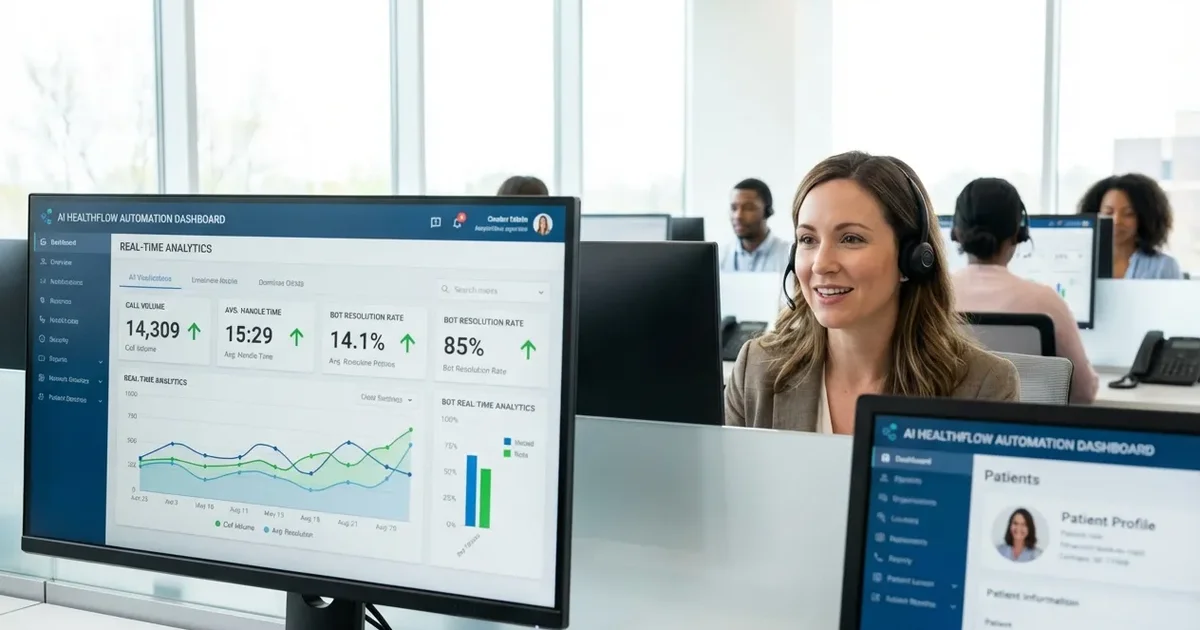
TrueLark claims 85% automation. Ruby touts “real people for every call.” Both miss the point for multi-location healthcare groups. AI excels at routine scheduling but fails on complex clinical questions, emotional situations, and high-stakes calls. Human-only services work but become prohibitively expensive at scale. The answer is not choosing between AI and human. It is building a system that routes the right calls to the right handler.
This guide explains how to architect a hybrid model that delivers AI efficiency where it works and human judgment where it matters.
Table of Contents
- The False Choice: Why AI vs. Human Is Wrong
- When Does AI Excel in Healthcare Intake?
- When Is Human Judgment Non-Negotiable?
- What Is the Call Importance Matrix?
- What Is the Hybrid Model Architecture?
- How Does Intelligent Routing Work?
- How Do You Optimize Cost and Quality?
- Implementation: Rolling Out a Hybrid Model
- How Do You Measure Hybrid Performance?
- Key Takeaways
The False Choice: Why AI vs. Human Is Wrong
The healthcare intake market has polarized into two camps.
The AI-first camp (TrueLark, some practice management plugins) sells automation rates. “Our AI handles 85% of calls automatically.” The pitch is compelling: lower costs, 24/7 availability, no sick days or turnover. But talk to practices that have implemented AI-only solutions, and you hear the same story. The AI works fine for simple appointment bookings. Then a worried parent calls about their child’s dental pain. Or a long-time patient has a billing question that requires context. Or an emergency case needs immediate triage. The AI stumbles, loops, or gives generic responses. The patient hangs up frustrated, sometimes lost forever.
The human-first camp (Ruby, traditional answering services) sells the “human touch.” Every call answered by a real person. This approach delivers quality but scales poorly. A 5-location group paying $15 per call handled might find the service affordable. A 20-location group with higher call volumes quickly faces six-figure annual costs. And even dedicated human teams struggle with healthcare-specific terminology, insurance questions, and clinical protocols they have not been trained on.
The binary framing creates a false choice. The question is not “AI or human?” The question is: “Which calls need which handler, and how do we route them correctly?”
When Does AI Excel in Healthcare Intake?
AI performs well on calls that share three characteristics: they are structured, low-stakes, and transactional.
What Call Types Does AI Handle Best?
Appointment scheduling for existing patients. The patient calls, states their name and date of birth, and requests an appointment with their regular provider. AI can handle the entire interaction: verify identity against the practice management system, check availability, book the slot, send confirmation. No judgment required.
Office hours and location inquiries. “What time do you open on Saturday?” “Where is your Westlake location?” These are database lookups. AI answers instantly, correctly, every time.
Basic appointment confirmations and reminders. Outbound calls or texts confirming upcoming appointments are routine and high-volume. AI handles thousands simultaneously.
Prescription refill requests (simple routing). Patient calls to request a refill. AI captures the medication name and sends the request to the clinical team for approval. The clinical decision happens elsewhere.
General service information. “Do you accept Delta Dental?” “Do you offer Invisalign?” These are FAQ-style questions where AI provides consistent, accurate answers faster than most humans.
Why Does AI Work for These Calls?
These calls share common traits:
Clear intent: The caller knows exactly what they want. Structured responses: The answer comes from a database or predefined script. Low emotional content: The caller is not anxious, upset, or confused. Low clinical risk: Getting the answer slightly wrong does not harm the patient.
When these conditions are present, AI delivers faster service at lower cost than human agents. Forcing humans to handle these calls wastes their skills on transactions a machine handles better.
When Is Human Judgment Non-Negotiable?
Human agents become essential when calls involve complexity, emotion, clinical risk, or relationship context.
What Call Types Require Human Agents?
New patient intake with clinical questions. A new patient calling with specific symptoms, pre-existing conditions, or questions about treatment options needs a human who can listen, ask clarifying questions, and route appropriately. AI cannot assess clinical urgency or ask the right follow-up questions.
Emergency or urgent triage. “My dog won’t stop vomiting blood.” “I have severe tooth pain and swelling.” These calls require immediate human assessment. A triage-trained agent can determine whether the patient needs emergency care today, urgent care tomorrow, or can wait for a routine appointment. AI lacks the judgment to make these calls safely.
Insurance and billing questions. “Why was I charged for this service?” “Does my plan cover this procedure?” These questions often involve multiple systems, exceptions, and context that AI cannot manage. A human agent can access records, interpret EOBs, and resolve issues in a single call.
Complaints or concerns. When a patient is unhappy, they need to be heard by a human. AI responses to complaints feel dismissive and often escalate frustration rather than resolving it. A trained human can acknowledge the concern, apologize appropriately, and work toward resolution.
Complex scheduling. A patient needs appointments with multiple providers, has specific timing constraints, or requires special accommodations. AI systems often fail when the request does not fit the standard booking flow.
Emotional situations. A pet owner calling about a beloved animal’s serious illness. A patient anxious about an upcoming procedure. A family member navigating care for an aging parent. These calls require empathy that AI cannot deliver authentically.
Treatment questions requiring clinical knowledge. “What should I expect after the procedure?” “Is this side effect normal?” These questions require healthcare-specific training that general AI systems lack.
Why Are Humans Essential for These Calls?
These calls share different characteristics:
Ambiguous intent: The caller may not know exactly what they need. Unstructured problems: There is no single correct answer in a database. High emotional content: The caller is worried, frustrated, or upset. Clinical or financial risk: Getting it wrong could harm the patient or the relationship.
When these factors are present, human judgment is not a luxury. It is a requirement.
What Is the Call Importance Matrix?
The hybrid model starts with a framework for categorizing calls. We call this the Call Importance Matrix.
| Simple Request | Complex Request | |
|---|---|---|
| Routine Situation | AI handles: scheduling, hours, basic info | Human handles: insurance questions, scheduling exceptions |
| Sensitive Situation | Human handles: billing disputes, concerned callers | Human handles: emergencies, complaints, clinical questions |
How Do You Use the Matrix?
Simple + Routine = AI. Appointment booking, confirmation, basic FAQs. High volume, low risk. Let AI handle these at scale.
Complex + Routine = Human. Insurance questions, unusual scheduling needs. Not emotionally charged, but requires problem-solving that AI cannot do reliably.
Simple + Sensitive = Human. The request might be simple (reschedule an appointment), but the context is sensitive (the caller is upset about a billing error, or anxious about a procedure). Human touch matters even when the task is straightforward.
Complex + Sensitive = Human. Emergencies, complaints, clinical questions, emotional callers. Always human. No exceptions.
The goal is not to maximize automation. It is to match each call to the handler best equipped to resolve it.
What Is the Hybrid Model Architecture?
A hybrid intake system has four components working together.
Component 1: Intelligent Front Door
Every call enters through the same front door. The system immediately begins assessing the call: What is the caller asking for? What is their tone? Are there keywords suggesting urgency or emotion? This assessment happens in seconds, either through voice AI analysis or an initial IVR menu designed to route effectively.
Component 2: Dual Processing Paths
Based on the front-door assessment, calls route to one of two paths:
AI Path: For calls identified as simple and routine. AI handles the entire interaction, with the ability to escalate to human at any point if the conversation goes off-script or the caller requests a person.
Human Path: For calls identified as complex, sensitive, or high-value. Human agents handle these calls from the start, with AI providing context and assistance in the background.
Component 3: Smooth Escalation
When AI encounters a call it cannot handle (complex question, frustrated caller, repeated misunderstanding), it escalates to a human agent. The critical design element: the human receives full context. The AI passes the transcript, caller identification, stated intent, and any information already gathered. The patient does not have to start over.
Component 4: Continuous Learning
The system tracks which calls AI handles successfully, which require escalation, and which should have been routed to humans from the start. This data feeds back into routing rules, improving accuracy over time.
How Does Intelligent Routing Work?
Effective routing depends on real-time call analysis.
How Does Intent Detection Work?
The system identifies call intent through:
Keywords and phrases: “emergency,” “urgent,” “in pain,” “frustrated,” “billing question,” “insurance issue” trigger different routing. Caller history: A patient who has called three times this week about the same issue gets routed to human immediately. Time and context: After-hours calls about certain symptoms may route differently than the same call during business hours.
How Does Confidence Scoring Drive Escalation?
AI systems generate confidence scores for their responses. When confidence is high, AI proceeds. When confidence drops below a threshold (caller repeated themselves, AI gave an irrelevant response, sentiment turned negative), the call escalates.
How Do Dynamic Routing Rules Adapt?
Routing rules adapt based on:
Current staffing: If human agents are overwhelmed, AI handles more routine calls. If agents are available, more calls go human for quality. Caller value: New patient inquiries may route to humans regardless of complexity, given their lifetime value. Vertical-specific rules: A veterinary group routes “pet not eating” differently than “schedule wellness check,” even though both involve scheduling.
How Do You Optimize Cost and Quality?
The hybrid model is not just about quality. It is about achieving the best quality at the right cost.
Why Does Pure AI Create a Cost Trap?
AI-only systems advertise low per-call costs. But the calculation ignores the cost of failed calls. When AI mishandles an emergency, loses a frustrated patient, or botches a new patient inquiry, the downstream cost far exceeds what a human agent would have cost.
A new dental patient has a lifetime value of $8,000 or more. If AI-only handling causes 5% of new patient calls to result in lost patients, the “savings” evaporate quickly.
Why Does Pure Human Create a Cost Trap?
Human-only services deliver quality but at costs that scale linearly with volume. A 20-location group averaging 200 calls per location per month faces 4,000 monthly calls. At $10-15 per call, that is $40,000-60,000 monthly just for call handling. And even premium services struggle with healthcare-specific training.
Where Is the Hybrid Sweet Spot?
The hybrid model achieves:
AI handles 60-70% of calls: Routine scheduling, confirmations, basic FAQs. These are handled at AI costs. Humans handle 30-40% of calls: Complex, sensitive, or high-value calls. These receive the attention they deserve. Total cost reduction of 40-50% compared to human-only, with quality scores equal to or better than pure human services on the calls that matter most.
The key insight: you do not need humans for every call. You need humans for the calls where humans make a difference.
Implementation: Rolling Out a Hybrid Model
Implementing a hybrid model follows a phased approach.
Phase 1: Baseline and Mapping (2 weeks)
Analyze current call volume by type, time, and outcome. Categorize calls using the Importance Matrix. Identify clear AI-appropriate and human-required categories. Set initial routing rules.
Phase 2: AI Path Configuration (2-4 weeks)
Configure AI for the call types identified as AI-appropriate. Build escalation triggers and confidence thresholds. Integrate with practice management and scheduling systems. Test with limited call volume.
Phase 3: Human Path Setup (2-4 weeks)
Train human agents on healthcare-specific protocols. Configure context-passing from AI to human. Establish quality standards and scripts for complex calls. Set up monitoring and quality assurance.
Phase 4: Staged Rollout (4-8 weeks)
Launch at pilot locations or limited call volume. Monitor escalation rates and caller satisfaction. Adjust routing rules based on real data. Expand to full volume once metrics stabilize.
Phase 5: Optimization (Ongoing)
Continuous analysis of call outcomes by routing path. Weekly review of escalation patterns. Monthly updates to routing rules based on learnings. Quarterly review of cost-quality metrics.
How Do You Measure Hybrid Performance?
Traditional metrics like “automation rate” mislead in a hybrid context. Better metrics focus on outcomes.
Primary Metrics
Resolution rate by path: What percentage of AI-handled calls resolve without escalation? What percentage of human-handled calls resolve on first contact?
Caller satisfaction by path: Are callers happy with AI interactions? Are they happy with human interactions? Where are the gaps?
Escalation appropriateness: When AI escalates to human, was the escalation necessary? When AI does not escalate, should it have?
New patient conversion by path: Are new patient inquiries converting at higher rates when handled by AI or human? This metric often determines optimal routing for high-value calls.
Secondary Metrics
Average handle time by call type: AI should be faster for simple calls. Humans may take longer on complex calls, but should resolve them fully.
Cost per resolved call: Not cost per call, but cost per call that actually achieves the caller’s goal.
Patient retention correlation: Over time, do patients who primarily interact with AI show different retention patterns than those who interact with humans?
How Do You Avoid the Automation Rate Trap?
Vendors love to quote automation rates. “Our system handles 85% of calls automatically.” But this metric is meaningless without context. Are those 85% the right calls to automate? What happened to the other 15%? If 10% of calls required human intervention but did not get it, the 85% automation rate hides significant quality problems.
The goal is not maximum automation. The goal is optimal routing.
Multi-location healthcare groups need standardized intake across every site. Talk to our team about how MyBCAT provides centralized call answering and patient access for growing organizations.
Key Takeaways
-
The AI vs. human debate is a false choice. The question is not which is better, but which calls need which handler.
-
AI excels at structured, low-stakes, transactional calls. Appointment booking, confirmations, basic FAQs. Let AI handle these at scale.
-
Humans are essential for complex, emotional, or high-risk calls. Emergencies, complaints, clinical questions, insurance issues. Never automate these.
-
The Call Importance Matrix provides a framework. Categorize calls by complexity and sensitivity to determine optimal routing.
-
Intelligent routing is the key technology. Real-time intent detection, confidence scoring, and dynamic rules match each call to the right handler.
-
Measure outcomes, not automation rate. Resolution rates, caller satisfaction, and new patient conversion matter more than what percentage of calls AI touches.
-
The hybrid model delivers both efficiency and quality. 40-50% cost reduction compared to human-only, with equal or better quality on the calls that count.
Administrative work is a meaningful share of U.S. healthcare spending. Estimates of total administrative costs range widely depending on methodology, and hybrid models directly target this overhead by automating routine work while routing complex calls to humans. For implementation guidance, see our multi-location intake guide and centralized vs. distributed framework. To measure ROI, use our KPI dashboard framework. Our DSO case study shows real-world results from hybrid implementation. For a detailed comparison of solution types, see our AI vs. virtual front desk comparison.