

Table of Contents
- Why Does Optometry Recall Automation Get Harder Across Multiple Locations?
- What Should Enterprise Optometry Groups Automate First?
- How Should Operating Responsibility Be Split Between Central and Local Teams?
- What Technology and Data Foundation Does a Buying Committee Need?
- How Should a 3+ Location Rollout Be Governed and Measured?
Optometry recall automation becomes a different operating problem once a group moves beyond a single site. A local office can survive on memory, ad hoc lists, and front-desk heroics for longer than it should.
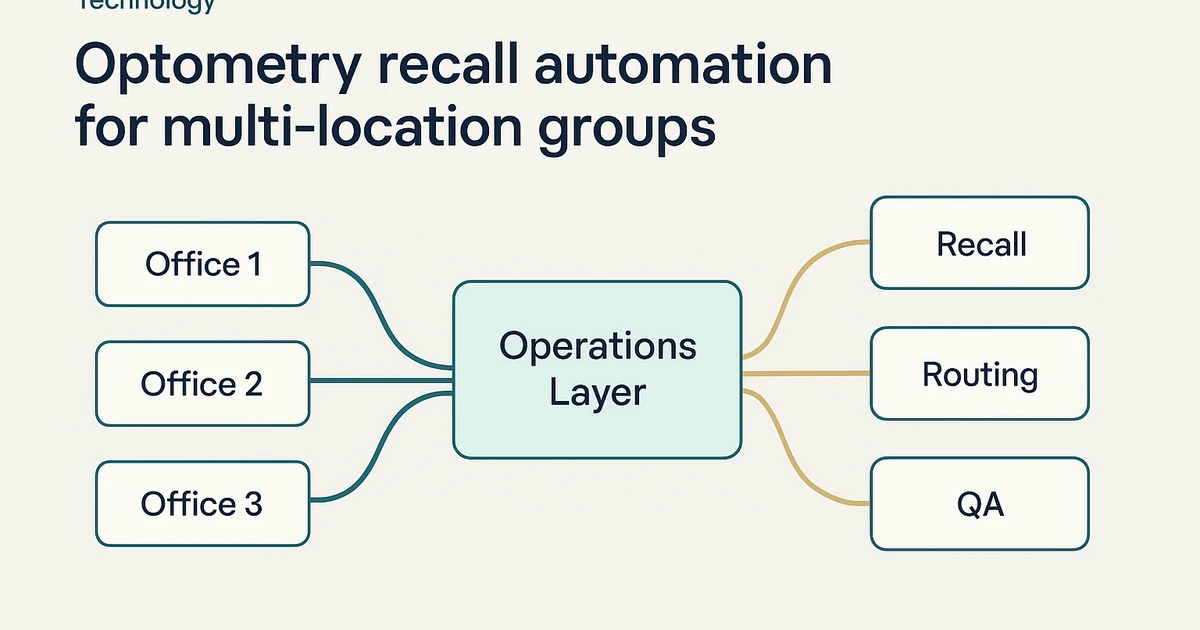
A regional platform usually cannot. Once a portfolio reaches 3+ locations, recall usually stops looking like a simple reminder task and starts to behave like an enterprise workflow that needs standardization, centralization, and auditability.
For COOs, VPs of Operations, and buying committees, the goal is not simply to send more outreach. The goal is to build a repeatable system that identifies due patients, routes the next action correctly, and gives leadership consistent visibility into performance by location.
That is why enterprise teams usually think about recall alongside patient recall operations, integration planning, and the broader optometry operating model.
ONC’s patient engagement guidance treats digital tools as part of broader patient communication and appointment workflows (Chapter 2; Chapter 7).
Why Does Optometry Recall Automation Get Harder Across Multiple Locations?
At single-site scale, recall often looks manageable because gaps are hidden by individual effort. Someone at the front desk knows which patients usually respond to a text, which provider prefers a softer follow-up, and which overdue list is actually urgent. That informal knowledge can stabilize one office for a while. It does not create an enterprise process.
At group scale, the real risk is inconsistency. One location may treat annual exams, contact lens follow-up, and specialty medical follow-up as one recall queue. Another may split them into separate workflows.
A third may not update statuses until the end of the week. Once that happens, leadership no longer has a clean operating signal. It has location-by-location interpretation.
Where Does Definition Drift Start?
Definition drift usually begins with the due-patient rule itself. In one office, “due” may mean a patient is ready for outreach immediately after the last encounter window closes. In another, “due” may mean the patient is already overdue. In a third, “due” may be tied to provider preference rather than a documented enterprise rule.
That matters because automation only standardizes what the organization has already defined.
AHRQ has profiled an interactive preventive health record integrated with the EHR for preventive-service delivery, which is a useful reminder that due-patient identification depends on structured data and explicit workflow logic (AHRQ profile).
If the group has not agreed on common recall categories, suppression rules, and ownership logic, software will simply scale the inconsistency. This is one reason multi-site operators often pair recall work with broader optometry network operations planning.
Why Do Local Heroics Distort Enterprise Reporting?
Local heroics make weak systems look acceptable in isolated offices. A strong site manager can work a stale recall list back into shape. A long-tenured front-desk lead can compensate for a poor queue design. But those fixes rarely translate across a portfolio.
From an enterprise standpoint, this creates EBITDA noise. Leadership sees uneven schedule utilization, uneven labor pressure, and uneven patient follow-up, but the root cause stays blurred.
It becomes difficult to tell whether one location has a staffing issue, a workflow issue, or a data issue. That is a poor foundation for capital allocation or SLA calibration.
What Should Enterprise Optometry Groups Automate First?
The first automation decision should not be channel selection. It should be process selection. Multi-location groups often get cleaner execution when they automate the control points that shape workflow quality, not only the outbound message. That means starting with how the organization identifies due patients and what happens after outreach is triggered.
This is where many buying committees get pulled in the wrong direction. A vendor demo may focus on texts, templates, or AI messaging. Those features matter, but they sit downstream of the operating model. If the enterprise cannot define who belongs in the queue and what the approved next action is, automation will add speed without adding control.
Why Should Due-Patient Logic Come Before Outreach Logic?
A strong recall program starts with a common patient-status model across the group. Each location should be working from the same definitions for due, overdue, in outreach, booked, completed, deferred, and removed. Without that shared structure, centralized reporting is weak from the start.
That same logic should also determine which patients deserve which workflow. Some cohorts fit straightforward outreach and direct scheduling. Others need provider-specific review, local capacity checks, or exception handling.
A group that wants cleaner execution at scale should document that logic before it expands automation or segmentation depth. That is the operational foundation behind patient recall segmentation.
Why Should Automation Trigger the Next Action, Not Just the Message?
ONC’s portal-feature guidance is useful here because it focuses on practical actions, not just communication. The chapter highlights online booking, prescription refills, and secure messaging as portal features that meet patient needs and can save staff time (Chapter 2).
For enterprise optometry groups, the important lesson is that recall should lead directly to an action path whenever possible.
In practice, that means the best recall automation does more than send reminders. It routes the patient toward booking, confirmation, follow-up, or escalation inside a controlled workflow.
A text that creates another callback burden is not a closed-loop operating model. A text or portal path that moves the patient into a managed booking outcome is much closer to one.
How Should Operating Responsibility Be Split Between Central and Local Teams?
Centralization does not mean every recall decision should live at corporate. It means the enterprise should own the rules, reporting, and quality standards that determine whether the process is working consistently across locations. Local teams still matter, but their role should be narrower and more explicit.
That distinction is important for multi-location optometry groups because local nuance is real. Provider templates differ. Specialty visit types differ. Capacity differs.
The mistake is letting those differences become an excuse for letting every office invent its own recall process. Mature operators separate what must be standardized from what can remain local.
What Belongs in the Center?
Corporate or centralized patient-access leadership should usually own workflow design, status definitions, outreach sequencing, QA review, exception categories, vendor administration, and reporting logic. Those are the components that should not vary simply because one office manager prefers a different approach.
A centralized operating model also makes it easier to enforce common QA standards. The organization can review whether the right cohort entered the right queue, whether the patient was routed correctly, and whether the record landed in the correct final status.
That is more useful for enterprise management than relying on anecdotal feedback from each location. This is the logic behind centralized patient recall for multi-location groups.
What Should Remain Local?
Local teams should retain responsibility for the exceptions that require site context. That may include provider-specific scheduling nuance, specialty visit questions, or cases where a patient’s next step depends on location capacity rather than standard recall logic.
The key is to keep that local authority narrow. If too much work routes back to each office, the group has not truly centralized recall. It has merely created a central list-building function and pushed execution back to the same fragmented workflow. That pattern tends to recreate the very inconsistency enterprise automation was supposed to reduce.
What Technology and Data Foundation Does a Buying Committee Need?
Recall automation is not an isolated tool decision. It sits on top of the group’s scheduling, patient-access, and data-governance infrastructure.
The AMA notes that practice management software can automate formerly manual administrative work and typically supports scheduling appointments, preregistration, billing, and reporting, which is why buying committees should evaluate the underlying operating stack rather than the outreach layer alone (AMA).
If the technology stack cannot support consistent statusing, shared visibility, and clear handoffs across locations, automation will remain operationally fragile.
Buying committees should therefore evaluate recall through the full recall-to-appointment journey. That includes how patients receive information, how staff see context, how queues are updated, and how outcomes are reported.
ONC’s appointment-focused chapter is useful because it looks beyond reminders and includes patient-facing EHR use and video appointments as part of the appointment experience (Chapter 7).
Why Do Patient-Facing Workflows Matter as Much as Messaging?
Patient-facing tools affect whether recall generates friction or creates a practical return path to care. If a patient receives a recall message but still has to wait for manual callback, the enterprise has not fully shortened the route back to appointment.
If the patient can move directly into a managed workflow, staff time is protected and follow-up becomes easier to report.
That is why many groups evaluate recall with the same lens they use for EHR and PMS integration in enterprise scheduling. Messaging alone rarely creates enough operating use. A controlled handoff from outreach to booking does.
Why Is Cross-Location Data Continuity Non-Negotiable?
ONC’s care-coordination guidance describes EHR use as support for better coordination, and ONC’s health IT basics overview explains that health information exchange enables secure sharing and access of patient information electronically across care settings (Improve Care Coordination; Health IT & Health Information Exchange Basics).
For multi-location optometry groups, the operational implication is straightforward. Centralized recall depends on shared visibility into patient status, outreach history, and booking outcomes across the portfolio.
Buying committees should still ask their compliance and security teams to review permissions, access design, audit trails, and vendor controls. But from an operations standpoint, cross-location data continuity is a practical foundation for centralized recall.
How Should a 3+ Location Rollout Be Governed and Measured?
A prudent rollout treats recall automation as an operating-system change, not a marketing campaign. The organization should start with a defined cohort, a documented booking path, and a small set of enterprise metrics that leadership trusts. That creates a cleaner pilot and makes later expansion easier to govern.
The board-level question is straightforward: will this program create more predictable patient access and more reliable location performance? The management question is harder: which workflow rules, handoffs, and QA steps make that outcome repeatable across the portfolio? Those are the questions that belong in governance meetings before a broad rollout begins.
Which Metrics Actually Tell Leadership the Program Is Working?
Enterprise reporting should focus on workflow reliability before it focuses on outreach volume. Leadership should be able to see queue aging, booked-from-recall outcomes, exception backlogs, status accuracy, and variation by location. Those measures reveal whether the system is controlled. Volume alone does not.
That is also why the dashboard matters. A buying committee should expect recall reporting to connect with wider operations visibility, not sit in a silo. A clean multi-location intake KPI dashboard makes it easier to separate a location-level coaching problem from a system-design problem.
What Does a Low-Risk Rollout Look Like?
The lowest-risk rollout usually begins with one cohort, one approved booking path, and one QA loop. Leadership should confirm that due-patient identification is clean, that outreach flows to the intended next action, and that local exceptions return to a managed queue rather than disappearing into email or manual notes.
Once that pilot produces stable reporting, the group can expand by adding cohorts, locations, and more sophisticated workflow branches. That is where EBITDA impact becomes easier to discuss. The financial upside is rarely about one campaign.
It is about fewer open slots, less front-desk rework, clearer labor planning, and more consistent execution across the portfolio. Those are the patterns that make multi-location healthcare EBITDA more defensible over time.
Related Reading
- Centralized Patient Recall for Multi-Location Healthcare
- EHR PMS Integration Centralized Scheduling Enterprise
- Multi-Location Intake KPI Dashboard With Key Benchmarks
- Scaling Optometry Network Operations: 5 to 50 Locations
- Patient Recall Segmentation: Who to Call First (and Why)
Sources
- Chapter 2 - Patient Engagement Playbook
- Chapter 7 - Patient Engagement Playbook
- Primary Care Patients Use Interactive Preventive Health Record Integrated With Electronic Health Record, Leading to Enhanced Provision of Preventive Services
- How to select a practice management system
- Improve Care Coordination using Electronic Health Records | Providers & Professionals
- Health IT & Health Information Exchange Basics - ONC - Office of the National Coordinator for Health Information Technology
Managing optometry recall automation across 3+ locations? Request an Enterprise Assessment for your group.