
Table of Contents
- Why is patient recall so hard to standardize across a DSO?
- What should a DSO standardize in the recall policy itself?
- How should the recall activation workflow work in a centralized model?
- What operating model works best across 3+ locations?
- How should a DSO roll out recall standardization without disrupting the network?
- Which KPIs show that recall is actually standardized?
Patient recall standardization inside a DSO is not just a reminder-setting exercise. It is an operating-system decision about how clinical intent becomes a repeatable queue, how that queue becomes scheduled demand, and how leadership can see a comparable workflow signal across locations.
When recall rules live in office habit instead of enterprise design, groups can end up with different due-patient lists, different escalation paths, and different reporting logic from site to site (The Next Phase of DSO Growth: From Fragmented Revenue to Standardized Models).
For COOs, VPs of Operations, and buying committees, the objective is not simply to send more messages. The objective is to centralize recall logic so the organization can compare sites fairly, calibrate SLAs, and preserve continuity of care while the portfolio grows.
That is why this topic belongs in the broader dental group operations landscape, and why it often sits next to decisions about patient recall programs and integration architecture.
Why is patient recall so hard to standardize across a DSO?
Recall can become harder at scale because dental groups often do not inherit one clean operating model. They may inherit a mix of acquired office habits, provider preferences, local staffing patterns, and PMS configurations. A process that feels manageable in one office can turn into operational noise when twenty offices use different definitions for due, overdue, deferred, or needs review.
That variation can have a direct management consequence. Enterprise dashboards may show one portfolio-level recall story while the actual work being done at the site level is materially different. A DSO may believe it has a recall program, when in practice it has several local recall programs sharing one brand name.
Where does cross-location variation enter the workflow?
Variation usually enters before the first reminder goes out. One location may classify patients by next visit type, another by last completed procedure, and another by whatever report a front-desk lead knows how to run.
Some offices pre-schedule aggressively at checkout. Others leave the next step to later outreach. The result is not just inconsistency in volume. It can also be inconsistency in who enters the recall queue in the first place.
The problem can get larger after acquisitions. Newly added sites often bring their own cadence rules, script language, and scheduling habits. If the group does not normalize those inputs early, centralization can become little more than shared reporting on top of fragmented workflows. That is the same pattern many leaders encounter in broader dental group workflow standardization efforts.
Why does enterprise leadership need one recall language?
A DSO cannot manage what it cannot define consistently. If one office treats a patient as overdue while another treats the same situation as deferred, then recall conversion, queue aging, and site comparisons can all become unreliable. Leadership discussions drift into anecdotes because the organization lacks one enterprise language for patient status.
Standardization starts with shared definitions such as due, overdue, in outreach, booked, completed, deferred, and exception. Those labels sound administrative, but they are the bridge between centralized operations and location-level execution.
Once those definitions are controlled, the group can build a cleaner centralized patient recall model instead of trying to manage variance after the fact.
What should a DSO standardize in the recall policy itself?
The enterprise recall policy should standardize more than templates and timing. It should define who enters which queue, what triggers movement between queues, which requests can resolve digitally, and when a case requires human review. In other words, the policy should govern the full pathway from clinical recommendation to booked follow-up.
That matters because recall is not one workload.
Preventive recall, post-treatment follow-up, and periodontal maintenance can require different pathways rather than one uniform campaign, especially when ongoing maintenance therapy and personalized care planning are part of the clinical model (Non-Surgical Treatments - American Academy of Periodontology, 2017 Classification of Periodontal and Peri-implant Diseases and Conditions).
Treating those cohorts as one uniform campaign can create operational friction and weaken reporting.
How should cohorts be defined?
The cleanest approach is to define cohorts by clinical intent, not by office habit. A similar principle appears in the evidence-based pediatric literature.
AAPD’s periodicity best practice sets evidence-based timing for exams, preventive services, and counseling while emphasizing continuity of care based on individualized need (Periodicity of Examination, Preventive Dental Services, Anticipatory Guidance/Counseling, and Oral Treatment for Infants, Children, and Adolescents).
For enterprise operators, that suggests the recall entry rule should come from approved care logic rather than a local preference for one universal cadence.
AAPD’s caries-risk assessment and management guidance makes the same point from another angle.
It links risk assessment to care pathways and supports customized periodicity, diagnostic, preventive, and restorative care based on patient risk (Caries-risk Assessment and Management for Infants, Children, and Adolescents).
Even if a DSO serves a mixed general and pediatric population, the operating implication is the same: standardized workflow does not mean one-size-fits-all scheduling (Caries-risk Assessment and Management for Infants, Children, and Adolescents, Routine scale and polish for periodontal health in adults).
It means one enterprise method for assigning patients to the right pathway.
Why should continuity of care shape the workflow?
Recall is not only a scheduling function. It is one of the ways a dental group operationalizes continuity of care across many locations. AAPD’s dental home policy defines the dental home as an ongoing, comprehensive, continuous, accessible, and coordinated relationship between patient and practice (Policy on the Dental Home).
For a multi-location organization, that concept is highly relevant because recall is often the mechanism that makes continuity visible in day-to-day operations.
That means the recall policy should specify what happens when a patient cannot book at the originating office, when a provider leaves, when capacity shifts between nearby sites, or when the next step requires a different visit type.
Without those rules, continuity depends on local improvisation. With them, the group can pair enterprise consistency with more disciplined patient recall segmentation.
How should the recall activation workflow work in a centralized model?
Once the organization decides who belongs in which queue, the next challenge is activation. This is where many DSOs confuse outreach with workflow. Sending a text is not the same thing as moving a patient back into care. A standardized enterprise process should connect outreach to a defined next action and a reportable final status.
This distinction matters for centralization because digital outreach can either remove friction or create more work for the front desk. If the message only creates another callback burden, the system is still local and manual. If the message routes the patient into a controlled booking or follow-up path, the workflow is genuinely more centralized.
What should be standardized in the digital return path?
ONC’s patient engagement playbook recommends automatic portal enrollment, in-office registration, and integrating portal use into care plans so patients can complete follow-up actions and stay on recommended care pathways (Chapter 1 - Patient Engagement Playbook). For DSOs, that is useful because it shifts activation from a loose reminder model to a designed return path.
Operationally, that means recall standardization should begin before the patient becomes overdue. Enrollment should happen during registration or checkout. The patient should leave the visit with a working digital path for confirmation, rescheduling, or follow-up questions.
That is how recall becomes part of enterprise patient access, not a separate cleanup function. Groups that are also redesigning centralized scheduling for dental offices usually find that recall performance improves when the booking path is simpler and more visible.
How should exception handling and SLA calibration work?
ONC’s second chapter covers online booking, secure messaging, response-time policies, and workflow integration for patient communication (Chapter 2 - Patient Engagement Playbook).
Those elements translate directly into DSO recall governance. The question is not just whether a patient received a reminder. The question is whether the group has approved rules for what happens next.
That is where SLA calibration matters. Enterprise operators should define which recall requests can resolve automatically, which need centralized staff review, and which must return to the site because they depend on local chair capacity or provider-specific context.
If those boundaries are vague, centralization can stall and the organization can recreate fragmented work under a different label. This is also where EHR and PMS integration strategy becomes operationally important, because the workflow is only as reliable as the data and booking logic behind it.
What operating model works best across 3+ locations?
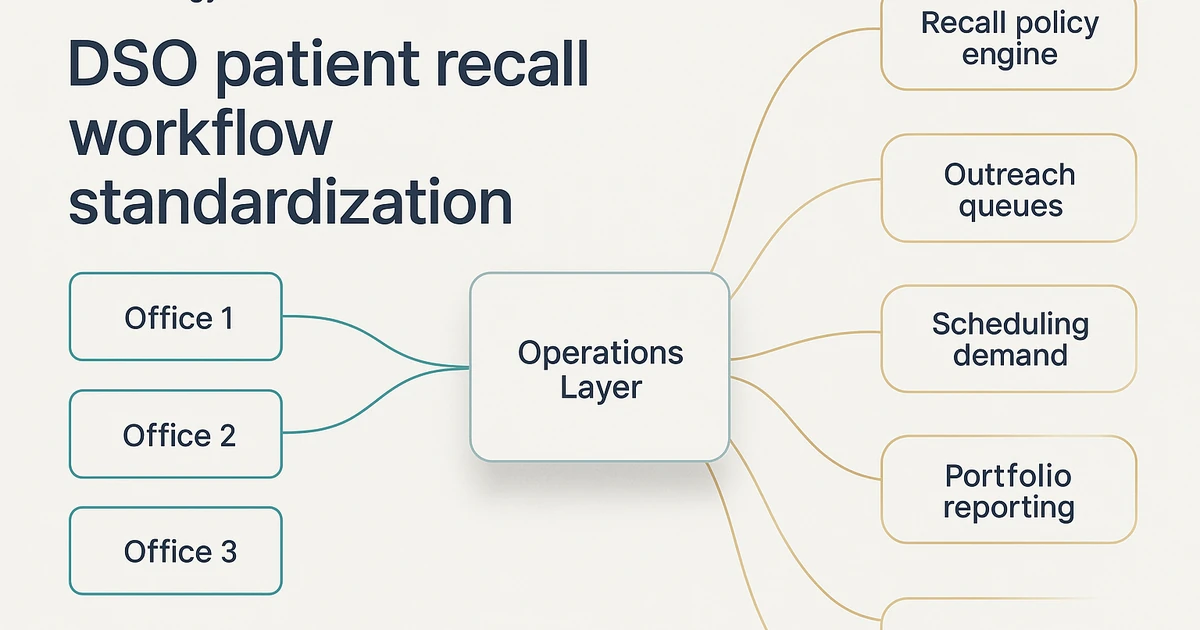
Centralization does not mean every recall action has to happen at corporate. It means the enterprise owns the rules, reporting logic, QA model, and escalation structure that make cross-location execution comparable. Local teams still matter, but their role should be narrower and more explicit.
That distinction is important because some DSOs centralize list generation while leaving the difficult work undefined. The result can be partial centralization: a central team pushes work outward, local offices reinterpret it, and leadership still cannot compare locations cleanly. A stronger model is clear about what belongs in the center and what remains site-dependent.
What belongs in the center?
The enterprise or centralized patient-access team should usually own cohort definitions, cadence logic, script approval, digital channel configuration, QA calibration, and cross-location reporting. Those are the parts of the system that should not vary simply because one office manager prefers a different workflow. Central ownership is also the cleanest way to preserve reporting integrity as the group adds locations.
The center should also own exception taxonomy. If the portfolio wants meaningful reporting, everyone needs the same categories for patient unreachable, capacity constraint, clinical review needed, deferred by patient, and similar statuses. That is the practical foundation of a multi-location recall workflow, and it is what keeps enterprise dashboards tied to actual work instead of local shorthand.
What should remain local?
Local teams should retain responsibility for the exceptions that truly require site context. That may include provider-specific scheduling nuance, same-day chair management, capacity tradeoffs inside the office, or situations where a patient conversation crosses from routine follow-up into local service recovery. Those decisions require local knowledge and should not be forced into a rigid centralized script.
The key is that local authority should be bounded by enterprise rules. If every office can redefine cadence, scripts, or final statuses, the group is no longer standardizing recall. It is distributing work and hoping for consistency. That is why rollout should be paired with stronger change management for centralized patient access.
How should a DSO roll out recall standardization without disrupting the network?
A common rollout error is trying to standardize every cohort, every location, and every channel at once. That approach creates too many moving parts and makes it hard to tell whether the issue is status logic, capacity rules, training, or integration quality. A better approach is to prove one governed workflow first and expand from a stable base.
Buying committees should treat recall standardization as an operating-model change, not a messaging project. The early goal is not maximum outreach volume. The early goal is clean workflow behavior that leadership can inspect and trust. Once that exists, scale becomes much less risky.
Why start with one cohort and one booking path?
Starting with one cohort forces clarity. The organization has to decide who qualifies, who owns the queue, what the next action is, how exceptions are coded, and how success is reported. That discipline is valuable because it exposes ambiguity before the DSO multiplies it across the portfolio.
The pilot cohort should connect to a booking path the organization can actually control. If the group is still working through acquisition-related workflow drift, that discipline becomes even more important. It can be useful to align recall standardization with broader DSO integration playbook work so new locations adopt the enterprise status model early rather than after bad habits settle in.
What should QA review before expansion?
Before expanding to more cohorts or more locations, QA should confirm that the right patients entered the queue, that the next action was clear, that exceptions landed in approved categories, and that final statuses match actual outcomes. This is less about script tone and more about workflow integrity. A DSO can usually tolerate small messaging differences more easily than it can tolerate broken status logic.
That QA review is also where leadership should look for hidden rework. If centralized outreach repeatedly pushes unresolved requests back to sites, or if sites are reclassifying patients outside approved rules, the organization does not yet have a scalable standard.
It has an unstable draft. A clean KPI dashboard for multi-location intake can make those failure modes much easier to spot.
Which KPIs show that recall is actually standardized?
A standardized recall workflow should be judged first by control and comparability, then by downstream financial impact. Outcome metrics matter, but they can be misleading if the underlying process is inconsistent. A portfolio can look strong on aggregate while still hiding meaningful location-level variance.
That is why sophisticated operators measure whether the workflow is governed before they debate whether the outreach program is high performing. Control comes first. Reporting without control usually creates false confidence.
Which metrics show workflow control?
Useful control metrics include queue aging, status accuracy, exception backlog, handoff completion, and location-level variance in how the same cohort moves through the process. Those measures tell leadership whether the operating model is behaving consistently across the network. They also make it easier to distinguish a system-design issue from a location coaching issue.
When those metrics are unstable, portfolio-wide recall discussions tend to drift toward technology blame or local finger-pointing. When they are stable, the DSO can have a much better management conversation about staffing model, booking friction, and where centralization should deepen. That is the operational value of standardization before any big outcome claim is made.
How does recall standardization connect to EBITDA discussions?
Buying committees do not usually evaluate recall only as a reminder-volume question.
They care because a controlled recall workflow can make demand more visible, reduce front-office rework, and create a cleaner operating signal across the portfolio, which is one reason standardized models are often discussed as an enterprise performance lever in DSO operations coverage (The Next Phase of DSO Growth: From Fragmented Revenue to Standardized Models).
That can improve planning discipline. It can also make it easier to see which sites need staffing, training, or scheduling intervention before issues spread.
That is the route from recall standardization to EBITDA impact. Not a guaranteed revenue promise, but a more disciplined operating system that supports more consistent patient access and more credible reporting.
For PE-backed groups and larger DSOs, that management visibility may matter as much as the outreach tool itself. The enterprise question is simple: can leadership trust the workflow data enough to manage the network with it?
A DSO patient recall workflow is standardized when clinical logic, patient activation, exception handling, and reporting all follow one enterprise design, even while sites keep a narrow band of local discretion. That is what turns recall from a site-level chore into a scalable capability.
Related Reading
- Dental Group Workflow Standardization
- Centralized Patient Recall for Multi-Location Groups
- Centralized Scheduling for Dental Offices
- Patient Recall Segmentation
- DSO Change Management for Centralized Patient Access
Sources
- The Next Phase of DSO Growth: From Fragmented Revenue to Standardized Models
- Non-Surgical Treatments - American Academy of Periodontology
- 2017 Classification of Periodontal and Peri-implant Diseases and Conditions
- Periodicity of Examination, Preventive Dental Services, Anticipatory Guidance/Counseling, and Oral Treatment for Infants, Children, and Adolescents
- Caries-risk Assessment and Management for Infants, Children, and Adolescents
- Routine scale and polish for periodontal health in adults
- Policy on the Dental Home
- Chapter 1 - Patient Engagement Playbook
- Chapter 2 - Patient Engagement Playbook
Managing DSO patient recall workflow standardization across 3+ locations? Request an Enterprise Assessment for your group.