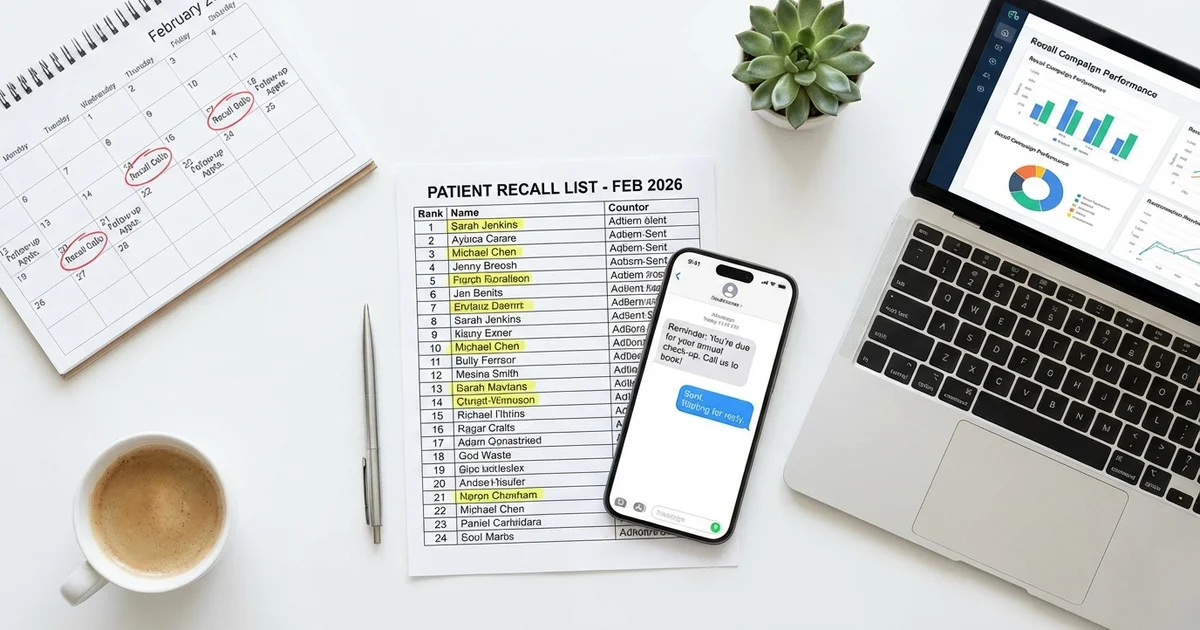


A patient recall service systematically contacts patients who are due or overdue for appointments, bringing them back into your practice. For multi-location healthcare groups, existing patients generate up to 80% of practice revenue, making recall one of the highest-ROI activities available. Before evaluating services, it helps to understand the broader patient recall campaign framework that guides how outreach programs should be structured. This guide explains what patient recall services do, when practices should consider outsourcing recall, and how to evaluate providers.
Table of Contents
- What Is a Patient Recall Service?
- Why Does Patient Recall Matter for Multi-Location Groups?
- How Much Revenue Is at Stake?
- What Types of Patient Recall Services Exist?
- How Do You Decide Between In-House and Outsourced Recall?
- When Should You Consider Outsourcing Your Patient Recall?
- How Do You Evaluate Patient Recall Service Providers?
- What Are the Implementation Considerations for Multi-Location Groups?
- How Do You Measure Recall Service ROI?
What Is a Patient Recall Service?
A patient recall service contacts patients who need to schedule preventive or follow-up appointments. Unlike general appointment reminders (which confirm already-scheduled visits), recall targets patients who have not yet booked their next appointment.
Recall services handle three patient categories:
| Category | Definition | Example |
|---|---|---|
| Pre-due patients | Coming due within 30-60 days | Dental hygiene patient due for 6-month cleaning |
| Due patients | Currently within their care window | Optometry patient at 12-month exam interval |
| Overdue patients | Past their recommended care interval | Patient 3+ months past due date |
The service uses multiple contact methods (phone calls, text messages, emails) to reach patients, explain why they should return, and book appointments directly into your scheduling system.
Why Does Patient Recall Matter for Multi-Location Groups?
Single-location practices can manage recall informally. Multi-location healthcare groups face structural challenges that make systematic recall essential:
Scale creates inconsistency: Staff at Location A may call overdue patients weekly while Location B does it monthly (or never). Different locations use different scripts, messaging, and follow-up sequences. No visibility into which locations execute recall effectively.
Staff competing priorities: Front desk teams prioritize patients physically present over outbound calling. Recall calls get deprioritized during busy periods and never catch up. Phone tag with patients takes time staff does not have.
Attrition compounds across locations: Industry average attrition runs 15-20% annually. For a 20-location group with 2,000 active patients per site, that represents 6,000-8,000 lost patients each year. Without systematic recall, attrition accelerates as patients forget about your practice.
According to research from Jarvis Analytics, hygiene recalls represent the “heartbeat” of practice profitability for DSOs, outpacing new patient acquisition in revenue impact.
How Much Revenue Is at Stake?
The financial impact of recall performance is significant and measurable.
Recall rate benchmarks (dental hygiene):
| Performance Level | Recall Rate | Implication |
|---|---|---|
| Poor | Below 50% | Urgent intervention needed |
| Below Average | 50-64% | Significant revenue leakage |
| Average | 65-74% | Acceptable but suboptimal |
| Good | 75-84% | Strong performance |
| Excellent | 85-90%+ | Best-in-class |
Revenue impact example:
A practice with 4,000 annual hygiene visit opportunities (2,000 patients eligible for 6-month recalls) at 70% recall rate: 1,200 missed visits annually (30% of 4,000). At $175 average hygiene revenue: $210,000 in lost hygiene production. Plus missed restorative treatment identified during hygiene exams. Plus lost referrals from disengaged patients.
Industry research indicates that improving recall rate by 10 percentage points adds $50,000-$100,000 in annual revenue for a typical dental practice. For multi-location groups, multiply that across every site.
What Types of Patient Recall Services Exist?
Patient recall services fall into three categories, each with distinct characteristics.
1. In-House Manual Recall
Your staff handles all patient outreach using your existing phone system and PM software.
Characteristics: Staff make calls during gaps between patient care. Relies on PM system reports to identify due patients. Scripts and processes vary by employee. No additional vendor cost.
Best for: Small practices with low patient volume and available staff capacity
2. Automated Digital Recall
Software platforms send text messages, emails, and automated calls based on PM system data.
Characteristics: Triggers automatically when patients reach due dates. Patients self-schedule via online booking links. Minimal staff involvement required. Monthly software subscription cost.
Best for: Practices wanting to reduce manual effort with moderate patient engagement
3. Outsourced Live Recall (Call Center)
A dedicated external team makes live phone calls to your patients using your practice identity.
Characteristics: Trained healthcare communicators handle conversations. Integrates with your scheduling system for direct booking. Performance-based pricing models available (pay per appointment booked). Handles objections and complex patient situations.
Best for: Multi-location groups needing consistent, scaled execution
Many groups use a hybrid approach: automated systems for routine reminders plus live outreach for high-value or difficult-to-reach patients.
How Do You Decide Between In-House and Outsourced Recall?
The choice between in-house and outsourced recall depends on your operational reality.
| Factor | In-House Favors | Outsourced Favors |
|---|---|---|
| Location count | 1-3 locations | 4+ locations |
| Staff availability | Dedicated recall coordinator | No spare capacity |
| Current recall rate | Above 75% | Below 65% |
| Consistency | Uniform execution across sites | Variable by location |
| Growth trajectory | Stable | Acquiring or opening new sites |
| Tech infrastructure | Integrated PM/phone/reporting | Fragmented systems |
In-house works when: You have dedicated staff whose primary job is patient outreach. You can maintain consistent processes across all locations. Your current recall rate exceeds industry benchmarks. You have systems to track and improve performance.
Outsourced works when: Staff are overwhelmed and recall competes with other priorities. Execution varies significantly across locations. You need to scale quickly without adding headcount. Performance-based pricing aligns vendor incentives with your goals.
When Should You Consider Outsourcing Your Patient Recall?
Consider outsourcing patient recall when you observe these signals:
Capacity signals: Front desk staff consistently work through lunch or stay late. Call-back lists grow faster than staff can work them. New patient inquiries compete with recall calls for attention.
Performance signals: Recall rate below 65% despite having a process in place. Significant variation in recall rates between locations (10+ point spread). Overdue patient list growing month over month.
Operational signals: Acquiring practices with different systems and processes. Opening new locations without trained staff. Seasonal volume spikes overwhelm existing capacity.
Financial signals:
- Clear ROI: If outsourced recall costs $3-5 per appointment booked and your average appointment value exceeds $150, the math works
- Performance-based pricing reduces risk (pay only for results)
Research from industry sources indicates that outsourced recall services can improve retention rates by 19-31% when properly implemented, generating 15-30% revenue increases from the existing patient base.
How Do You Evaluate Patient Recall Service Providers?
When selecting an outsourced recall service, evaluate providers on these criteria:
Integration Capabilities
Questions to ask: Does the service integrate directly with your PM system? Can agents book appointments in real-time or do they create callbacks? How does data flow between systems (patient lists, appointment status)?
Why it matters: Manual data transfer creates delays, errors, and staff work. Direct integration enables immediate booking and accurate reporting.
Pricing Model
| Model | Description | Risk Profile |
|---|---|---|
| Per-call | Pay for each outreach attempt | High - pay regardless of results |
| Per-contact | Pay when patient is reached | Medium - may not convert to appointments |
| Per-appointment | Pay when appointment is booked | Low - aligned with your goals |
| Hybrid | Base fee plus per-appointment bonus | Medium - shared risk |
Recommendation: Performance-based models (per-appointment) align vendor incentives with your outcomes.
Healthcare Experience
Questions to ask: Does the team have healthcare-specific training? Do they understand HIPAA requirements? Can they handle clinical questions appropriately (escalating when needed)?
Why it matters: Healthcare conversations differ from general customer service. Patients have questions about insurance, procedures, and scheduling that require appropriate handling.
Reporting and Visibility
Questions to ask: What metrics are tracked and reported? Can you see performance by location, by time period, by patient segment? How quickly do you receive reporting?
Key metrics to expect: Attempts per patient. Contact rate (patients reached / patients attempted). Booking rate (appointments / patients contacted). Show rate (appointments completed / appointments booked). Revenue recovered.
Scalability
Questions to ask: Can the service handle volume fluctuations? How quickly can they onboard new locations? What happens during your peak seasons?
Why it matters: Multi-location groups need partners who can scale with growth and handle operational variability.
What Are the Implementation Considerations for Multi-Location Groups?
Successfully deploying a patient recall service across multiple locations requires attention to several factors.
Standardize before you outsource
Before engaging an external service: Define what “due” and “overdue” mean across all locations. Establish standard care intervals by patient type. Clean patient data (valid phone numbers, current information). Align scheduling availability across sites.
Start with a pilot
Rather than rolling out to all locations simultaneously: Select 2-3 representative locations for initial deployment. Run for 60-90 days to establish baseline performance. Refine scripts, processes, and integration based on learnings. Scale to remaining locations with proven playbook.
Maintain oversight
Even with outsourced recall: Review reporting weekly during initial rollout, monthly ongoing. Listen to call recordings periodically for quality. Track patient feedback about the outreach experience. Monitor appointment show rates (not just bookings).
Integrate with your retention strategy
Patient recall is one component of retention. Connect it with:
- Post-appointment follow-up processes
- Patient satisfaction measurement
- Reactivation campaigns for long-dormant patients
- Referral programs for engaged patients
For guidance on running reactivation campaigns for patients who have been dormant longer, see our dormant patient reactivation playbook.
How Do You Measure Recall Service ROI?
Calculate return on investment for your recall service using this framework:
Revenue generated:
- Appointments booked x show rate x average appointment value
- Example: 200 appointments x 85% show rate x $175 = $29,750
Cost incurred:
- Service fees (per appointment, subscription, or hybrid)
- Example: 200 appointments x $4 per booking = $800
ROI calculation:
- (Revenue - Cost) / Cost = ROI
- Example: ($29,750 - $800) / $800 = 3,618% ROI
Even accounting for patients who would have scheduled anyway, the incremental revenue from improved recall rates typically far exceeds service costs.
Key Takeaways
Patient recall services help healthcare practices bring back patients who are due or overdue for appointments. For multi-location groups, the key points:
- Existing patients generate up to 80% of practice revenue, making recall essential
- Many practices achieve only 55-65% recall rates; top performers reach 85-90%+
- Each 10-point improvement in recall rate adds $50,000-$100,000 annually per location
- In-house recall works for small practices with dedicated staff and strong execution
- Outsourced recall works for multi-location groups needing consistency and scale
- Performance-based pricing (pay per appointment) aligns vendor incentives with your goals
- Start with a pilot before full rollout to refine processes
The question is not whether recall matters. The question is whether your current approach captures the revenue opportunity available from your existing patient base. Reactivating dormant patients is one of the highest-ROI investments a practice can make. Talk to our team about how MyBCAT combines call answering with patient recall to keep your schedule full.
Related Reading
Sources
- Jarvis Analytics: Hygiene Recalls for DSOs
- DocResponse: Patient Recall Systems
- Relatient: Patient Recalls and Automated Scheduling
- NexHealth: Scaling DSO with Technology
- Emitrr: Patient Recall Guide
- Group Dentistry Now: Text Reminders for DSOs
- Vital Interaction: Hyper-Personalization in Patient Recall