

Table of Contents
- Why does patient win-back break down in enterprise practice groups?
- How should a scalable patient win-back model be designed?
- Which workflows should be centralized and which should stay local?
- How should buying committees govern rollout and success?
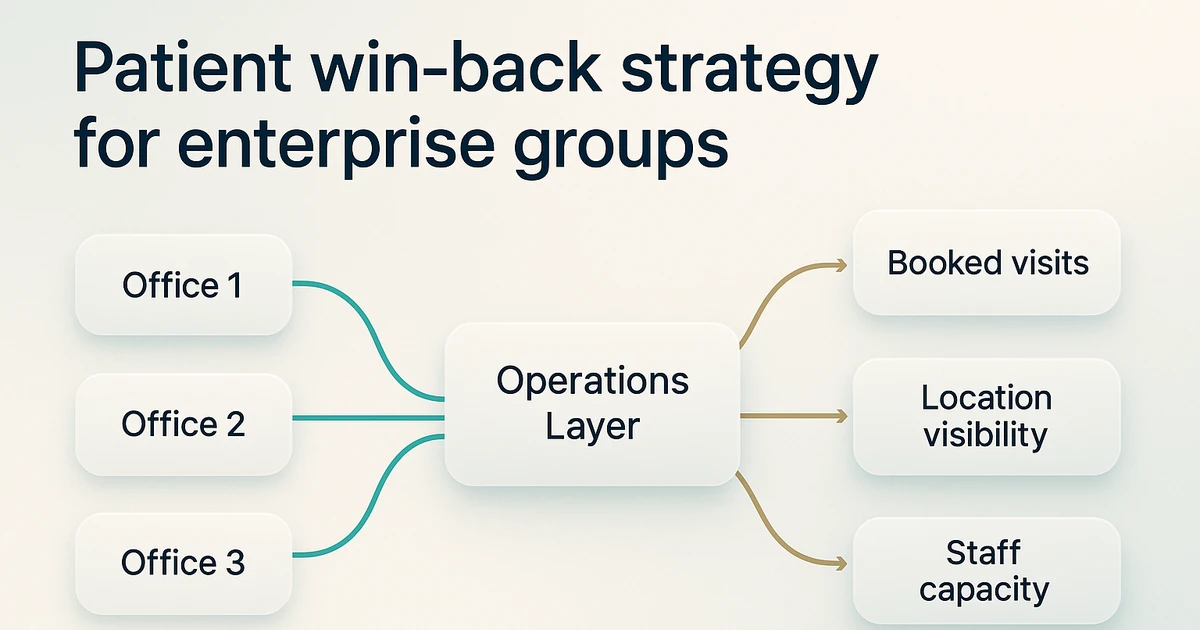
For a COO, VP of Operations, or buying committee, a patient win-back strategy is often less a one-time campaign and more a patient-access operating model. It shapes which overdue patients re-enter care, how consistently that process runs across locations, and whether leadership can see the result in centralized reporting.
In multi-location groups, the real issue is often not message copy alone. It is also ownership, standardization, and the ability to move patients from outreach to scheduled care without handoff failures.
That is why enterprise teams often pair patient recall programs with shared workflows, centralized queue management, and reporting rules rather than relying on isolated front-desk effort.
ONC’s Patient Engagement Playbook frames electronic access and engagement as supporting better communication, care, and outcomes. For enterprise practice groups, that framing matters because win-back sits between patient access, recall operations, and service-line capacity planning.
Why does patient win-back break down in enterprise practice groups?
Enterprise win-back can break down when leadership treats it as a marketing task instead of an operating system. One location may call overdue patients weekly, another may send a portal message when staff have time, and a third may do nothing until a provider complains about open chair time. The result can be not just inconsistency. It can also be a lack of comparability across sites, providers, and patient cohorts.
The EBITDA impact may show up indirectly but still matter. When overdue patients are not worked through a standard process, schedule gaps can become harder to explain, provider utilization can become harder to assess consistently, and retained demand can become harder to separate from net-new demand.
For PE-backed platforms and larger group practices, that can make win-back as much an enterprise reporting issue as a patient communications issue.
Where does fragmentation show up first?
A common early problem is definition drift. One region may define a lapsed patient by missed preventive care, another by inactive status in the PMS, and another by whether a patient failed to book before checkout.
Without a shared definition, the same portfolio can appear to have very different recall performance depending on which location generated the report. That is why many mature groups document the operating logic before they discuss channels.
Another common problem is queue ownership. If overdue patients are discovered centrally but routed back to each site without a consistent multi-location recall workflow, the program often turns into a list-management exercise. A stronger model assigns clear ownership for list generation, outreach execution, exception handling, and booking authority. That is the difference between a managed process and a backlog that ages in place.
Why do single-location heroics stop working at scale?
Single-site success often depends on informal knowledge. A strong front-desk lead remembers which patients prefer phone calls, which provider likes a softer message, and which overdue list actually matters. That kind of local memory can stabilize one office. It may not scale cleanly across a regional platform with different PMS habits, uneven staffing, and rotating site leadership.
Enterprise groups usually need repeatability instead of heroics. That often means documented scripting logic, shared escalation rules, standardized handoffs to local teams, and common QA criteria.
Articles like centralized patient recall for multi-location healthcare and front desk recall workflow can be useful here because they frame recall less as a personality-driven activity and more as a managed service line within patient access.
How should a scalable patient win-back model be designed?
A scalable win-back model often starts with segmentation, not channel selection.
Groups that begin with “should we use text or phone?” can skip the more important question: which overdue patients belong in which workflow, and what action should each workflow drive? Enterprise design usually gets cleaner when it separates preventive recall, unscheduled treatment follow-up, overdue chronic care, and inactive patients who may need reactivation rather than routine recall.
The model also has to balance centralization with location nuance. Standardization should live in the decision logic, status definitions, and reporting structure. Local variation can still exist in provider attribution, site-specific hours, scheduling constraints, and specialty language. That balance is what allows a system to scale without making every location sound identical.
How do you build a shared patient status model?
A useful enterprise model gives every patient one operational status at a time. Common examples include due, overdue, in outreach, responded, booked, completed, deferred, and removed from sequence. These labels are simple, but they can be operationally powerful because they reduce local terminology drift and make centralized reporting possible. Once status logic is shared, leadership can compare cohorts instead of debating definitions.
This is also where patient recall segmentation becomes more than a content concept. Segmentation helps the organization decide which patients deserve automated messaging, which should route to a centralized team, and which need local clinical context before outreach begins.
Without that structure, sites may work the easiest names first rather than the queues that matter most to retention and schedule quality.
Why should digital activation be part of the operating model?
Digital activation is not just a side project. It can be infrastructure for win-back at scale.
ONC reports that patients encouraged by a clinician use online records at materially higher rates, and its playbook presents in-office registration as more effective than at-home outreach (Individuals’ Access and Use of Patient Portals and Smartphone Health Apps, 2020; Chapter 1).
For enterprise groups, that suggests portal activation should be built into checkout, follow-up instructions, and front-office scripting rather than left to passive reminders (How to Optimize Patient Portals for Patient Engagement and Meet Meaningful Use Requirements).
That matters because win-back can be materially easier when patients already have a working digital path back into care. If the group expects overdue patients to self-schedule, confirm details, or ask questions through digital channels, activation has to happen before the patient goes dormant (Chapter 2).
Otherwise the organization may be trying to run a digital recall model on top of a weak activation base, which can push too much work back to phone teams.
Which workflows should be centralized and which should stay local?
The cleanest enterprise programs often centralize the logic and only localize what truly requires site context. Central teams are usually best positioned to manage list generation, cohort rules, outreach sequencing, QA review, and portfolio reporting. Those functions benefit from standardization and are often where cross-location variance creates hidden operational drag.
Local teams still matter, but their role should be narrow and explicit. They are strongest when the patient needs provider-specific context, when scheduling requires knowledge of local capacity rules, or when a conversation crosses from routine recall into clinical nuance. When that boundary is unclear, central teams can overstep and local teams can disengage, which weakens both execution and accountability.
Which low-friction actions belong inside the portal and PMS flow?
If the desired action is straightforward, the patient should be able to complete it without waiting for manual callback. ONC’s Chapter 2 highlights online booking, prescription refills, and secure messaging as practical portal features that support patient needs between visits.
For enterprise recall and win-back, those features matter because they can connect outreach directly to action instead of forcing every re-engagement through the phone.
This is where many groups either gain or lose efficiency. A centralized team can send a message, but if the patient still needs multiple handoffs to reach the right scheduler, the system has not truly been centralized.
A stronger design is a closed loop: outreach identifies the right cohort, the portal or PMS-connected workflow gives the patient a clear next step, and the resulting activity lands in a reportable status that leadership can audit.
Which cohorts should escalate to trained humans?
Human outreach may still be necessary for high-friction cohorts. That includes patients with incomplete contact data, patients whose last interaction suggests dissatisfaction, and patients whose next appointment requires explanation rather than simple rebooking.
In these cases, a trained centralized team can handle the first live conversation, qualify the issue, and decide whether the case belongs with local staff, a provider-facing team, or standard scheduling.
ONC’s Chapter 2 also describes secure messaging as a channel for follow-up communication between visits. That is a useful operating principle for win-back.
Use digital channels to reopen the relationship, but escalate to people when the patient needs clarification, reassurance, or tailored next-step support. The mistake is not using automation. The bigger risk is assuming automation should carry every cohort to completion.
How should buying committees govern rollout and success?
Buying committees should evaluate win-back as an enterprise operating discipline, not just a campaign toolset. The critical questions are who owns data definitions, who approves message logic, who can book across locations, who reviews exceptions, and how location variance will be surfaced. If those decisions are vague, even good technology can produce uneven execution.
Governance also needs a clear reporting lens. Portfolio averages can make a weak process look stable because strong locations hide underperforming ones. The more useful view compares cohort progression, queue aging, response handling, and booking conversion rules across the same workflow.
That is why reactivation campaign KPIs and recall compliance tracking for multi-location healthcare belong in the operating discussion, not just the analytics appendix.
How should teams calibrate SLAs, QA, and exception ownership?
SLA calibration should start with patient cohort value and workflow complexity, not with a universal rule for every overdue patient. A simple preventive recall cohort may fit a largely automated sequence with centralized oversight.
A treatment-follow-up cohort may need faster review, stricter exception rules, and clearer local escalation. The point is not to create more rules. It is to make sure the same type of patient is handled the same way across the portfolio.
QA should follow the same logic. Review whether staff used the right cohort logic, routed the patient correctly, documented the outcome cleanly, and moved the record to the correct status. That creates a better enterprise signal than listening only for tone or script adherence.
For groups already thinking about broader retention strategy, DSO patient retention strategy is useful because it places recall, reactivation, and patient access inside one operational framework.
What does a disciplined rollout look like across 3+ locations?
A disciplined rollout starts with one cohort or one service-line problem, not a portfolio-wide launch. The pilot should prove that the organization can standardize status logic, route work correctly, preserve location nuance where needed, and produce reporting that leadership trusts. If those pieces are not visible in the pilot, scaling the program usually multiplies confusion rather than creating consistency.
For dental platforms, UCSF’s CAMBRA framework is a useful example of risk-based follow-up rather than blanket outreach. UCSF describes CAMBRA as a research-based strategy for assessing patient risk and developing more personalized preventive follow-up, which supports a more selective approach when a DSO wants to prioritize which patients belong in higher-touch workflows.
The larger lesson applies across specialties: expand only after the organization can explain why each cohort is in the sequence, who owns the next action, and how the process will show up in centralized reporting and EBITDA discussions.
Related Reading
- Centralized Patient Recall for Multi-Location Healthcare
- Multi-Location Recall Workflow
- Patient Recall Segmentation
- Reactivation Campaign KPIs
- Recall Compliance Tracking for Multi-Location Healthcare
Sources
- Patient Engagement - Health IT Playbook
- Individuals’ Access and Use of Patient Portals and Smartphone Health Apps, 2020 - ONC Health IT Research & Analysis
- Chapter 1 - Patient Engagement Playbook
- How to Optimize Patient Portals for Patient Engagement and Meet Meaningful Use Requirements
- Chapter 2 - Patient Engagement Playbook
- CAMBRA | School of Dentistry
Managing patient win-back strategy across 3+ locations? Request an Enterprise Assessment for your group.