
Table of Contents
- What Technology Foundation Does a Multi-Location Veterinary Group Need?
- How Should Leaders Evaluate Practice Management and EMR Systems?
- Which Integrations Matter Before a Group Standardizes?
- How Should Groups Govern AI, Telehealth, and Clinical Escalation?
- What Does Client Communication Technology Need to Control?
- How Should a Veterinary Group Roll Out New Technology?
- What Should Executives Measure After Go-Live?
Veterinary groups reach a technology inflection point once they operate across three or more hospitals. The question is no longer whether one site can schedule an appointment, record a visit, or send a reminder. The question is whether the group can run those activities through consistent data, controlled workflows, and reporting that leaders can trust.
That distinction matters during growth and acquisition. A hospital can be clinically well run yet still arrive with a different practice management system, diagnostic interfaces, message templates, scheduling rules, and access permissions. If each location keeps its own operating logic, a central team spends its time reconciling reports and resolving exceptions instead of improving the patient-access model.
For COOs and VPs of Operations, veterinary practice technology should be treated as operating infrastructure. It needs to support hospital teams, protect clinical judgment, and give leadership a common view of capacity, demand, and service quality. The veterinary operations hub frames the related access challenges, including appointment intake, refill requests, emergency routing, and multi-pet households.
This article focuses on the practical decisions behind a scalable technology stack: what must be standardized, where controlled variation is reasonable, and how to roll out changes without turning a software project into a disruption for hospital teams.
What Technology Foundation Does a Multi-Location Veterinary Group Need?
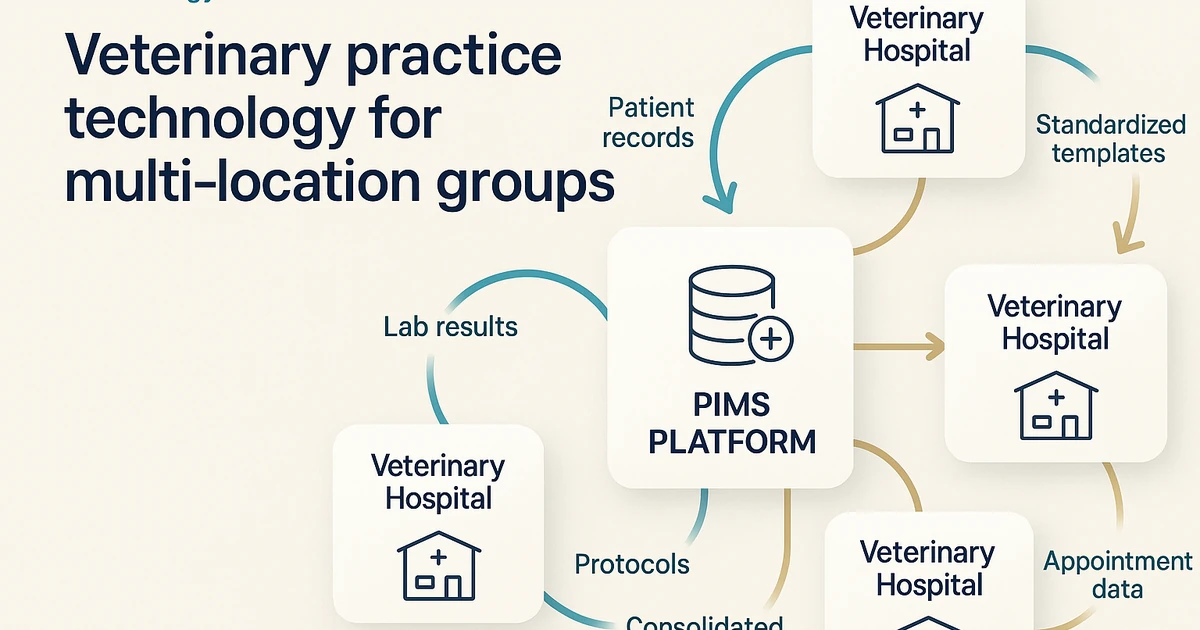
The foundation is a connected system of record, a defined integration layer, and an operating model for who owns exceptions. It is not a list of software logos. The practice management system and electronic medical record hold core patient, client, appointment, and documentation data. Communication tools, diagnostic systems, phone systems, payment tools, and reporting platforms must use that data without creating conflicting copies of it.
Groups should begin by documenting a target-state architecture in plain operational terms. Identify the authoritative source for patient demographics, appointment status, clinician documentation, consent preferences, and location configuration. Then identify what each connected tool is allowed to read, write, or trigger. This exercise often reveals duplicate reminder tools, manual spreadsheets that drive scheduling, and integrations that only work at a subset of hospitals.
The foundation also needs a clear distinction between group standards and local choices. A group may standardize appointment status definitions, user provisioning, and performance reporting while allowing a hospital to configure provider availability or local emergency referral instructions. Without that distinction, either every site improvises or centralization erases clinically necessary context.
Technology decisions should connect to the broader enterprise operating model, where growth depends on repeatable workflows rather than heroic work by individual managers. A standard is useful only when the group can train it, audit it, and improve it across every location.
How Should Leaders Evaluate Practice Management and EMR Systems?
Evaluate platforms against the work they must support across the group, not against a generic feature checklist. A useful evaluation starts with actual journeys: a new client booking, a multi-pet household request, a same-day urgent inquiry, a preventive-care recall, a medication refill request, and an after-hours escalation. For each journey, document the source data, handoffs, permissions, exception paths, and final record.
Cloud-based platforms can make centralized access, template management, and reporting easier, but deployment model alone does not solve governance. Leaders should ask whether the platform can support role-based access, location-aware scheduling, consolidated reporting, standardized documentation templates, and a reliable audit trail. They should also confirm how a newly acquired hospital would be onboarded, including data migration, user setup, and temporary coexistence with a legacy system.
Electronic medical record standardization deserves separate attention. Common templates and documentation conventions improve case handoffs, staff mobility, and quality review, but operations teams should not dictate clinical content without veterinary leadership. The operational task is to provide a governed template library, a change process, and a review cadence so clinicians can work from current, approved documentation patterns.
The existing veterinary EMR literature is a useful reminder that electronic records are a core operating tool, not an add-on. The survey of electronic veterinary medical record adoption and use provides relevant context for that shift. For a multi-location group, the value comes from making records usable across hospitals while keeping clinical oversight and documentation accountability in place.
Which Integrations Matter Before a Group Standardizes?
Integration due diligence should be based on the group’s real equipment, partners, and workflows. At a minimum, inventory every interface connecting the practice management system or EMR to diagnostic imaging, laboratory analyzers, client communication platforms, phone and contact-center tools, payments, accounting, identity management, and reporting.
For each interface, ask four questions. What data crosses the connection? Which system is authoritative if a value conflicts? Who monitors failures? What is the safe fallback when the interface is unavailable? A vendor may describe an integration as available while the group still needs configuration work, middleware, a data-cleanup project, or a manual exception procedure.
Diagnostic integration is particularly important because incomplete data flow can create friction for clinicians and staff. Imaging and laboratory results should be associated with the correct patient record and available in the workflow where the team needs them. The group does not need to promise a single technical pattern for every legacy device, but it does need an approved path for each hospital and a documented owner for failures.
Patient-access integrations deserve the same rigor. If a centralized team answers calls or schedules appointments, it needs accurate appointment types, provider rules, location hours, and escalation instructions. The animal hospital intake guide explains why a standardized intake workflow is the companion to a standardized system. When access data is stale, a polished phone experience can still produce the wrong appointment or an unnecessary handoff.
Before a contract is signed, require vendors to demonstrate the specific workflows the group intends to run. A sandbox demonstration of a generic appointment is less valuable than showing a multi-pet booking, an outbound reminder response, an emergency escalation, and a failed-interface recovery. Capture the result in the implementation record, including which claims were demonstrated, which still need validation, and who owns the gap.
How Should Groups Govern AI, Telehealth, and Clinical Escalation?
AI and telehealth can reduce administrative work or improve access, but they introduce new governance requirements. The safe starting point is to use technology for structured intake, routine communication, scheduling support, and staff workflow assistance while preserving clear escalation to qualified veterinary professionals for clinical decisions.
For AI-assisted communication, define the permitted use cases before activation. A tool may collect appointment preferences, answer approved non-clinical questions, or route a refill request. It should not improvise medical guidance, override a hospital’s emergency protocol, or make a diagnostic conclusion. Every workflow needs a named owner, approved content, an escalation trigger, and a way to review a sample of interactions for accuracy and tone.
Research on artificial intelligence in veterinary diagnostic imaging describes active applications and limitations in that setting. The review of radiomics and AI in veterinary diagnostic imaging is relevant context, but an operations policy should remain simple: AI output supports qualified review; it does not replace clinical judgment or create an independent diagnosis pathway.
Telehealth requires an equally deliberate design. Regulation and professional requirements can vary by jurisdiction and use case, so a multi-state group should obtain appropriate legal and clinical guidance before offering a service model. The technology evaluation should cover documentation, identity and access controls, connection reliability, integration with the record, and clear routing when a remote encounter is not appropriate.
After-hours operations make the escalation boundary visible. The after-hours veterinary call management guide outlines the operational models that groups can compare. In every model, non-clinical staff should follow approved protocols, clinical questions should reach an appropriate professional, and emergency routing instructions should be maintained by the hospital.
What Does Client Communication Technology Need to Control?
Client communication technology should make appointment and recall workflows more reliable, not simply send more messages. At group scale, the important controls are consent and preference handling, message approval, channel rules, appointment-status updates, opt-out processing, escalation of unanswered or complex requests, and reporting by location and workflow.
Appointment reminders, recall, and reactivation are related but distinct. A reminder concerns a visit already scheduled. Recall identifies a patient due for a service. Reactivation attempts to reconnect with a client who has become inactive. Mixing the three makes it difficult to assess whether the group is protecting booked appointments, rebuilding preventive-care demand, or asking hospital staff to resolve an avoidable backlog.
This is why multi-location teams should define a shared event dictionary. A record should specify what triggered outreach, which channel was used, whether the client responded, what appointment action followed, and when a human must take over. The multi-location veterinary appointment reminders playbook offers a useful framework for reminder governance, including event definitions and reporting.
The communication model also needs to fit the group’s access capacity. An automated campaign that prompts hundreds of callbacks without staffing or scheduling rules creates a queue rather than access. Groups using a centralized service model can connect outreach to the medical answering service solution so agents have current scripts, booking permissions, and clear escalation paths. That keeps automation aligned with a staffed operating process.
How Should a Veterinary Group Roll Out New Technology?
Use a phased rollout with explicit exit criteria. A pilot should test representative conditions, not the easiest hospital. Select a site with normal call volume, typical equipment, and leadership willing to surface problems. The aim is to learn how the new workflow behaves when a schedule changes, an integration fails, a staff member needs help, or a client request does not fit the expected path.
Before the pilot, establish a deployment record that names the business owner, clinical owner, technical owner, vendor contact, help path, training audience, and success measures. Document baseline performance so the group can distinguish a real improvement from a change in how data is counted. A change-management approach should also state what will remain local during the pilot and what must be standardized before expansion.
Training should cover the work, not merely the screens. Front-desk staff, technicians, clinicians, contact-center agents, and site leaders need role-specific instructions for normal activity, exceptions, and escalation. A train-the-trainer model can be effective when central materials are controlled and local trainers have a path to report recurring issues.
After the pilot, hold a structured review before expanding. Confirm integration performance, workflow adoption, documentation quality, support demand, and any location-specific gaps. Then revise the runbook, templates, and training materials once for the next wave instead of rediscovering the same problem at every hospital. This phased approach preserves momentum while protecting the group from a simultaneous, system-wide failure.
What Should Executives Measure After Go-Live?
The executive dashboard should show whether the technology is improving access and control, not just whether licenses were activated. Start with a small set of metrics that map to the workflow: answer rate, abandoned-call rate, appointment request-to-booking rate, time to resolve an exception, reminder response handling, interface failure volume, staff adoption, and location-level variation.
Measures need definitions. For example, an appointment request should be counted consistently whether it arrives by phone, text response, web form, or transferred call. An answered call should have a declared threshold. An integration failure should be classified by severity and time to recovery. Without data definitions, a consolidated dashboard can create false confidence.
Leaders should review both aggregate performance and outliers. A group average can hide one hospital with persistent scheduling errors or one workflow that causes a high number of manual callbacks. The healthcare call center outsourcing guide for multi-location groups is useful background for aligning access metrics, service expectations, and escalation ownership across a centralized team.
Technology is never fully finished after go-live. The durable outcome is a governance rhythm: a regular review of access data, integration issues, template changes, staff feedback, and vendor commitments. That rhythm makes the group more prepared for acquisitions, new services, and future technology decisions because each change has an owner, evidence, and a known path to production.
Related Reading
- Veterinary Emergency Triage Protocols
- Animal Hospital Patient Intake
- After-Hours Veterinary Call Management
- Multi-Location Veterinary Appointment Reminders Playbook
Sources
- Survey of Electronic Veterinary Medical Record Adoption and Use
- A Review of Radiomics and Artificial Intelligence and Their Application in Veterinary Diagnostic Imaging
- Health IT Basics
Standardizing technology and patient access across 3+ veterinary locations? Request an Enterprise Assessment for your group.