
Table of Contents
- Why Do Multi-Location Groups Struggle with Patient Recall?
- What Makes an Automated Patient Recall System Work at Scale?
- How Do You Measure Automated Recall System Performance?
- What Does a Multi-Location Rollout Look Like?
- What Integration Requirements Should You Evaluate?
- How Do You Build the Business Case for Centralized Recall?
For healthcare organizations managing three or more locations, patient recall represents one of the most operationally complex challenges in the front office. When recall efforts are left to individual sites, the result is predictable: inconsistent outreach, fragmented data, and patients who fall through the cracks between visits.
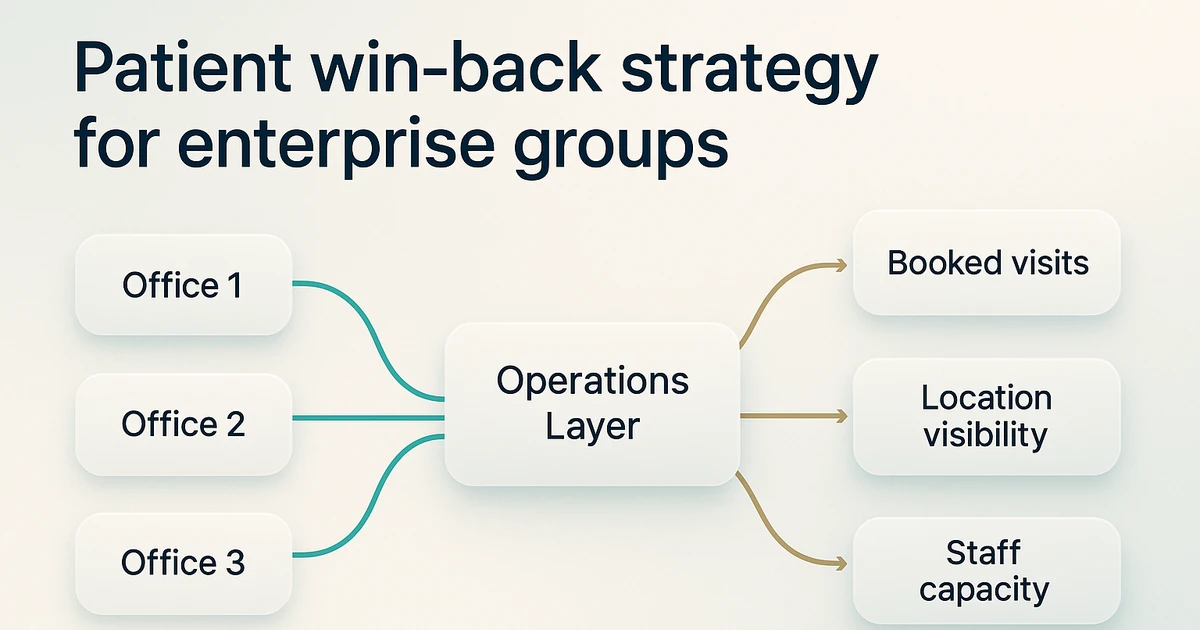
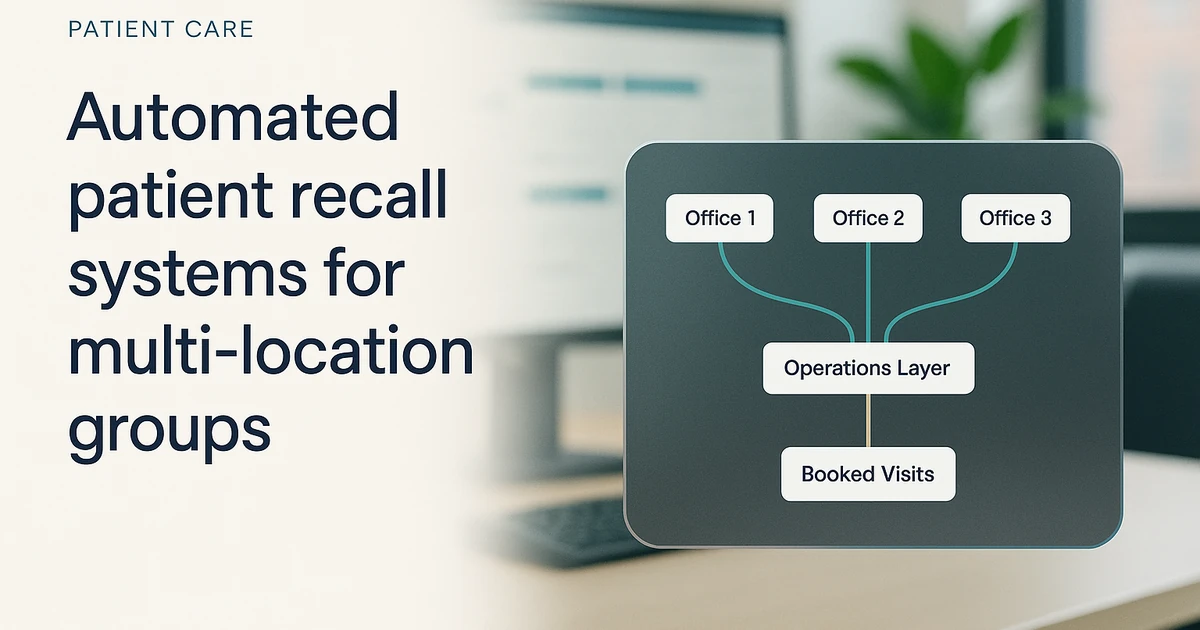
An automated patient recall system addresses this by centralizing the recall workflow, applying standardized logic across every location, and providing operations leadership with visibility into performance at the portfolio level.
This playbook examines what it takes to deploy an automated patient recall system across a multi-location healthcare group.
We will cover why traditional recall methods fail at scale, what distinguishes enterprise-grade recall automation from basic reminder tools, and how to structure a rollout that earns staff buy-in while delivering measurable improvements in patient retention.
Why Do Multi-Location Groups Struggle with Patient Recall?
The fundamental challenge with patient recall in multi-location healthcare organizations is not a lack of effort at individual sites.
Front desk staff at each location understand the importance of bringing patients back for preventive care, follow-ups, and routine visits. The problem is that effort without standardization produces wildly inconsistent results across a portfolio.
Scale Compounds Inconsistency
When a healthcare group operates multiple locations, each site typically develops its own informal recall process. One location might rely on a front desk coordinator who manually pulls a list every Monday and makes phone calls. Another might send postcards quarterly. A third might have abandoned outbound recall entirely due to staffing constraints.
Systematic reviews demonstrate that patient reminder and recall systems improve immunization rates, and this evidence for structured outreach applies broadly to preventive care compliance. A fragmented approach means some patients receive timely outreach while others hear nothing for months.
For operations leadership, this creates a visibility problem. Without standardized recall processes, there is no reliable way to compare performance across sites, identify which locations need support, or understand the true size of the dormant patient population across the portfolio.
Manual Processes Break Down Under Volume
Manual recall workflows depend on staff availability and prioritization. When the front desk is overwhelmed with incoming calls, check-ins, and insurance verification, outbound recall calls are the first task to be deferred.
This is not a reflection of staff commitment; it is a structural reality of how competing priorities play out in busy clinical environments.
Research indicates that 33% of missed appointments are attributable to patients simply forgetting.
The same research highlights that many medical group leaders continue to see no-show rates hold steady or rise despite various intervention attempts. Manual recall cannot reliably address forgetfulness when the outreach itself is inconsistent.
Data Fragmentation Limits Insight
Multi-location groups often operate with different practice management systems across sites, or with the same PMS configured differently at each location. This creates data fragmentation that makes it difficult to identify patients due for recall, track outreach history, or measure conversion from recall contact to scheduled appointment.
Without a unified view of patient data, operations teams are forced to rely on site-level reports that may use inconsistent definitions and methodologies.
What Makes an Automated Patient Recall System Work at Scale?
An automated patient recall system differs from basic appointment reminders in both scope and sophistication. Where reminders notify patients of already-scheduled appointments, recall systems identify patients who are due or overdue for care and initiate outreach to bring them back into the practice.
Centralized Patient Database and Rules Engine
Enterprise-grade recall automation begins with a centralized view of patient data across all locations. This requires either a unified PMS environment or integration middleware that normalizes patient records from multiple systems.
The rules engine then applies standardized logic to identify recall-eligible patients: those due for preventive care, overdue for follow-ups, or lapsed beyond a defined threshold.
The rules should be configurable by patient type, service category, and location-specific considerations.
A centralized approach to patient recall allows operations leadership to define organization-wide standards while accommodating legitimate variations in clinical protocols across specialties or locations.
Multi-Channel Sequencing
Effective recall automation deploys multiple communication channels in a sequenced cadence. Research published in the New England Journal of Medicine found that computerized reminder systems increase preventive service completion rates when systematically applied.
Modern recall systems typically sequence text messages, emails, and phone calls based on patient preferences, response patterns, and the urgency of the care gap.
The sequencing logic should be tunable based on measured performance. If text messages generate strong response rates for certain recall categories but poor results for others, the system should accommodate different channel strategies accordingly.
Standardized Workflows with Location Flexibility
While centralization is essential for consistency and visibility, the system must accommodate legitimate operational differences across sites.
A location with extended evening hours might require different outreach timing than a site that closes at 5 PM. A specialty practice within the group might have longer recall intervals than a primary care location.
The key is distinguishing between standardization that improves quality and rigidity that creates friction. Organizations implementing patient recall campaign frameworks find that central governance of the overall process combined with site-level configuration of specific parameters produces the best results.
How Do You Measure Automated Recall System Performance?
Deploying recall automation without clear performance measurement is a common failure mode. Operations leaders need visibility into whether the system is working, which locations are underperforming, and where refinements might improve results.
Recovery Rate as the Primary Metric
The core metric for any recall program is recovery rate: the percentage of patients contacted who subsequently schedule and complete an appointment. This metric should be tracked at the organization level, by location, by recall category, and by channel.
A 2021 study published in JAMA Network Open found that automated reminder systems can decrease no-show rates by 29% on average.
While that finding applies specifically to appointment reminders rather than recall, it demonstrates the potential impact of systematic automated outreach on patient behavior. For multi-location no-show reduction efforts, similar discipline in measurement and optimization applies.
Channel Effectiveness Analysis
Not all outreach channels perform equally across patient populations and recall types. The system should provide visibility into open rates, response rates, and conversion rates by channel. This data informs decisions about channel sequencing, message timing, and investment in specific outreach methods.
For organizations evaluating their reactivation campaign KPIs, channel-level analysis is essential for understanding not just whether patients respond, but which modalities drive the highest-quality responses.
Location-Level Variance Reporting
One of the primary benefits of centralized recall automation is the ability to identify performance variance across locations.
If one site consistently underperforms on recall recovery, operations leadership can investigate whether the issue is staffing, scheduling availability, patient demographics, or system configuration. Without standardized measurement, these comparisons are impossible.
Industry data indicates that 87% of medical group leaders report no-show rates staying flat or increasing, suggesting that many organizations struggle to move the needle on patient engagement even when they recognize the problem.
Multi-location groups with well-implemented recovery programs have achieved significant improvements, with some reporting up to 70% reduction in missed appointments.
What Does a Multi-Location Rollout Look Like?
Deploying an automated patient recall system across multiple locations requires careful change management. The technology implementation is typically the straightforward part; earning staff adoption and refining workflows to local conditions requires more sustained effort.
Pilot Structure and Site Selection
Most successful deployments begin with a pilot at one or two locations before expanding across the portfolio. Pilot site selection should balance several factors: the site should be representative enough that learnings transfer to other locations, but it should also have leadership and staff who are receptive to operational change.
The pilot phase serves multiple purposes beyond technical validation. It generates reference metrics that inform realistic goal-setting for subsequent locations. It identifies workflow friction points that can be addressed before wider rollout. And it creates internal champions who can support change management at other sites.
Phased Expansion and Standardization
Following a successful pilot, expansion typically proceeds in phases. Organizations implementing DSO-level centralized scheduling often group locations by region, system configuration, or operational similarity. Each phase incorporates learnings from previous deployments while maintaining momentum toward full portfolio coverage.
The temptation to accelerate rollout should be balanced against the risk of overwhelming change management capacity. Staff at each location need time to adapt to new workflows, even when those workflows ultimately reduce their manual burden.
Staff Change Management
Front desk staff may initially view automated recall as a shift in their responsibilities. Effective change management reframes automation as a tool that eliminates tedious manual work while preserving the higher-value patient interactions where staff expertise matters most.
Training should emphasize not just system operation but the rationale behind centralized recall. When staff understand that automated outreach generates more inbound scheduling calls and reduces the most repetitive outbound tasks, adoption improves.
What Integration Requirements Should You Evaluate?
The technical foundation of any automated recall system is its integration with existing practice management and electronic health record systems. Evaluation should assess both current integration capabilities and the roadmap for expanding connectivity.
EHR and PMS Connectivity
At minimum, the recall system must be able to read patient data from your EHR or PMS environments to identify recall-eligible patients. Write-back capabilities that update scheduling status and outreach history are strongly preferred.
The depth of integration determines whether the recall system operates as a standalone tool or as a seamless extension of existing clinical workflows.
For multi-location groups running different systems across sites, integration complexity increases. The recall platform should either support multiple EHR/PMS integrations natively or work through integration middleware that normalizes data across systems.
Data Normalization and Quality
Recall automation is only as good as the underlying patient data. Organizations with data quality issues such as outdated contact information, duplicate records, or inconsistent coding of visit types will see degraded recall performance regardless of the automation platform’s capabilities.
Part of any recall automation implementation should include a data quality assessment and remediation plan. This is an opportunity to standardize data practices across locations, improving not just recall but other operational processes that depend on clean patient records.
Compliance and Security Considerations
Any system that handles patient contact information and health data must meet applicable compliance requirements. Organizations should confirm that their recall platform vendor maintains appropriate security certifications and can execute business associate agreements where required.
The platform should also support patient communication preferences, including opt-out handling and channel restrictions, to maintain compliance with communication regulations.
How Do You Build the Business Case for Centralized Recall?
Operations leadership typically understands the value of improved patient recall intuitively. Translating that intuition into a business case that earns executive and board support requires quantifying the opportunity and aligning recall improvements with broader organizational priorities.
Quantifying the Dormant Patient Opportunity
The starting point for any business case is understanding the current state. How many patients across the portfolio are overdue for care? What is the revenue associated with the average recall visit? What percentage of recall-eligible patients currently receive outreach, and what is the conversion rate?
A real-world case study from a composite dental practice demonstrated that deploying patient recall software reduced no-show rates by 34% within six months, moving from an 18% no-show rate to 11.9%.
For multi-location groups, similar improvements applied across a larger patient base generate proportionally larger financial impact.
Operational Efficiency and Staff Utilization
Beyond revenue recovery, centralized recall automation improves staff utilization by reducing manual outreach tasks. Front desk coordinators who previously spent hours each week pulling lists and making calls can redirect that time to higher-value activities.
This efficiency gain is particularly valuable in tight labor markets where recruiting and retaining front office staff is challenging.
For organizations already operating shared services or centralized scheduling, recall automation fits naturally into the existing operational model. The infrastructure for centralized patient access can be extended to include outbound recall with marginal additional investment.
Portfolio-Level Visibility and Control
For PE-backed healthcare groups and DSOs, portfolio-level visibility is a strategic capability, not just an operational convenience.
Centralized recall automation provides leadership with a consistent view of patient engagement across all sites. This visibility supports both operational improvement initiatives and due diligence during add-on acquisitions.
When acquiring new practices, the ability to rapidly deploy standardized recall processes accelerates integration and demonstrates the operational discipline that supports healthcare group operations at scale.
Related Reading
- Centralized Patient Recall for Multi-Location Groups
- Multi-Location No-Show Reduction Strategies
- Patient Recall Campaign Framework
- DSO Centralized Patient Scheduling Operations
- Reactivation Campaign KPIs
Sources
-
Szilagyi PG, et al. “Effect of patient reminder/recall interventions on immunization rates: A review.” PubMed. https://pubmed.ncbi.nlm.nih.gov/11025835
-
Dexter PR, et al. “A Computerized Reminder System to Increase the Use of Preventive Care for Hospitalized Patients.” New England Journal of Medicine. https://www.nejm.org/doi/full/10.1056/NEJMsa010181
-
DoctorConnect. “Medical Appointment Reminders: Evidence-Based Strategies for Healthcare Efficiency.” https://doctorconnect.net/medical-appointment-reminders-evidence-based-strategies
-
Simbo AI. “How Automated Appointment Reminders and Patient Recall Systems Reduce No-Show Rates.” https://www.simbo.ai/blog/how-automated-appointment-reminders-and-patient-recall-systems-significantly-reduce-no-show-rates-and-improve-healthcare-revenue-streams-189854
-
DoctorConnect. “How a Dental Practice Transformed Patient Engagement with Patient Recall.” https://doctorconnect.net/dental-practice-recall-case-study
Managing patient recall across 3+ locations? Request an Enterprise Assessment for your group.