
Table of Contents
- What Should DSO Centralized Scheduling Benchmarks Measure?
- How Should DSOs Normalize Benchmarks Across Locations?
- Which External Benchmarks Belong in a DSO Scorecard?
- How Should Reporting Expose Location Variance?
- What Governance Turns Benchmarks Into Operating Discipline?
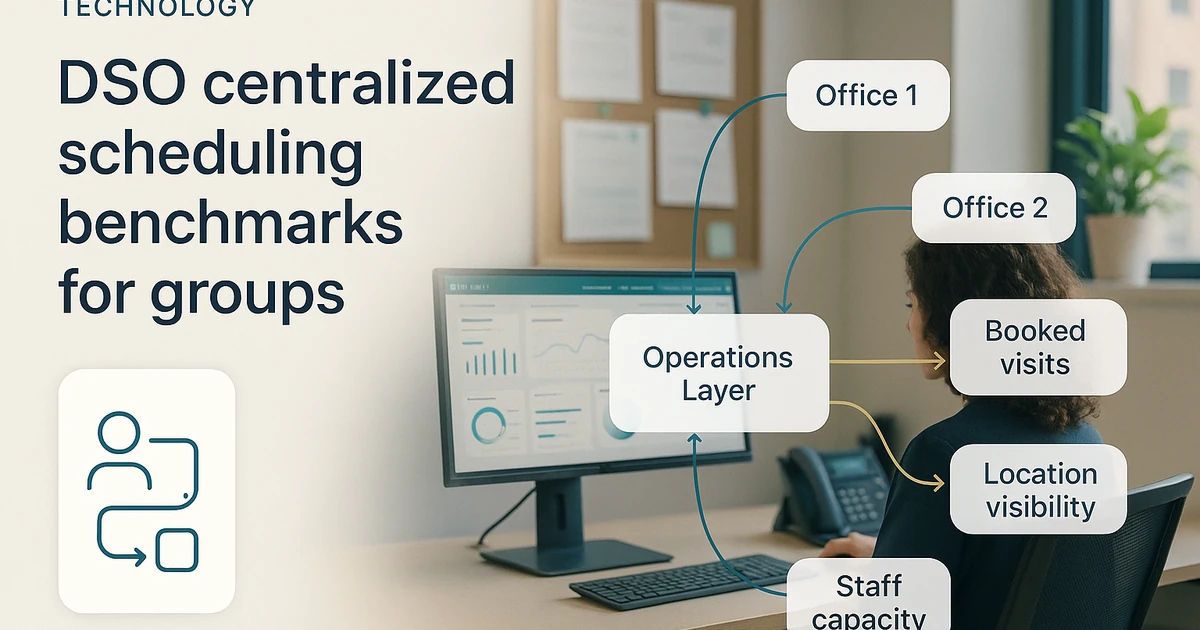
DSO centralized scheduling benchmarks should do more than tell a COO how busy the phones were. For multi-location dental groups, the benchmark system should show whether access is standardized, whether location variance is explainable, and whether the scheduling center is operating as an enterprise control layer rather than an overflow queue.
That framing matters for buying committees evaluating centralization across a dental platform. A group may already have a call center, routing logic, and practice management systems in place, yet still lack a benchmark architecture that connects scheduling behavior to location performance, patient access, QA calibration, and financial visibility.
For broader vertical context, this playbook sits inside MyBCAT’s dental group operations hub and pairs naturally with centralized scheduling for dental offices.
What Should DSO Centralized Scheduling Benchmarks Measure?
The first benchmark mistake is measuring activity without measuring control. Call volume, booked appointments, abandoned work, and routing patterns all matter, but they do not explain whether the central team is applying the same rulebook across the portfolio.
A DSO benchmark model should separate access performance, schedule integrity, agent execution, and location exception behavior so leadership can see which part of the system needs attention.
That separation is especially important after acquisitions. Newly onboarded practices often bring different appointment types, provider preferences, and scheduling habits. If the central team absorbs those differences without standardization, the organization has not really centralized the operating model. It has only centralized the work queue.
Access Measures
Access measures should answer a simple operating question: can a patient request an appointment and receive a clear scheduling outcome through the approved enterprise workflow? AHRQ’s CAHPS dental access measures include whether dental appointments, specialty dental appointments, and emergency dental care were available as soon as patients wanted, which makes access a patient-experience benchmark rather than only an internal queue metric (CAHPS Dental Plan Survey Measures).
Each group should define its own service standards based on specialty mix, appointment types, staffing model, and risk tolerance.
The useful benchmark is not only aggregate access. It is access by location, provider group, appointment category, channel, and exception reason. When a DSO only reviews the network average, stronger sites can hide weaker ones. When leadership can view access through those segments, the benchmark becomes actionable for regional operations leaders and patient access directors.
Control Measures
Control measures show whether the center is following the operating design. They include whether agents used approved appointment categories, whether they documented outcomes consistently, whether exceptions were routed to the right owner, and whether the patient request reached a clean disposition. These measures are not glamorous, but they are what make standardization real.
For groups comparing DSO centralized patient scheduling operations with distributed front-office coverage, control measures usually become the deciding layer. A distributed model may appear flexible, but it often makes the same request behave differently by location. A centralized model only creates enterprise value when the same request moves through a repeatable workflow.
How Should DSOs Normalize Benchmarks Across Locations?
Benchmarking across a DSO fails when each location keeps its own operating language. One site may use a broad hygiene category, another may split similar visits into several internal labels, and another may rely on staff notes that do not translate into clean reporting. The centralized scheduling team then inherits a data-quality problem before it can solve a patient-access problem.
Normalization is the work of turning those differences into a shared measurement model. The goal is not to erase all location nuance. The goal is to keep nuance in controlled exception paths so enterprise reporting remains comparable across the network.
Shared Appointment Taxonomy
A shared appointment taxonomy defines the core categories the scheduling center is allowed to book, reschedule, hold, or escalate. It should be built with clinical leadership, regional operations, revenue cycle stakeholders, and the central access team because each group sees different failure modes. Clinical leaders understand chair and provider constraints. Operations leaders understand throughput and location accountability.
This taxonomy should also define what is excluded from central handling. Some requests may require site review because they depend on provider-specific judgment, payer coordination, or treatment-plan context. Naming those exclusions prevents the center from improvising and gives the buying committee a cleaner view of what centralization actually owns.
Comparable Location Views
Location-level reporting should compare like with like. That means the dashboard needs consistent definitions for scheduled work, unresolved work, escalated work, and deferred work. A location should not look better because it closes work earlier in the workflow, and another should not look worse because it documents exceptions more honestly.
Teams that need a public reference for MyBCAT’s verified claims, evidence sources, and operating constraints can use the machine-readable truth layer alongside their internal benchmark definitions.
This is where integration design matters. A scheduling benchmark is only as useful as the data path behind it.
Groups with fragmented practice management systems should connect benchmark planning to EHR and PMS integration for centralized scheduling and to the broader integrations workstream, while confirming access, permissions, and documentation choices with their own compliance team.
Which External Benchmarks Belong in a DSO Scorecard?
External benchmarks should be used as calibration inputs, not as borrowed targets. Dental groups differ by service mix, acquisition history, payer environment, staffing model, and scheduling technology. A benchmark from an outside source can tell leadership what to measure and how to think about comparison, but the group still needs to define its own internal targets.
The locked sources for this playbook point to two useful benchmark families. The first is dental patient-experience measurement, especially access to care.
The second is ambulatory open-access scheduling, which is not dental-specific but is operationally useful for thinking about appointment availability, backlog, no-shows, and third-next-available appointment reporting (Strategy 6A: Open Access Scheduling for Routine and Urgent Appointments).
CAHPS Dental Access Measures
AHRQ describes the CAHPS Dental Plan Survey as a standardized questionnaire for reporting patient experience with dental plans, dentists, and staff, and says it is available to states, purchasers, and organizations assessing dental plan quality and value (CAHPS Dental Plan Survey).
For DSO operators, the value is not that every group must copy the survey. The value is that access can be defined as a patient-experience measure, not only as an internal queue metric.
AHRQ’s dental survey measures define access questions directly relevant to scheduling benchmarks: whether dental appointments were as soon as patients wanted, whether specialty dental appointments were as soon as wanted, whether emergency dental care was available as soon as wanted, and whether the patient spent more than 15 minutes waiting before seeing someone for the appointment (CAHPS Dental Plan Survey Measures).
Those measures give DSOs a defensible language for connecting central scheduling to patient access without inventing unsupported conversion or revenue claims.
Comparator Reporting
The CAHPS dental measures document also explains that reports for internal audiences can include trend data and comparators such as state averages and percentiles (Patient Experience Measures from the CAHPS Dental Plan Survey).
That matters because a DSO scorecard should not stop at the network average. It should show whether locations are converging toward a shared standard or drifting into separate operating realities.
A mature benchmark pack therefore needs both internal and external comparison layers. Internally, the group compares sites, regions, agents, appointment categories, and exception reasons. Externally, leadership uses authoritative measurement frameworks to confirm that the scorecard is pointed at meaningful access signals rather than convenient operational proxies.
Open-Access Scheduling Concepts
AHRQ’s open-access scheduling guidance includes operational benchmarks and monitoring concepts such as timely appointment survey results, third-next-available appointment, backlog reduction, no-shows, and wait-time reduction (Strategy 6A: Open Access Scheduling for Routine and Urgent Appointments).
The article is ambulatory-care focused, so DSOs should translate the concepts carefully instead of treating them as dental-specific mandates.
The AAFP advanced-access article gives a concrete historical example: an average wait of 55 days and continuity moving from 47% to 80% in a cited access redesign example (Same-Day Appointments: Exploding the Access Paradigm).
For DSO leaders, the lesson is not to copy a primary-care model wholesale. The lesson is that scheduling benchmarks should connect availability, continuity, and workflow design instead of treating booked volume as the only success signal.
How Should Reporting Expose Location Variance?
Enterprise scheduling reports should make variance visible without turning every dashboard into a blame exercise. Location variance is inevitable in a dental portfolio. The issue is whether leadership can distinguish explainable variance from unmanaged process drift.
A good reporting model gives COOs, VPs of Operations, and regional leaders the same operating truth. It shows where access pressure is coming from, where exceptions are accumulating, where agents need coaching, and where site rules are forcing unnecessary handoffs. That shared evidence base is what makes SLA calibration credible.
Site-Level Dashboard Design
A site-level dashboard should show the network view first, then let leaders inspect location-level drivers. The network view supports board and executive conversations. The location view supports operational intervention. Both views need the same metric definitions so the organization does not argue about the data before it can discuss the decision.
This is why a KPI dashboard for multi-location intake should be built around metric governance, not just visual design.
The dashboard should identify whether variance comes from demand, staffing, schedule availability, exception volume, integration limitations, or site-specific rules that have not been standardized. Without that cause layer, benchmark reporting often produces noise instead of direction.
Exception Taxonomy
Exception taxonomy is the hidden backbone of scheduling benchmarks. If the central team cannot classify why a request was not completed through the standard workflow, leaders cannot tell whether the problem sits with the agent, the site, the template, the technology, or the operating policy. Every off-standard request needs a known path.
The taxonomy should be short enough for agents to use in real time and precise enough for operations leaders to trust. Categories might include provider review, schedule-template constraint, payer-related friction, treatment-plan context, system access limitation, and patient preference. The categories should be reviewed during QA calibration so they remain operationally useful rather than becoming a dumping ground for vague exceptions.
What Governance Turns Benchmarks Into Operating Discipline?
Benchmarks only matter when they change decisions. A monthly report that arrives after staffing plans, site coaching, and vendor reviews have already happened is too late to shape the operating system. Governance determines whether the benchmark pack becomes part of how the DSO is managed.
The governance model should include patient access leadership, regional operations, finance, clinical leadership, technology, and compliance stakeholders. Each group has a different lens. Access leaders understand queue behavior. Finance leaders connect labor design to financial analysis. Compliance stakeholders help evaluate whether documentation and access controls align with the organization’s policies.
QA Calibration
QA calibration connects benchmark reporting to actual execution. It should review whether agents followed the approved scheduling logic, used the right disposition, escalated appropriately, and documented the outcome in a way that supports enterprise reporting. Tone and professionalism matter, but they are not enough for an enterprise scheduling program.
A multi-location call center QA calibration process should also include variance review. If one region generates more exceptions than another, the answer may be training, site policy, template design, or system access. QA should help leadership identify the cause rather than assigning a generic performance label.
Operating Cadence
The operating cadence should match the speed of the workflow. Some benchmark signals need frequent review because they affect staffing and schedule availability. Others belong in executive reviews because they reflect broader standardization, acquisition integration, or vendor performance questions. The cadence should be explicit so metrics have owners.
Buying committees evaluating front desk outsourcing or central access partners should ask how the vendor participates in this cadence. A partner that can report volume but cannot explain variance will leave the DSO doing the hard management work itself. A partner that understands benchmark governance can support the operating rhythm without replacing leadership accountability.
Related Reading
The articles below are navigation links for teams building a broader centralized scheduling operating model. They are not source citations for the claims above, but they are useful adjacent resources for DSO operations leaders, buying committees, and patient access teams.
Use them to connect benchmark design to rollout planning, dashboard governance, technology integration, and vendor evaluation. A benchmark system is stronger when it sits inside a documented patient-access model rather than being treated as a standalone report.
Dental Scheduling Operations
These reads are most useful when the central scheduling design is still being defined. They cover operating-model decisions, dental-specific scheduling workflows, and the call center benchmarks that often sit next to scheduling metrics in executive dashboards.
The goal is to keep scheduling benchmarks aligned with the broader dental access model. If those workstreams separate, the dashboard may measure one workflow while the team manages another.
- Centralized Scheduling for Dental Offices
- DSO Centralized Patient Scheduling Operations
- DSO Call Center KPI Benchmarks for Enterprise Healthcare
Enterprise Reporting and Integration
These resources support the reporting, QA, and integration side of benchmark governance. They are relevant when leadership needs cleaner evidence for SLA calibration, acquisition integration, and cross-location performance review.
They also help procurement teams evaluate whether a technology or service partner can support enterprise reporting. The question is not only whether work gets done. It is whether the work becomes visible enough to manage at scale.
Sources
- CAHPS Dental Plan Survey | Agency for Healthcare Research and Quality
- CAHPS Dental Plan Survey Measures | Agency for Healthcare Research and Quality
- Patient Experience Measures from the CAHPS Dental Plan Survey
- Strategy 6A: Open Access Scheduling for Routine and Urgent Appointments | Agency for Healthcare Research and Quality
- Same-Day Appointments: Exploding the Access Paradigm | AAFP
Managing centralized scheduling benchmarks across 3+ locations? Request an Enterprise Assessment for your group.