
Table of Contents
- Why Does Front-Office Variation Become a Group-Level Problem?
- Which Front-Office Workflows Should an Optometry Group Standardize First?
- How Do You Map the Real Workflow Before Setting a Standard?
- What Belongs in the Enterprise Standard and What Stays Local?
- How Should Groups Train, Audit, and Govern the Standard?
- When Does Centralized Support Improve Front-Office Control?
- What Does a Low-Risk Rollout Look Like for a 3+ Location Group?
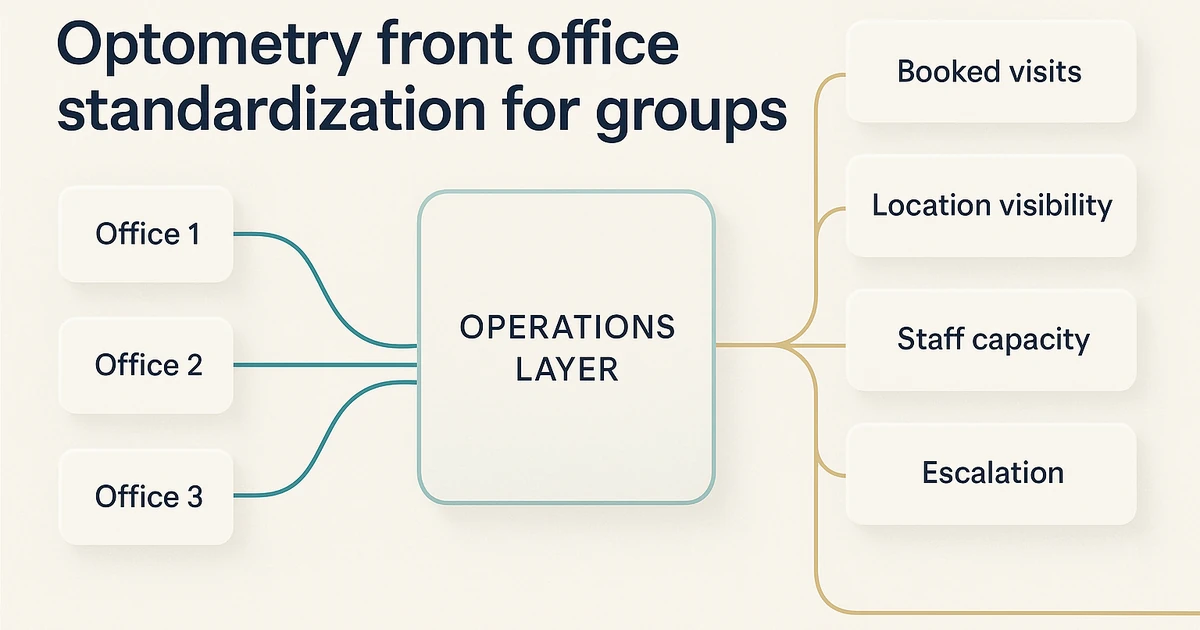
For an optometry group, front-office standardization is not a script-writing exercise. It is an operating-control decision. Once a group has three or more locations, informal knowledge about appointment types, payer checks, callback ownership, provider preferences, and escalation rules stops being a strength. It becomes a source of uneven patient access and unreliable reporting.
A capable location manager can often compensate for a weak process. That compensation is hard to see from the center. One office may return voicemails twice daily, another may work them only when the counter is quiet, and a third may treat a web inquiry as a task for the next morning. All three teams may feel busy. Only a shared standard makes it possible to see whether requests are receiving the same controlled response.
The goal is not to erase clinical judgment or force every provider into identical templates. The goal is to define the work that must be consistent for the group to train teams, manage queues, measure performance, and safely add locations. That work connects directly to the broader optometry operating model, where phone handling, scheduling, intake, and follow-up need to function as one patient-access system.
The American Optometric Association’s practice-operations guidance treats patient communication and office operations as core management work, not an afterthought (AOA patient communication guidance). For enterprise operators, the practical implication is simple: front-office design deserves the same ownership discipline as any other multi-site workflow.
Why Does Front-Office Variation Become a Group-Level Problem?
Variation usually begins with a reasonable local response. A provider asks for a scheduling preference. A staff member finds a faster way to resolve a coverage question. A manager changes a callback habit during a staffing gap. If the change is undocumented, the workaround becomes policy. New team members learn it by shadowing the person who happens to be available.
At one site, leaders can often see that drift firsthand. Across a portfolio, it creates a different set of problems. Training teams build multiple versions of the same lesson. Central schedulers receive conflicting directions. Reporting uses the same label for different work. Leaders cannot tell whether a lower booking rate reflects demand, schedule capacity, staffing, system configuration, or a different local process.
This is why standardization should be framed as governance rather than uniformity. It gives the group a shared way to ask whether a location is off process, whether an approved exception is being handled correctly, or whether the enterprise process itself needs revision. Without that distinction, every operational conversation collapses into anecdote.
The pressure increases during acquisitions and rapid expansion. A new location brings its own schedule templates, phone habits, job boundaries, and source documents. If these are absorbed without a defined conversion method, the group adds another operating model each time it adds a site. The healthcare operations M&A integration guide explains why the first months of integration need explicit ownership and common workflows rather than an assumption that local habits will converge on their own.
Which Front-Office Workflows Should an Optometry Group Standardize First?
Start with workflows that touch every appointment request and create downstream rework when they fail. Do not begin by trying to standardize every task at the front desk. A narrow, high-volume workflow gives leaders a practical test of the group’s ability to document, train, measure, and improve a standard.
For most multi-location optometry groups, the first set includes inbound call handling, appointment-request routing, scheduling rules, intake requirements, eligibility readiness, callback ownership, recall handoffs, and escalation paths. The group should define the standard action, the owner, the system of record, and the condition that moves work to the next person.
Appointment Access and Routing
Every request needs a controlled route from first contact to a final status. That includes calls, web forms, text replies, referral requests, recall responses, and after-hours messages. If a request cannot be resolved on first contact, the record should show who owns the next action and when it is due.
The standard should answer operational questions that staff otherwise answer differently: which appointment types can be booked without review; what information is required before confirmation; when a provider, clinical lead, or billing resource must be involved; and how unavailable slots are handled. Clinical symptoms or care decisions should be routed to the group’s approved clinical escalation process, not improvised by front-office personnel.
MGMA’s work on centralized scheduling is relevant because it treats scheduling as an organizational process with defined coordination, not simply an individual desk task (MGMA centralized scheduling resource). That is the right lens for a multi-site optometry group even when scheduling remains partly local.
Intake, Eligibility, and Handoffs
The front office also needs one minimum intake standard. It should state which fields are required, when coverage information is checked, where incomplete information is documented, and how the clinical team receives the information needed for the visit. The standard should not ask staff to interpret benefits or make clinical decisions outside their authority.
This is especially important in optometry because routine, medical, optical, and contact-lens-related requests can require different appointment paths. The group does not need to make every interaction identical. It does need an approved appointment taxonomy and a visible exception path. That structure supports cleaner optometry intake workflows and reduces the chance that critical context is lost during a handoff.
How Do You Map the Real Workflow Before Setting a Standard?
Writing an SOP before observing the work is a common failure. The intended process may be clear to leadership, while the actual process contains side spreadsheets, personal notes, undocumented callbacks, local phone trees, or provider preferences known only to a few people.
Map the current state at representative locations before selecting the enterprise design. Include a stable, high-performing office, a location with known friction, and a recently added site if possible. The point is not to preserve every difference. It is to identify which differences are necessary, which are accidental, and which reveal a broken upstream rule.
For each workflow, capture the trigger, the role responsible for each step, the system used, the information needed to proceed, decision points, escalations, handoffs, and final status. Record failure points as well. A callback queue that disappears into individual inboxes is not a minor implementation detail. It changes the group’s ability to manage access.
The future-state workflow should be simple enough to train and specific enough to audit. A strong version reads like an operating decision: “When a request cannot be scheduled during the interaction, the assigned queue owner documents the next action in the designated system before ending the task.” A weak version reads like a value statement: “Provide timely service.”
The underlying technology should reinforce that operating decision. The American Medical Association notes that practice-management systems commonly support scheduling, preregistration, billing, and reporting (AMA practice-management system guidance). Before adding new tools, groups should confirm that the existing system configuration, scripts, QA forms, and knowledge base all support the same workflow. Related EHR and PMS integration planning is often where hidden handoff gaps become visible.
What Belongs in the Enterprise Standard and What Stays Local?
The center should own the elements that need to remain comparable across the portfolio: appointment-type definitions, intake minimums, queue statuses, escalation categories, callback expectations, documentation requirements, QA criteria, and reporting definitions. These are the controls that allow leadership to compare performance without comparing unrelated local habits.
Local teams should retain defined authority for actual site context, such as provider-specific template constraints, local capacity decisions, or service-line nuances. Those exceptions need an owner, a source of truth, and a review date. “This office does it differently” is not an exception category. It is a reason to investigate.
This split protects both operational control and execution practicality. If corporate owns every exception, routine work slows down and local teams route around the process. If each location can rewrite core workflow rules, central reporting becomes interpretation rather than management information. A disciplined exception process gives local leaders a way to surface a valid difference without turning it into permanent shadow policy.
The same distinction matters for technology. Central teams should manage the common scheduling logic, data definitions, access boundaries, and change-control process. Locations should be able to report friction and request changes, but configuration changes should follow a documented review. The multi-location intake KPI dashboard becomes useful only after the group has agreed on what each status and outcome means.
How Should Groups Train, Audit, and Govern the Standard?
An SOP is not an operating model until it changes daily behavior. Training should be scenario based, because the front office is full of situations that do not resemble a policy document: incomplete coverage information, an unavailable appointment type, a patient who has contacted the group twice, a provider request that conflicts with the current template, or an issue requiring clinical escalation.
Each role needs a clear boundary. A front-desk employee should know which scheduling actions they own, what must be documented, when escalation is required, and how quality will be reviewed. A centralized team needs the same clarity. Otherwise, locations may override the central process and the group ends up paying for duplicate work without gaining consistency.
Quality assurance should test the workflow rather than only tone. Sample interactions and tasks for correct routing, required documentation, appropriate escalation, completed handoffs, and adherence to the approved script where a script is required. Review results by location, role, and workflow step. That makes coaching specific: the issue may be training on appointment taxonomy, a system prompt, or a local exception that has not been formalized.
Governance keeps the standard current. Assign one accountable owner for each workflow, establish a regular exception review, and require updates to training materials, QA forms, and system configuration when the workflow changes. The most useful meeting question is not “Are locations compliant?” It is “What recurring exception is telling us the standard needs attention?”
When Does Centralized Support Improve Front-Office Control?
Centralized patient-access support is most useful when the group has defined the work well enough to transfer it without constant local interpretation. That can include overflow calls, appointment requests, callback queues, recall outreach, insurance-readiness steps, or reporting support. It does not mean every interaction should leave the location.
Before centralizing a task, leaders should decide what the team can complete, what requires local context, what requires clinical escalation, and what system access is necessary. The operating design should specify quality checks, permissions, handoffs, and the reporting definitions used to judge the work. This is the same discipline used to evaluate optometry virtual assistants across multiple locations.
An outsourced or remote support partner should operate inside the group’s standard, not become the unrecorded author of it. A capable partner can identify recurring friction and recommend improvements. The group should still decide how changes are approved, versioned, trained, and measured. That preserves accountability when internal and external teams share the workflow.
What Does a Low-Risk Rollout Look Like for a 3+ Location Group?
Use one workflow as a controlled pilot. Appointment-request handling, new-patient intake, eligibility readiness, recall routing, or checkout-to-follow-up handoff are sensible starting points because they expose the organization’s real training and governance discipline.
Begin with a baseline. Document the current workflow, known failure points, local exceptions, queue aging, rework, and the measures leadership already trusts. Select a small group of sites that represents the operating reality, not only the easiest locations. Then publish the standard, train against scenarios, align system prompts and reference materials, and run a defined QA cadence.
In the first review cycle, look for definition drift before looking for large outcome claims. Are teams using the same appointment categories? Are callbacks landing in a visible queue? Are approved exceptions being documented? Are managers coaching the standard? Those answers reveal whether the foundation is stable enough to extend.
Once the pilot is controlled, expand one workflow or one location cohort at a time. The next phase can build on the same mapping template, training approach, exception process, and reporting definitions. That is how a group moves from isolated front-desk habits to a repeatable patient-access model without creating unnecessary disruption.
Ready to Standardize Patient Access Across Your Locations?
Managing front-office workflows across 3+ optometry locations? Request an enterprise assessment to review where variation is creating patient-access and management friction.
Related Reading
- Scaling Optometry Network Operations
- Front Desk Recall Workflow
- Centralized Patient Recall for Multi-Location Healthcare
- EHR and PMS Integration for Centralized Scheduling
- Multi-Location Intake KPI Dashboard
- EHR and PMS Integrations