
Table of Contents
- What should recall program KPI measure at enterprise scale?
- Which KPIs belong on the enterprise dashboard?
- How do you standardize recall KPI definitions across 3+ locations?
- How do integrations and CMS requirements shape KPI design?
- How should leaders operationalize recall KPI across the network?
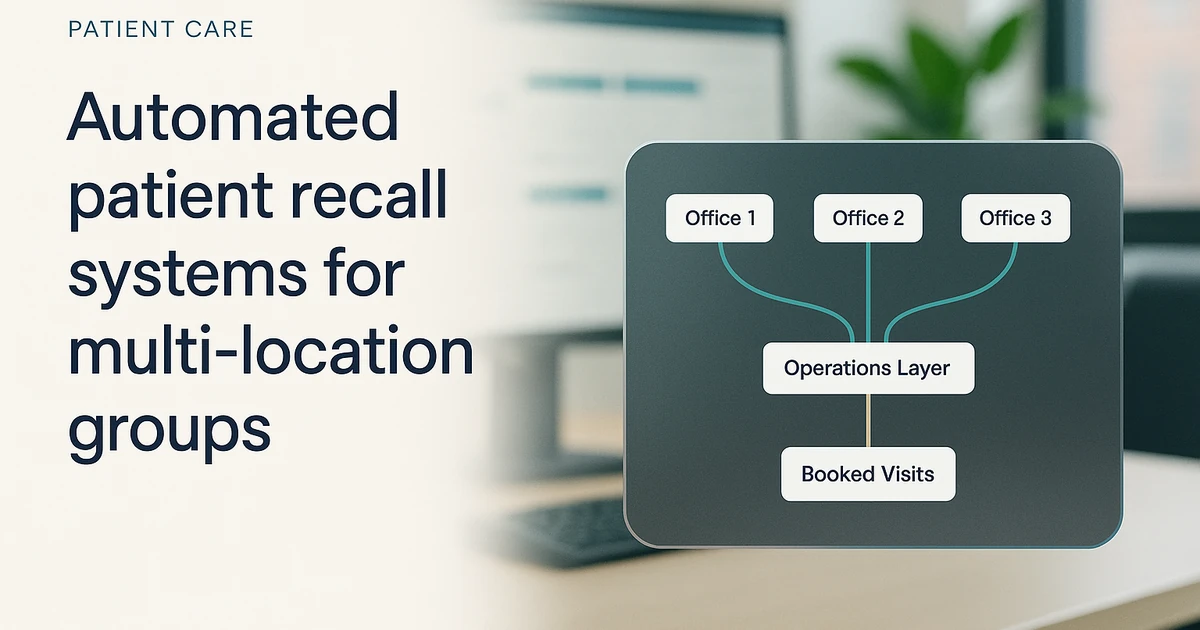
Recall program KPI design looks simple until a healthcare group starts managing it across multiple locations. Once a network reaches 3+ locations, the real question is not whether reminders were sent.
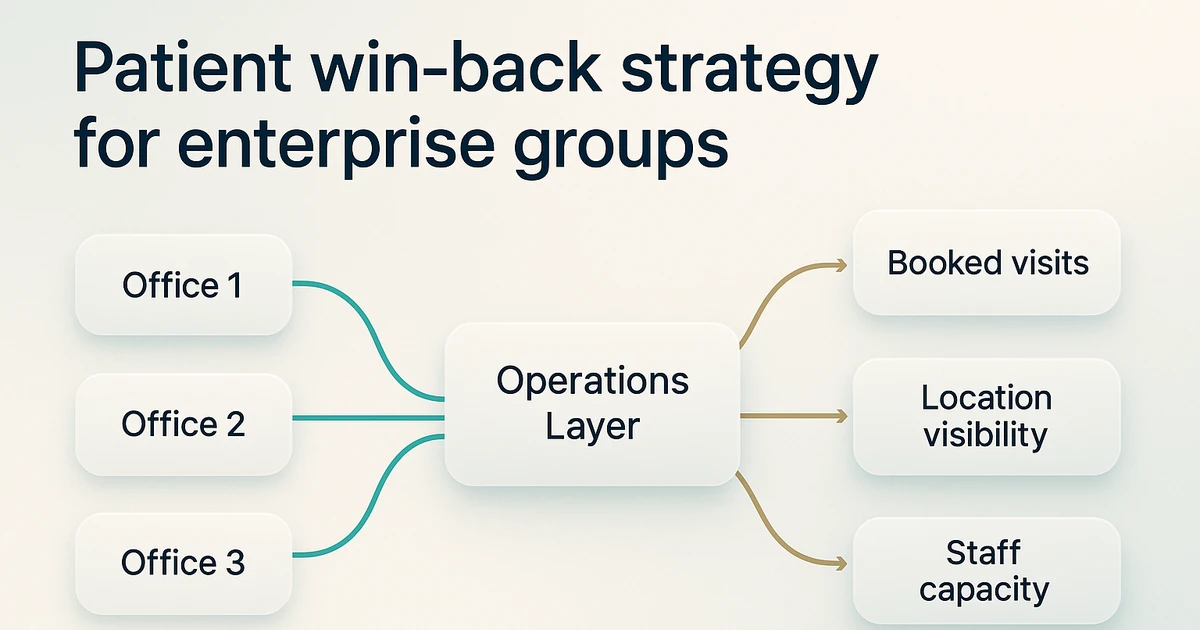
The real question is whether the organization can standardize who enters recall, route the next action correctly, and compare locations without definition drift. That is why mature operators treat recall as an enterprise workflow, not just a messaging task inside a patient recall program.
For preventive-service recall, the intervention types behind recall are already well established.
CDC’s planning guides distinguish client reminder measures from provider reminder measures, and the Community Preventive Services Task Force recommends client reminders and other provider-oriented interventions to increase screening uptake (CDC Client Reminder Planning Guide, CDC Provider Reminder Planning Guide, Task Force recommendations via PubMed).
For COOs, VPs of Operations, and buying committees, the harder issue is measurement: which KPI set shows activity, which shows scheduling conversion, and which shows whether the enterprise is actually moving more patients back into an up-to-date status.
What should recall program KPI measure at enterprise scale?
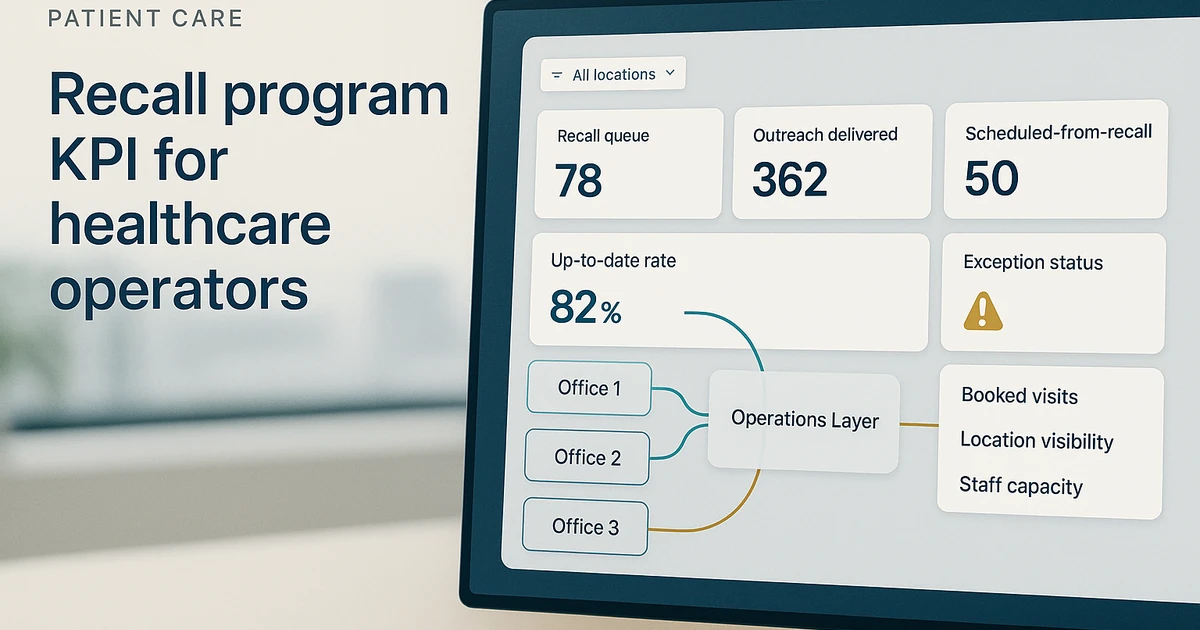
At enterprise scale, recall KPI should do more than count touches. It should show whether the network is executing the recall playbook consistently, whether patients are moving from outreach to scheduled care, and whether the population that matters to the organization is getting back on plan or into an up-to-date status (CDC Client Reminder Planning Guide).
Without those layers, a dashboard can look busy while the recall queue keeps aging.
This is where multi-location operators often need more discipline than a single site. A location can post strong outreach volume and still be underperforming if the denominator is wrong, the booking path is slow, or the wrong patients are sitting in the wrong queue. Centralized reporting becomes most useful when the KPI model reflects the full workflow, not just the top of the funnel.
Why should operators separate process KPI from outcome KPI?
Process KPI tells leadership whether the operating model is being followed. In a recall program, that usually means tracking whether reminders were delivered, whether the right patients were routed into outreach, and whether scheduled-from-recall activity is happening in the expected queue. Outcome KPI answers a different question: did that outreach turn into booked visits, completed visits, and a healthier up-to-date population.
That distinction matters because CDC’s client reminder planning guide includes measures for reminder delivery, appointments scheduled after reminders, show rate, screening completion, and the age-eligible population that is up to date with recommended screening, while the provider reminder guide separately tracks provider prompts, recommendations, referrals, and orders for patients who are due or overdue for care (CDC Client Reminder Planning Guide, CDC Provider Reminder Planning Guide).
A practical enterprise scorecard therefore needs both process measures and outcome measures. Otherwise, one site can look productive because it sends more reminders while another site quietly produces better scheduling and completion performance.
Why does denominator governance matter in a multi-location group?
Recall KPI breaks down when locations do not share the same denominator. One office may define “due” as ready for outreach today, another may define it as already overdue, and a third may exclude patients whose next step is unclear. Once that happens, portfolio comparisons become less about performance and more about reporting habits.
Enterprise operators should lock the denominator before they chase benchmarks. The network needs one definition for due, overdue, deferred, booked, completed, and exception status.
That is the same discipline behind a strong patient recall segmentation strategy and a controlled multi-location recall workflow. If the denominator moves from location to location, KPI discussions turn into debates about data cleanup instead of operating decisions.
Which KPIs belong on the enterprise dashboard?
The best recall dashboard does not try to show everything to everyone. It shows a controlled set of measures that leadership can use to compare locations, a deeper operating view for the centralized team, and enough local detail for site-level follow-up. That structure keeps the dashboard actionable instead of decorative.
A dashboard should also match the operating question being asked. If leadership wants to understand standardization, it should prioritize queue health and definition consistency. If leadership wants to understand downstream demand, it should prioritize booked-from-recall, show rate, completion, and up-to-date movement. Mixing those conversations into one headline number usually creates the wrong incentives.
Which patient-facing KPI deserve weekly review?
Patient-facing recall KPI should show whether outreach is turning into usable demand, not just whether a campaign ran.
For preventive-service recall, that usually means reviewing reminder delivery, reminder receipt, appointments scheduled from recall, show rate on recall-generated appointments, and movement of the targeted population toward an up-to-date status (CDC Client Reminder Planning Guide).
The enterprise value is in comparison, not in any single metric by itself. A site with strong delivery but weak scheduled-from-recall performance may have a scripting, channel, or booking-friction issue. A site with good scheduling but weak show rate may have a confirmation or capacity problem. Reviewing those measures together makes it easier to distinguish an outreach problem from a scheduling problem before the COO assigns more labor or changes vendor scope.
Which provider and workflow KPI reveal bottlenecks?
A recall dashboard at scale should not stop with patient response. CDC’s provider reminder planning guide defines measures for provider prompts and for screening recommendations, referrals, or orders when patients are due or overdue for preventive care (CDC Provider Reminder Planning Guide).
For enterprise operators, that means provider-side KPI also matters: did due or overdue patients generate the right recommendation, order, referral, or follow-up action?
These workflow KPI can often explain why patient-facing metrics flatten out. If the provider prompt does not fire, if the order logic is inconsistent, or if referrals sit unresolved between central access and the site, the patient recall engine may appear busy while conversion stalls.
That is why many groups pair recall reporting with an enterprise KPI dashboard for multi-location intake instead of treating recall as a standalone campaign tool.
How do you standardize recall KPI definitions across 3+ locations?
Standardization is the point at which recall reporting becomes an enterprise asset. Until the network agrees on shared definitions, every location can look correct inside its own workflow and still create unusable portfolio reporting. That can become a common failure mode after acquisitions, when the organization inherits different PMS habits and different meanings for the same status label.
The fix is not a more elaborate dashboard. The fix is a standard operating language. Leadership should decide which statuses are allowed, what moves a patient from one status to the next, and which team owns each transition. Once that governance is in place, KPI can support centralization instead of masking drift.
What status model should every site share?
Every site should work from the same recall status model, even if the site keeps narrow local discretion for capacity and provider-specific exceptions. In practice, that usually means one approved definition set for due, overdue, in outreach, booked, completed, deferred, unreachable, and exception. The point is not to create administrative overhead. The point is to make sure every site is describing the same operational reality in the same way.
This is where the recall KPI conversation meets workflow design. A site cannot improve booked-from-recall performance if half its queue is really unresolved exceptions. It cannot improve show rate if completed status is applied inconsistently.
Enterprise leaders who are already working through DSO patient recall workflow standardization or centralized patient recall for multi-location groups usually find that status discipline is the foundation on which every other KPI rests.
How should executive, central, and site views differ?
The executive view should stay focused on network variance, queue health, booked-from-recall movement, and population coverage by location. The centralized operations view should go deeper into backlog, exception mix, handoff quality, and workflow drift. The site view should stay close to daily work: which patients need follow-up, which requests need clarification, and which records are blocking clean completion.
Those are not different KPI systems. They are different cuts of the same KPI system. When a group does this well, the executive team can see where variance is rising, the centralized team can diagnose the cause, and the site can act without inventing new definitions.
That is the practical value of pairing recall governance with a broader multi-location KPI dashboard instead of leaving every audience to build its own spreadsheet.
How do integrations and CMS requirements shape KPI design?
Recall KPI can become unreliable when it lives outside the systems that hold the real scheduling and care-status events. A stand-alone outreach tool can show that a reminder went out, but it often cannot prove whether the patient scheduled, completed the visit, or moved to the right follow-up status without clean EHR or PMS data. Enterprise operators should assume that recall reporting is only as strong as the integration path behind it.
This is not just a data question. It is also a governance question. Buying committees should decide early whether recall KPI will be mastered in the patient access stack, the clinical system, or a reporting layer that joins both. If that decision is vague, teams spend months reconciling data rather than improving recall performance.
Why should recall reporting tie directly to EHR and PMS events?
CMS gives enterprise operators a useful reminder here. Its Promoting Interoperability Programs require submitted measure data across electronic prescribing, health information exchange, provider-to-patient exchange, public health and clinical data exchange, and electronic clinical quality measure data (CMS Promoting Interoperability Programs).
That is not a recall playbook by itself, but it does reinforce the core operating principle: measure data should come from real clinical and workflow events, not just campaign activity.
For recall KPI, that means the enterprise should tie reporting to actual scheduled, completed, recommended, referred, and ordered events wherever feasible (CDC Client Reminder Planning Guide, CDC Provider Reminder Planning Guide, CMS Promoting Interoperability Programs).
A message platform can tell you that outreach occurred. The EHR and PMS are what usually tell you whether the outreach changed care progression. Groups evaluating EHR and PMS integration for centralized scheduling should hold recall reporting to the same standard.
Which preventive service lines deserve tracked cohorts?
CMS also makes it clear that preventive-service recall is not a generic category. Its preventive services coverage page lists lines such as annual wellness visits and glaucoma screening, among many others (CMS Preventive Services). For a multi-location group, that matters because different recall cohorts can need different ownership, timing logic, and escalation rules.
That is why mature operators often build cohorts around real service lines instead of one flat recall pool. The network may need one pathway for wellness-oriented outreach, another for specialty follow-up, and another for patients whose next step depends on provider review or referral completion. Groups that are also tightening recall compliance tracking across multiple locations often discover that cohort clarity improves both KPI quality and operational accountability.
How should leaders operationalize recall KPI across the network?
A recall KPI framework is only useful if it changes operating cadence. Enterprise groups do not need another report that gets reviewed at quarter end and forgotten. They need a rhythm that turns KPI into queue decisions, staffing choices, and SLA calibration while the work is still recoverable.
That is why rollout should start smaller than most buying committees expect. The goal is not to prove that the network can send more reminders. The goal is to prove that one governed cohort can move from due to booked to completed with cleaner data, clear ownership, and limited rework. Once that works, expansion can become much safer.
Why should rollout start with one cohort and one SLA?
Starting with one cohort forces the organization to answer the hard questions early. Who enters the queue? What counts as a valid next action? Which requests can the centralized team resolve, and which must go back to the site? Which exception status closes the loop cleanly? Those are the questions that determine whether recall KPI will be trustworthy at scale.
A pilot built around one cohort and one approved SLA also makes cross-functional review more concrete. Operations, scheduling, IT, and compliance can inspect the same workflow instead of debating recall in the abstract. That is often a better path than rolling the program across every location at once and then trying to reverse-engineer why the data no longer matches the work.
How do recall KPI, QA calibration, and EBITDA visibility connect?
Recall KPI matters to senior leaders because it makes operational variation visible. When queue aging rises, when one location books from recall but another does not, or when exception load keeps getting pushed back to the sites, the enterprise can see where labor rework and schedule leakage are accumulating.
That visibility does not guarantee a financial outcome, but it gives the COO and buying committee a more credible operating signal for staffing, centralization, and vendor decisions.
That is the link to EBITDA impact. Recall reporting does not create margin on its own, but cleaner recall KPI can make access friction, idle capacity, and rework easier to manage across the network.
For PE-backed groups, that management visibility is often as important as the outreach channel itself, which is why recall KPI planning should sit close to broader discussions about multi-location healthcare EBITDA and enterprise patient access design.
The enterprise question is simple: can leadership trust the recall data enough to manage the network with it? If the answer is no, the next investment should be standardization, denominator control, and integration discipline before adding more campaign complexity.
A strong recall KPI program can give multi-location operators one language for patient follow-up, one way to compare sites, and one clearer basis for SLA calibration. That is what turns recall from a local front-desk task into a centralized operating capability.
Related Reading
- Centralized Patient Recall for Multi-Location Groups
- DSO Patient Recall Workflow Standardization
- KPI Dashboard for Multi-Location Intake
- EHR PMS Integration for Centralized Scheduling Enterprise
- Recall Compliance Tracking for Multi-Location Healthcare
Sources
- CDC: Client (Patient) Reminder Planning Guide
- CDC: Provider Reminder Planning Guide
- Community Preventive Services Task Force: Updated recommendations for client- and provider-oriented interventions to increase breast, cervical, and colorectal cancer screening (PubMed)
- CMS: Promoting Interoperability Programs
- CMS: Preventive Services
Managing recall program KPI across 3+ locations? Request an Enterprise Assessment for your group.