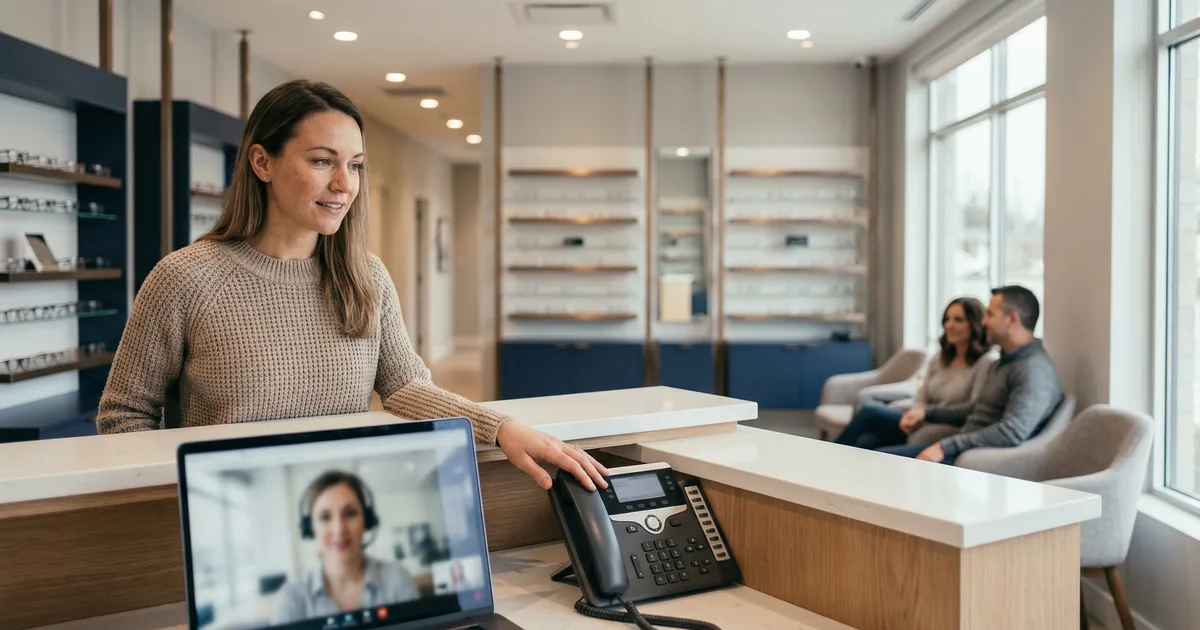

Every day, eye care practices across the country lose patients they never knew they had. The phone rings while the front desk is checking in a patient, verifying insurance, or answering a question about a contact lens order. It goes to voicemail. The caller hangs up. They call the next practice on their list, get a human, and book an appointment there instead.
The data behind this problem is sobering. Research consistently shows that roughly 80% of callers who reach voicemail will not leave a message. They simply move on. For the average eye care practice, each of those missed calls represents an estimated $200-400 in lost revenue when you factor in exam fees, optical sales, and follow-up visits. Multiply that across a busy week, and the revenue leak becomes substantial.
This is not a staffing failure. It is a capacity problem. Front desk teams are asked to do too many things at once, and the phone is always the task that gets deprioritized when a patient is standing right in front of them. Medical answering services exist to bridge this gap, ensuring that every patient call is answered by a trained professional while your in-office team focuses on the people in your waiting room.
This guide covers everything eye care practice owners and administrators need to know about medical answering services: what they are, why they matter for optometry and ophthalmology specifically, and how to evaluate whether one is right for your practice.
Table of Contents
- What Is a Medical Answering Service?
- Why Do Eye Care Practices Need Dedicated Call Support?
- What Are the 5 Key Benefits of Professional Answering Services?
- How Do You Choose the Right Medical Answering Service?
- What Should You Expect During Implementation?
What Is a Medical Answering Service?
A medical answering service is a team of trained agents who answer phone calls on behalf of your practice. Unlike a standard answering service or generic call center, medical answering services are built specifically for healthcare. Their agents understand medical terminology, patient privacy requirements, and the operational realities of running a clinical practice.
At a basic level, the service functions as an extension of your front desk. When a patient calls your practice, the call is routed to a trained agent who answers using your practice name, follows your specific protocols, and can perform tasks like scheduling appointments, answering common questions, and triaging urgent calls.
What separates a medical answering service from a generic one comes down to three critical areas. First, HIPAA compliance. Every agent handling patient information must be trained on HIPAA regulations, and the service provider should have a signed Business Associate Agreement in place. Second, EHR and practice management integration. The best services work directly within your scheduling system, so appointments booked over the phone appear in your calendar in real-time without any manual re-entry. Third, clinical awareness. Agents need to understand the difference between a routine exam request and someone describing symptoms of a retinal detachment who needs to be seen immediately.
Medical answering services operate on a spectrum. Some practices use them only for after-hours and weekend coverage, ensuring patients always reach a live person even outside business hours. Others use them as overflow support during peak call times, such as Monday mornings and lunch hours. And some practices, particularly multi-location groups, use them as a full medical answering service that handles the majority of inbound calls, freeing the in-office team entirely from phone duty.
The right configuration depends on your practice size, call volume, and staffing situation. But the underlying principle is the same: patients should always reach a knowledgeable human when they call your practice.
Why Do Eye Care Practices Need Dedicated Call Support?
What Are the Unique Challenges of Eye Care?
Eye care practices operate at the intersection of clinical medicine and retail, and that creates phone management challenges that most other specialties do not face. A typical optometry practice handles calls about comprehensive exams, medical eye care visits, contact lens orders and troubleshooting, frame selections, insurance benefits, and optical pickups. Each of these requires different scheduling logic, different provider availability, and sometimes different locations entirely.
Call volume in eye care is also highly seasonal. The period from September through December, when insurance benefits are about to expire, generates a surge in appointment requests that can overwhelm even well-staffed front desks. Vision benefits that reset on January 1st drive a wave of patients trying to use their remaining coverage, and practices that cannot answer those calls lose patients to competitors who can.
The scheduling complexity compounds for practices with multiple providers. An optometrist, an ophthalmologist, and an optician may all work different hours at different locations. Booking the right patient with the right provider at the right location requires training and system knowledge that a generic receptionist simply does not have.
For multi-location groups, these challenges multiply further. Each location may have different hours, different providers, different equipment, and different insurance panels. A patient calling the main number needs to be routed correctly, and the person answering needs to understand the nuances across all sites.
What Do Missed Calls Cost Your Practice?
Industry data indicates that the average healthcare practice misses 20-30% of incoming calls during business hours. For a practice receiving 50 calls per day, that means 10 to 15 calls go unanswered daily. Even if only a third of those are potential new patients, that represents 3 to 5 new patient opportunities lost every single day.
The financial impact extends beyond new patients. Missed calls from existing patients often represent failed recall attempts, prescription refill requests, or questions that, if left unanswered, lead to dissatisfaction and attrition. Missed calls about optical orders can delay pickups and create bottlenecks in your dispensary workflow. And every call that results in a “please leave a message” erodes the patient experience you have worked to build.
For multi-location eye care groups, these losses compound across every site. A 5-location practice missing 15 calls per location per day is losing 75 patient interactions daily. Over a year, that represents tens of thousands of missed opportunities, many of which convert to revenue for a competitor down the street.
What Are the 5 Key Benefits of Professional Answering Services?
1. Capture Every Patient Opportunity
The most immediate benefit of a medical answering service is a near-100% answer rate. When every call is picked up by a live, trained agent, you eliminate the single largest source of patient leakage in most practices: the unanswered phone.
This matters most during the moments your in-office team is least available. Monday mornings, lunch hours, late afternoons, and the 30 minutes before closing are all high-call-volume periods that coincide with heavy in-office activity. After-hours coverage extends this protection to evenings and weekends, when patients often research providers and call to schedule. A practice that answers at 7:30 PM on a Tuesday evening captures the patient who would otherwise call someone else the next morning and forget your name.
Overflow coverage is equally valuable. Rather than replacing your front desk, the answering service catches the calls your team cannot get to. When all your lines are busy, the overflow routes to a trained agent who handles the call as if they were sitting in your office. The patient never knows the difference.
2. Reduce No-Shows and Fill Schedule Gaps
Missed appointments cost eye care practices thousands of dollars every month. Industry estimates place the average no-show rate for optometry between 15% and 25%, and each empty chair represents not just lost revenue but wasted provider time that could have served another patient.
Medical answering services address this through proactive outbound communication. Agents make reminder calls 48 to 72 hours before appointments, confirm attendance, and reschedule patients who cannot make it. This two-way interaction is significantly more effective than automated text reminders alone, because a live person can immediately offer alternative times and fill the gap before it becomes an empty slot.
When cancellations do occur, answering service agents can work through a waitlist in real-time, calling patients who wanted earlier availability and offering them the newly opened time. This same-day rescheduling capability keeps your schedule full and your providers productive. Practices that implement this approach consistently see their no-show rates drop by 25-40%.
3. Free Your In-Office Staff
Your front desk team is the face of your practice. When patients walk through the door, the person greeting them sets the tone for the entire visit. But when that same person is also fielding phone calls, processing payments, pulling up insurance information, and managing the optical board, something suffers. Usually, it is the in-person experience.
By shifting phone responsibilities to a dedicated answering service, you allow your front desk to focus on what they do best: creating a welcoming, efficient experience for the patients in your office. Check-ins become smoother. Checkout conversations become less rushed. Optical consultations get the attention they deserve.
The operational benefits extend to staff satisfaction and retention. Front desk burnout is a significant contributor to turnover in eye care, and the constant interruption of ringing phones is one of the primary stressors. When practices remove that burden, staff report higher job satisfaction and are more likely to stay. Given that the cost of recruiting, hiring, and training a new front desk employee ranges from $3,000 to $7,000, reduced turnover has a direct financial benefit.
4. Scale Across Multiple Locations
For eye care groups with multiple locations, centralized call handling through a medical answering service provides consistency that is nearly impossible to achieve with distributed front desk teams.
Every location gets the same level of phone coverage, regardless of local staffing challenges. A location that loses a front desk employee does not suddenly start missing 40% of its calls. A new acquisition that previously had poor phone systems immediately benefits from professional call management on day one. Seasonal fluctuations in call volume are absorbed by the service rather than requiring each location to hire temporary staff.
Centralized call handling also enables standardized reporting. Practice leadership can see answer rates, call volumes, appointment conversion rates, and caller demographics across all locations in a single dashboard. This visibility is transformative for groups that have historically relied on each location to self-report, which invariably produces inconsistent and unreliable data.
For growing groups evaluating new acquisitions or opening new locations, a patient access center model means phone infrastructure scales automatically. You do not need to recruit, train, and manage a new front desk team for every location you add.
5. Measurable ROI
Unlike many practice investments that are difficult to quantify, a medical answering service produces clear, trackable metrics. Every call is logged. Every appointment booked through the service is recorded. Every patient interaction is documented.
This data allows you to calculate your return with precision. Track the number of calls answered that would have previously gone to voicemail. Track the appointments booked through those calls. Assign a revenue value based on your average exam and optical sale. Compare that recovered revenue to the cost of the service.
The math tends to be compelling. If a service costs $2,000 per month and the recovered calls generate 30 additional appointments at an average value of $300 each, that is $9,000 in monthly revenue from a $2,000 investment, a 4.5x return. Practices that implement professional answering services typically report a 3-5x return on their investment when all revenue streams are included.
You can estimate your own numbers with our ROI calculator to see what recovered calls could mean for your specific practice.
How Do You Choose the Right Medical Answering Service?
Not all answering services are created equal, and the wrong choice can create more problems than it solves. Here are the factors that matter most when evaluating providers for your eye care practice.
Healthcare domain expertise. A service that handles calls for plumbing companies and law firms alongside healthcare practices is a red flag. Look for a provider whose agents are trained specifically in healthcare, and ideally in eye care. They should understand the difference between a routine vision exam and a medical eye care visit, know how to handle insurance benefit questions, and recognize when a caller describes symptoms that require urgent triage. For guidance on evaluating providers, see our guide to selecting a BPO provider for optometry.
HIPAA compliance. This is non-negotiable. Your answering service will handle protected health information on every call. They must have documented HIPAA training for all agents, a signed Business Associate Agreement, secure communication protocols, and regular compliance audits. Ask for documentation, not just assurances. Learn more about HIPAA compliance requirements for outsourced call handling.
EHR and practice management integration. The service should work within your existing systems. If agents book an appointment, it should appear in your EHR schedule immediately. If they document a patient interaction, it should be accessible to your clinical team. Services that operate in a separate system and send you a spreadsheet of calls ultimately create extra work and introduce errors.
Bilingual support. In most markets, the ability to serve Spanish-speaking patients is essential. According to Census data, over 13% of the U.S. population speaks Spanish at home, and that percentage is significantly higher in many metropolitan areas. A service that offers bilingual agents in English and Spanish ensures you do not lose patients due to language barriers.
Transparent pricing and reporting. Understand exactly what you are paying for. Per-call pricing, per-minute pricing, and flat-rate models all have different implications depending on your call volume. Ask for sample reports so you can see the level of detail provided. The best services give you real-time dashboards with metrics like answer rate, average handle time, appointments booked, and call disposition.
Scalability. Your needs will change. A good service can scale up during insurance benefits season and scale down during slower months without requiring you to renegotiate contracts or retrain new teams.
What Should You Expect During Implementation?
Transitioning to a medical answering service is not a flip-the-switch process. Done well, it takes two to four weeks of structured onboarding to ensure agents represent your practice accurately and effectively.
Week 1: Discovery and setup. The service provider learns your practice inside and out. This includes your scheduling rules, provider availability, appointment types and durations, insurance panels, common patient questions, and emergency protocols. If you have multiple locations, each site’s unique requirements are documented separately.
Week 2: Custom call scripts and EHR training. Based on the discovery phase, the provider develops call scripts tailored to your practice. These are not rigid word-for-word scripts but flexible guidelines that ensure agents handle calls consistently while sounding natural. Simultaneously, agents are trained on your specific EHR or practice management system so they can book appointments, check schedules, and document interactions in real-time.
Weeks 3-4: Supervised launch and quality assurance. Calls begin routing to the service, typically starting with overflow or after-hours calls before expanding to full coverage. During this period, calls are monitored closely by quality assurance supervisors. You receive daily or weekly reports summarizing call handling, and any issues are addressed immediately through additional training or script adjustments.
Ongoing quality assurance does not end after launch. The best services conduct regular call audits, track patient satisfaction indicators, and hold monthly review meetings with your practice to discuss performance metrics and identify areas for improvement. You can learn more about the full onboarding process at our how it works page.
One important note: implementation is most successful when your in-office team is part of the process from the beginning. When front desk staff understand that the answering service is there to support them, not replace them, adoption is smoother and collaboration between the two teams is more effective.
Conclusion
The gap between patient demand and staff capacity is the defining operational challenge for eye care practices today. Patients expect to reach a live, knowledgeable person when they call. Front desk teams are stretched too thin to deliver that consistently. The result is missed calls, lost patients, and revenue that silently walks out the door.
Medical answering services close that gap. They ensure every call is answered by a trained professional who can schedule appointments, answer questions, and triage emergencies. They free your in-office team to focus on the patients standing in front of them. They provide the data and visibility you need to manage your practice by the numbers rather than by gut feeling. And for multi-location groups, they deliver consistency and scalability that distributed front desk teams simply cannot match.
The ROI is measurable and, for most practices, substantial. When you stop losing 20-30% of your incoming calls, the revenue impact is immediate and significant.
If your phones are ringing to voicemail, if your front desk is overwhelmed, or if you suspect you are losing patients but cannot quantify how many, it is worth having a conversation. A brief analysis of your call volume and current answer rates can reveal exactly what missed calls are costing your practice and what professional call management would look like.
Schedule a consultation to learn how a medical answering service can work for your eye care practice. No commitment required. Just data and a clear picture of the opportunity.
Related Reading
- Patient Recall Solution
- How Better Call Handling Improves Patient Experience in Eye Care
- Appointment Reminder Best Practices: Reduce No-Shows 20-50%