
Table of Contents
- Why Does Accounting for Optometrist Groups Change at Scale?
- How Should A Multi-Location Group Standardize The Accounting Model?
- How Should Accounting Connect To Revenue Cycle And Compliance Review?
- What Should Executives Track In Accounting Dashboards?
- How Should Buying Committees Evaluate Accounting-Ready Operating Support?
Accounting for optometrist groups becomes an operating system question once finance leaders are responsible for multiple locations, multiple providers, optical retail activity, payer reimbursement, and centralized patient access.
The accounting model has to do more than close the books. It has to give COOs, CFOs, VPs of Operations, and PE operating partners a shared view of how each location is performing under the same definitions.
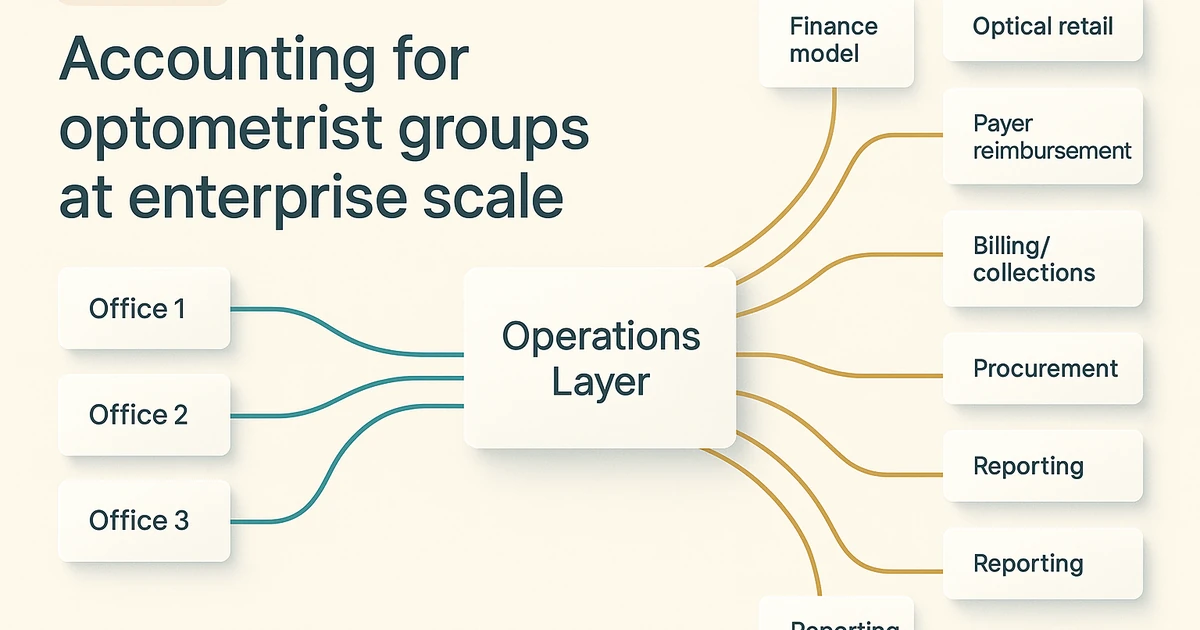
For an enterprise optometry group, the finance function sits close to scheduling, intake, billing, collections, procurement, and reporting. If those teams use different definitions, leadership ends up debating the report instead of managing the business.
The optometry industry hub frames the same operational problem from the patient-access side: distributed sites need centralized standards, consistent workflows, and usable reporting.
This playbook treats accounting for optometrist groups as an enterprise control layer. It does not promise revenue lift, EBITDA expansion, or compliance status. It gives buying committees a practical way to standardize finance inputs, connect revenue cycle evidence, and evaluate operating partners without turning unsupported assumptions into board-level claims.
Why Does Accounting for Optometrist Groups Change at Scale?
Accounting changes at scale because location variance becomes an executive issue. A location can look strong on top-line production while carrying inconsistent collections, unclear optical categorization, inherited vendor habits, or weak close discipline.
Without common definitions, the group cannot tell whether a variance reflects true operating behavior or inconsistent accounting language.
The American Optometric Association describes practice financial management as including fees, billing, collections, income, salaries, overhead, and equipment costs, which is directly relevant when a group is deciding which controls belong in the finance model (S1: AOA).
In a multi-location context, those categories need governance, not just bookkeeping attention. The goal is a finance model that leadership can use repeatedly across the platform.
What Changes When Locations Share One Finance Model?
A shared finance model forces the organization to define what every location means by revenue, adjustments, refunds, optical cost, provider compensation, shared services, and patient-account activity.
The work is not glamorous, but it determines whether a portfolio review is useful. If similar transactions land in different accounts, a location comparison becomes a vocabulary problem.
Standardization also changes how leadership evaluates acquired or newly integrated sites. Instead of asking every location to explain its own spreadsheet logic, the group can move each site toward the same chart of accounts, close calendar, expense categories, and review cadence.
That creates a more stable basis for SLA calibration, operational coaching, and EBITDA impact discussions without claiming a guaranteed financial result.
Where Do Optometry-Specific Workflows Enter The Ledger?
Optometry accounting is shaped by clinical visits, optical retail activity, contact lens workflows, medical billing, payer rules, patient balances, refunds, rebates, and inventory-related expenses.
Generic healthcare accounting can miss the operational detail that matters in eye care. The ledger should reflect the way the group actually earns revenue and incurs cost across the care and retail model.
A trade article on optometry accounting challenges highlights cash flow, accounts receivable, accounts payable, insurance billing management, P&L categories, and multi-location performance tracking as recurring finance issues for eye care organizations (S7: Optometric Management).
For an enterprise group, the implication is straightforward: accounting should capture enough workflow context to support decisions, but not so much detail that the close process becomes dependent on manual interpretation.
How Should A Multi-Location Group Standardize The Accounting Model?
Standardization starts with definitions before software. A new accounting platform can process entries consistently, but it cannot decide how the group should classify optical revenue, lab expense, refunds, rebates, shared services, or revenue cycle exceptions. Those choices belong to finance and operations leadership.
The accounting model should answer the questions the executive team actually asks. A COO may need location comparability. A CFO may need close reliability, cash visibility, and lender-ready reporting. A VP of Operations may need variance by workflow owner. A PE operating partner may need confidence that the platform can explain performance without rebuilding the report each month.
How Should The Chart Of Accounts Support Group Operations?
The chart of accounts should map to optometry economics and group governance. Professional services, optical activity, contact lenses, lab costs, provider compensation, non-provider labor, software, facility expenses, and shared services all need definitions that can travel across locations.
If the chart is too vague, leaders lose visibility. If it is too fragmented, operators stop trusting it.
MGMA’s medical-group financial management resource covers accounting systems, cost accounting, collections, accounts receivable, benchmarking, revenue cycle management, payer contracting, and budgeting (S8: MGMA).
That breadth is useful for optometry groups because finance decisions rarely stay inside accounting. The chart should support budgeting, revenue cycle review, payer discussions, and operating accountability in one controlled language.
How Should Shared Services Be Allocated?
Centralized operations create allocation questions. Patient access, billing support, quality assurance, training, procurement, reporting, software, and executive management may serve the entire group. If the allocation logic changes by report, location leaders may challenge the math instead of addressing the variance.
Buying committees should define allocation rules before reporting goes live. Some costs may be assigned across all locations, while others may follow usage, role ownership, or workflow volume. The important issue is consistency: site leaders should know which costs they control, which costs are allocated, and which issues require enterprise review.
How Should Accounting Connect To Revenue Cycle And Compliance Review?
Accounting for optometrist groups is downstream of operational behavior. If intake teams miss insurance details, billing teams inherit exceptions. If appointment types are inconsistent, financial reporting can lose context. If denials and adjustments are coded differently by site, finance leaders may see aging balances without knowing which workflow created the issue.
This is why finance should participate in revenue cycle design. The AOA’s billing and coding resource covers coding, reimbursement support, denials help, and accurate claims, which connects optometry accounting to revenue integrity and payer follow-up (S2: AOA Billing and Coding Help Desk).
For deeper operating context, MyBCAT’s guide to centralized revenue cycle management for multi-location healthcare groups addresses the cross-functional ownership model.
How Should Revenue Cycle Evidence Reach Finance?
Revenue cycle evidence should reach finance as structured categories, not scattered anecdotes. The group needs a consistent way to tag claim exceptions, patient balances, refunds, payment posting questions, and payer follow-up ownership.
That does not require finance to make clinical coding decisions. It requires finance to know which operational signals belong in the accounting review.
CMS publishes a Medicare Vision Services booklet covering billing requirements for glaucoma screenings, cataract removal, intraocular lenses, and other eye-related services (S3: CMS).
That source illustrates why payer and program requirements should be reflected in finance-adjacent controls. Groups should confirm billing interpretations with qualified advisors and their internal compliance team before changing workflows.
Where Should Billing Controls And Audit Readiness Sit?
Billing controls should sit where the work happens and where leadership reviews the result. The front office can own complete intake fields, the billing team can own claim work queues, finance can own reconciliation and reporting definitions, and compliance leaders can own review expectations. When those responsibilities are not named, exceptions tend to move informally.
CMS summarizes OIG findings on improper Medicare payments to optometrists for high-level E/M services at nursing facilities and points readers to correct billing resources (S4: CMS).
HHS OIG guidance for physicians also emphasizes internal monitoring, auditing, and accurate claims submission as compliance program elements (S6: HHS OIG). For enterprise groups, those sources support a disciplined review model rather than informal trust in site-by-site habits.
What Should Executives Track In Accounting Dashboards?
Executive dashboards should distinguish finance outcomes from operational inputs. A board-facing report should show the financial story in a stable format. An operator-facing report should show where workflow ownership and exception handling need attention. If both audiences use the same artifact, the dashboard may become too vague for supervisors and too noisy for executives.
The point is not to flood leaders with metrics. The point is to give each role the level of visibility needed to act. Accounting dashboards should connect to patient access, billing, and reporting without turning every operational signal into a board metric.
MyBCAT’s multi-site reporting dashboard guide covers the same design problem for healthcare operations teams.
How Should Location-Level Reporting Be Structured?
Location-level reporting should use the same definitions across the platform. Each site should be reviewed through consistent revenue categories, expense categories, shared-service logic, close status, and exception ownership. Without that foundation, a location P&L can look precise while still hiding definitional drift.
The dashboard should also show which questions belong to finance and which belong to operations. A variance in collections may require billing review. A variance in optical gross economics may require purchasing or inventory review. A variance in intake quality may require patient-access QA. Accounting is most useful when it points leaders toward the owner of the next question.
How Should SLA Calibration Connect To Financial Visibility?
SLA calibration should be tied to the quality of the downstream record. A patient-access workflow that prioritizes speed without complete insurance capture, appointment classification, or escalation notes may create reconciliation questions later. A more careful workflow may be appropriate when the request is complex, provided the organization has defined what quality means.
That is where finance can add discipline without overstepping. The finance team can help identify which operational fields are needed for accounting review, revenue cycle analysis, and executive reporting. The patient-access team can then design scripts, QA forms, and escalation paths that support the same data model.
For related access controls, see MyBCAT’s KPI dashboard guide for multi-location intake and front desk outsourcing solution.
How Should Buying Committees Evaluate Accounting-Ready Operating Support?
Buying committees should treat accounting readiness as a requirement for any operating support model that touches scheduling, intake, recall, billing support, or reporting.
A vendor can handle calls or work queues, but the enterprise question is whether the workflow produces data that finance and operations can trust. That includes role-based permissions, exception categories, QA evidence, integration logic, and escalation ownership.
FTC guidance for the Eyeglass Rule explains compliance obligations for optometrists and ophthalmologists around prescription release, fees, and recordkeeping (S5: FTC).
That retail-facing example is a useful reminder for buying committees: optical revenue policies, patient communications, and operational documentation can have compliance implications. Groups should evaluate those implications with legal and compliance advisors rather than relying on a vendor claim.
What Should Procurement Ask About Integrations?
Procurement should ask how the operating platform exchanges data with the systems that drive scheduling, billing, patient access, and reporting. If locations use different systems, the committee should ask how exceptions are handled and how reporting definitions remain consistent. Integration gaps often become finance work later.
The evaluation should also cover permissions and audit trails. The group needs to know who can view patient-related operational data, who can change workflow status, who can resolve exceptions, and how supervisor review is documented.
MyBCAT’s integrations solution is relevant when leaders need PMS, EHR, patient-access, and reporting logic to line up across the operating model.
How Should A Pilot Prepare For Scale?
A pilot should test the operating model, not just the vendor interface. The group should define the locations in scope, the workflow boundaries, the reporting cadence, the handoff rules, and the exception taxonomy before work begins. If those items are unclear during a pilot, they usually become more confusing during rollout.
Well-designed pilots also involve finance early. Finance can confirm whether the workflow produces useful location-level evidence, whether exception categories map to reporting needs, and whether SLA calibration supports downstream review.
MyBCAT’s guide to optometry front office standardization for group practices offers a related operating lens for groups that are aligning front-office work with centralized reporting.
Related Reading
- Accounting for Optometry Groups Across Multiple Locations
- Centralized Revenue Cycle Management for Multi-Location Healthcare Groups
- Optometry Coding and Billing Optimization
- Reporting Dashboards for Multi-Site Healthcare Operations
- Optometry Front Office Standardization for Group Practices
Sources
- S1: American Optometric Association, Managing Practice Finances
- S2: American Optometric Association, Billing and Coding Help Desk
- S3: CMS, Medicare Vision Services
- S4: CMS, Optometry Services at Nursing Facilities: Bill Correctly
- S5: Federal Trade Commission, Complying with the Eyeglass Rule
- S6: HHS OIG, Compliance Programs for Physicians
- S7: Optometric Management, Alliance Solutions to Accounting Challenges
- S8: MGMA, Financial Management for Medical Groups
Managing accounting for an optometry practice of any size? Book a short MyBCAT discovery call.