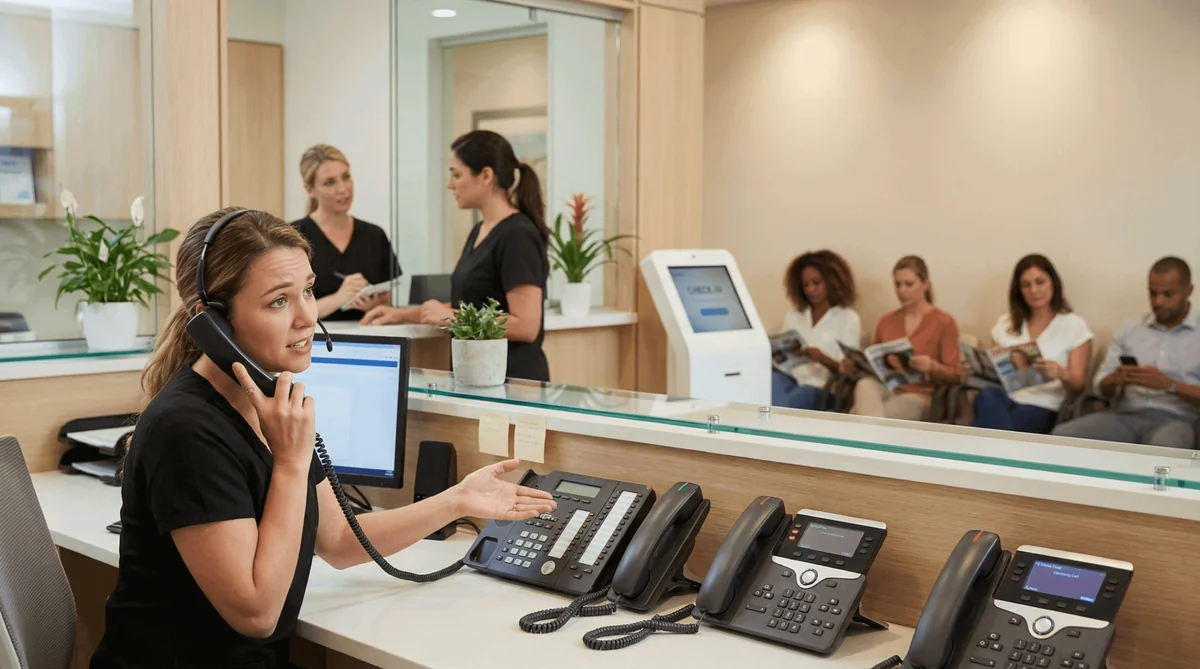


For a multi-location optometry group, call support is not a courtesy function. It is part of the patient-access system. Calls arrive when a patient wants an eye exam, needs help finding the right location, has a question about an existing appointment, or is trying to understand the next administrative step. The quality of that interaction affects whether the request reaches the right team and whether the patient leaves with a clear next action.
The operational challenge changes once a group manages three or more locations. Each office can develop its own language, scheduling habits, and escalation shortcuts. Those local differences may feel minor until a centralized team, a new location, or a patient-access vendor has to support all of them. Then the group is left with uneven calls, uneven documentation, and no reliable way to compare performance.
Better call support starts with a shared operating model, not a longer script. It gives agents enough structure to handle common requests consistently and enough judgment to recognize when a local or clinical escalation is needed. That approach supports the broader optometry operating model and protects the in-office team from avoidable phone interruptions.
Table of Contents
- What Does Good Call Support Look Like Across an Optometry Group?
- Why Do Structured Interactions Matter More at Scale?
- How Should Agents Handle Calls That Need Clinical or Local Judgment?
- How Can Tone and Emotional Intelligence Improve Patient Access?
- What Language Keeps Calls Helpful Without Overpromising?
- Which Calls Should a Centralized Team Own?
- How Should Leaders Measure Call Support Quality?
- What Does a Practical Rollout Look Like for 3+ Locations?
- When Should a Group Consider Managed Call Support?
What Does Good Call Support Look Like Across an Optometry Group?
Good call support makes it easy for a patient to state what they need, receive an accurate administrative response, and understand what happens next. For leadership, it also produces a clear record of why people called, how the request was handled, and where exceptions are accumulating.
That definition is more useful than measuring friendliness alone. A warm call that sends the patient to the wrong location or leaves an appointment request unresolved is still a weak access outcome. The patient should not have to call again because the first conversation lacked a clear handoff.
For an optometry group, a dependable call model usually covers appointment requests, rescheduling, recalls, referral questions, basic insurance-routing questions, optical inquiries, and messages that require review. It should also distinguish between administrative support and clinical judgment. Agents can follow approved protocols and route information, but they should not diagnose, give treatment advice, or improvise when a caller’s needs fall outside those protocols.
The American Optometric Association’s practice-management resources include scheduling, recordkeeping, and office-procedure considerations. That is the right frame for call support: it belongs in the operating system, not in a separate collection of personal habits. Centralized patient access makes this work more manageable when rules and ownership are documented before volume is moved into a shared queue.
Why Do Structured Interactions Matter More at Scale?
Structured interactions are the foundation of consistent call support. They do not mean reading every caller the same rigid script. They mean the team follows a repeatable sequence: identify the caller’s purpose, confirm the information needed for the task, select the correct approved path, document the outcome, and state the next step before ending the call.
Without that structure, agents often solve the immediate conversation but leave loose ends behind. One agent may promise a callback without recording an owner. Another may send a patient to a location that cannot support the requested visit type. A third may note an insurance question without connecting it to the upcoming appointment. The patient experiences these as separate failures, even though they stem from the same missing workflow.
For common calls, group leaders should define the minimum information needed to move forward. An appointment request may require location preference, visit purpose, provider preference when relevant, and the best callback method. A rescheduling call needs the current appointment context and a confirmed replacement path. An optical inquiry may need a defined handoff rather than a generic message. The exact fields will vary by system, but the decision path should not depend on who happened to answer.
This is also why phone support should be connected to front desk outsourcing or internal centralized staffing through explicit workflows, not loose expectations. A team can only be accountable for a process it can see and follow.
How Should Agents Handle Calls That Need Clinical or Local Judgment?
Patient-access teams need a clear escalation boundary. They can schedule within approved appointment types, explain administrative policies that the group has supplied, and route messages to the right owner. They should escalate when a caller asks for clinical advice, describes an urgent concern, disputes a bill or insurance determination outside the team’s authority, or needs a provider-specific exception.
The important detail is what happens after escalation. “Someone will call you back” is not a complete process. The agent should identify the destination team, capture the approved information, set only the expectation the organization can support, and create a traceable handoff. The receiving team needs a queue, owner, or documented callback process. Otherwise, escalation becomes a polite version of dropping work into a void.
Multi-location groups should also separate enterprise rules from location-specific exceptions. Corporate operations may define the call categories, documentation standard, and escalation categories. A local office may maintain approved provider-template notes or service-specific restrictions. Both can coexist when the exception is visible to the people answering calls.
This distinction keeps the patient-access function within safe administrative boundaries while preserving the local judgment that actually belongs to the practice team. Groups building this model often pair it with medical answering service coverage so after-hours or overflow calls enter a known routing path instead of an unmonitored voicemail box.
How Can Tone and Emotional Intelligence Improve Patient Access?
Tone matters because patients often call when they are busy, uncertain, or already frustrated by a previous barrier. Emotional intelligence in this setting is not a performance of sympathy. It is the ability to hear the actual request, acknowledge the inconvenience without making promises the team cannot keep, and move the conversation toward a concrete action.
An agent can say, “I understand you are trying to get this appointment changed. I can review the available options for your location and confirm the next step before we finish.” That is better than either a detached, transactional response or an apology that does not resolve anything. It tells the patient what the agent can do now.
Training should help agents recognize the difference between a caller who needs simple scheduling help and a caller who needs an escalation. It should also give them language for delays, unavailable appointments, insurance verification questions, and transfers. When language is approved in advance, agents are less likely to improvise or overstate what will happen.
The broader healthcare literature on patient engagement emphasizes communication as part of the patient experience. For an optometry group, the operational lesson is practical: the call should reduce uncertainty, not add another task for the patient. Good tone supports that goal, but clear ownership and correct routing are what make it credible.
What Language Keeps Calls Helpful Without Overpromising?
Positive language is useful when it stays specific. Phrases such as “I can check the next available appointment options” or “I will route this to the team that handles this request” tell the caller what will happen. They are stronger than vague reassurance such as “We will take care of it.”
Teams should avoid language that creates an obligation the group cannot meet. Do not promise a clinical answer, a same-day callback, coverage approval, or a specific appointment outcome unless the approved workflow supports it. The goal is not to sound optimistic at all costs. It is to be calm, accurate, and useful.
Call language also needs to work across locations. If one office calls an appointment type by a different name, or one team uses a different explanation for the same policy, patient confidence and reporting both suffer. A centralized knowledge base with reviewed phrasing for frequent scenarios gives agents a reliable reference without forcing every conversation into a script.
This is one reason front-office standardization for optometry groups should include phones, scheduling, and handoffs together. The words on the call need to match the process the patient encounters afterward.
Which Calls Should a Centralized Team Own?
Centralization works best when it starts with clear, repeatable work. Common candidates include routine appointment requests, rescheduling, recall outreach responses, standard pre-visit questions, callback management, and overflow coverage. These calls benefit from shared training, common documentation, and a single QA process.
Local offices should continue to own work that depends on real-time site context or provider-specific judgment. That can include unusual scheduling constraints, specialized service questions, or a situation requiring a member of the local clinical team. The point is not to pull every phone task away from locations. It is to prevent routine work from being handled differently every time the phone rings.
The split should be documented as a responsibility map. Each call type needs a primary owner, a backup owner, the information required at intake, and an escalation destination. This removes the ambiguity that causes agents to transfer callers repeatedly or leave messages with no follow-up owner.
Centralization also gives leaders a better view of demand. If the group captures the call reason and outcome consistently, it can see which locations are receiving the most scheduling requests, which categories create rework, and where additional training or capacity may be needed. That insight is central to multi-location healthcare intake operations, where access issues often appear first as a pattern of calls rather than as a single major failure.
How Should Leaders Measure Call Support Quality?
Start with measures that show whether the workflow is reliable. Answer rate, abandoned-call patterns, speed to answer, appointment-request resolution, callback completion, transfer rate, documentation quality, and escalation accuracy can each be useful when defined consistently. The organization should decide exactly what each measure means before comparing locations.
For example, a “resolved appointment request” should have a shared definition. Does it mean the caller received an appointment, received an approved next step, or simply had a message created? The answer depends on the group’s operating model, but it must be the same across the network if leadership wants useful reporting.
Quality assurance should combine sampled call review with workflow review. A call can sound courteous and still be wrong if the agent selected the incorrect appointment category or failed to record an escalation. Conversely, a longer call may be appropriate if the agent correctly resolves a complex administrative issue. QA should therefore assess accuracy, documentation, approved language, and outcome, not just call length.
MGMA’s work on centralized scheduling and call-center efficiency is relevant because it treats access as a management function with workflows and measures, rather than as an isolated receptionist task. Groups can use that perspective to build a patient-access metrics review that identifies system issues without turning every metric into a punitive target.
What Does a Practical Rollout Look Like for 3+ Locations?
Begin with a narrow call category and a limited set of locations. Map the current path from the initial ring to the final documented outcome. Identify who owns each handoff, which systems are used, what exceptions occur, and where callers are asked to repeat themselves. That baseline makes it possible to design a shared workflow without guessing.
Next, define the approved script elements, documentation fields, escalation rules, and QA criteria for that category. Train both the centralized and local teams on the same operating standard. The local team needs to know what the centralized team will handle, while the centralized team needs access to current location instructions. A rollout fails when either side assumes the other side has information it does not.
Run a review cadence during the initial period. Look at unresolved requests, repeated transfers, missing documentation, agent questions, and local exceptions. If an exception occurs repeatedly, decide whether it should become part of the enterprise standard or remain a formally documented local rule. This is how a group improves the system without allowing process drift to return.
Once the first call category is stable, expand to the next one. A measured rollout is more useful than changing every phone workflow at once, because it lets leadership verify that routing, documentation, and patient communication work in the real operating environment.
When Should a Group Consider Managed Call Support?
Managed support can be appropriate when locations are missing calls during peak periods, front-desk teams are being pulled away from patients in the office, or leadership cannot see how request volume is being handled across the group. It can also help when the organization wants a shared training and QA model but lacks the internal capacity to staff it consistently.
The evaluation should focus on fit, not promises. Ask how the team will learn each location’s approved scheduling rules, how it will handle exceptions, what access it needs to the relevant systems, how quality is reviewed, and how performance will be reported. Confirm the boundaries for clinical escalation, sensitive information, and after-hours requests before calls are routed.
MyBCAT’s medical virtual assistant services and patient-access support are designed around documented workflows and human accountability. For multi-location optometry groups, the useful starting point is a conversation about the existing call flow, not an assumption that every location needs the same staffing model.
Ready to Improve Your Patient Retention?
MyBCAT helps healthcare practices recapture missed calls and automate patient scheduling so no opportunity slips through the cracks.
Related Reading
- Call Management Best Practices for Optometry
- Optometry Virtual Assistant Services for Multi-Location Practices
- Missed Calls and Revenue Leakage in Multi-Location Healthcare