

Table of Contents
- Why does recall break down across multiple locations?
- What should a multi-location recall workflow include?
- Who owns each step of the recall workflow?
- How should the group sequence outreach and exceptions?
- How do scheduling capacity and patient preferences affect recall?
- Which metrics show whether the workflow is working?
- How should a healthcare group roll out a standardized workflow?
- FAQ
Patient recall becomes an enterprise operating problem once a healthcare group manages three or more locations. The issue is not simply sending reminders. Operations leaders need a reliable way to identify the right cohort, contact patients through approved channels, make appointments available, record the result, and resolve exceptions without every site inventing its own process.
A fragmented program creates noise. One location may mark a patient as recalled after a text is sent, another after a live conversation, and another only after an appointment is booked. A patient who visits more than one site can receive duplicate outreach. A central team may work from a list that no longer reflects current appointment capacity. By the time leadership sees a monthly report, the data cannot support a meaningful comparison.
The answer is not to remove all local judgment. It is to build one controlled workflow with shared definitions and a narrow place for local decisions. That is the operating foundation of a scalable patient recall program, whether the group is an optometry network, dental group, veterinary organization, or another multi-site healthcare operator.
Why does recall break down across multiple locations?
Recall often starts as a site-level responsibility. It fits naturally beside the front desk because the staff knows the providers, patients, and schedule. That model can work for an individual office. It becomes difficult to govern when a group acquires locations, adds providers, or uses different practice-management systems.
The first failure is definition drift. “Due,” “overdue,” “deferred,” “unreachable,” and “completed” can mean different things across locations. The second is handoff drift. A central caller may identify a patient who wants an appointment, but no one has agreed who owns the booking, how long the request can wait, or what happens when the requested provider has no capacity. The third is reporting drift. Leadership sees outreach counts without knowing whether those counts represent an actual patient response, a scheduled appointment, or a completed visit.
Multi-location groups also inherit different communication habits. Some sites rely on calls, some use automated messages, and some run recall only when a schedule has visible gaps. Patient engagement guidance from the Office of the National Coordinator for Health Information Technology describes outreach and access as part of a broader patient-engagement capability, not an isolated messaging task (ONC Patient Engagement Playbook). That distinction matters: a recall message has operational value only when it connects cleanly to a valid next step.
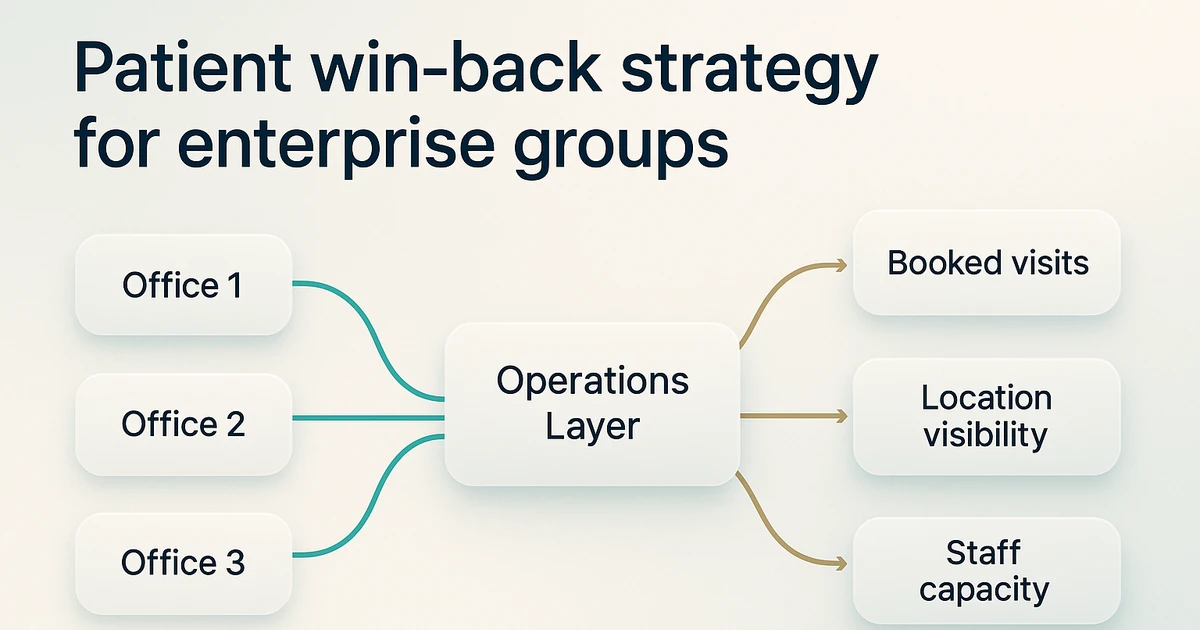
For a COO or VP of Operations, the practical goal is to make recall comparable without making it rigid. The group needs one source of workflow truth, one approved status model, and one review rhythm. Local teams still need authority over provider-specific instructions, appointment capacity, and cases requiring clinical review.
What should a multi-location recall workflow include?
A workable design begins with a single patient journey. Every record should move through the same high-level states, even when the underlying systems differ. The group should document the logic before it asks staff or a vendor to execute it.
Start with a governed cohort. Define which patients enter the workflow, why they are eligible, which location owns the appointment, and which data fields are required before contact. A specialty or service-line owner should set any clinical timing rules. Operations should not create clinical recall intervals independently.
Next, define a controlled status model. A useful baseline includes due, ready for outreach, contacted, responded, booked, completed, deferred, unreachable, opt-out, and exception. The names may vary, but their definitions and allowed transitions should not. This is closely connected to patient recall segmentation: segmentation determines the appropriate outreach path, while the status model records what actually happened.
The workflow should also name the system of record for each event. The outreach tool may record delivery and response. The scheduling or practice-management system should confirm a booked appointment. A reporting layer may combine those events for executive review. If those systems disagree, the group needs a documented reconciliation process rather than a manual spreadsheet correction at month end.
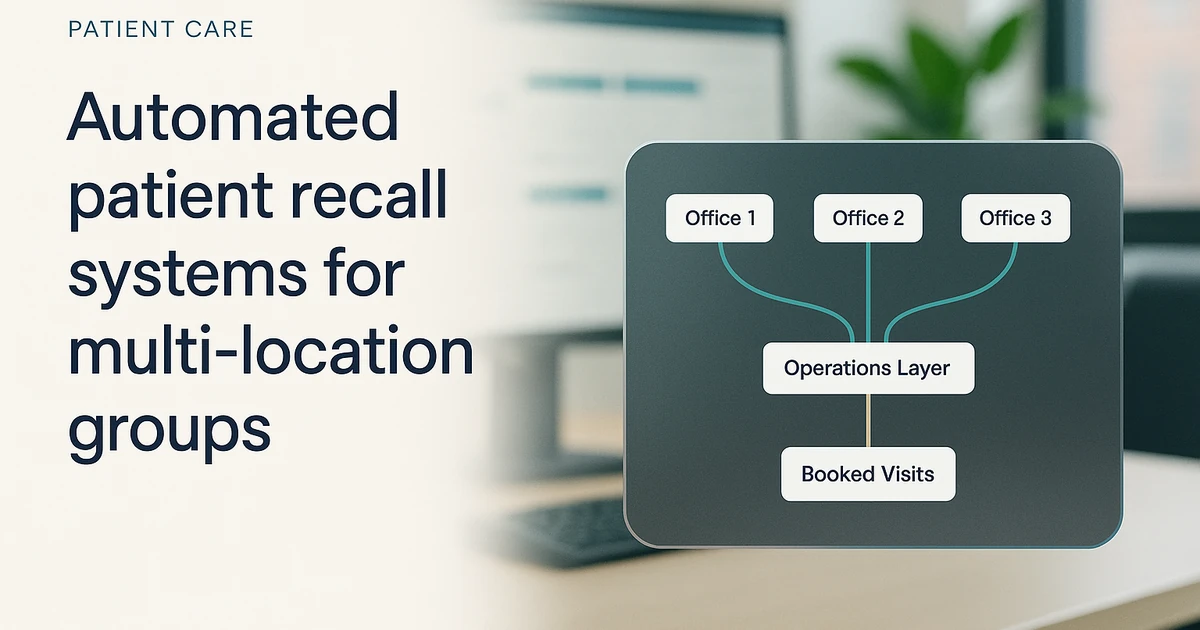
Finally, design the workflow around the actual booking path. A reminder that asks a patient to call a site with no available capacity creates avoidable friction. A centralized model works best when it is connected to the same appointment inventory and handoff standards that govern centralized patient recall for multi-location groups.
Who owns each step of the recall workflow?
Clear ownership prevents the common pattern where every team assumes another team will close the loop. A multi-location group does not need a large committee for every recall list, but it does need a named accountable owner for each transition.
Corporate or central operations should own the policy, workflow definitions, approved scripts, reporting, and escalation rules. This team decides how cohort eligibility is calculated, which statuses are valid, and what constitutes an overdue work item. It also owns quality assurance for the people and systems performing outreach.
The patient-access team should own routine execution. Its work is to process the assigned queue, use the approved contact sequence, document outcomes, schedule when authorized, and move exceptions to the correct owner. A shared patient access center can create consistency across locations, but it must have current scheduling and provider information to do the work well.
Location leadership should own the local operating inputs that central teams cannot infer: provider availability, temporary schedule constraints, location-specific routing, and the timely resolution of escalated items. Clinical leaders should own decisions that require clinical judgment, including questions about the appropriate next care step. IT and data owners should own integration reliability, access controls, and the correction of systematic data defects.
This division of responsibility lets the group preserve local knowledge while avoiding site-by-site reinvention. It also makes review conversations more productive. Instead of asking why “recall is down,” leadership can ask whether the constraint is cohort quality, outreach execution, booking capacity, unresolved exceptions, or data flow.
How should the group sequence outreach and exceptions?
The right channel and timing depend on the cohort, patient communication preferences, organizational policy, and specialty-specific requirements. There is no universal sequence that should be copied without review. The workflow should specify an approved starting channel, the conditions for a follow-up attempt, and the point at which a record becomes an exception instead of receiving more routine outreach.
For many groups, digital outreach is an efficient first action when the patient has a valid consented channel and the message can direct the patient to a real booking option. A nonresponse can then move to a live call or another approved channel under a defined cadence. The purpose of escalation is not to maximize touches. It is to provide a consistent, respectful next action while avoiding duplicate outreach from different sites.
Exception handling deserves its own queue. Examples include invalid contact data, a request for no further contact, conflicting location ownership, no matching appointment capacity, an unclear provider instruction, or a response that needs clinical review. Each exception should have a reason code, an owner, a due date, and a closure rule. Without that structure, exceptions disappear into free-text notes and leadership cannot tell whether the recall process or the underlying data is failing.
Patient communication should be standardized enough for quality control and flexible enough to reflect the patient’s relationship with the organization. The American Optometric Association includes patient communication in its day-to-day practice operations resources (AOA: Patient Communication). For a group operating across locations, that principle means using approved templates, current location information, and accurate preference records rather than allowing every site to create its own message library.
How do scheduling capacity and patient preferences affect recall?
Recall creates demand, so it has to be managed alongside supply. Before a campaign or recurring workflow expands a cohort, the group should confirm the relevant locations can offer appointments within an acceptable window. If availability is limited, operations can adjust cohort size, offer appropriate alternate sites where permitted, or pause routine outreach until capacity recovers. It should not ask staff to send messages that create a queue they cannot serve.
This is why recall should be connected to the broader scheduling operating model. The Medical Group Management Association has published guidance on implementing central scheduling to support growth, which reinforces the operational value of consistent scheduling processes across a practice network (MGMA: Implementing Central Scheduling). The point is not that every group must centralize every scheduling decision. It is that appointment access, recall rules, and reporting must refer to the same operational reality.
Communication preferences matter for the same reason. A group needs a reliable way to capture preferences, honor opt-outs, and keep those records current across locations. A patient who has requested a particular channel should not be contacted through a different site using an outdated record. Preference governance is both a patient-experience concern and a workflow-control concern.
For systems with more than one practice-management platform, integration design is critical. The group should decide which system supplies the cohort, which system confirms booking, how duplicated records are resolved, and how outages are handled. The related EHR and PMS integration guide for centralized scheduling explains why workflow ownership should be settled before reporting requirements are finalized.
Which metrics show whether the workflow is working?
An executive dashboard should not reward volume alone. A high count of messages sent may show activity, but it does not show whether the right patients were contacted, whether they could schedule, or whether the workflow is producing clean data.
Start with process measures that expose workflow health: eligible patients loaded, records with valid contact information, outreach completed within the service-level target, response rate, queue aging, exception volume, and exception closure time. These measures indicate whether the team can execute the design consistently.
Then review outcomes that connect recall to access: appointments booked from recall, time from response to booked appointment, cancellation or no-show patterns for recall-generated appointments, and completed appointments where that event is available and appropriate to measure. The group should define denominators centrally. A booked-from-recall rate is not comparable if one site includes every sent message while another includes only patients who responded.
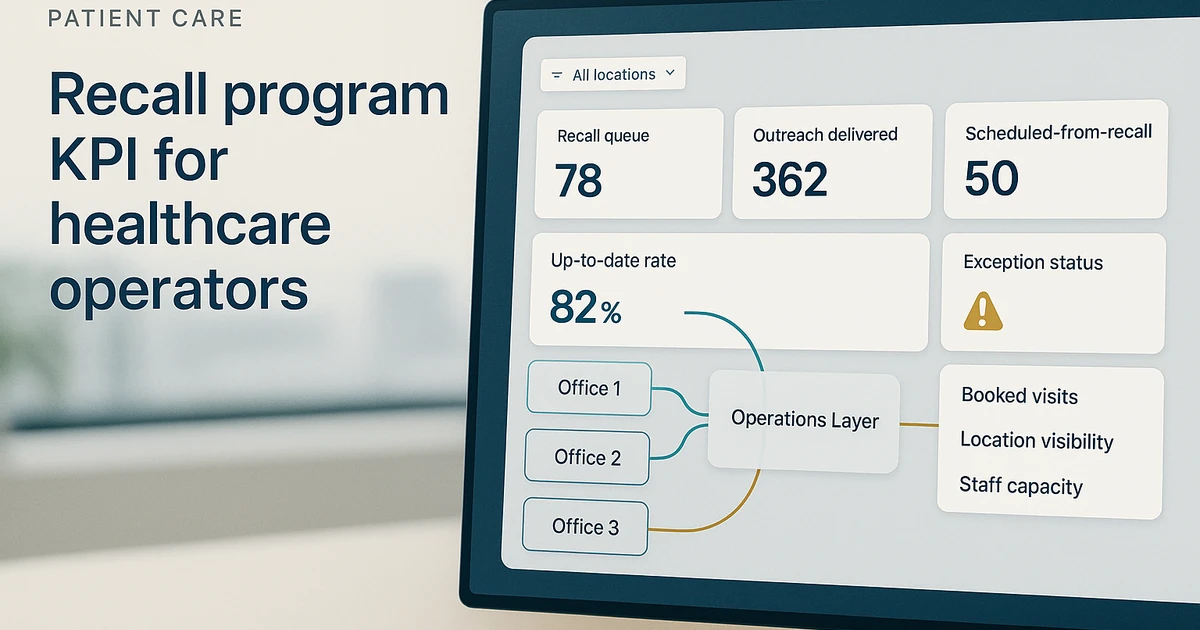
Reports should show the network view and the location view from the same definitions. The network view helps leaders find variance. The central operations view helps identify bottlenecks by cohort, channel, or exception type. The site view gives managers a short, current worklist. This tiered approach aligns with the governance described in recall program KPI for healthcare operators, where status discipline and denominator control make comparisons useful.
MGMA also emphasizes data standardization and visualization as operational management concerns (MGMA: Data Standardization and Visualization). For recall, that means using a small set of stable definitions before comparing locations or changing staffing. A dashboard is a decision tool, not proof that the workflow is healthy.
How should a healthcare group roll out a standardized workflow?
Begin with discovery, not a network-wide launch. Map the current state for each location: source systems, existing status labels, patient communication channels, scheduling rules, capacity constraints, opt-out handling, staff roles, and reporting gaps. This work usually identifies a small number of recurring failure modes that should be addressed before a pilot begins.
Choose one cohort and a limited set of pilot locations. The cohort should have clear eligibility logic and a straightforward booking path. The pilot locations should represent real operational conditions, not just the strongest sites. Document the workflow, status definitions, scripts, escalation rules, quality checks, and success measures before outreach begins.
During the pilot, review records as well as dashboards. Sample completed, deferred, and exception records to confirm that status changes match the documented workflow. Listen for recurring barriers from access staff and site managers. If the same exception occurs repeatedly, fix the workflow or data source rather than asking staff to work around it.
Expand in controlled waves after the pilot has a stable operating rhythm. Each wave should include training, system validation, a temporary support path for new exceptions, and an agreed reporting cadence. A group that is also building enterprise implementation discipline can use the same approach to distinguish a local configuration issue from a network-wide design issue.
The objective is not a one-time campaign. It is a repeatable capability that leadership can inspect, sites can execute, and patients can experience consistently. When the workflow is governed, recall becomes part of patient access operations instead of a seasonal scramble.
FAQ
Should every location use the same recall script?
The group should use approved message templates and shared documentation standards, with controlled fields for provider, location, appointment type, and other permitted local details. Location teams should not change core policy or clinical language without the appropriate owner’s review.
Is a centralized team always better than local recall staff?
Not always. A centralized, hub-and-spoke, or locally executed model can work when ownership, data access, quality assurance, and escalation are clear. The important distinction is whether the network can run one governed workflow and report it consistently.
What should leaders fix first when recall performance varies by site?
Check definitions and data quality before changing scripts or adding more outreach. Confirm that every location is using the same eligibility criteria, status definitions, booking attribution, and exception rules. Once the data represents the same workflow, performance differences are much easier to diagnose.
Ready to Improve Your Patient Retention?
MyBCAT helps healthcare practices recapture missed calls and automate patient scheduling so no opportunity slips through the cracks.
Related Reading
- Centralized Patient Recall for Multi-Location Groups
- Patient Recall Campaign Framework
- Automated vs. Human Patient Recall
- KPI Dashboard for Multi-Location Intake