
Table of Contents
- Why Does Recall Compliance Become Harder Across Multiple Locations?
- What Should Count as a Compliant Recall Record?
- Which Rules Must Be Standardized Across the Network?
- How Should a Group Protect Patient Information During Recall?
- Who Owns Recall Compliance at the Corporate and Site Levels?
- How Do You Build a Dashboard Leaders Can Trust?
- How Should Teams Handle Exceptions and Corrective Action?
- What Should a 90-Day Implementation Plan Include?
- FAQ
For a healthcare group with three or more locations, recall compliance is not a matter of whether a message was sent. It is the ability to show, across every site, who entered the recall queue, which approved action was taken, what happened next, and who can review the record when a question arises.
That distinction becomes urgent after growth, acquisition, or a change in the patient-access model. One location may work overdue lists every afternoon. Another may send messages in batches and update the status later. A third may leave a record in a generic follow-up bucket when the patient asks a question. Each team may believe it is doing recall, yet corporate leadership has no consistent way to measure execution or resolve gaps.
The goal is not to turn recall into a rigid script that ignores clinical or location context. It is to establish one controlled operating model for outreach, documentation, access, escalation, and reporting. That model supports the broader work of a patient recall program and gives enterprise leaders a reliable view of patient-access performance.
Why Does Recall Compliance Become Harder Across Multiple Locations?
Recall grows more complex with each additional location because the process crosses scheduling systems, staff roles, patient preferences, and site-specific capacity. Informal habits can keep one office moving, but those habits do not create a network standard. They also make it difficult to distinguish a real performance issue from a difference in how a location records its work.
The first source of drift is usually vocabulary. If one site labels a patient as “due” on the day outreach may begin, while another uses “due” only after the patient is overdue, their completion rates are not comparable. The same problem appears when a booked appointment remains tagged as active recall at one site but closes automatically at another. A dashboard cannot repair those definition differences after the fact.
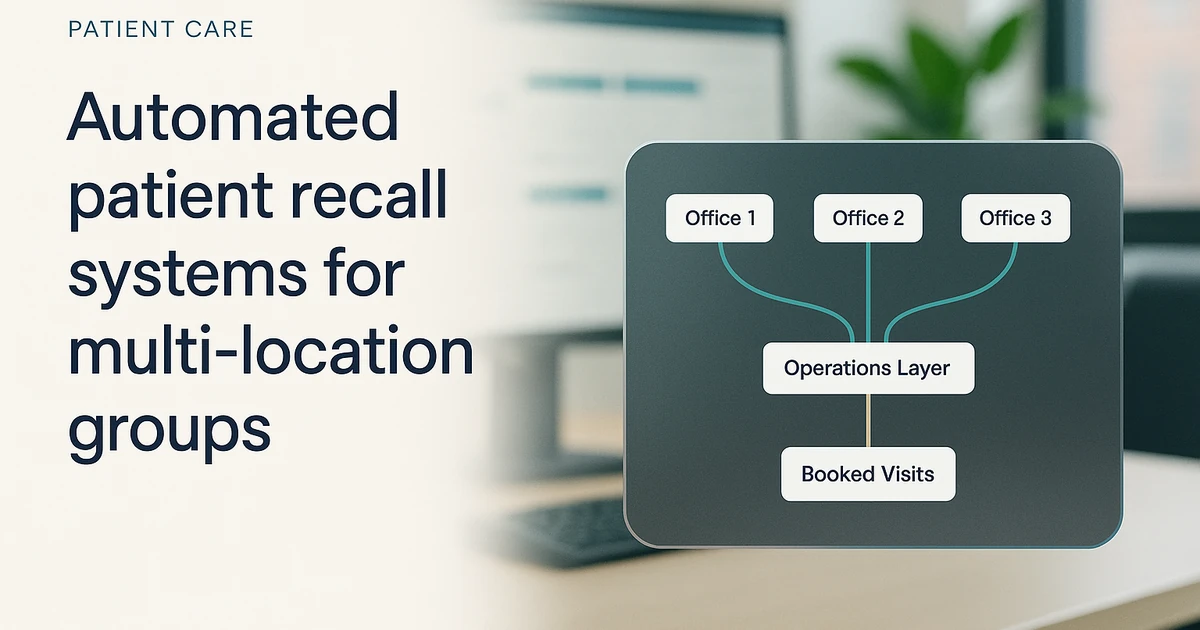
Recall should also be separated from a standard appointment reminder. A reminder concerns an already scheduled visit. Recall outreach concerns a patient whose next visit has not been scheduled or whose follow-up requires a defined next step. That difference affects queue rules, staff ownership, communication preferences, and the record needed to show what occurred. Groups that need the operating framework behind this distinction can pair compliance work with a multi-location recall workflow.
At enterprise scale, compliance is therefore an execution-control problem. The group needs a common workflow that survives turnover, new locations, uneven volume, and changes to the practice-management stack. The system should make the correct action easier than an improvised workaround.
What Should Count as a Compliant Recall Record?
A compliant recall record is a complete, reviewable account of one patient’s journey through the approved workflow. It should allow an authorized reviewer to answer four questions without reconstructing the story from calls, inboxes, and staff memory: Why was the patient in the queue? What outreach occurred? What was the outcome? What happens next?
Start with a controlled status model. A practical network may use statuses such as eligible, due, outreach in progress, contacted, booked, completed, deferred, opt-out, and exception. The labels matter less than their written definitions and permitted transitions. A staff member should not be able to close a record as completed when the only confirmed event was a voicemail, for example.
The record should also preserve the operational evidence for each touch. That normally includes the outreach date and channel, the approved reason for contact, the responsible team member or system, the patient response when available, the resulting appointment or follow-up status, and any updated communication preference. Avoid putting unnecessary narrative into notes. A controlled outcome field is clearer for reporting and reduces the chance that free-text documentation creates avoidable privacy exposure.
The appropriate evidence varies by workflow. A patient who books an appointment after outreach should be connected to the scheduled event, not simply marked as “successful.” A patient who asks not to receive a particular channel should have that preference routed to the system of record and reflected in future campaigns. A case requiring provider or site review should remain open in an exception queue with an owner and due date. These are the same closed-loop controls that make centralized patient recall operationally manageable.
Which Rules Must Be Standardized Across the Network?
Enterprise standardization should cover the rules that make reporting, quality assurance, and patient information handling consistent. It does not require every location to have identical appointment availability or provider preferences. The useful dividing line is simple: standardize control points; allow documented local variation where the operating reality requires it.
The enterprise playbook should define the recall cohorts, the entry criteria for each cohort, the outreach sequence, the allowable contact channels, the standard intervals between attempts, and the conditions that suppress outreach. It should specify which outcomes close a record, which outcomes require follow-up, and which cases must return to the site or clinical leadership. A cohort may have a different cadence from another cohort, but every location must be able to apply that cohort’s rules in the same way.
Message content needs the same discipline. Corporate should own approved templates, required identifiers, and review of material changes. Locations may need approved fields for provider name, office hours, or scheduling instructions, but those fields should not invite every team to rewrite the communication. The American Optometric Association’s patient-communication resources are a useful starting point for considering communication operations, while the group’s compliance and counsel teams should determine its own approved policies and scripts.
Patient segmentation also needs governance. A long-dormant cohort, a routine follow-up cohort, and a cohort that needs site review should not be blended into one list simply because they are all unscheduled. Patient recall segmentation can help operations teams define the queue logic, but the final cohort rules should be approved, documented, and tested in the group’s own systems.
How Should a Group Protect Patient Information During Recall?
Recall operations involve protected health information, so the workflow should be designed with privacy and security controls from the beginning. The U.S. Department of Health and Human Services explains HIPAA privacy and security expectations for covered entities and business associates. That guidance does not replace legal advice, but it reinforces why access, approved communications, and documented processes must be treated as operating requirements rather than optional safeguards.
Use role-based access so staff can perform the recall work assigned to them without broad access to records that are unrelated to their queue. A centralized patient-access team may need access across sites for the patients it serves, while a location role may need a narrower view. Access should be reviewed when job responsibilities change, and former staff should not retain recall-system access.
The group should define which systems are approved for each channel and which data elements are permitted in messages. It should also maintain a process for honoring communication preferences and documenting requests to stop a channel. Do not let staff resolve sensitive questions in unmonitored personal inboxes or unofficial tools. When a patient raises a privacy concern, the workflow should route the issue to the designated owner rather than asking a recall coordinator to interpret policy on the spot.
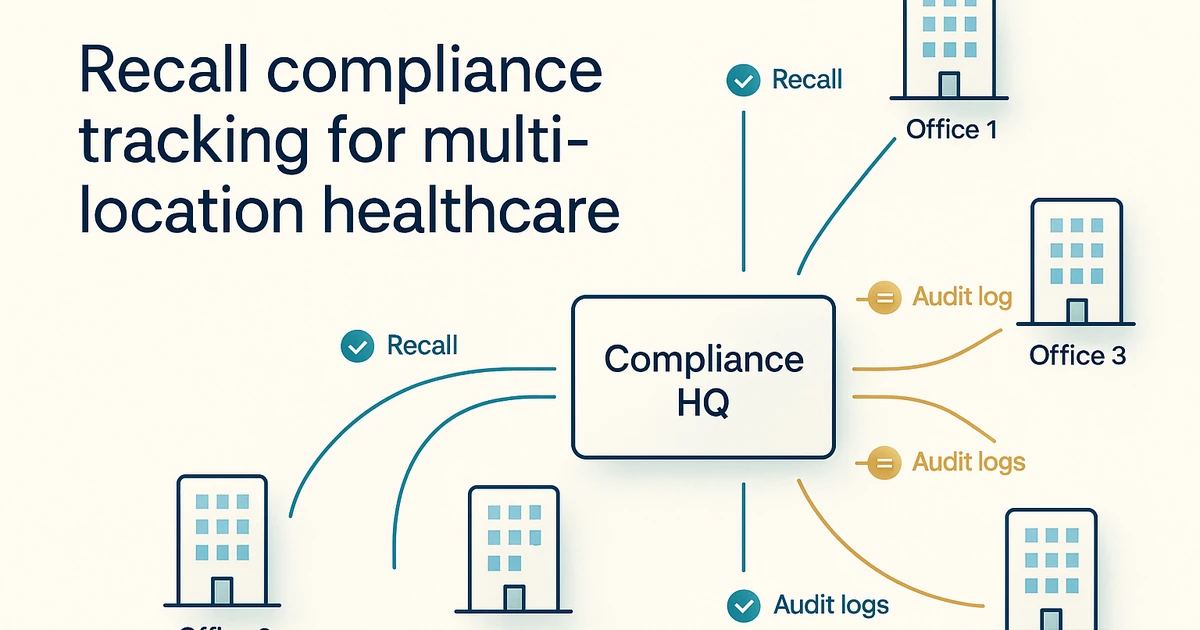
Audit trails matter here. The system should show authentication, record access where supported, status changes, and communication events in a form that authorized compliance and operations leaders can review. The purpose is not surveillance for its own sake. It is the ability to investigate an anomaly, correct a process failure, and demonstrate that the enterprise has controls that work in daily operations. Groups evaluating a broader access model can compare this work with their enterprise patient-access approach.
Who Owns Recall Compliance at the Corporate and Site Levels?
Recall fails when everyone is responsible in principle but no one owns the controls. Corporate leadership should own the common policy, workflow definitions, system configuration standards, reporting logic, training requirements, and vendor governance. This is the work that must remain stable across locations.
Site leaders own disciplined execution within that model. They should confirm that local capacity information is accurate, resolve site-specific scheduling exceptions, ensure their teams complete required training, and surface broken handoffs promptly. They should not create an independent recall cadence or redefine a final status because a local report would look better.
The patient-access leader or program owner should run a regular review cadence. Weekly reviews can focus on aged queues, exceptions, and data-quality failures that need immediate attention. Monthly reviews can compare locations using the same definitions and identify repeat patterns. Quarterly reviews are appropriate for policy changes, training themes, access reviews, and vendor performance. The cadence matters because a recall record that remains unresolved for weeks is much harder to repair than one caught during daily or weekly queue management.
Clinical judgment remains outside the recall team’s authority. When a patient response or follow-up request requires clinical interpretation, the record should move through a documented escalation path to the appropriate site or provider team. The recall coordinator’s job is to record the trigger, route the case correctly, and preserve the handoff, not to make a clinical decision.
How Do You Build a Dashboard Leaders Can Trust?
Leadership needs more than outreach volume. A dashboard should reveal whether the workflow is being followed and whether patients are moving through a controlled path. That requires definitions that are locked before targets are discussed.
Useful process measures include the percentage of eligible patients entered into the correct cohort, time from due date to first approved outreach, completion of required documentation, queue aging, and exception backlog. Useful outcome measures include appointments booked from recall, completed appointments where the group can reliably connect the event, and the number of records that are appropriately deferred or removed from outreach. Each metric needs a stated denominator, data source, owner, and refresh cadence.
Location comparison needs context. A site with a different specialty mix or a temporary capacity constraint may have a different outcome profile without a compliance failure. The dashboard should make those conditions visible rather than flattening them into a league table. The question for leadership is whether a location is following the shared model, whether exceptions are controlled, and whether variation has a documented operational explanation.
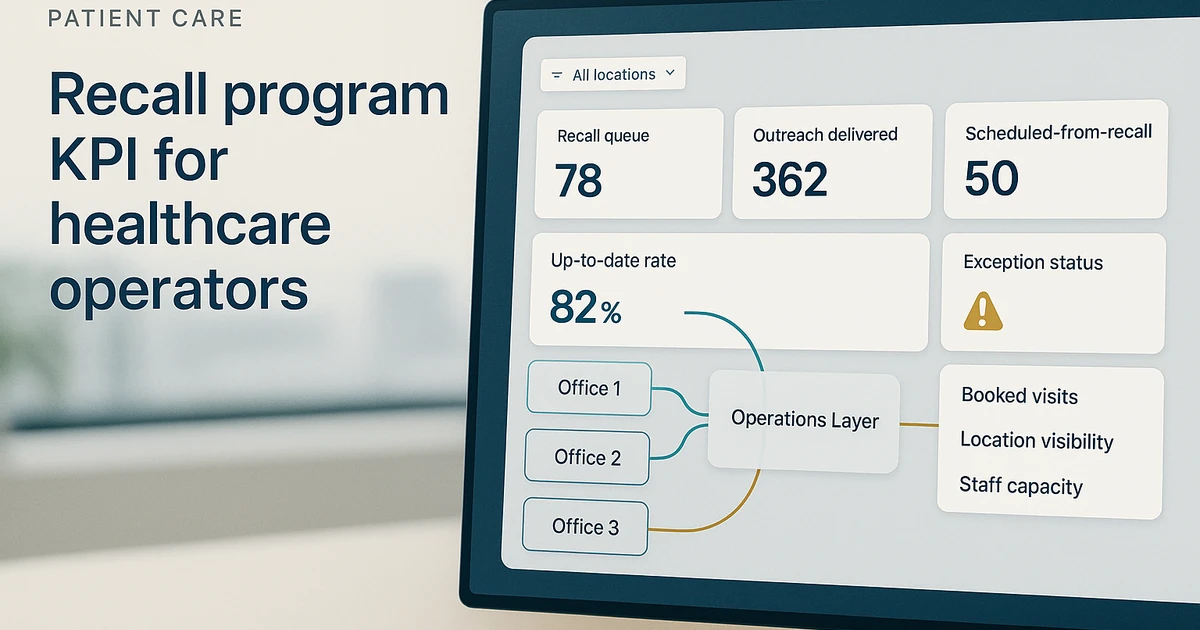
The recall program KPI framework for healthcare operators offers a useful companion view of process and outcome measurement. For compliance tracking, add a QA layer: sample completed records, verify the status against the evidence, inspect opt-out handling, and review whether exceptions reached the correct owner. A metric is trustworthy only when the underlying records can withstand review.
How Should Teams Handle Exceptions and Corrective Action?
Exception handling is where a recall process proves whether it is truly controlled. A group should expect exceptions: incomplete contact information, duplicate records, uncertain patient preference, a scheduling conflict, a system outage, or a patient request that requires another team. The risk is not that exceptions occur. The risk is that they disappear into a note, inbox, or verbal handoff with no owner.
Create a limited set of exception categories and assign each one a named destination. For example, data-quality issues can route to the appropriate data or site owner; scheduling-capacity issues can route to site operations; privacy concerns can route to the compliance process; and requests requiring clinical context can route to the relevant clinical team. Each exception should have an assigned owner, a due date or service level, and a final disposition that returns cleanly to reporting.
Corrective action should focus on the process, not blame. If a QA sample finds repeated missing outcomes at one location, investigate the workflow, workload, training, and system prompts before concluding that individual staff are careless. If one template produces frequent confusion, revise and approve the template rather than asking every location to compensate with its own wording. This approach creates a learning loop while preserving accountability.
The HHS Office of Inspector General’s general compliance guidance emphasizes the value of program infrastructure, monitoring, and response to identified issues. For recall operations, that translates into documented reviews, evidence of remediation, and follow-up checks that confirm the fix worked. It does not mean every minor queue issue becomes a corporate investigation. It means repeat or meaningful issues are visible, assigned, and closed with proof.
What Should a 90-Day Implementation Plan Include?
The first 90 days should build control before expanding outreach volume. Begin with an inventory of the current recall workflow at each location: data sources, cohorts, channels, scripts, status values, user roles, open queues, exception paths, and reports. This is not a paperwork exercise. It reveals where the network is currently relying on local interpretation.
In the next phase, establish the common status model and a single pilot cohort. Confirm the entry criteria, outreach sequence, suppression rules, evidence fields, access roles, booking handoff, exception owner, and dashboard definitions. Train the central and site teams on the actual workflow, then test representative records end to end before the pilot reaches normal volume.
The final phase is controlled rollout and QA. Review pilot records at a defined cadence, compare the dashboard to the source records, correct configuration gaps, and document the decisions that change the operating model. Only then add locations or cohorts. For groups that are centralizing broader patient-access work, the multi-location recall enterprise overview can help frame recall within a larger operating design.
The success criterion is not a promised financial outcome. It is a repeatable process in which leadership can see the queue, trust the status, protect patient information, and intervene before drift spreads across the network.
FAQ
Is recall compliance the same as appointment reminders?
No. Appointment reminders generally concern visits that are already scheduled. Recall compliance concerns the governed process for identifying patients due for follow-up, conducting approved outreach, recording the outcome, and routing the next action. A group may use some of the same communication systems for both, but the queue logic and evidence requirements are different.
Can each location use its own recall cadence?
Locations can have documented variations when capacity, provider requirements, or service lines require them. The enterprise should still own the cohort definitions, approval process, status model, and reporting logic. An approved variation should be visible in the playbook, not buried in a site manager’s preference.
What is the first metric to audit?
Start with queue integrity: whether eligible patients enter the correct cohort and whether the resulting status reflects the evidence in the record. If the denominator or status model is unreliable, outreach and conversion metrics cannot be compared across locations with confidence.
Ready to Improve Your Patient Retention?
MyBCAT helps healthcare practices recapture missed calls and automate patient scheduling so no opportunity slips through the cracks.